
The Current State and Future of International Cruise Ship Reception in Island Regions

As the number of cruise ship calls and passenger volumes in Japan are returning to pre-pandemic levels, with further growth expected in the future, "island regions" are attracting attention as new ports of call. This article examines the current state of international cruise ship reception in island regions and discusses key strategies for enhancing their value.
1. Growth and Transformation of the Cruise Market
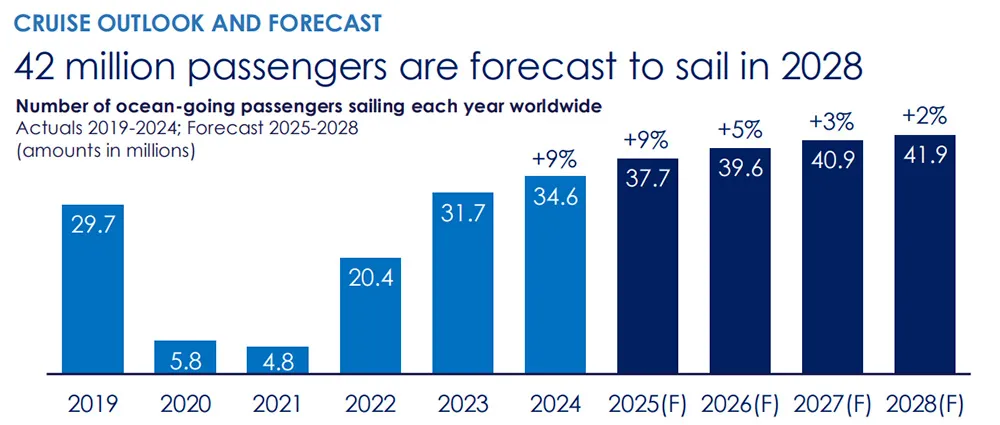
According to the Cruise Lines International Association (CLIA), the global cruise market is recovering and growing after a temporary slowdown caused by the pandemic, with the global cruise passenger count projected to reach 42 million by 2028.
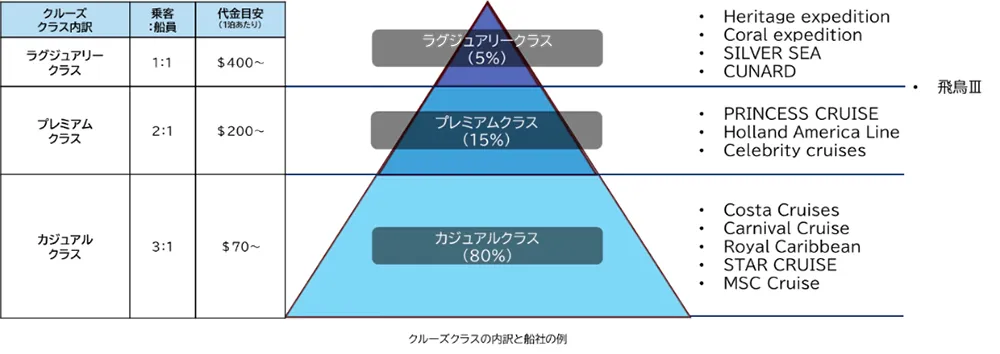
Cruise ships are generally categorized based on the amount of space per passenger and the number of crew members per passenger. In addition to the traditional “Casual” and “Premium” categories served by large ships, cruises on smaller vessels—such as “Luxury” and “Expedition” cruises—have been expanding in recent years. The Japanese-flagged “Asuka III,” which made its debut this summer, is classified as Premium to Luxury class based on its size.
In the global cruise market, the “Expedition” class (small ships carrying approximately 100 to 200 passengers), which is part of the Luxury class, is experiencing dramatic market growth. Growth has been particularly notable since 2019; according to CLIA, the market is projected to grow by as much as 150% (compared to 2019) by 2024.
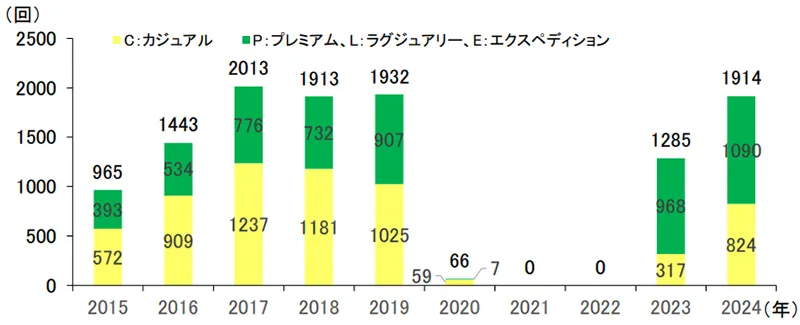
In line with the expansion of the cruise market, the number of cruise passengers visiting Japan is also reaching record highs, with approximately 1.44 million passengers and 2,472 port calls (1,914 of which are by foreign-flagged ships) projected for 2024.
A breakdown of the data shows that the premium, luxury, and expedition classes are expanding, and a comparison of pre- and post-COVID figures reveals a significant increase in the proportion of port calls by medium- to small-sized ships.
Furthermore, leveraging their smaller vessel sizes, these smaller ships—which cater to the high-end market, such as the Luxury and Expedition classes—are increasingly calling at island regions that are difficult for large ships to access.
2. Reasons for Focusing on Island Regions
There are several reasons why luxury and expedition-class ships are calling at island regions.
First, the increase in small vessels has made it easier for cruise ships to access small ports and remote islands that were previously inaccessible to large ships.
Furthermore, travelers’ values have shifted from “consumption-oriented sightseeing” to “experiential tourism” that involves unique local cultural experiences and interaction with local people, drawing particular attention to island regions with their own distinct cultures.
3. Current Status of International Cruise Ship Reception in Japan’s Island Regions
(1) The Case of Kamigoto Town (Utilization of Fishing Ports)
Kamigoto Town in Nagasaki Prefecture has established a unique model as a cruise ship port of call by leveraging the Goto Islands’ abundant fishery resources and historical and cultural assets. Since the “Nippon Maru” made its first port call in 2010, ships up to the 20,000-ton class have docked directly at Aogata Port, while larger vessels have anchored offshore and used tender boats (small vessels connecting the ship to shore when large ships cannot dock directly) to disembark at Kamigoto Fishing Port (Funasaki District).
The reception system is led by the Shin-Kamigoto Town Office, which collaborates with the Tourism and Local Products Association, the Fisheries Cooperative, and economic organizations, as well as the Nagasaki Prefecture Cruise Promotion Council. Although there are few tourist facilities or experiential programs within easy reach of the port, during port calls, the town maximizes the use of its limited resources by offering sightseeing routes such as tours of the cluster of churches, guided tours by local guides, and arrangements for buses and taxis. Welcome events feature activities that highlight the region’s appeal, including performances by local children and groups, send-offs with large fishing flags, sales of local products, promotion of tuna farms, and sales of seafood to cruise ships.
(2) The Case of Ujishima (Utilization of an Uninhabited Island)
Ujishima is an uninhabited island located off the coast of Tomonoura, Fukuyama City, Hiroshima Prefecture. While there are typically no regular ferry services and visitors must charter a boat to land on the island, it has a track record of special port calls by international cruise ships.
Although Ujishima has no tourist facilities, it features expansive sandy beaches and crystal-clear waters, making it ideal for marine activities such as swimming. Through collaboration between Fukuyama City and local businesses, the island has successfully offered unique, experiential programs that take advantage of its natural environment, including marine activities (such as stand-up paddleboarding), island walks, and cleanup activities.
Since there is no port, cruise ships anchor off the coast of Ujishima and use tender boats (small boats used to transport passengers and supplies between the ship and the shore when large ships cannot dock at the pier) or small vessels to bring passengers ashore; this method of disembarking is also highly regarded as a unique experience in itself.
Furthermore, since it is an uninhabited island, setting up temporary restrooms and rest areas, as well as ensuring safety management, pose challenges; however, these are addressed by setting up simple rest areas (tarps, blue tarps, and chairs), providing drinking water and water for handwashing, and installing prefabricated portable toilets.
(3) The Case of Okinoerabu Island (Introduction of International Exchange)
Okinoerabu Island in Kagoshima Prefecture is a case study of actively incorporating international exchange during cruise ship port calls. Passengers who disembark explore the island on foot or by taxi, stopping at beautiful beaches and local souvenir shops to enjoy interactions with the islanders. At the same time, when cruise ships call at the port, the island hosts welcome ceremonies led by local residents and sells local specialties at the pier as a form of hospitality that allows direct interaction between local residents and foreign passengers. This builds a reception system that emphasizes “connections between people” rather than merely focusing on tourism-driven consumption.
One notable initiative is the ship tours offered to island residents. This activity provides a valuable opportunity for the island’s children and residents to foster cross-cultural understanding and a global perspective. It contributes not only to the economic benefits of tourism but also to the revitalization of the local community and a shift in residents’ attitudes.
4. Steps for Hosting International Cruise Ships—From Pre-Port Call to Post-Port Call
To maximize the unique appeal of island regions and ensure a fruitful port call for both visitors and the host community, several strategies can be implemented. Here, we divide the cruise ship port call into three steps—"Before Arrival," "During the Port Call," and "After Departure"—and examine key points for enhancing value at each stage.
(1) Pre-port Call: Key Preparation Steps to Build Anticipation
Thorough preparation starting before the port call is the first step toward success.
- Optimizing and Utilizing Limited Resources: The capacity of port facilities, secondary transportation (buses and taxis), and
dining establishments differs from that of major cities. Therefore, efficient utilization that takes into account the port call schedule and time of day, as well as the introduction of online reservation systems, are key to a smooth reception. We can view limited resources as an opportunity to design personalized experiences that are only possible on a small scale. - Deepening and Diversifying Experiential Value: Experience programs that leverage local resources are a true strength of island regions. By offering multiple options tailored to different activity levels—such as indoor programs unaffected by weather, or activities for those who want to be active versus those who prefer a more relaxed pace—you can further enhance satisfaction among a diverse range of travelers. Preparing alternative plans that allow visitors to feel they’ve had a “special experience” even during inclement weather also improves the quality of hospitality.
- Innovative Communication and Information Sharing Multilingual support is a key priority. In addition to training English-speaking guides and enhancing multilingual signage, the use of translation apps and warm, gesture-filled communication will create unforgettable memories. Furthermore, actively promoting the region’s appeal through social media and other channels to foster anticipation—so that visitors look forward to “visiting that island” even before boarding—is also effective.
- Fostering Community-Wide “Hospitality” To ensure the success of cruise ship visits, it is essential to create a welcoming atmosphere not just among a few businesses, but across the entire community. Holding pre-visit briefings for residents and organizing welcome events for children helps foster a sense of unity—that “the whole island is welcoming the guests”—which further enhances the value of the port call.
(2) During the Port Call: On-Site Initiatives to Maximize Satisfaction
The day of the port call is a critical time that determines traveler satisfaction.
- Flexible On-Site Response: On-site adaptability—such as efficient dispatch management to allocate limited buses and taxis, or guiding visitors to small restaurants and experience facilities in staggered time slots—significantly influences satisfaction. Going beyond a rigid, by-the-book approach and making flexible decisions based on the situation on the ground enhances the quality of the travel experience.
- High-Quality Guided Tours and Fostering Interaction: Beyond professional guides, the presence of “island resident guides”—who can speak about local history and daily life in their own words—is a major draw. Guided tours that go beyond a one-size-fits-all approach and involve personal interaction create added value unique to the region.
- Creating a Sense of Unity Across the Community Welcome ceremonies at the pier and sales of local specialties are delightful surprises for travelers. Rather than letting this “hospitality” end as a one-off event, devising a system that involves the entire community is the first step toward embedding the economic and cultural benefits of port calls within the local area.
(3) After the Port Call: Creating Systems to Connect to the Next Step
A port call is not the end goal, but rather the starting point for the next phase.
- The PDCA Cycle: Applying Experience to the Future It is important to establish a “review session” after the port call where businesses, local government, and tourism associations gather to share results and identify areas for improvement. By accumulating both successes and areas for improvement as valuable regional assets and implementing the PDCA cycle to apply them to future efforts, the reception infrastructure will be continuously strengthened.
- Extending the Value of Port Calls to the Entire Community The challenge lies in how to ensure that the economic benefits and opportunities for international exchange brought by cruise ship port calls are shared by the entire community. As seen in the case of Okinoerabu Island, creating opportunities for residents to feel a personal connection to port calls—such as through onboard tours for residents—fosters civic pride and raises awareness of sustainable tourism. A perspective is needed that expands port calls from “point” events to “lines,” and ultimately to a “surface” encompassing the entire region.
5. Generating Benefits from Hosting International Cruise Ships (Summary)
We believe that hosting international cruise ships in island regions is an initiative that brings multifaceted value, including not only tourism promotion and economic benefits but also the revitalization of local communities, international exchange, and changes in residents’ awareness.
Cruise ship port calls serve as a “gateway for exchange,” attracting a diverse range of people from overseas to island regions where transportation conditions are challenging and access is limited. This creates a local circulation of tourism spending—through the sale of local products and the provision of experiential programs—which directly leads to the revitalization of the local economy. Unique reception models that leverage each region’s distinct characteristics—such as fishing ports, uninhabited islands, and international exchange—will help differentiate the region from others and attract repeat visitors. Furthermore, hosting cruise ships provides local residents with increased opportunities to engage with different cultures and diverse values, fostering a global perspective among children and young people while helping residents rediscover their pride and love for the region.
The key to success lies in building a hub function through public-private partnerships. It is essential for local governments, tourism associations, and private-sector operators to work together to establish a system that proactively promotes hospitality, while ensuring economic sustainability so that these activities do not rely solely on volunteer efforts.
Moving forward, we look forward to the establishment of an “island-based cruise port model” that balances sustainability with local character—through initiatives such as information dissemination using digital technology, multilingual support, the harmonization of environmental conservation and tourism, and the strengthening of resident-participatory reception systems. We believe that the foundation for this lies in clearly identifying and sharing the “benefits of hosting cruise ships on the island” within the local community.
References
- "State of the Cruise Industry Report 2025" CLIA
- "Number of Cruise Passengers Visiting Japan and Number of Cruise Ship Port Calls (Final Figures for 2024)" Ministry of Land, Infrastructure, Transport and Tourism, Port and Harbor Bureau, Industrial Ports Division
- "Report on the Feasibility of Hosting Cruise Ships in Fishing Regions and Fishing Ports" General Incorporated Foundation, Comprehensive Research Institute for Fishing Ports, Fishing Grounds, and Fishing Villages
著者













