Has the vision of "a great place to live and visit" been realized?
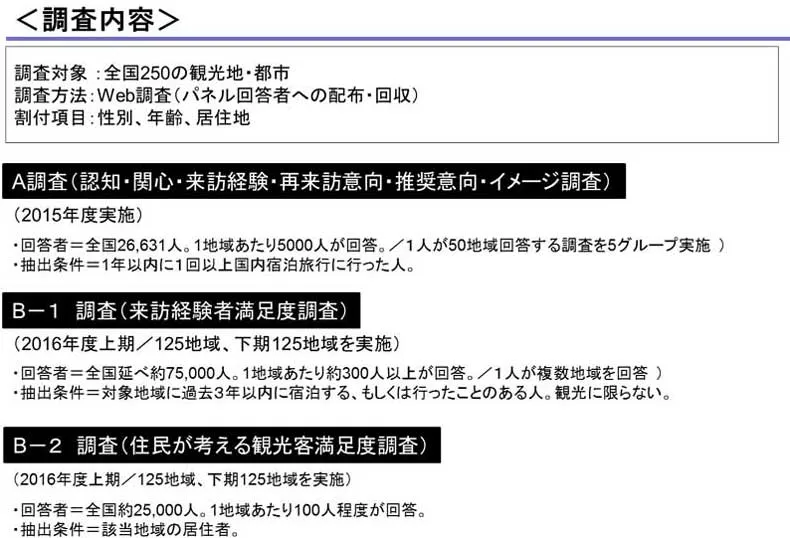
~ The Gap Between Tourist and Resident Satisfaction in Leading Tourist Destinations, as Revealed by the JTB Regional Power Index Survey ~ JTB conducted its proprietary survey, the “JTB Regional Power Index Survey,” in 2012 and 2013.This survey used an online questionnaire to gauge consumer perceptions and satisfaction levels regarding more than 200 major tourist destinations and cities nationwide. The second edition of the survey is currently underway for FY 2016, covering 250 tourist destinations and prefectural capitals. With results now compiled for half of these areas—125 regions—we would like to discuss the characteristics and trends revealed by these findings.
This survey examines awareness and interest in the target areas (whether respondents would like to visit), the intention to revisit among those who have visited, and perceptions of the areas. It also asks those who have visited within the past three years about their satisfaction across 12 categories, including “overall satisfaction,” “local cuisine and ingredients,” and “townscape” (Figure 1).While similar survey results have been reported elsewhere, a distinctive feature of this study is that, in addition to measuring tourist satisfaction, it also asks residents of each district whether they believe tourists are satisfied—in other words, it examines how residents perceive their own neighborhoods. Here, we focus on the gap between tourist satisfaction and the satisfaction levels perceived by residents.
(Figure 1)
1. Districts with Highest Tourist Satisfaction
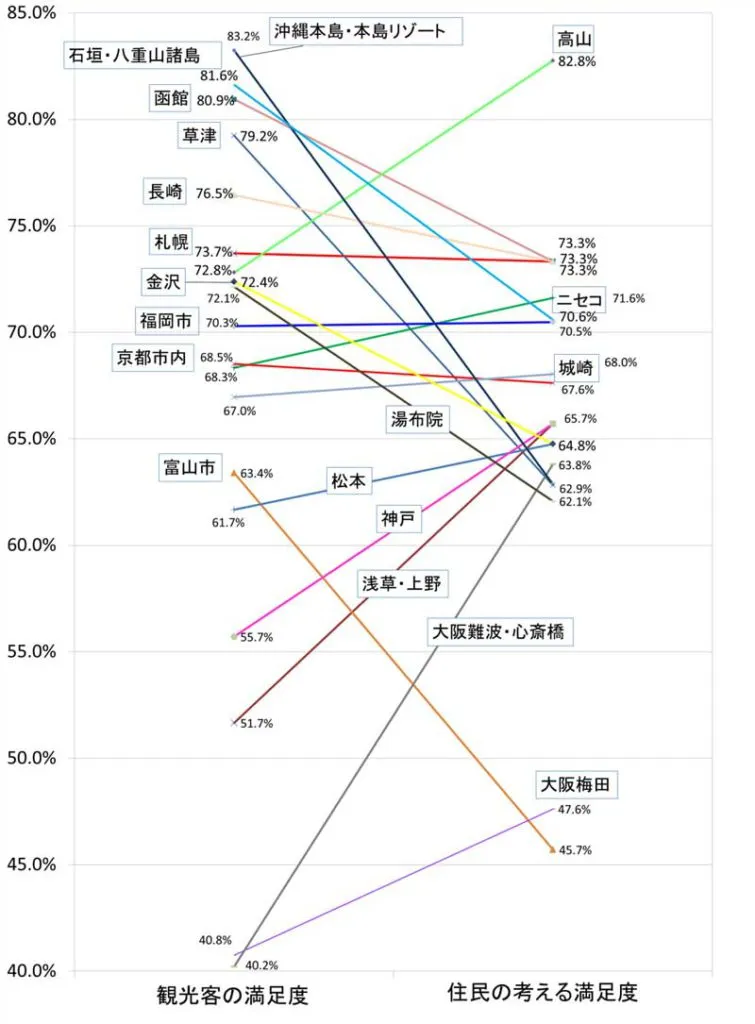
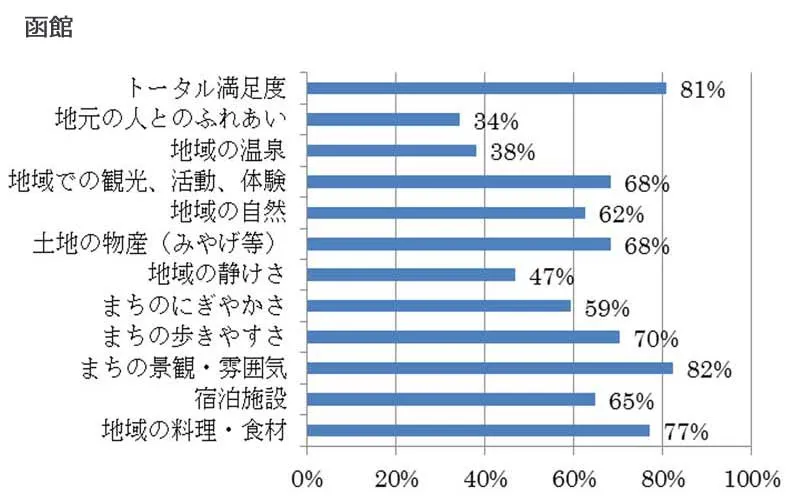
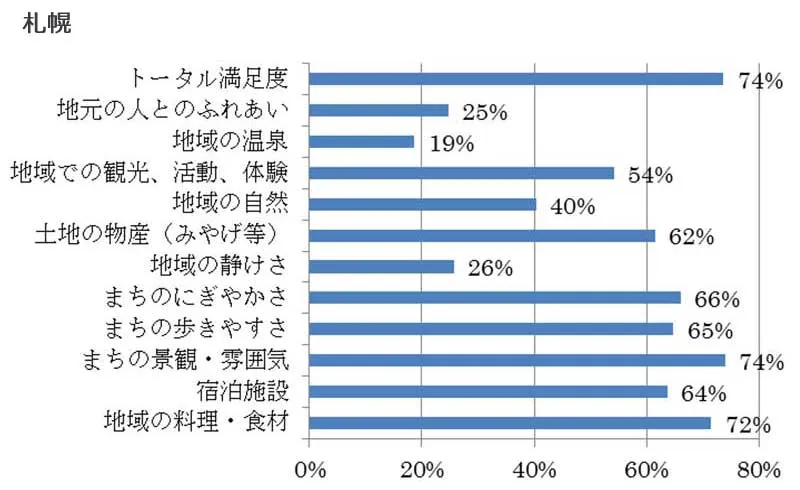
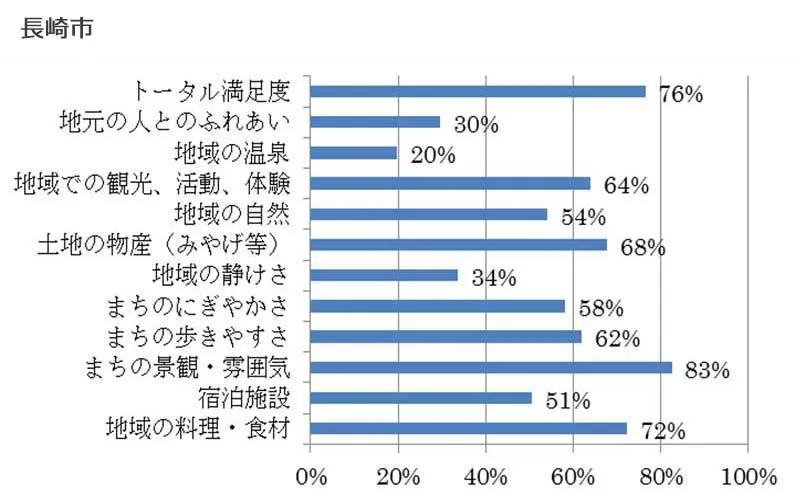
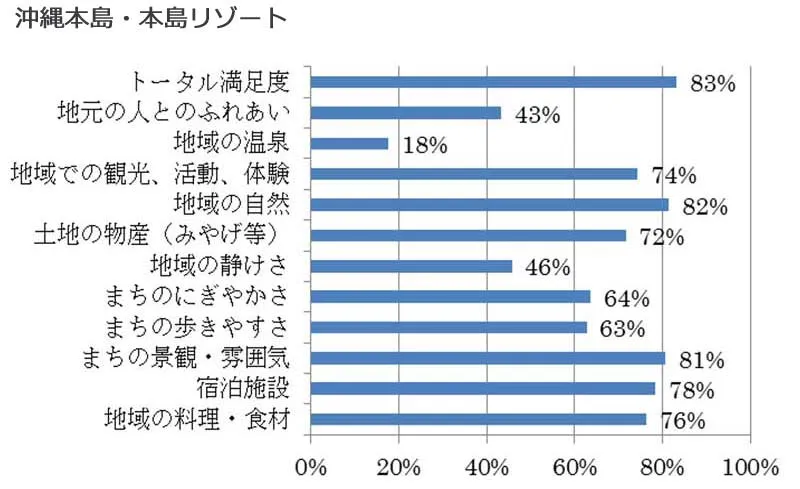
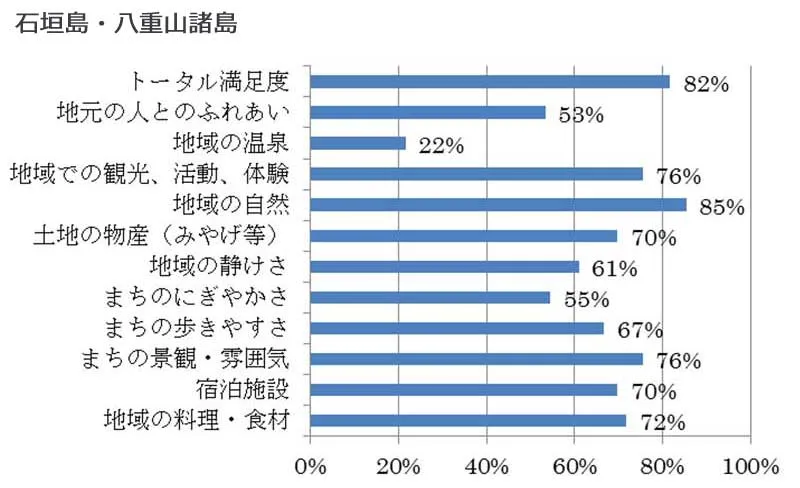
Figure 2 shows the results for major districts regarding overall satisfaction. “Okinawa Main Island and Resort Areas” and “Ishigaki and Yaeyama Islands” rank at the top, followed by “Hakodate City” and “Kusatsu,” the leading hot spring resort. While this survey covers not only tourist and resort destinations but also major cities including prefectural capitals, tourist satisfaction is particularly high for “Nagasaki City,” “Sapporo City,” and “Fukuoka City.” “Kyoto City” also ranks high but trails behind these cities. The factor underpinning the “Overall Satisfaction” of these top-ranked cities is high satisfaction with “local cuisine and ingredients” (Figure 3).In cities such as Hakodate and Sapporo, individual satisfaction with cuisine and ingredients exceeds 70%. While Nagasaki also has high satisfaction with cuisine and ingredients, it is characterized by equally high satisfaction with the “cityscape and atmosphere” category (83%). Looking at the individual satisfaction rates for the two Okinawan districts mentioned earlier, high satisfaction with multiple resort-related resources and offerings—such as “local nature,” “cityscape and atmosphere,” and “accommodations”—underpins their overall satisfaction. In contrast, the slightly lower figure of 68.5% for the world-renowned tourist city of Kyoto is due to the fact that this graph includes not only overnight guests but also day-trippers. When narrowed down to overnight guests alone, Kyoto’s satisfaction rate reaches 80% across all age groups. Kyoto is a tourist destination supported by its historical resources, as well as a city with a population of 1.5 million. It is likely that the depth of the city—including its bustling nightlife and unique charm—can only be fully appreciated by staying overnight.
(Figure 2) Tourist Satisfaction vs. Residents’ Perception of Tourist Satisfaction (*)
(Figure 3) Tourist Satisfaction by Category
2. Residents’ Perception of Tourist Satisfaction
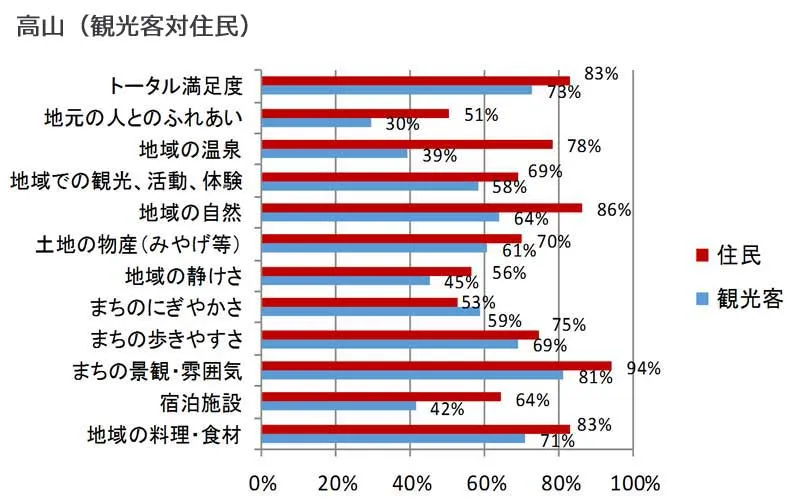
On the other hand, when residents were asked whether they thought visiting tourists were satisfied with their area, the highest percentage was recorded in Takayama City, Gifu Prefecture (82.8%).Incidentally, in the 2012 survey, the resident questionnaire results for “Kurokawa Onsen” in Kumamoto Prefecture ranked first at 100%, but in FY 2023, Kurokawa Onsen was included in the latter half of the survey locations and is not included in this report. Takayama City also had a high tourist satisfaction rate of 72.8%, on par with Sapporo City, but the residents’ confidence and pride in tourism are extraordinary. So, among the 12 individual items, what do Takayama City residents believe tourists are most satisfied with? As shown in Figure 4, three items—"local cuisine and ingredients" (82.8%), "townscape and atmosphere" (94.3%), and "local nature" (86.2%)—exceeded 80%, and residents believe tourists are likely satisfied with these aspects. Could this high level of resident awareness regarding the region’s diverse resources be the result of treating tourism not merely as an issue confined to the tourism industry or sector, but as an integral part of urban planning and community development, with the entire region working together?In the aforementioned cities with high tourist satisfaction—Hakodate, Nagasaki, Sapporo, and Fukuoka—residents’ perceived tourist satisfaction is by no means low, exceeding 70%. On the other hand, in Okinawa and Kusatsu, a slight gap is observed between tourist satisfaction and residents’ perceived satisfaction. Residents of regions blessed with outstanding natural resources or hot spring resources may need to reevaluate whether their local resources are truly one-of-a-kind, perhaps because they have grown accustomed to seeing them in their daily lives.
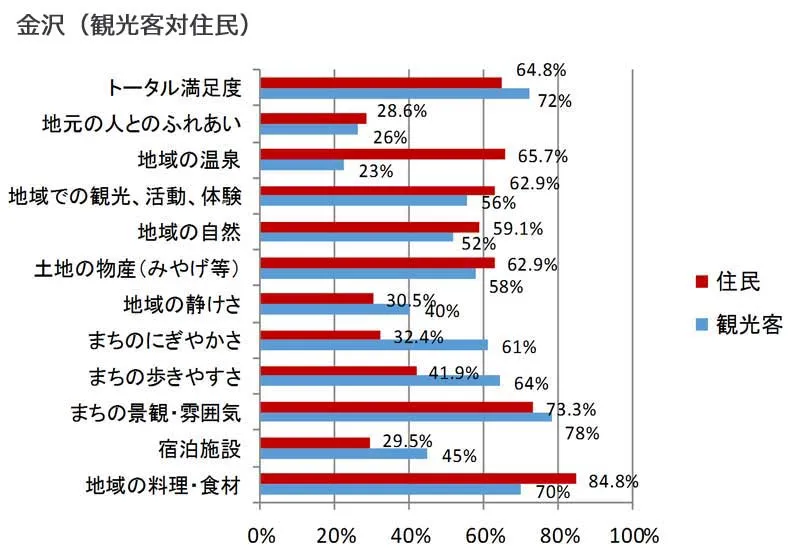
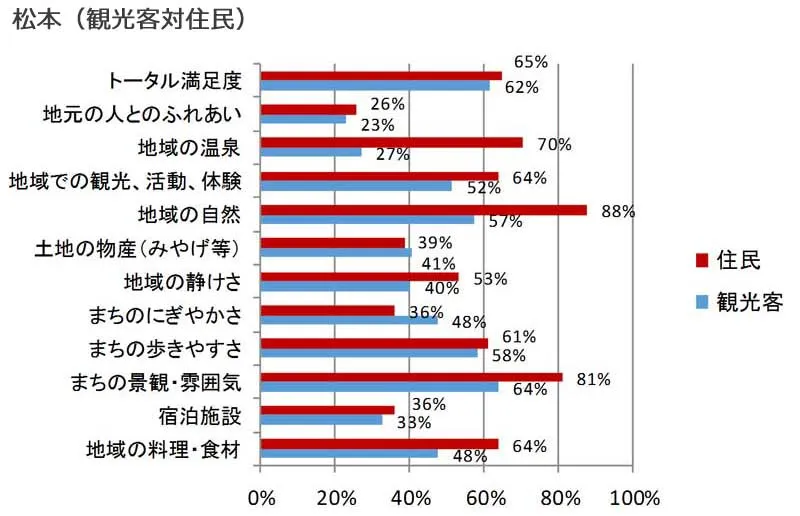
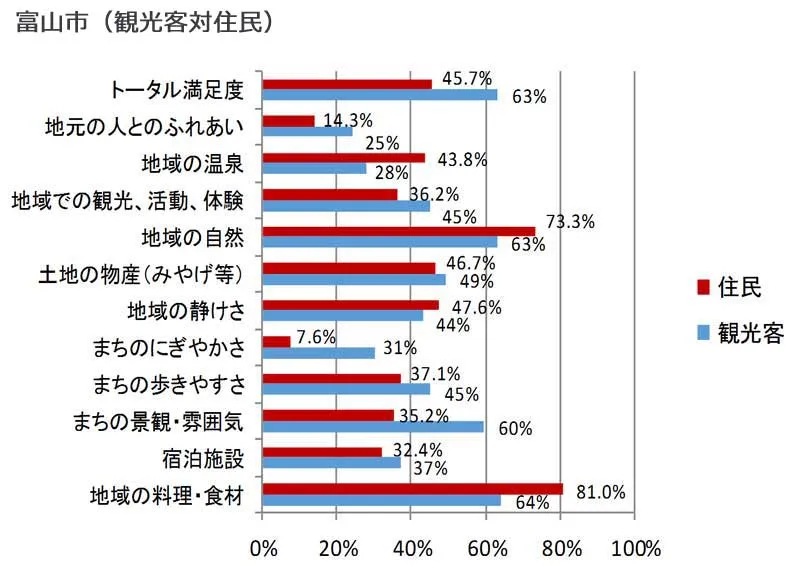
(Figure 4) Tourist Satisfaction and Resident Perceived Satisfaction by Category
3. Reexamining Cities from a Tourism Perspective
The top-ranked cities highlighted in this paper—Hakodate, Sapporo, Kyoto, Fukuoka, and Nagasaki—are not only tourist destinations but also regional hub cities. Residents of regional cities that attract large numbers of tourists generally seem to believe that tourists are satisfied with their cities. In contrast, among prefectural capital-level cities where urban tourism plays a minor role, there are cases where residents believe tourists are not satisfied with their cities. Looking at Toyama City, Kanazawa City, and Matsumoto City in the Chubu and Hokuriku regions, while the satisfaction rate among tourists visiting Toyama City is 63.4%—which is by no means low—only 45.7% of Toyama residents express confidence in their city, meaning more than half do not feel confident. Could the presence of neighboring Kanazawa City be influencing residents’ perceptions in terms of tourism? Even in Kanazawa City, while 72.4% of tourists expressed satisfaction, residents’ perceived satisfaction stood at 64.8%. In contrast, Matsumoto City in Nagano Prefecture has a tourist satisfaction rate of 61.7%, which is fairly decent; however, it is interesting to note that residents’ perceived tourist satisfaction—at 64.8%—exceeds that of the tourists themselves, matching the figure for Kanazawa City. Similarly, when examining the items that residents of the three cities consider to contribute to tourist satisfaction (Figure 4), residents of Kanazawa and Matsumoto show well-balanced, high scores across multiple categories such as food, scenery and atmosphere, and nature. In contrast, while Toyama City scores high for “local cuisine and ingredients (81.0%),” its scores are generally low across other categories. Does this mean that Toyama City lacks appeal as a city simply because it lacks famous tourist attractions like Kanazawa’s cityscape or Matsumoto Castle? Nestled between the spectacular Northern Alps and Toyama Bay, the city boasts a unique blend of nature and urban scenery not found in other prefectural capitals, and it surely possesses cultural resources rooted in the daily lives of its citizens—not just in terms of food.
Looking at satisfaction ratings among residents and tourists in major cities like Tokyo and Osaka, one can generally see a high level of pride among residents. I have cited Tokyo’s “Asakusa and Ueno,” Osaka’s “Umeda,” “Namba and Shinsaibashi,” and “Kobe,” and there is a tendency for residents’ perceived satisfaction to be higher. However, since tourists visiting these major cities base their responses on experiences of specific parts of the city where various functions and facilities are concentrated, it is possible that overall satisfaction levels do not rise.
While these examples alone cannot tell the whole story, it is fair to say that highly regarded tourist destinations and cities tend to have residents with a strong sense of pride and self-esteem. Of course, there may be cases where a gap exists between resident satisfaction and tourist satisfaction due to residents’ overconfidence in their own area. However, pride and overconfidence, though a fine line, are distinct concepts. If we consistently incorporate outside perspectives and values, and look at the appeal of our region not just from the perspective of the tourism industry but as “the town as a whole,” and if the entire community is committed to its value, wouldn’t that lead to confidence and a sense of purpose in living there—in other words, a sense that “it’s a good place to live”?