"South Korea: A New Starting Point for Overseas Travel"
We have compiled and analyzed a portion of unpublished data regarding Japanese travelers’ attitudes toward travel to South Korea over the past few years. By examining these shifts in traveler attitudes, we aim to uncover insights that can inform our thinking about tourism in Japan.
- The number of Japanese tourists visiting South Korea fell by nearly half, from a record high of 3.52 million in 2012 to 1.84 million in 2015 (Korea Tourism Organization). With the recovery of overseas travel and the waning impact of MERS, signs of recovery emerged in 2016
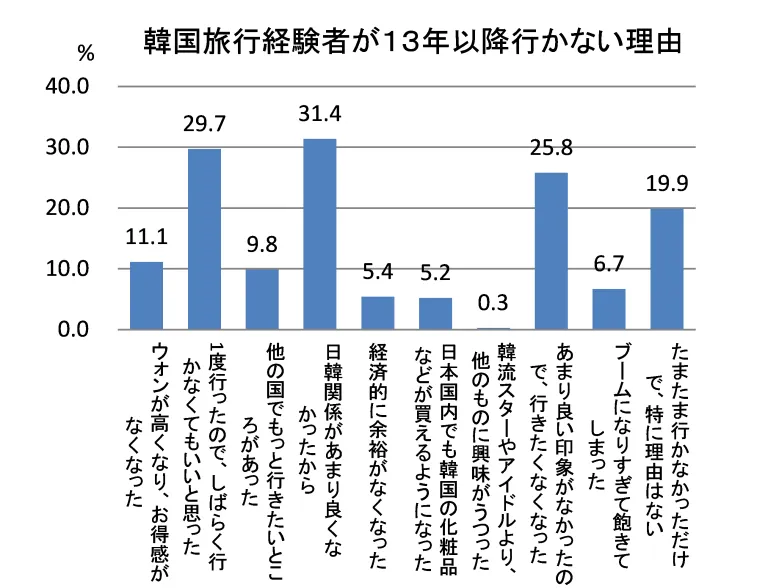
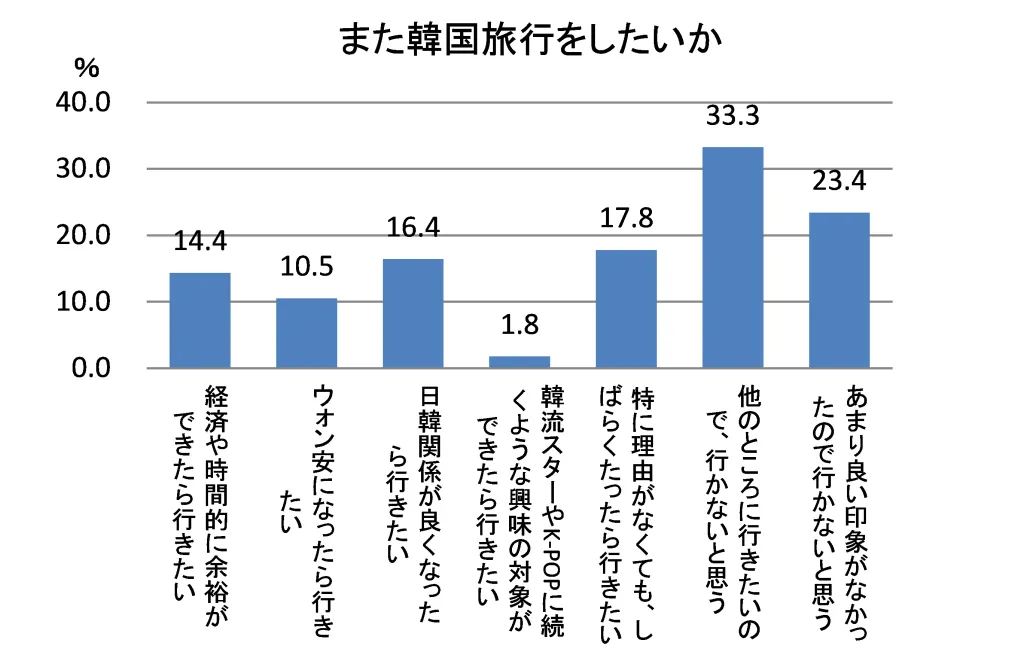
- Among those who have visited South Korea in the past but have refrained from traveling there since 2013, 31.4% cited “Japan-South Korea relations” as the reason, but only 16.4% said they “would like to go again if relations improve.” On the other hand, 30% said, “I’ve been there once, so I thought I didn’t need to go again for a while.”
- Interpreting trends in foreign visitors to Japan based on the behavior of Japanese travelers to South Korea
The “JTB REPORT 2016: Everything About Japanese Overseas Travel” (published by JTB, edited by JTB Tourism Research & Consulting) released in July 2016 revealed that the number of people reluctant to travel overseas—a trend that had persisted for several years—had declined for the first time in seven years. In fact, the number of Japanese travelers departing the country, which had been stagnant since peaking in 2012, exceeded the previous year’s figures in every month from January to May 2016, signaling a recovery in overseas travel.
Of particular note is the trend among Japanese travelers visiting South Korea. The number of travelers reached 3 million annually for four consecutive years from 2009 to 2012, peaking at 3.52 million in 2012 before declining to 1.84 million in 2015; however, it has begun to rise again this year. This recovery is likely driven by the appreciation of the yen, the establishment of low-cost carriers (LCCs), slight progress in Japan-South Korea relations, and improved mutual perceptions between the two nations (*1). However, the momentum of the “Korean Wave” has waned, and with South Korea’s inexpensive and unique cosmetics now available in Japan, it may be necessary to rethink what constitutes “attractions worth visiting” in order to reach the 3 million mark again.
In this article, we have compiled and analyzed a portion of unpublished data regarding Japanese attitudes toward travel to South Korea over the past few years. These shifts in traveler sentiment offer valuable insights for rethinking Japan’s tourism strategy.
[Survey Overview] Survey Method: Online questionnaire Survey Participants: 3,399 individuals from the screening survey who had traveled abroad (for business or leisure) since January 2014 (of whom 2,936 were leisure travelers) Survey Period: May 16–20, 2016
Key Factors for Choosing South Korea as a Travel Destination and Comparison with Other Popular Countries
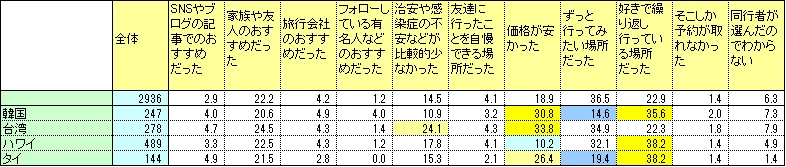
When asked why they chose their most recent destination among those who had traveled abroad since 2014, the top reasons for South Korea were “a place I like and visit repeatedly (35.6%)” and “low prices (30.8%).”While it is true that the survey respondents were travelers from 2014 onward—a period when travel to South Korea was sluggish—South Korea can be described as a familiar destination supported by repeat visitors. On the other hand, the response “It was a place I had always wanted to visit” (14.6%) was lower than for Hawaii, Taiwan, and Thailand—countries and regions that are similarly popular among Japanese travelers.
Similarly, the number of Japanese travelers to Taiwan—another destination close to Japan—increased by approximately 200,000, from 1.43 million in 2012 to 1.63 million in 2015 (Source: Taiwan Tourism Bureau, Ministry of Transportation and Communications). The top reasons for choosing Taiwan were “It was a place I’d always wanted to visit (34.9%)” and “It was affordable (33.8%).”Since “It was a place I liked and had visited repeatedly (22.3%)” was cited less frequently than for South Korea, Hawaii, and Thailand, it can be inferred that Japanese travelers’ interest shifted to Taiwan, resulting in a certain degree of traveler migration. Since January 2016, the number of travelers to Taiwan has continued to grow at a double-digit rate each month (Table 1).
(Table 1) Reasons for choosing the most recent overseas travel destination (multiple responses allowed)
Changes in the Purposes and Motives for Traveling to South Korea
The table below shows the triggers and purposes for visiting South Korea by survey year. While “wanting to eat authentic Korean cuisine” and “wanting to shop” consistently ranked first and second for the purpose of travel to South Korea in every year, we will also examine other reasons.
(Table 2) Triggers and Purposes for Traveling to South Korea (Multiple answers allowed)
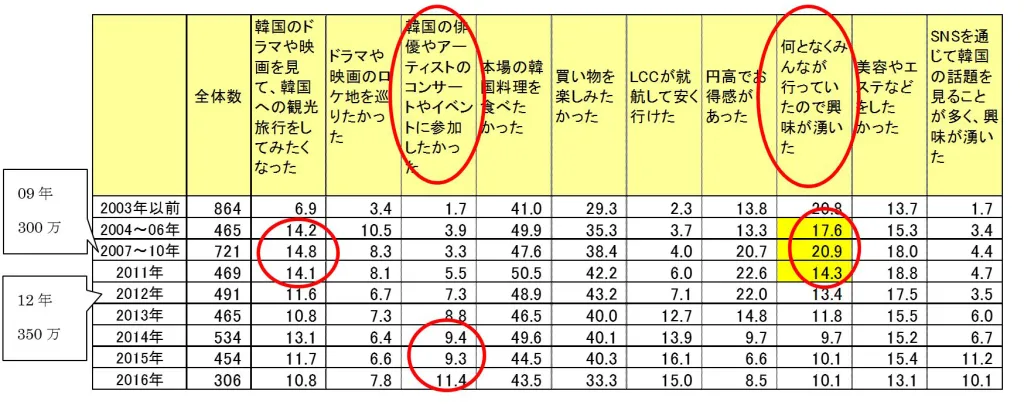
The Impact of the Korean Wave: The Korean Wave boom, which began with the emergence of hit dramas in 2004, has heightened interest in South Korea and has served as a direct catalyst for travel to a certain extent. While “visiting filming locations” was popular in the early days of the boom, the trend has now shifted toward attending concerts and events featuring South Korean actors and artists—so-called fan meetings—which accounted for 11.4% of the purposes for travel to South Korea in 2016.Fan meetings are gaining popularity primarily among men and women aged 15 to 29, as well as women in their 30s to 50s. However, according to our interviews, traveling to Korea to attend concerts or events is not necessarily driven by an interest in Korea itself; rather, the appeal lies in the opportunity to interact closely with actors and artists. Some respondents even stated that they would travel to places like Hawaii if such events were held there. In any case, it can be said that the Korean Wave played a significant role in creating opportunities for people to learn about Korea as a country.
The Korean Travel Boom Supported by Swing Voters: Among the most common reasons and outcomes for travel to Korea—following dining and shopping—was “I became interested because everyone else seemed to be going.” In 2004, Japanese travelers increased by 35.4% year-over-year due to recovery from the previous year’s SARS outbreak and the massive success of TV dramas; furthermore, in 2009, the number rose by 28.4% year-over-year, reaching the 3 million mark for the first time. In our latest survey, the percentage of people citing “I became interested because everyone else seemed to be going” as their purpose or motivation was 17.6% between 2004 and 2006, 20.9% between 2007 and 2010, and 14.3% in 2011.When the number of travelers increases at a rapid pace, it can be inferred that the trend is driven not only by the appeal of the tourism content itself but also by a large number of “followers”—those who lack strong personal initiative and are simply interested because “everyone else is doing it.” Conversely, among travelers to South Korea in 2015 and 2016, when visitor numbers hit rock bottom, the “just because…” segment accounted for only about 10%. It appears that the South Korea travel boom was sustained by this floating voter base.
Why Have People Not Traveled to South Korea Since 2013?
When we asked people who had previously traveled to South Korea but had not done so since 2013 about their “reasons for not going,” the most common reason was “Japan-South Korea relations” (31.4%). The majority of those who cited Japan-South Korea relations as a reason were men and women in their 60s and 70s.
The second most common reason for not traveling was “I’ve been there once, so I felt I didn’t need to go again for a while.” This response was particularly prevalent among women aged 15–29 (43.9%) and men and women in their 30s (38.4% and 38.7%, respectively). While we noted earlier that the trend is supported by repeat visitors, it is also possible that travel satisfaction varies significantly from person to person (Figure 1).
(Figure 1) Reasons why people who have traveled to South Korea have not visited since 2013 (N=1,016, multiple responses allowed)
When asked about their future intentions regarding travel to South Korea, while “Japan-South Korea relations” was the most common reason for not visiting (31.4%), only 16.4% said they “would like to go again if Japan-South Korea relations improve.” The most common response was “I don’t think I’ll go because I want to visit other places” (33.3%). The slump that has persisted for several years appears to have diminished even the interest in South Korea among travelers who had previously expanded the market as “floating voters” (Figure 2).
(Figure 2) Would you like to travel to South Korea again? (Those who have not visited since 2013) (N=1,016; multiple responses allowed)
The Appeal of Shopping: In Japan, attention has been focused on the slowdown in the number of Chinese tourists and the decline in their spending in Japan. Due to the popularity of Japanese products, “cross-border e-commerce” has expanded in the Chinese market, and the focus is shifting from “mass buying” to “cross-border e-commerce”; similar trends are evident in this survey as well. Regarding the reasons why Japanese people have not traveled to South Korea since 2013, the response “Korean cosmetics have become available in Japan” was most common among those aged 15–29 (14%) and women in their 30s (9.7%).Shopping is a key purpose of travel to South Korea. Speaking personally, I used to have several pairs of stylish, low-priced glasses made every time I visited Seoul, but now it is possible to have them made at low prices in Japan as well. As the focus on shopping intensifies—whether for cosmetics or daily necessities—it is increasingly likely that these items will eventually become readily available in one’s home country, so it seems prudent to assume that shopping will not remain the primary purpose of travel for long.
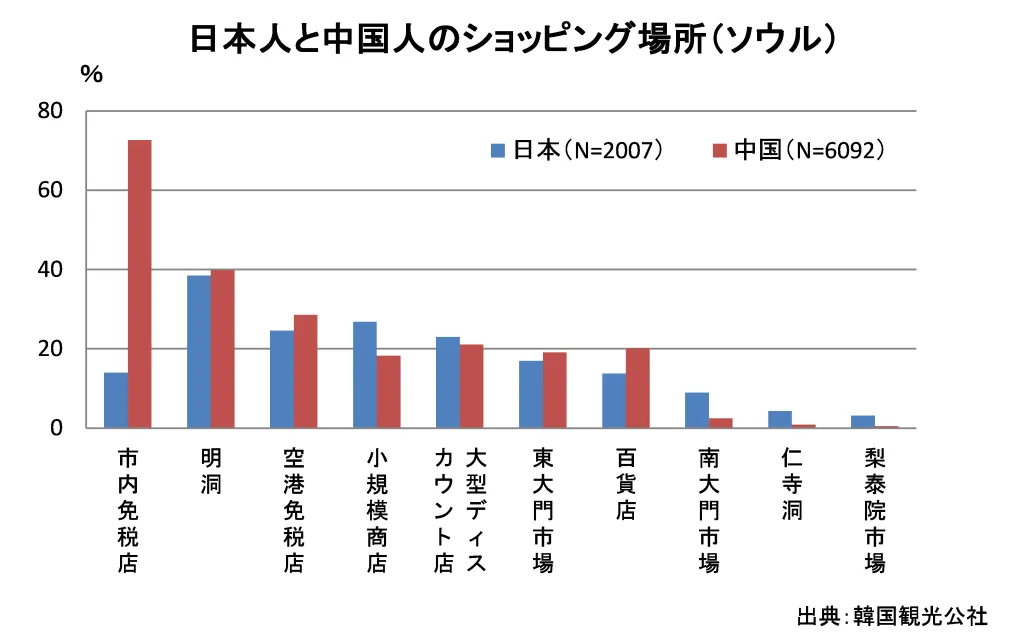
When comparing the shopping areas of Japanese and Chinese tourists, Japanese tourists tend to cover a wider area and also visit smaller shops. As travelers become more experienced and the number of repeat visits increases, independent travel becomes more common, and their range of activities expands. Shopping is not just about buying things; strolling through shops in the city to find favorites is also a fun experience. To encourage visitors to travel even a little farther, isn’t it necessary to convey not only the charm of the city but also the appeal and background of the products as part of the local lifestyle and culture?
(Figure 3) Comparison of Shopping Areas for Japanese and Chinese Tourists (Multiple responses allowed)
South Korea: A New Starting Point for Overseas Travel
Since the start of this year, conditions for a recovery in travel to South Korea have come together, including a strong yen and the establishment of LCCs. However, going a step further, isn’t there a need for fresh, appealing themes that can attract people anew? In fact, the growth of travel to South Korea has been driven by “floating voters”—those drawn by low prices, proximity, and the notion that “everyone seems to be going there.” Furthermore, since 30% of those who have refrained from traveling to South Korea since 2013 believe that “since I’ve been there once, I don’t need to go again for a while,” this situation seems to highlight the necessity of conducting detailed analyses of satisfaction ratings—including intentions to revisit—and taking appropriate measures, especially when traveler numbers are strong. Currently, South Korea, like Japan, is supported by Chinese tourists, but observing the behavior and values of these travelers is essential for any country to consider its own intrinsic appeal.
Our findings showed that South Korea has a higher proportion of “Empathizers” (marketing term: Early Adopters) compared to other countries, and also a significant number of “Highly Attuned” (Innovators). While many sales promotions and PR campaigns target “Empathizers,” perhaps we should consider leveraging “Innovators”—who tend to proactively seek out and delve deeply into new things—as a new step toward revitalizing travel to South Korea.
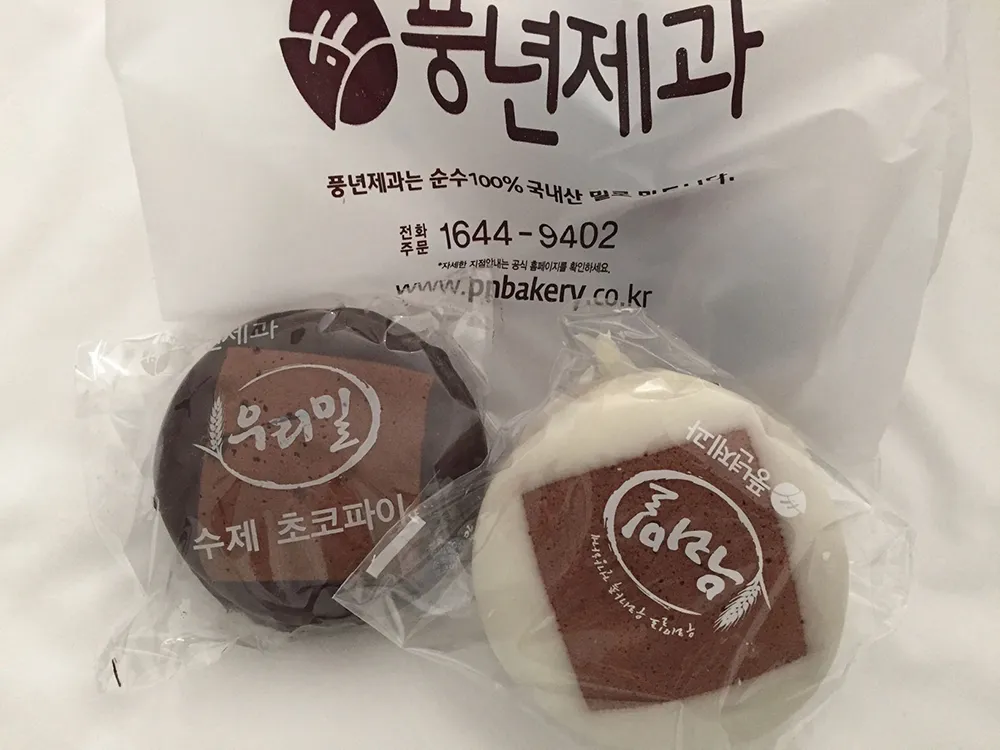
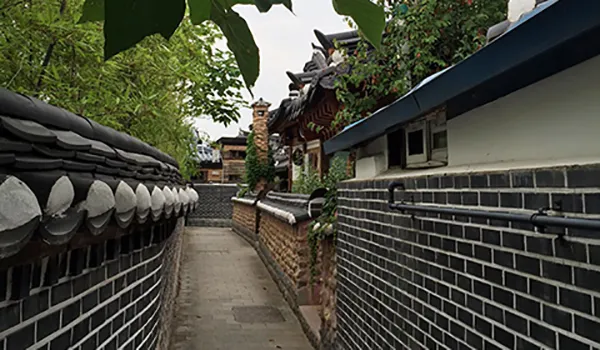
The photo shows the old town of Jeonju, which one of our consultants visited during an academic conference. Located about 1.5 hours from Seoul by high-speed rail, it offers a relaxed and tranquil atmosphere distinct from downtown Seoul, allowing visitors to experience Korean traditions and daily life—giving it an impression similar to Kanazawa. It seems to be gaining attention in recent years as a travel destination in Korea, where domestic travel options are limited. A famous spot here is “PNB Punnyeong Chegwa,” a shop known for its handmade chocolate pies. With their refined and unique texture, many people reportedly make the trip all the way from Seoul just to visit. While it is currently true that travel to regions of Korea outside of Seoul and Busan may feel unfamiliar to Japanese travelers, one approach could be to expand the range of destinations accessible from a Seoul base, even without staying overnight.
(Photo 1) Jeonju Hanok Village
(Photo 2) PNB Punnyeong Chegwa (Pungnyeon Confectionery)