The Role Expected of Regional Airports in Revitalizing Tourism

Against the backdrop of an increase in international visitors to Japan, expectations are rising for attracting tourists to regional areas and revitalizing local communities. In this context, regional airports are expected to play a role not only as transportation hubs but also as centers for promoting the region’s appeal and generating visitor traffic. In this article, we examine the role regional airports are expected to play in revitalizing tourism, drawing on specific case studies.
*This column is a reprint, with permission, of an article originally published in the August 2026 issue of “JR Gazette” (Kotsu Shimbun Co., Ltd.).
1. Introduction
In recent years, Japan’s tourism industry has achieved remarkable recovery and growth. By 2025, the number of international visitors to Japan is projected to reach a record high of approximately 42.68 million, with total spending reaching 9.4549 trillion yen, making tourism a key pillar driving regional economies.While the national and local governments aim to further expand inbound tourism, the current concentration of tourists on the “Golden Route”—cities such as Tokyo, Kyoto, and Osaka—presents an urgent challenge for revitalizing tourism across Japan as a whole. Diversifying tourism demand to regional areas is essential for sustainable tourism.
This concentration in major metropolitan areas is largely due to the “entry point” structure—that is, where visitors enter Japan. According to data from the Ministry of Land, Infrastructure, Transport and Tourism, the majority of visitors to Japan have traditionally used major international airports such as Narita, Haneda, Chubu, and Kansai, while the proportion arriving via regional airports is only about 5 percent.Of course, a combination of factors—including travelers’ needs, differences in regional recognition and the availability of information, and the weakness of secondary transportation networks—also play a role. However, the fact that the starting point for tourism itself is skewed toward urban areas contributes to a structure that makes it difficult for the flow of visitors to expand into regional areas.To improve this situation and promote tourism in regional areas, I believe it is essential to fundamentally reevaluate the role of regional airports and maximize their potential.
2. Challenges Facing Regional Airports
While the inbound tourism market continues to grow, the situation facing regional airports is by no means cause for optimism. The following three points are cited as the main challenges:
(1) Lack of International Flights
Many regional airports have a limited number of international flights and tend to be highly dependent on specific routes. Consequently, any reduction in flight frequency or suspension of service on these routes directly leads to a decline in passenger numbers, dealing a significant blow to airport operations. Building a stable international flight network is essential for attracting visitors to regional areas.
(2) Vulnerability of Secondary Transportation from Airports
In many regional areas, public transportation connections from airports to major tourist destinations are often inadequate. The inconvenience of getting around after arrival causes stress for travelers; not only does it prevent them from extending their stays in the region, but it also limits the range of places they can visit, ultimately leading to lower satisfaction levels. Ensuring seamless transportation is critically important for attracting visitors to regional areas.
(3) Lack of Coordination Between Airport and Tourism Initiatives
Traditionally, airports have been viewed primarily as transportation infrastructure—essentially “transportation hubs”—and their utilization from the perspective of tourism promotion has not always been sufficient. Rather than viewing airports merely as transit points, they must be regarded as hubs for promoting the region’s appeal and as gateways to tourism experiences, and coordination with tourism policies must be strengthened.
3. How Will the Role of Regional Airports Change?
In light of these challenges, regional airports are required to create new functions and value that go beyond their traditional role as “transportation hubs.” This applies not only to attracting inbound tourists but also to expanding domestic travel. For example, the following roles are conceivable:
(1) Creating Appeal as the Gateway to the Region
The airport is the first place travelers encounter the region, and that first impression greatly influences their overall satisfaction with the trip. By designing the airport space itself as a “showcase” where visitors can experience the region’s culture, history, and nature, it is possible to convey the region’s unique character from the moment of arrival and heighten anticipation for the journey.
(2) A Hub for Information Dissemination
Since airports attract large numbers of travelers from both domestic and international destinations, providing high-quality tourism information here has a major impact on their subsequent activities. It is essential to utilize multilingual tourist information centers, digital signage, and interactive content to ensure the airport functions as a hub for effectively promoting the region’s attractions.
(3) Starting Point for Exploration
By using the airport as a starting point and coordinating with public transportation such as trains and buses to facilitate access to surrounding areas, mobility constraints after arrival are alleviated. This expands the areas where travelers can stay and is expected to encourage exploration of the entire region.In particular, rail connections are crucial for enabling wide-area exploration, and it is essential to create seamless travel routes linking the airport to train stations and rail lines.
4. Initiatives at Akita Airport—A Place Connecting the “Beginning and End” of the Tourism Experience
The initiatives at Akita Airport concretely demonstrate a new role for regional airports. In the airport lounge, visitors can sample sake produced in Akita Prefecture (Photo 1) and enjoy Hinai-jidori chicken soup, while local crafts and artworks are on display. This allows travelers to experience Akita’s culture and cuisine right at the airport, enabling them to feel the region’s charm from the moment they arrive.

Such spaces serve as vital venues that connect the “beginning and end” of the tourism experience.Upon arrival, it provides an opportunity to discover the region’s charms, while before departure, it offers a chance to reflect on travel memories and inspire a desire to return. For example, a traveler who develops an interest in Akita’s sake brewing through a sake tasting might decide to visit a sake brewery in person. In this way, the fact that the airport experience leads to concrete actions afterward is a major characteristic of Akita Airport’s initiatives.
5. A New Model for Airports: Aso-Kumamoto Airport—Evolving as a Hub for Extended Stays and Community Interaction
Another pioneering example is Aso Kumamoto Airport, which underwent a major overhaul of its facilities with the opening of a new terminal in 2023.While the concept of a “stay-type airport” has been explored through pioneering initiatives at airports such as Chubu Centrair International Airport and New Chitose Airport, Aso-Kumamoto Airport has elevated this concept in a way that is more deeply rooted in the local region. The new terminal features a significantly expanded selection of dining and retail options, evolving the airport into a “stay-and-explore airport” where passengers can enjoy their time before boarding. The spatial design incorporates Kumamoto’s rich natural scenery and culture throughout, showcasing the prefecture’s charm across the entire airport (Photo 2).
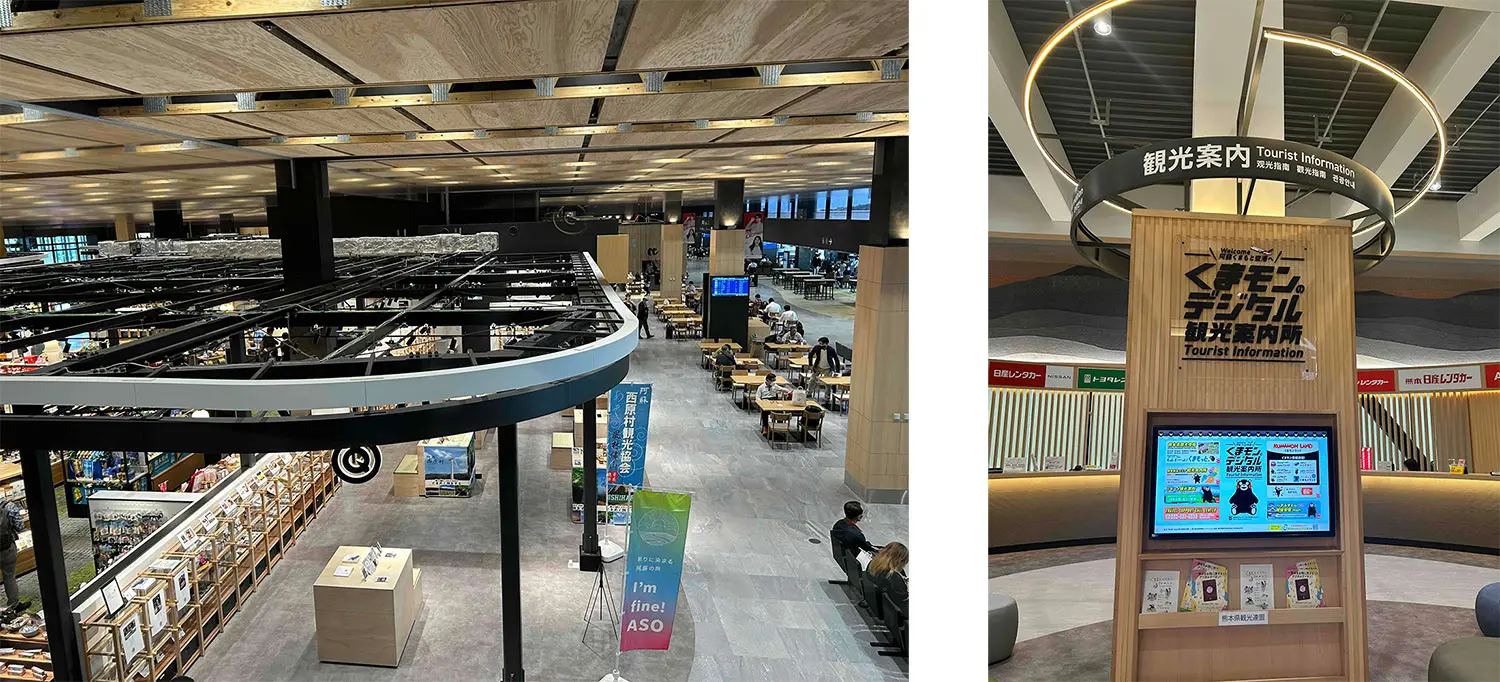
Furthermore, Aso Kumamoto Airport aims to be “an airport that attracts visitors even if they aren’t flying,” and its role as a hub for regional interaction is being strengthened.By establishing commercial facilities and event spaces where local residents can casually drop by, the airport is transforming from a mere transit point into a “place where people gather and linger” that is open to the community. This initiative suggests the potential for the airport to become the center of the local community and foster new interactions between travelers and local residents.
6. Future Direction
Going forward, the following perspectives are essential for utilizing regional airports as the core of regional revitalization.
(1) Conveying the Region’s Appeal at the Airport
Design airport spaces as venues where visitors can experience local culture, cuisine, and nature, and introduce features that heighten anticipation for the journey from the moment of arrival.
(2) Adding Value to the Airport Experience Itself
Enhance the appeal of the airport as a “stay-type airport” where passengers can comfortably spend time before and after their flights by expanding dining, retail, and entertainment facilities.
(3) Coordinate with rail and bus services to create an environment that facilitates easy travel
We will strengthen public transportation connections between the airport and major tourist destinations to enable seamless travel, thereby increasing travelers’ desire to explore the region.
It is crucial that these initiatives (1) through (3) be promoted as an integrated whole. The examples of Akita and Kumamoto cited earlier have achieved particular success in (1) and (2), but collaboration with secondary transportation (3) is essential to extend those benefits to the entire region.For example, Sendai Airport is connected directly to Sendai Station via the “Sendai Airport Access Line,” allowing travelers to transfer immediately upon arrival to conventional rail or Shinkansen lines and stress-free travel to various destinations throughout the Tohoku region, such as Matsushima and Hiraizumi.This is an example of a virtuous cycle in which a positive experience at the airport leads seamlessly to a rich, wide-ranging tourism experience across the region. Advancing both the enhancement of the airport’s own appeal and the development of an environment that facilitates easy travel from the airport will be the key to successfully attracting visitors to regional areas in the future.
7. Conclusion
In the coming era, the role expected of regional airports is undergoing significant change.Airports are no longer limited to functioning merely as “transportation hubs.” First and foremost, they serve as “gateways that showcase the region’s appeal,” and for local residents, they are expected to become “hubs for community interaction.” Enhancing the appeal of regional airports leads to improved convenience and comfort for Japanese travelers on business trips or visiting their hometowns, which directly contributes to an increase in domestic travel.As a result, the entire region will be revitalized, and as its appeal is communicated both domestically and internationally, a virtuous cycle of “two-way tourism”—encompassing both the attraction of inbound tourists and outbound travel as a departure point—will emerge.
The key to revitalizing tourism lies not only in where to gather people, but also in the perspective of “where to begin offering them an attractive experience.” Making the most of regional airports as these attractive starting points will be crucial for sustainable regional development in the future.
著者