
The Importance of Risk Communication: The Pros and Cons of Simplifying Information Released During a Crisis or Its Escalation

On July 31, the government’s Subcommittee on Infectious Disease Control decided to classify the COVID-19 infection situation into four stages and urge the national government and prefectures to implement measures appropriate to each stage. In light of progress made in expanding PCR testing and healthcare systems, the aim is to provide uniform measures and standards to facilitate local governments’ responses and decision-making.
The four stages are “Zero Sporadic Infections,” “Gradual Increase in Infections,” “Rapid Increase in Infections,” and “Explosive Spread of Infections.” The government plans to establish indicators based on factors such as the number of confirmed cases and the strain on the healthcare system, enabling prefectures and other local governments to determine for themselves which stage they fall under. As of the end of July, Tokyo and Osaka, among others, are classified as being in the “Gradual Increase in Infections” stage.“Epidemic Explosion” refers to a severe situation in which a chain of cluster infections occurs, causing public health centers and hospitals to become overwhelmed. The current situation—where the number of confirmed cases is increasing daily but medical institutions still have capacity—is recognized as falling under the “Gradual Increase” category.
That said, “gradual increase” is a general term meaning “to increase gradually,” and whether a situation where more than 200 new cases are confirmed daily can be perceived as “gradual” is likely to vary depending on each individual’s subjective perception.Bridging the gap between the government’s use of crisis terminology and the general public’s “intuitive understanding of the words” is no easy task.
Yasunori Hata, an associate professor at the Faculty of Engineering at Yamanashi University, conducted a survey in late May among students to assess their understanding of messages regarding the “Three Cs,” examining how the information was being conveyed.
The survey results show that while a majority of respondents understood that “the ‘Three Cs’ refer to the overlap of ‘closed spaces,’ ‘crowded places,’ and ‘close-contact settings,’” only about half agreed that “it is important to avoid the overlap of the Three Cs,” andand just under 30% agreed that “the Three Cs can be avoided in outdoor settings such as parks or the beach.” This suggests that the concept has not necessarily been understood accurately (*Note: While each of the Three Cs should be avoided, the risk of contact transmission exists independently of these factors).Consequently, while people may be able to take actions to avoid the greatest risks, there is a risk that this could lead to a new problem: a decline in vigilance in various other places and situations where risks are present. Although the sample size of this survey is small, the results suggest the risks associated with conveying information through overly simplified messages.
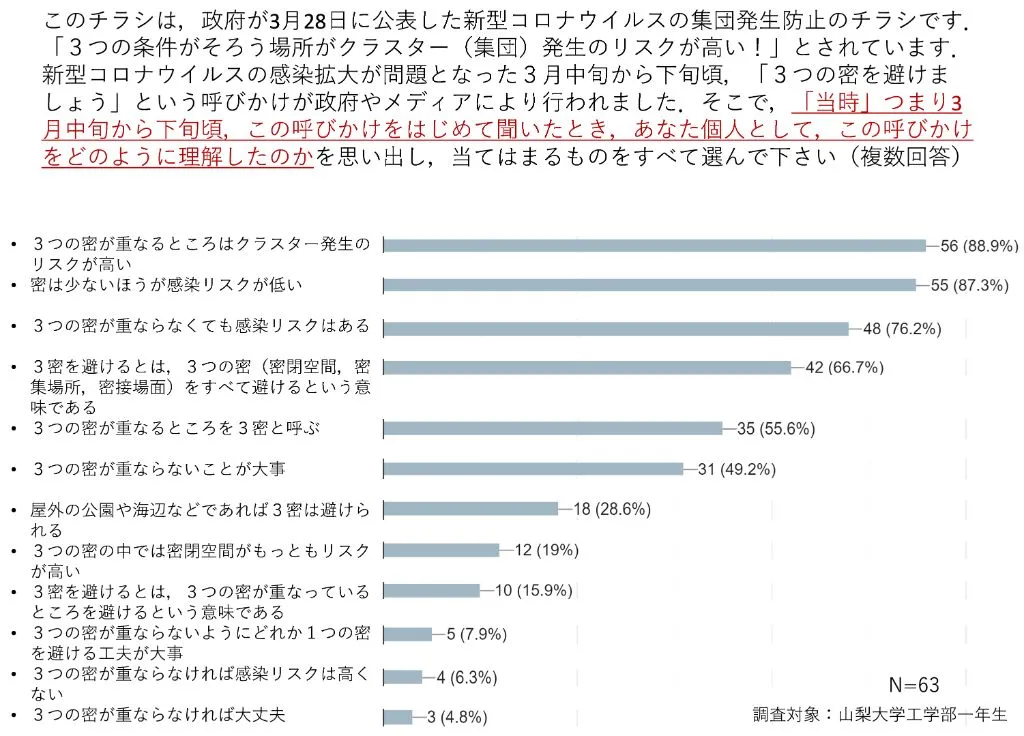
Survey Title: COVID-19 Questionnaire
Survey Conducted by: Yasunori Hata, Associate Professor, Faculty of Engineering
, University of Yamanashi Participants: First-year civil engineering students
, N=63 Survey Period: May 21 (Thu) – 27 (Wed), 2020
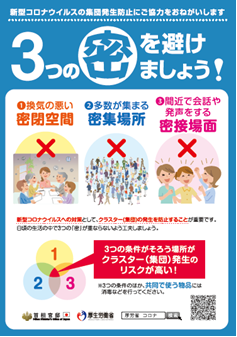
In risk communication, simplifying language has both advantages and disadvantages. During a crisis or in situations where there is a risk of the crisis escalating—particularly at stages when urgent action is required—there is significant value in conveying strong, concise, and straightforward messages.When each consumer quickly and intuitively understands a message designed to avert a major risk, they can be encouraged to avoid actions that carry significant risk. On the other hand, however, it is crucial that individuals accurately understand the risk situation in order to take more appropriate actions based on their own judgment.When disseminating risk information, it is necessary to simultaneously verify the extent to which the simplified message is being accurately conveyed to the market. If it is determined that the public’s understanding of the situation is insufficient, it becomes necessary to adjust the messaging approach in accordance with the progression of the crisis.
Recipients of risk information share it with relevant family members, colleagues, and friends, as well as posting it on social media. The likelihood of avoiding or mitigating risks increases when they are shared and understood in a two-way manner among those involved. In other words, risk communication cannot achieve its intended effects through one-way dissemination by the media or experts alone.Only then—through the dissemination of information and mutual understanding among stakeholders who share the risk—can appropriate actions be implemented on a broad scale, based on trust and cooperation fostered by a correct understanding of the risk.
As crisis situations change daily and a wealth of new information is released by experts and local governments, the first step toward dealing with risks more accurately is for each member of society—as a recipient of information—to understand that they are also an active participant (a communicator) in risk communication.
著者













