How to Utilize Local Tourism Data
Regions working to promote tourism are collecting data on local lodging guests and exploring ways to use this information to objectively and effectively attract visitors and boost spending. While many regions aim to establish a cycle consisting of 1) data collection, 2) data analysis, 3) policy development and implementation, and 5) evaluation and improvement, we often hear that they are struggling to make this work. Given that these regions often face shortages of both manpower and financial resources, how can they make effective use of this data?
1. The Current State of Tourism Data Collection at the Local Level
To begin with, there is surprisingly little tourism-related open data available at the municipal level. Even today, in many regions, local governments and tourism organizations often compile and track visitor numbers—such as monthly total overnight stays and the number of foreign visitors—based on reports from local lodging and tourism facilities.In such cases, the standard practice is to distribute a standardized form listing the required data items to data providers in advance and collect the responses via email or other means. However, there are instances where facilities cannot provide the data requested by the government due to their own circumstances, or where submissions are sent in a disorganized manner via email or fax. Consequently, this remains a labor-intensive process for both the data providers and those compiling the data.
On the other hand, in recent years, marketing and management based on data collection and analysis of target regions—led primarily by regional DMOs and tourism associations—has gained prominence. Consequently, data platforms capable of tracking national or regional tourism trends relatively quickly are beginning to be developed and utilized. Through big data on lodging and visitor flow, it has become possible to track the number of overnight guests, their attributes, and average spending rates by municipality, and to estimate total tourist arrivals.Some local governments conduct visitor surveys using two-dimensional barcodes and publish data on tourist satisfaction, tourism spending, and repeat visit rates on these platforms. While such initiatives are helping to alleviate the burden of data collection, these data platforms often have too many features for municipalities to utilize in their daily marketing activities, making them difficult to operate and, in some cases, preventing them from becoming fully established.Depending on the resources and capabilities available for data utilization in each region, it is necessary to determine whether to collect data independently, implement a platform, or decide how to utilize the data effectively.
2. The Challenges of Analyzing Regional Tourism Data
Regional tourism-related industries and organizations often face chronic labor shortages. It is common to hear that there is simply no staff with analytical skills, and that there is neither the time nor the budget to train such personnel locally. Tourism is said to be a broad-based industry involving diverse sectors. Furthermore, since the types of tourist attractions, their appeal, accessibility, and reception infrastructure vary by region—as do the strengths and weaknesses of the tourism industry—the ways in which regions generate revenue differ vastly.In this context, while it may be possible to quantitatively track metrics such as year-over-year or month-over-month changes in lodging guests and assess a region’s position relative to others, it is undeniably difficult to dig deeper by digesting and interpreting current data to formulate hypotheses—such as identifying where the problems lie in promoting regional tourism and why they are occurring—and then determining what the region as a whole should do next and what specific actions individual businesses should take.
In this context, the Gero Onsen Tourism Association has, for many years, consistently maintained a cycle that spans data collection and analysis, through to the planning, implementation, evaluation, and improvement of initiatives. Even now, the association continues to refine its approach through trial and error. To understand how they have overcome these typically challenging hurdles, we spoke with Yasuhiro Taki, the association’s chairman—who also personally manages an accommodation facility and leads this initiative—and shared our insights.
3. Initiatives of the Gero Onsen Tourism Association
In Gero Onsen, the city has been aggregating and compiling common data points—such as the number of guests, their demographics, modes of transportation, and sales channels—from local lodging facilities for the past 50 years.Based on this data, the Gero Onsen Tourism Association—which also serves as the DMO—has taken on the core role of regional marketing. According to Chairman Taki, “We don’t have any marketing professionals among us.” However, following the 2011 Great East Japan Earthquake and the spread of COVID-19 in 2020, the association has successively rolled out measures based on data analysis, leading to one of the fastest recoveries in tourist numbers among domestic hot spring destinations. How have they managed to utilize data effectively despite “not having any marketing professionals”?
(1) Building Regional Consensus to Strengthen Data Collection and Utilization
There are two particularly significant hurdles in collecting regional tourism data (regarding users of tourism-related facilities such as lodging and restaurants).
The first is obtaining agreement from local businesses to provide customer numbers and demographic attributes—data that is vital to their operations. From the perspective of local businesses, it is natural to question why this data is needed, how it will be useful, and what benefits it offers them.It is likely
that in Gero Onsen as well, there has been constant pressure over the past 50 years to secure cooperation from data providers. In response to this, Chairman Taki points out that “it is important to continue delivering results and allowing them to experience the tangible changes.” In fact, guided by the mottos “to create an organization that is constantly evolving” and “to do everything within our power,” the Gero Onsen Tourism Association undertakes a vast number of initiatives throughout the year to adapt to the rapidly changing tourism market.
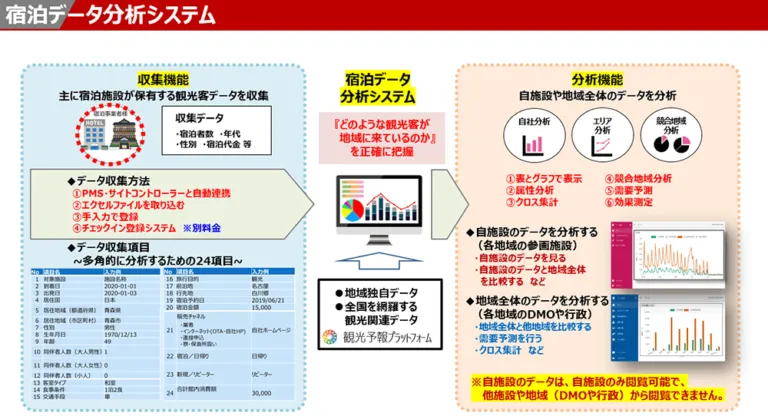
The second challenge is the need to have tourism businesses compile data monthly and continuously submit it via email or fax. For labor-intensive tourism businesses, this process is a significant burden. For those compiling the data, it involves the effort of sending reminders, checking for errors, aggregating the data, and visualizing the results. Since the information obtained from guests varies by accommodation facility within the region, there are also instances where data fields do not align.The Gero Onsen Tourism Association
has resolved this challenge by introducing the “Accommodation Data Analysis System” (*1). This system can be automatically linked to accommodation facilities’ PMS (Property Management Systems) and site controllers, allowing the system to automatically import the required accommodation data. This data can be easily visualized as graphs on screen, enabling smooth analysis and report generation.Furthermore, the data aggregated in the system is processed—for example, by removing facility names and aggregating numerical values—before being shared within the region. This allows each business operator to grasp overall tourism trends in the area. Using this data, operators can establish a shared understanding of regional tourism trends, assess their relative position within the region, and utilize this information for decision-making.It should be noted that the Gero Onsen Tourism Association is responsible for overseeing the region as a whole and promoting initiatives aimed at a broad customer base; specific targeting and positioning within this framework are handled individually by each tourism-related business operator. *1 Accommodation Data Analysis System
: A system that collects tourist data held by accommodation facilities and other entities, visualizing trends such as changes in the number of guests by facility and region, as well as spending by nationality, thereby enabling analysis by demographic attributes.By
automatically linking with accommodation facilities’ PMS and site controllers, the system eliminates the effort required to provide and aggregate data. It also includes analysis functions, allowing both the region as a whole and individual accommodation facilities to analyze their own data. *Note: Each facility can only view its own data; other facilities or regional entities (such as DMOs or government agencies) cannot access it.
(2) Data Utilization Methods
Data is aggregated and compiled by the 10th of each month, and meetings are held within 10 days thereafter. Regarding data analysis, the process does not necessarily rely on advanced data analytics techniques. Instead, it involves monthly monitoring of high-precision accommodation data and other available quantitative information collected within the region. This data is then logically synthesized and interpreted in conjunction with qualitative information regarding changes in the tourism environment surrounding Gero Onsen to inform decision-making regarding promotions and other initiatives.By continuously reviewing the data, they not only grasp which customer segments are currently active and how they are behaving, but also become attuned to discrepancies between their intuitive sense and the latest domestic and international socioeconomic and tourism trends, as well as any unease regarding unexpected behaviors. The Gero Onsen Tourism Association places great importance on analog data collection—such as conducting interviews at drive-in restaurants and checking the reactions and situations of travel agents visited during roadshows—to help understand the latest realities of tourists and assess the potential of initiatives.Furthermore, when it comes to analyzing and interpreting data, the task is not left solely to the association’s data analysts. Instead, individuals such as Chairman Taki—who possess a deep understanding of local tourism and, as business owners in the tourism sector, have extensive insight into tourist needs and the tourism industry as a whole—take the initiative to thoroughly review the data themselves. This approach enhances the accuracy of interpretation and leads to the development of more effective policies and initiatives.
(3) Key Points for Promoting Data Utilization in the Region
At the Gero Onsen Tourism Association, a shared vision is considered a key element supporting data utilization efforts. Chairman Taki conveys to the local community that “the true purpose of tourism promotion is to improve the lives of local residents” and emphasizes the importance of “increasing the number of stakeholders to foster regional unity.” This is the very essence of fostering a sense of participation among every single resident (business operator), which is paramount in the development of a tourism region.For those who endorse this vision, the simple act of providing data is a natural way to contribute to regional tourism promotion, and it is unlikely to raise doubts or cause discomfort. Furthermore, by understanding the local situation, the results of initiatives, and changes through regularly shared aggregated data, a common understanding can be achieved based on objective figures. This may lead to a renewed realization of the importance of providing data.
In addition to this, the concentration of resources achieved through “building an organization free of omissions and duplications” within the region, as well as the “leadership of the tourism association” exemplified by Chairman Taki, are also cited as key factors.
4. Summary: Toward Data Utilization by Municipalities
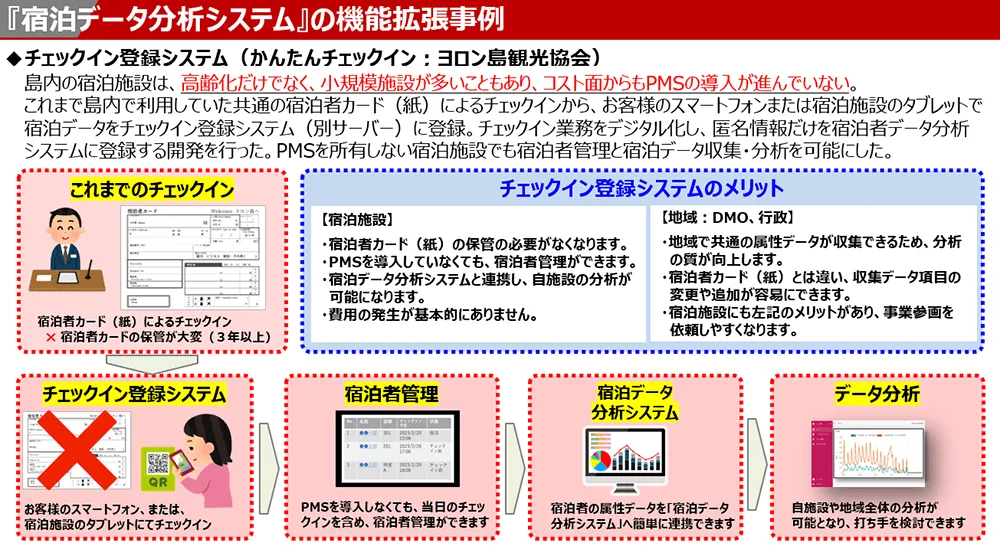
Finally, as a reference, I would like to mention the case of the Yoro Island Tourism Association, which has digitized the labor-intensive process of collecting and analyzing local accommodation data at a relatively low cost. On Yoro Island as well, there was a desire to utilize accommodation facility data for tourism promotion. However, they faced challenges: many small-scale accommodation facilities could not bear the burden of the time and cost associated with providing data, and due to the aging of business owners, they could not be asked to perform complex operations.To address this, they expanded the functionality of the accommodation data analysis system introduced by the Gero Onsen Tourism Association. By having guests enter their accommodation data via their smartphones or the facility’s tablets, they digitized the check-in process while simultaneously adopting a method that stores only anonymized information in the system. This enables even accommodations without a PMS to manage guests and collect and analyze accommodation data, allowing them to utilize daily guest numbers and demographic information for marketing purposes.Furthermore, by enabling the tourism association to monitor real-time accommodation trends on the island throughout the day and share this information locally, it is expected that tourism-related businesses will be able to use this data to inform their own operations—such as determining business hours for restaurants. This initiative serves as a model for overcoming the challenges of data utilization within the region and is a prime example of how to “continue delivering results and help people experience tangible change.”
Regarding regional data collection, the key is to “continue delivering results and allowing people to experience tangible change” through these initiatives. It is also important to approach this in conjunction with “sharing” to ensure that the necessity and effectiveness of the data are understood within the region.Regarding analysis and policy planning, rather than having local governments or tourism organizations—which often lack sufficient manpower and financial resources—undertake these tasks alone, one effective approach is to deeply involve individuals within the region who possess expertise and networks in the tourism sector. This allows for the generation of valuable insights and leads to highly effective initiatives. However, for any of these initiatives to succeed, it is essential to gain the empathy and cooperation of residents and business owners, as this is the key to sustaining the efforts.When municipal tourism departments or tourism organizations undertake data utilization, it is considered important not only to define specific objectives for data collection and analysis but also to link these efforts to a tourism promotion vision or plan that addresses overarching goals—such as “improving the living environment” or “increasing income”—so that residents and business operators can see these initiatives as directly relevant to their own lives.