
Fashion and Travel in the Age of Personalization

There was a time when fashion magazines helped drive travel. Amid the COVID-19 pandemic, while the fashion and tourism industries struggled, new products and services achieved steady growth. We explore the commonalities in consumer needs across these two industries at this turning point, as well as the relationship between fashion and travel.
1. Fashion is a dialogue with society
Since the late 2010s, there has been a growing trend of art museums hosting special exhibitions related to fashion. Major exhibitions held in Tokyo include “Dress Code?—A Game for the Wearer” in 2020, “Fashion in Japan 1945–2020: Trends and Society” in 2021, and “LOVE Fashion—When I Change My Clothes,” currently on view as of May 2025. This growing interest in fashion exhibitions demonstrates that fashion itself is a culture and an object worthy of appreciation, and that it serves as a powerful medium for understanding social contexts through its evolution.
There is a saying that “fashion is a dialogue with society.” While fashion during Japan’s bubble economy is a prime example, economic vitality and style are closely intertwined. “Uniforms” express roles, and dress codes for specific places and times serve as tools for communication. Looking back at major fashion trends over the past 20 years or so, they largely reflect the social environment, including the impact of technological advancements, changes in consumer purchasing behavior, and the global trend toward respecting diversity.
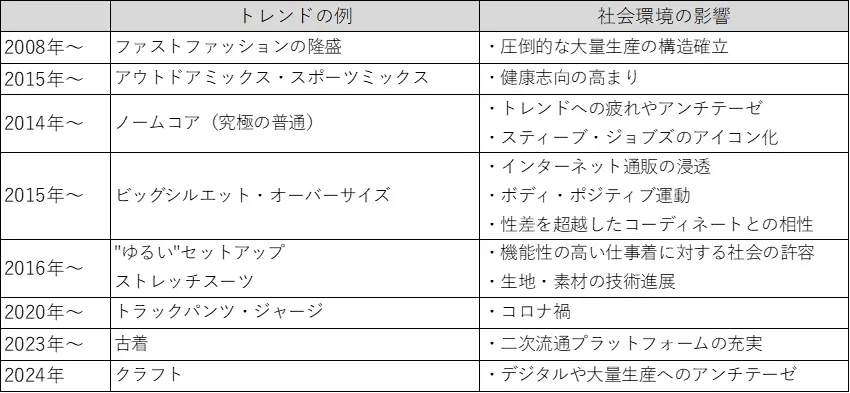
If we view “wearing clothes” purely as a function, it should suffice as long as they meet the needs of the climate and purpose. However, the discovery of various accessories as burial goods from the Jomon period suggests that concepts akin to fashion have likely existed continuously since ancient times.Dressing up and self-expression are not strictly essential for survival. Like “travel,” which has also existed since ancient times, they can be viewed as deeply ingrained in daily life within social activities—in the sense that “while one would not die without them, people have always desired them.”
2. Changes in Consumer Needs and Industrial Structures Related to Fashion and Travel
For people who view fashion and travel as important aspects of their lives, recent surges in prices and exchange rates have been a major headwind.According to a survey by Tokyo Shoko Research, the prices of standard bags and shoes from well-known global apparel brands have roughly doubled over the past decade, and sales prices at 15 domestic listed hotel brands for the July–September 2024 quarter were 1.8 times higher than in the same period of 2021. In this environment, how have consumer attitudes and the industrial structures of both industries changed in recent years?
(1) The Fashion Industry — The Rise of Independent Retailers Driven by E-Commerce and the Boom in the Reuse Market —
Against the backdrop of soaring clothing prices, the boom in the secondary market shows no signs of slowing down as of 2025. The size of the U.S. reuse market reached approximately $32 billion (4.6 trillion yen) in 2020.The annual growth rate is projected to be approximately 6.1%, and the market is expected to exceed $50 billion (7.2 trillion yen) by 2030. In Japan, department stores have begun introducing reuse services, and the domestic clothing subscription service market grew to approximately 1 trillion yen in 2021.
Additionally, the rise of small-scale shops with no (or very few) physical stores has been remarkable in Japan. By narrowing down their product selection and leveraging social media advertising to build customer loyalty and drive e-commerce sales, these shops minimize indirect costs—such as those associated with physical stores, advertising, and wholesale—to the absolute minimum, allowing them to deliver products to customers at reasonable prices. This model is particularly well-suited for basic items that do not require try-ons, as well as artisanal brands that wish to highlight their manufacturing processes and brand philosophy.
The global expansion of e-commerce has given rise to ultra-low-price brands that are incomparable to traditional brick-and-mortar fast fashion retailers. SHEIN’s market size (revenue) is projected to reach $36.5 billion (5.4 trillion yen) in 2023, with a target of $80.6 billion (10 trillion yen) by 2025.The luxury market, at the opposite end of the spectrum, is also performing well, with annual growth in the 1% range projected for 2019–2027. This growth is primarily driven by consumer demand in emerging markets such as China and the Middle East.
Attention is also growing regarding the relationship between fashion and environmental impact. According to a survey by the United Nations Alliance for Sustainable Fashion, established in 2019, the apparel industry accounts for 8–10% of greenhouse gas emissions across all industries. This represents a significant impact, roughly on par with emissions from the automotive industry, and is one of the major reasons why the reuse market is gaining support even among the affluent.
(2) Tourism-Related Industries — Growth of Subscription Services and Deepening of "Toki" Consumption —
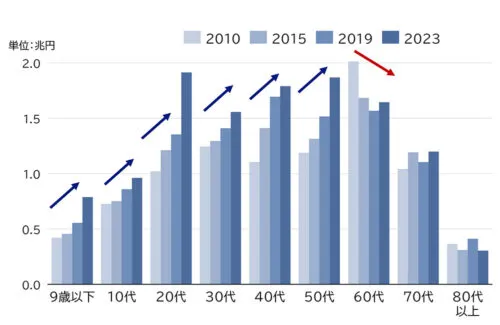
While the domestic travel market is expected to shrink over the long term due to population decline, spending on overnight trips varies significantly by generation. Spending is on the rise among those in their 50s and younger, with those in their 20s seeing an increase of approximately 500 billion yen between 2019 and 2023. On the other hand, led by those in their 60s—who had the highest spending in 2010—travel spending among those aged 60 and older has shifted from a decline to a plateau.The shift from the “active seniors”—who have historically driven the travel market—to younger generations is fueling changing demands for new services.
Figure 1: Trends in Accommodation Travel Expenditures for Tourism and Recreation (by Age Group)
Major industry changes over the past decade include the rapid advancement of online information gathering and purchasing behavior, as well as the expansion of services and content driven by changes in the quality of experiences sought. In the accommodation sector, the expansion of accommodation subscription services—a new form of membership-based hotels—is predicted.The Marketing Data Bank at the Japan Management Association Research Institute predicts that the market size for accommodation subscription services, which stood at 6.5 billion yen in 2022, will expand to approximately 18 billion yen by 2028. When the market first emerged around 2018, it centered on shared housing and guesthouses utilizing traditional Japanese houses, with people seeking a dual- or multi-location lifestyle as the primary users.Since then, various operators have entered the market, increasing the variety of facilities and introducing “light plans” that allow users to stay for just a few nights per month, thereby capturing leisure demand. In addition, to attract traditional vacation home users, high-end services such as NOT A HOTEL and SANU 2nd Home—which promote “lifestyle subscriptions” that allow users to enjoy extraordinary natural environments—have emerged and are proving popular.Furthermore, traditional membership-based hotels (resort memberships) have performed well, even during the COVID-19 pandemic, with memberships for newly opened hotels proving particularly popular. The market is expanding due to factors such as the high number of contracts signed under corporate names—which also serve as tax-saving measures—and the emergence of discounted products with shorter membership periods tailored for seniors.
Additionally, the expansion of travel experiences has encouraged entry from companies outside the traditional tourism sector.Projection mapping has now become established as a visual experience that leverages the unique character of tourist destinations, and the global market for immersive experiences (location-based entertainment, or LBE)—still in its infancy in Japan—is estimated to be worth 1 trillion yen. Beyond the shift in tourism from “consumption of things” to “consumption of moments,” we can see that demand is becoming increasingly personalized, moving toward “original moments of consumption that are completed by that specific location and the people present there.”
(3) The Common Factors for Growth: Cultivating a Fan Base and Online Communication
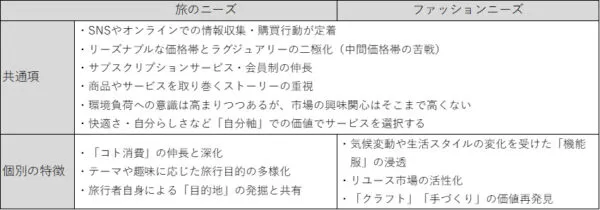
Looking at the recent trends in both industries, it becomes clear that the key to growth lies in retaining existing regular customers and new fans acquired through social media, as well as in creating platforms that allow these limited communities to repeatedly use the services. In cases where a “customer retention strategy” to build a small-to-medium-sized economic ecosystem is not feasible, cross-border e-commerce—which allows new customers to discover the business—becomes the foundation for customer communication.In such cases, it is crucial that customers can view product and service details online and make direct reservations or purchases, regardless of their location. In any case, to gather information online and select products and services that suit them, a certain level of “discernment” or “evaluations by experts and market reputation” is indispensable.Consumers are increasingly inclined to build communities with similar values and interests, or to select “products and services that suit their personal style” by referring to word-of-mouth from people they perceive as having similar values.
Table 2: Recent Changes in Needs Regarding Travel and Fashion
3. The Relationship Between Travel and Fashion
In the 1970s, women’s magazines such as *an·an* and *non-no*, which were read by the “Annon tribe” that drove domestic travel, promoted a sense of being the “protagonist”—going out dressed in the latest fashions against the backdrop of “picturesque scenery” at travel destinations.Around the same time, shortly after overseas travel was liberalized, many people would travel in formal attire—such as suits or traditional Japanese clothing—even when heading to a destination like Hawaii. In an era when travel was an even more extraordinary experience than it is today, a trip was an occasion to “wear one’s best outfit” regardless of the destination, and fashion served to further accentuate the “extraordinary” nature of the self.
Today, fashion is no longer driven by mass media, and new travel destinations often gain popularity through consumer-driven trends. Even amid this trend toward the personalization of both travel and fashion, certain “fashion conventions” still hold true. However, what differs significantly from 50 years ago is that the creation of this “sense of the extraordinary” is now predicated on the specific environment and scenery of the location.Some people coordinate matching outfits at theme parks, while others wear vibrant colors, patterns, or revealing clothing at overseas resorts that they wouldn’t wear in Japan. Those on long-term trips to Asia may also wear “casual local attire” suited to the local climate and culture.The pleasure of being able to become a different version of oneself “only” during the extraordinary experience of travel could be described as the fulfillment of a temporary, non-everyday desire for transformation—one that is permitted precisely because it takes place at a travel destination. These experiences are then reproduced as a kind of “style” through social media and passed on to the next generation of travelers.
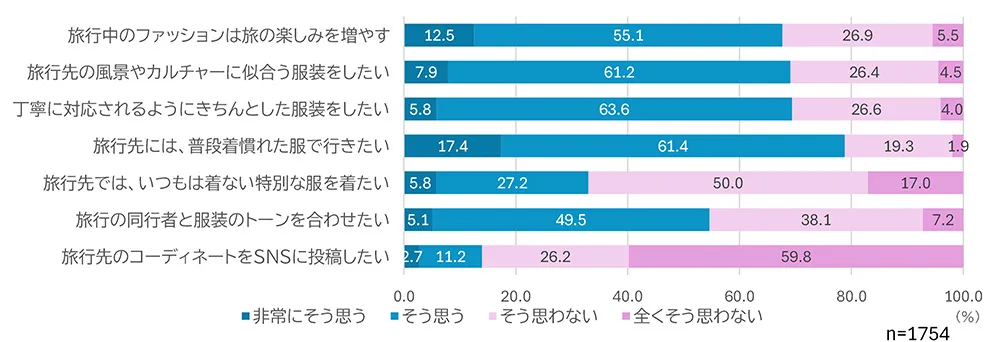
According to a survey conducted by JTB Tourism Research & Consulting in April 2025, approximately 68% of respondents believe that “fashion while traveling enhances the enjoyment of the trip,” and over 12% strongly agreed (Figure 2). Furthermore, one-third of respondents stated that they “want to wear special clothes at their destination,” suggesting the existence of the aforementioned “desire for a temporary transformation to fully experience the destination.”Additionally, approximately 70% of respondents said they “want to wear clothes that match the scenery and culture of their destination” and “want to wear neat clothes to be treated with courtesy,” revealing a sense of respect for the destination and a desire to enhance their own travel experience.
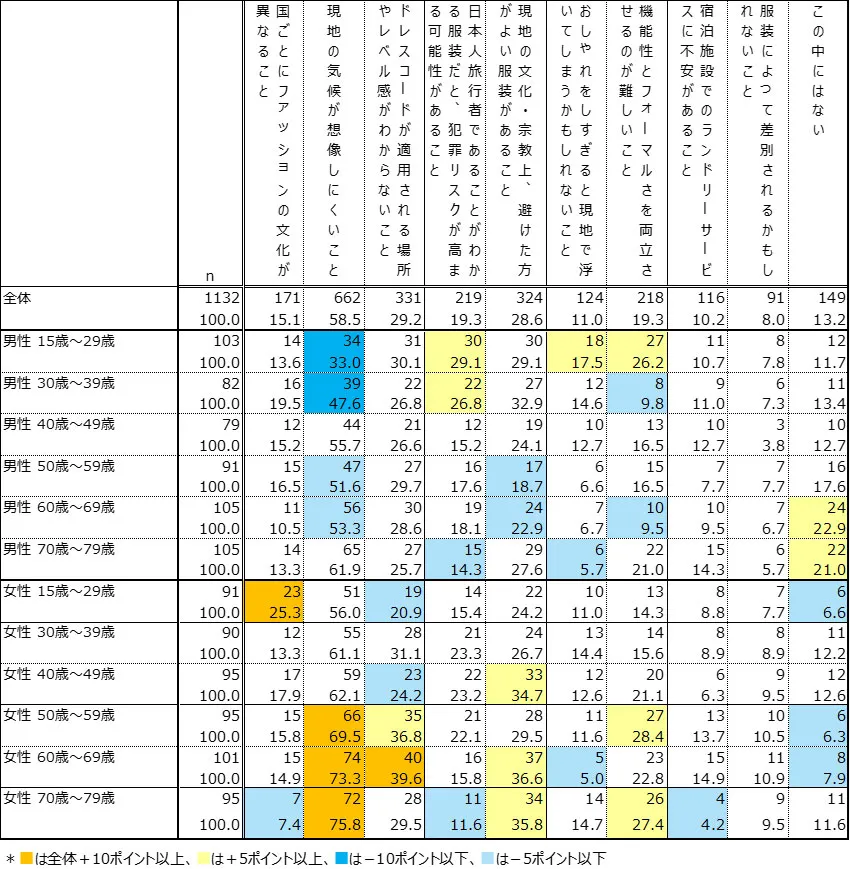
While the excitement of experiencing a different culture is heightened during overseas travel, concerns about the climate and local culture also increase. Regarding “difficulties with clothing while traveling abroad,” “difficulty imagining the climate” was particularly high at just under 60%, followed by concerns about “dress codes” at approximately 30% (Table 3).
Significant differences by age and gender emerged regarding consideration for local culture and customs, as well as awareness of crime risks. Men in their 30s and younger tended to be particularly concerned that being identified as Japanese tourists by their appearance might increase the risk of crime, revealing a cautious mindset.
On the other hand, anxiety regarding dress codes was highest among women aged 50 and older, while concern about avoiding inappropriate attire in light of local religious and cultural customs was highest among women aged 40 and older, suggesting a strong awareness of fashion as a sociocultural phenomenon.
4. Conclusion
Sociologist Marshall McLuhan once described media and technology as “extensions of the human body.” Although this quote comes from a book published in the 1960s, it resonates even more strongly today, as AI takes over our daily tasks, immersive digital content flourishes, and social media allows us to relive others’ experiences as if they were our own.Travel is becoming not only an escape from the ordinary but also an extension of daily life, with technology making our imagination of travel and our experiences while traveling increasingly personalized. Furthermore, fashion is shifting from being a tool for self-presentation—where one views oneself as a sort of protagonist by dressing up for travel—to being positioned more firmly as a functional and social communication tool that helps one blend into the local scenery and culture, thereby supporting more comfortable and fulfilling activities.
Furthermore, McLuhan described clothing as humanity’s “second skin.” If this means that one’s body and clothing become one, connecting the self to the world, then the clothes and accessories worn during a memorable trip may become companions that carry on the body’s memory of that extraordinary time, offering a little boost of energy upon returning to everyday life.
[Survey Overview]
JTB Tourism Research & Consulting “Survey on Attitudes Toward Travel Fashion” (April 2025)
Survey Method: Online questionnaire
Survey Participants: 1,000 men and 1,000 women aged 15–79 residing in Japan / 1,000 each from major metropolitan areas (Tokyo, Kanagawa, Saitama, Chiba, Osaka, Kyoto, Hyogo, Aichi, Fukuoka) and other regions, for a total of 2,000 respondents
著者













