How can we encourage people to venture abroad from Japan, a country that has everything?

Japan ranks 11th in the world for the number of countries its citizens can visit without a visa. However, the number of Japanese travelers going abroad is on the decline compared to other countries. What are the reasons for this? And what should we do to revitalize the overseas travel market?
Japanese people are blessed with an environment that supports overseas travel
Driven by the strong yen following the Plaza Accord and the bubble economy, the number of Japanese travelers abroad surged starting in the late 1980s, and the sight of Japanese tourists with cameras slung around their necks traveling around the world became a symbol of Japanese overseas travel. Japanese passports were regarded as “platinum tickets,” and the image that they could visit any country in the world became firmly established. However, the Japanese outbound travel market has been in a prolonged slump, although it did see a 5.6% increase in 2016—the first growth in four years—and the proportion of short-haul destinations is on the rise. According to the German National Tourist Board, the number of overnight stays by Chinese visitors in Germany increased by 1.1% in 2016, by 7.8% for Indians, and by 5.7% for South Koreans, but only Japan saw a 12.4% decline.
According to the 2017 VFS (Visa-Free Score) published by Arton Capital, a Canadian investment advisory firm, Germany is the country with the most visa-free travel destinations, allowing visa-free travel to 158 countries and regions. It is followed by Sweden, Singapore, the Nordic countries, France, the United Kingdom, and the United States. Singapore is the only Asian country in the top 10, while Japan ranks 11th.
Next, looking at the “Best Countries” ranking published by U.S. News—which is calculated based on a survey of 21,000 people worldwide regarding 65 criteria, including quality of life, cultural influence, and ease of doing business—we see that six countries appear in the top 10: the five European nations from the aforementioned VFS top 10 (the United Kingdom, Germany, France, Sweden, and Norway) and the United States. Japan ranked 5th (1st in Asia), suggesting it is blessed with an environment conducive to international travel, including economic stability, freedom of movement, and cultural background.
"Wanting to experience a new, uncharted world": The strong desire for overseas travel in emerging nations
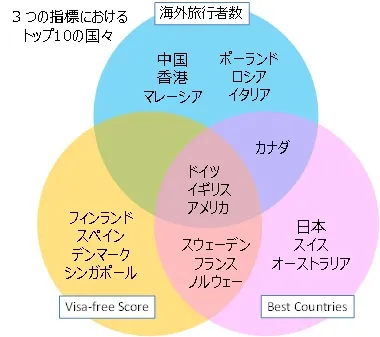
How does this compare to the rankings of international tourist arrivals? According to data from the UNWTO (United Nations World Tourism Organization), the top three countries in international tourist arrivals for 2014 were China (1st), Hong Kong (2nd), and Germany (3rd). Japan ranked 17th. Among the three indicators examined so far, only three countries—Germany, the UK, and the US—appeared in the top 10 across all three rankings. On the other hand, three Asian countries—China, Hong Kong, and Malaysia—are among the top 10 in terms of outbound travelers.
While it cannot be said that there is no correlation between the number of outbound travelers and the number of countries they can visit without a visa, the appearance of countries like Malaysia, China, Poland, and Russia—which did not appear in the top 10 of the first two tables—suggests to us the high level of desire for overseas travel in emerging nations. In other words, it highlights their strong desire to experience new worlds they have not yet seen and to broaden their horizons. Driven by this strong desire for overseas travel and alongside the economic development of emerging nations, the number of global outbound travelers is likely to continue increasing in the future. Looking back at Japan, what must we do to raise our current ranking of 17th in outbound travelers into the top 10?
The Significance and Thrill of Experiencing Things Firsthand
Personally, I believe the reason Japanese people’s desire to travel abroad is not as high as that of people in emerging nations is because “Japan is a country that has everything.” The streets are overflowing with a wide variety of overseas products, from luxury brands to casual brands, and restaurants offer cuisines from all over the world. Content from around the world, such as movies, is also easily accessible via the internet and video rental shops. Another key factor is that Japan is likely one of the safest countries in the world. The fact that Japan is such an attractive country is evidenced by the recent increase in the number of visitors to Japan. In such an environment, maintaining a strong desire to travel abroad may, in a sense, be a difficult task.
However, I want people in Japan to remember that what truly matters is “experiencing things for yourself.” The true thrill of traveling abroad lies in actually visiting a place, engaging with its culture and language, interacting with local people, and gaining new insights and perspectives for yourself.
One of the first steps in sparking an interest in other countries and a desire to visit them is “learning about the world.” In Japan, the school system requires students to choose between Japanese history and world history, so not everyone studies world history. Furthermore, education on world geography is by no means extensive. Fortunately, I myself received an education in multiple countries, and the universal and global perspective I gained through studying world history, culture, and geography has proven invaluable to me both personally and professionally. Incorporating more of the world’s history, culture, and geography into the Japanese education system would help convey the current state of the world to the generation that will shape Japan’s future, and could ultimately contribute to revitalizing Japan’s outbound travel market.
著者