An Interview with Calligrapher Taku Kosugi: What Travel Will Look Like in Five Years
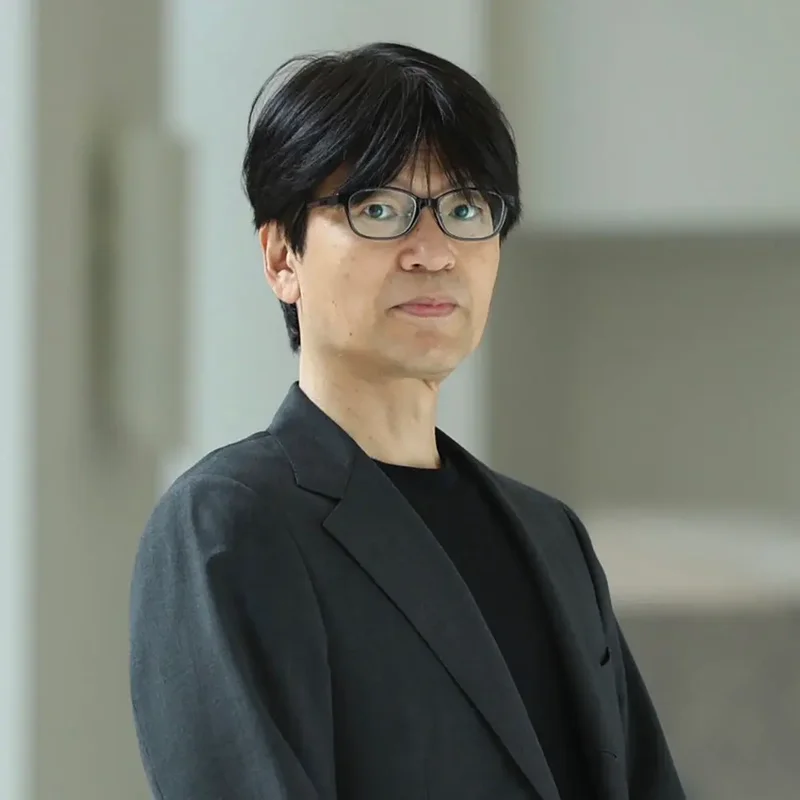
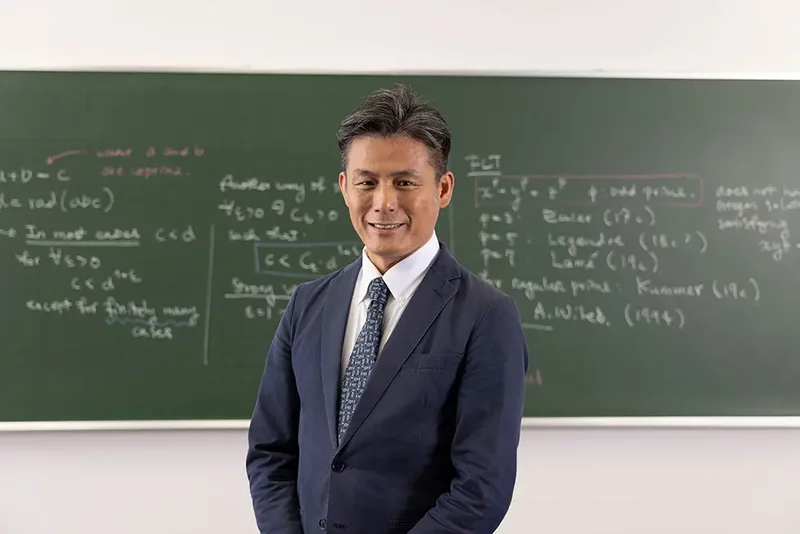
What does calligrapher Taku Kosugi, who is active in a wide range of fields, consider to be “calligraphy”—an art form that reveals the essence of words and their context? In this column, with the aim of identifying future trends in tourism and travel as well as signs of change (i.e., the seeds of new tourism), we present “exploration reports” (i.e., interview transcripts) featuring leading experts from various fields beyond just the travel industry. We spoke with Taku Kosugi, a calligrapher who is active in a wide range of fields, including solo exhibitions, teaching classes, community design for local areas and companies, and performance activities overseas.
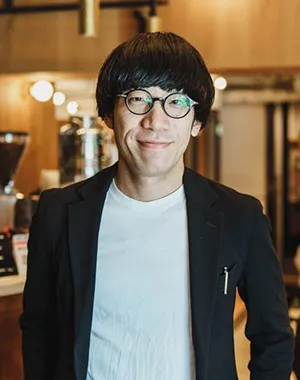
Born in 1990 in Kanuma City, Tochigi Prefecture. Graduated from the School of Liberal Arts at International Christian University (ICU). Began studying calligraphy at his grandmother’s calligraphy studio and has since studied under Kan’do Chijima and Kazuo Tsurumi. From 2017 to 2018, he lived in Paris to further his studies. He is currently based in Kamakura, where he runs “Calligraphy Studio Kamakurayama.”In addition to exhibiting her work and providing design services, she performs live calligraphy demonstrations and conducts lectures and workshops at museums and universities both in Japan and abroad. In recent years, she has been working on “Between Sound and Words,” a stage performance that explores the interplay between music and language. Beyond her artistic practice, she appears in corporate commercials, conducts workshops, and handles logo design and event planning.
The Allure of Calligraphy: Moving Hearts and Inspiring Others
Explorer Squad: After graduating from university, Mr. Kosugi was also active at Microsoft Japan, but why did you decide to pursue the path of calligraphy in the first place?
Mr. Kosugi: I started calligraphy at my grandmother’s calligraphy class. I’ve loved it since I was in elementary school and always intended to keep practicing it as I got older. Back then, my approach to calligraphy was simply to copy the models and win prizes in competitions, but the Great East Japan Earthquake in 2011 was the turning point that drastically changed my purpose. I was a university student at the time and visited an evacuation center in Ōtsuchi Town, Iwate Prefecture, as a disaster volunteer. During a casual conversation about hobbies, I happened to mention calligraphy. Someone then asked me, “Since you’re here, could you write something for us?” That was the first time I faced the challenge of creating a piece without a model. When I visited Ōtsuchi again and brought my work with me, the person who had requested it was overjoyed. I was both delighted and surprised to realize that “calligraphy can move people’s hearts through words. ”After graduating from university, as I held exhibitions, collaborated with companies, and gained more supporters, I began to feel that I wanted to delve even deeper into calligraphy right here and now.
Explorer Squad: When you were commissioned to create your first “work without a model” at the evacuation center, what were you most mindful of as you worked on it?
Mr.Kosugi: This is something I still consider very important when creating my work. First, I thought about what the “most important words” might be for the person who asked me, and how I could express them through my calligraphy. The people who gave me the opportunity to create this piece were part of a local traditional music group; even as the town was buried in rubble, they continued practicing their music.As I listened to their stories about the connection between the traditional festival music (Shishiodori) cherished in that area and the community itself, I gradually settled on a theme. The piece is titled “Shikimei.” For instance, the character for “deer” (鹿) is written in an ancient style reminiscent of pictographic characters—oracle bone script. Since classical texts contain a wide variety of calligraphic styles and forms, I consulted calligraphy dictionaries to explore the origins and history of characters as they’ve been written over time. I approached the work by reflecting on the legacy accumulated in the past and the reality before my eyes today.
Explorer Squad: Even after deciding on the words and calligraphic style to express, I imagine there are various methods of expression, such as the choice of washi paper or how the ink bleeds. How do you decide on these details?
Mr.Kosugi: There are two approaches: sometimes I have a fairly solid plan before I start writing, and other times I make changes as I go. Even if I have a rough idea of how much blurring will bring the piece closer to what I originally envisioned, the materials are living things—both the washi paper and the ink change depending on temperature and humidity. There are many types of bleeding that only appear during this season, so I pay very close attention to that. You can buy washi paper in Tokyo, but if I go to Tosa, for example, and choose paper unique to that place, it changes my sensibilities and how I approach my work.
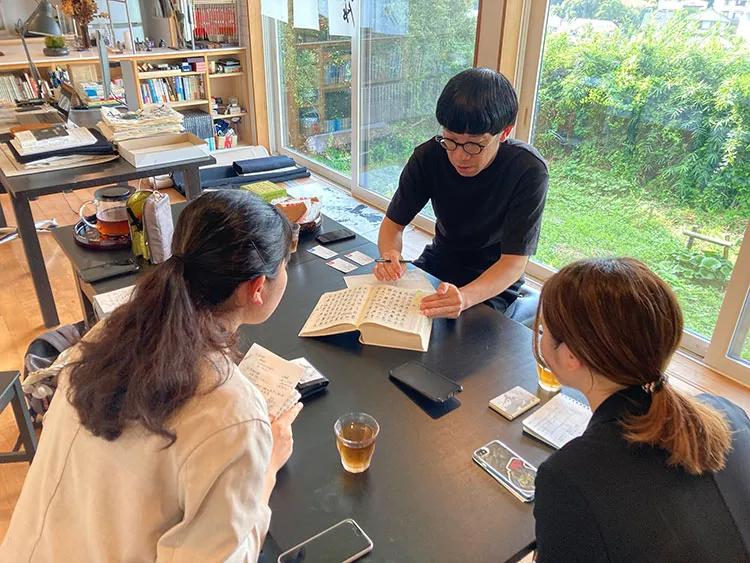
Calligraphy is about revealing the background of “words,” and it is, after all, just one means to an end
Explorer Squad: I felt that at the heart of your creative process, Mr. Kosugi, lies “words” and how to express what lies behind them. What do you value most?
Mr.Kosugi: I believe what I want to cherish most is, after all, “words.” I want to devote all my energy to figuring out how to derive the words that are appropriate for a given situation. When I do that, the circle that expands around what lies behind those words—what they truly mean—naturally comes into view. I want to create my work based on the idea that by gradually revealing that circle, the words at its center become more certain.
Explorer Squad: For example, do you ever preserve memories of your travels as “words” along with their context?
Mr.Kosugi: I don’t take many photos while traveling. For example, when people go to a fireworks display, many take photos or videos with their smartphones, right? While I do want to keep a record, I prefer to see things with my own eyes as much as possible—to smell the scents and hear the sounds with my body. I think what matters is how vivid an image I have of the word “fireworks” after actually seeing them. It’s the same with travel. I try not to limit my sensory input; instead, I jot down notes about what I felt in the moment, and then when I get home, I express those feelings through my work.
Explorer Squad: Mr. Kosugi, you also have experience living in Paris for a year. Did living abroad change your feelings toward or approach to calligraphy?
Mr.Kosugi: Living in Paris, I felt I was confronted with the unique nature of the Japanese language. The Japanese we speak daily consists of characters like hiragana, katakana, and kanji, and it’s a mix of words that came from China as Sino-Japanese terms and words that are uniquely Japanese. With kanji, for example, when Japanese people see the character for “deer” (鹿), we can trace it back from its origins to the image of a deer itself. In English, it’s “Deer”—a combination of sounds. Japanese packs a tremendous amount of information into a single character. This also changes one’s perspective: whether to view the characters as paintings or as symbols. I felt the difficulty of conveying calligraphy to people unfamiliar with Japanese, and I think it would be fascinating if I could successfully convey that.
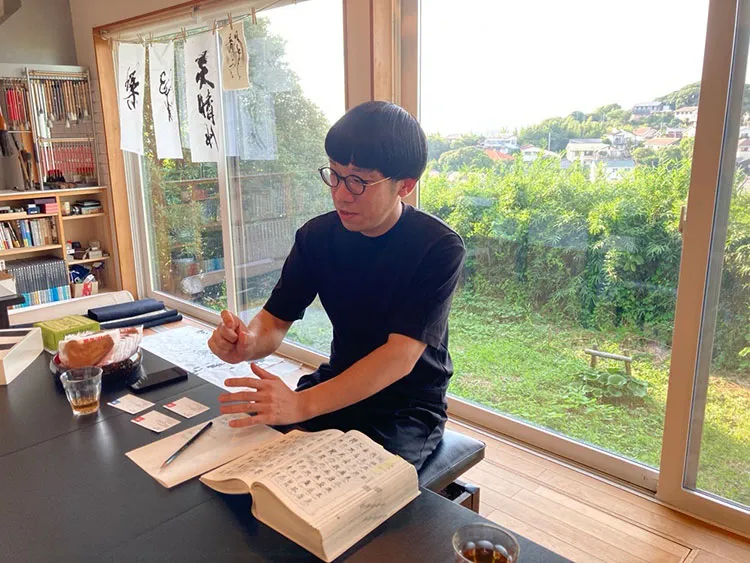
Explorer Squad: So you’re saying that the way things are expressed changes depending on the language. Mr. Kosugi, you also provide consulting services for regions and companies through “MATCHA,” a media platform for foreign visitors to Japan. In that context, are there situations where your perspective on the “language” of calligraphy has been helpful?
Mr.Kosugi: It’s not necessarily true that attracting a large number of tourists to a region will make that region or company happy. So, in my projects, I prioritize understanding how the region or company wants to engage with international visitors, what kind of future they want to build, and what they want to convey. Personally, I also aim to create and convey “words that truly convey one’s intentions.” I see calligraphy as just one means of expression. Whether writing with a brush or pencil, typing on a keyboard, or posting on social media—the moment you express the words you hold within yourself through any medium, I believe that becomes your personal “calligraphy.” I sometimes hold calligraphy workshops for communities and companies. Through calligraphy, I ask participants to describe the image and meaning behind a specific word, or to reflect on what that word means to them personally. I believe this approach helps reveal the essence of the matter.
The various thoughts that will be conveyed and should be conveyed through calligraphy in the future
Explorer Squad: Through calligraphy workshops, you’re helping people of all ages—from children to adults—reflect on the essence of “words.” What do you think the future of calligraphy will look like five years from now?
Mr.Kosugi: It’s not necessarily all positive visions for the future. Currently, everyone learns calligraphy in elementary and junior high school, right? I think that’s a wonderful thing, but with the current teaching methods that prioritize “correctness,” I can’t help but feel that not many students end up developing a genuine love for calligraphy. Of course, writing characters correctly and beautifully in Japanese is extremely important, but when they’re marked with a red pen, they inevitably end up feeling like they’ve made a mistake. On the other hand, in high school elective classes, the focus shifts toward deepening an appreciation for beauty as an art form. I want to convey much more strongly to elementary and junior high school students that there are all kinds of worlds beyond words and characters.
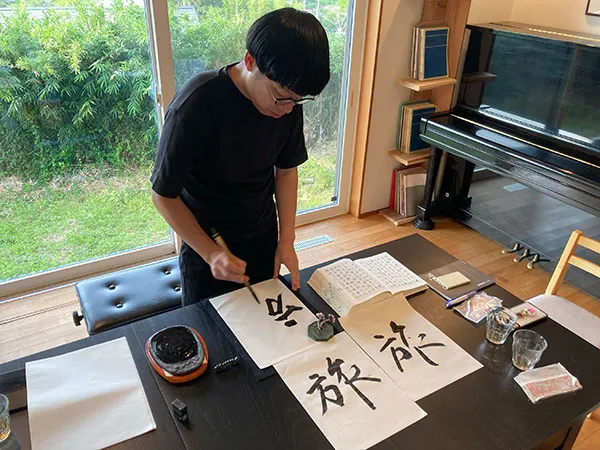
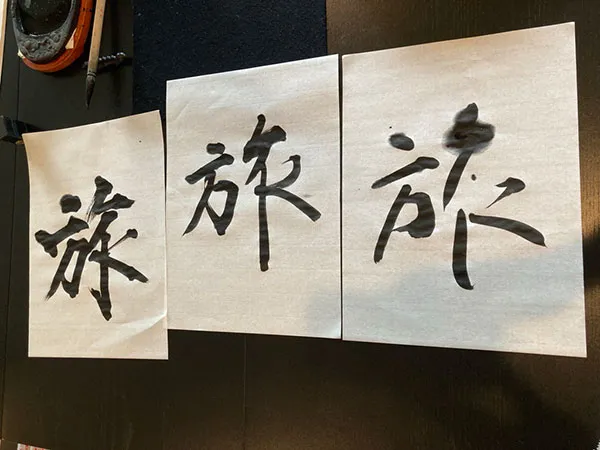
Even with the same character, “travel,” different writing styles can express different meanings.
Explorer Squad: Calligraphy has so much to offer—the history of the characters, the writer’s intentions, and much more—yet we rarely have the chance to learn about that background. It would be wonderful if there were opportunities during our travels to experience that context firsthand.
Mr.Kosugi: Old buildings often contain many examples of calligraphy and stone monuments, don’t they? I think it’s important to ask questions like, “Why is this particular phrase here?” or “Who wrote this? ”Throughout history, stone is probably the medium that has preserved data the longest. I doubt that the things we save on computers or in the cloud will still be around 4,000 years from now. While we’ve become able to efficiently produce large amounts of text today, I think it’s worth asking ourselves once again: are these really the words we want to preserve? I believe travel offers a great opportunity to encounter those precious words that have been preserved in this way.
Explorer Squad: Mr. Kosugi, is there anything you’d like to take on through “calligraphy” five years from now?
Mr.Kosugi: I’m thinking of incorporating calligraphy into the fashion industry. I think it would be even more interesting if the clothes walking the runway at Paris Fashion Week or similar events had words on them. For each brand, I’d listen to the vision behind the pieces they’re creating. Only after aligning what they want to express through their clothes with what I want to express through my words would I decide whether the best approach is to sew the text onto the garment, print it, project it, or write it live on the spot. First, I need to build relationships strong enough to facilitate that alignment, and I hope to develop a “personal calligraphy style” that can hold its own against the world of fashion.
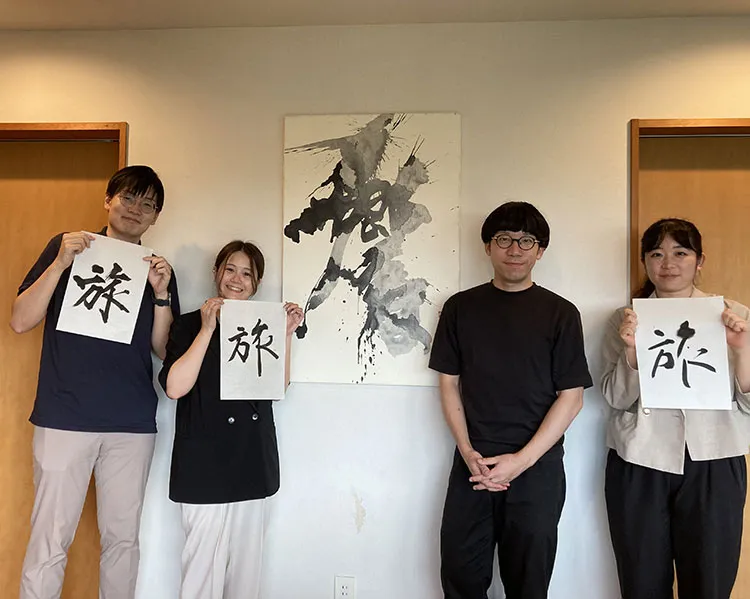
The “Seed” I Found on This Journey
What I discovered on this journey was that calligraphy is merely one means of expressing words and the context behind them. In our daily communication as well, I was reminded anew that it is crucial to decipher the context behind the other person’s “words” and discern their essence, while at the same time conveying that understanding through the means available to me. Also, while I often find myself trying to capture beautiful scenery in photos during my travels these days, if I could record the events of that moment as “words” along with what I felt through my five senses, I might be able to preserve and express even more wonderful memories.
著者