
An Interview with Diorama Artist MAJIRI: What Travel Will Look Like Five Years Ahead
What does diorama artist MAJIRI hope viewers will experience through his dioramas? In this column, we present “exploration reports” (interviews) with leading figures from various fields—beyond just travel—with the aim of identifying future trends in tourism and travel, as well as capturing signs of change (i.e., the seeds of new tourism). This time, we spoke with MAJIRI, a “diorama artist” who creates realistic scenes at a 1/150 scale and shares the appeal of dioramas and urban landscapes on platforms like YouTube.

Born in 1998. Hails from Yokkaichi City, Mie Prefecture. Majored in architecture and civil engineering at Wakayama University. After joining a diorama production company where he was in charge of miniature design, he became an independent diorama modeler in 2022. Currently, at his studio, Cityscape Studio, he creates numerous realistic urban dioramas, such as the “Shibuya Scramble Crossing,” and shares his creative process on YouTube.
The Turning Point That Led Me to Diorama Making
Explorer Squad: Thank you for joining us today. First, could you tell us a little about what you do for a living?
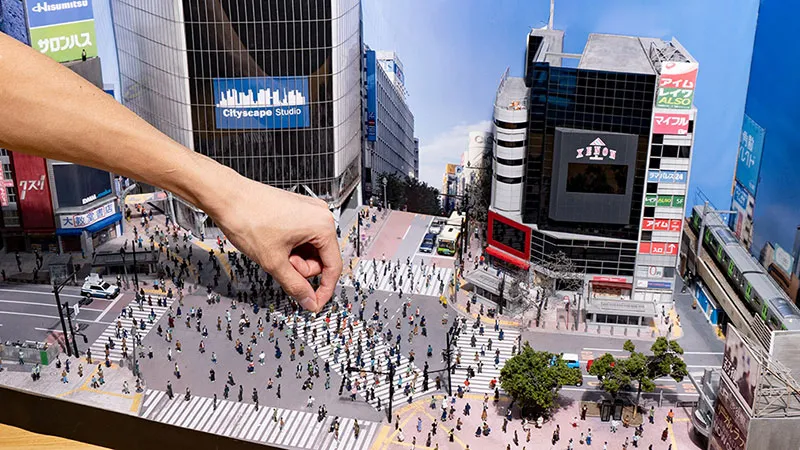
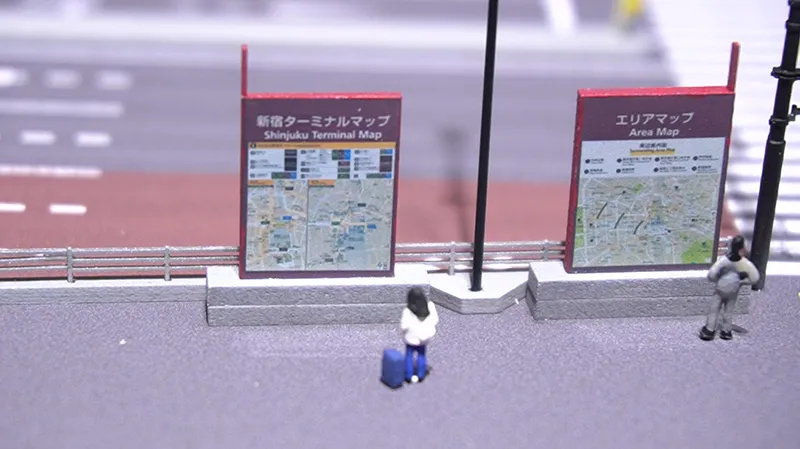
Mr. MAJIRI: My work centers on diorama creation. As for the content of the dioramas, I often create pieces based on urban settings. For example, I’ve recreated and built models of Shibuya’s Scramble Crossing, the south exit of Shinjuku Station, and, in the Kansai region, Kobe Sannomiya Station. I also post videos of the creation process on YouTube as part of the package. Additionally, I frequently create and deliver dioramas upon request from companies, such as model train manufacturers. Recently, I was commissioned by a film production company to build a movie set.
Explorer Squad: Thank you. What prompted you to start creating dioramas?
Mr. MAJIRI: I started in earnest four years ago, when I was a senior in college. I was studying architecture, but I was mainly focused on building solar cars for my club activities. However, in 2020, the COVID-19 pandemic hit, and I couldn’t go to school anymore, so the club had to suspend its activities. With all that free time on my hands, I was thinking about what to do when I remembered my childhood love of trains and cityscapes, and that’s when I came up with the idea of making dioramas—something I could do on my own at home.
The "Everyday Life" I Infuse into My Dioramas
Explorer Squad: From here on, we’d like to ask MAJIRI about your philosophy behind diorama creation. Are there any particular points you keep in mind when creating them?
Mr. MAJIRI: It’s about creating scenes from everyday life. When you travel and encounter unfamiliar landscapes, you feel their charm—that’s the extraordinary. But I believe there’s plenty of charm hidden in the ordinary, everyday scenery. That’s my philosophy. I want to convey that “charm of the everyday” through my dioramas. That’s why I deliberately create scenes everyone is familiar with. Also, dioramas allow you to view the city from angles and perspectives you wouldn’t normally see. Like realizing, “There was actually a train running right beneath my feet as I walked,” or “I didn’t know this building was here.” I strive to create works that encourage new discoveries in these everyday scenes.
Explorer Squad: So, the underlying idea was to help people discover new charm by viewing “everyday life” from a different perspective. Was the motto “Preserving Heisei-era landscapes through dioramas,” mentioned in the introduction on MAJIRI’s website, also born from that sentiment?
Mr. MAJIRI: That’s right. I was born in the Heisei era, so the scenery I’ve seen is that of the Heisei era. But Heisei ended six years ago now. I feel that the scenery from that time will continue to disappear, and in fact, redevelopment in places like Shibuya and Shinjuku has been quite noticeable lately. Also, many of the works by artists famous for dioramas today depict the Showa era, and surprisingly few focus on the Heisei era. So, I want to preserve the landscapes of the era in which I was born and raised by creating dioramas myself. Plus, I’m convinced that a “Heisei nostalgia” trend is bound to come along someday (laughs). So, by creating these now, I hope people will appreciate their value when that time finally comes.
Explorer Squad: So you create dioramas to preserve the everyday scenery of your own life, MAJIRI-san. What kind of perspective or skills are necessary for this kind of work?
Mr. MAJIRI: There are two essential things. The first is the ability to observe your surroundings on a daily basis. It’s about keeping little scenes in mind as you go about your day. My hobby is riding my bike all over Tokyo, and I use quiet times when there aren’t many people around to observe my surroundings and look for interesting places and objects. I also pay close attention to the characteristics of each area. For example, I make sure not to overlook details that give a place its unique character, like road signs or the color of the asphalt. If those details are different, the whole atmosphere changes. That kind of observational eye is important. The second is technical skill. You need technical expertise to accurately express the characteristics of a region. I use 3D CAD (a tool for designing three-dimensional objects using a computer) to design the buildings and figures I want to place in the diorama, and then print them out using a 3D printer. I also paint them after printing, and since urban areas tend to be quite dirty, I think the technical skill to recreate that kind of realism is also important.
Explorer Squad: When designing in 3D, do you go to the site to measure the buildings?
Mr. MAJIRI: I do take photos on-site, but I almost never take measurements. I calculate the dimensions by cross-referencing information from Google Earth and Google Maps Street View. It’s surprisingly little-known, but Google Earth displays building heights, which is incredibly convenient.
Explorer Squad: I’m surprised to hear you calculate dimensions that way. So, is there anything you’d like to focus on to further improve the quality of your work in the future?
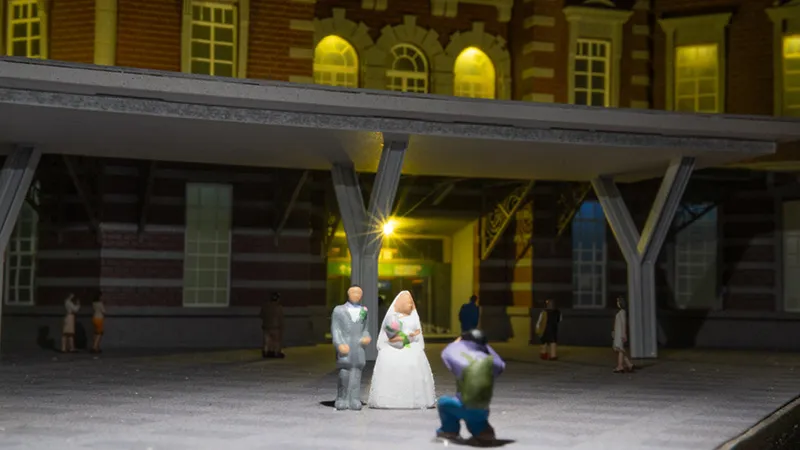
Mr. MAJIRI: I’d like to focus even more on creating a sense of narrative in my work. For example, lately, many people have been doing photo weddings in front of Tokyo Station, right? By expressing those kinds of situations through the design and placement of the figures, I want viewers to feel the stories of the people and the city within my work. Also, a common reaction from people who see my work at events is, “I always walk here like this,” or “I used to pass by here all the time back then.” I want to create works that evoke those personal stories in the viewers themselves. As for the overall direction of my diorama creation moving forward, I aim to position them as works of art. Currently, dioramas tend to have a strong character as educational materials that explain facts, much like those displayed in museums. While I certainly believe this role is important, I want to create works that go beyond that—works that stir people’s emotions and move them. To achieve this, it will be essential to weave narrative and meaning into my pieces. I am currently working on improving my expressive and directorial skills to make this happen.
The Potential of Dioramas and the Future of Travel
Explorer Squad: From here, we’d like to ask about the relationship between dioramas and travel/tourism. What possibilities do you see for their use in tourism?
Mr. MAJIRI: Recently, a visitor at an event I exhibited at told me they bought a house in the area after seeing my diorama (laughs). According to them, seeing the diorama was the first time they’d even heard of the place. While I’ve focused on the charm of everyday scenery, I realized that diorama creation could also serve the role of conveying landscapes people haven’t yet seen. I believe that by creating works packed with the appeal of a region, there may be a path toward revitalizing local areas and utilizing them for tourism.
Explorer Squad: Do you have any specific ideas for how dioramas could be used for tourism?
Mr. MAJIRI: I think there are two main ways to incorporate dioramas into travel and tourism. One is to recreate a region in a diorama and hold exhibitions in urban areas like Tokyo. The idea is to use this to promote the region and spark people’s interest. The other is to install dioramas in the region itself, enhancing the satisfaction of the on-site experience by adding new discoveries to people’s memories of the local scenery. I believe dioramas can serve as a catalyst for people to visit rural areas.
Explorer Squad: Regarding your enthusiasm for getting people to visit rural areas, was there a specific trigger that sparked that passion?
Mr. MAJIRI: I’m originally from Yokkaichi in Mie Prefecture, but I felt that the charm of the Yokkaichi I know wasn’t really reaching a wider audience. I’d always wanted more people to know about it, but I couldn’t think of an effective way to do so, so I hadn’t taken any action. However, once I started posting on YouTube, I finally began to realize there was something I could do, and that’s when I started thinking about using dioramas for tourism.
Explorer Squad: Thank you. What do you think is the appeal of travel, MAJIRI?
Mr. MAJIRI: Of course, there’s the joy of encountering unfamiliar landscapes that are a world away from everyday life. But beyond that, I believe that discovering new scenery helps you rediscover the charm of the place where you live—your “everyday life”—and that, to me, is the true meaning of travel.
Explorer Squad: Finally, MAJIRI, what do you think travel will look like five years from now?
Mr. MAJIRI: Recently, with the growing influence of YouTubers, I feel that more people are turning their attention to things that weren’t widely known before. The same applies to travel. I think that in five years, people will start focusing on more niche locations—such as areas that weren’t previously recognized as tourist destinations. I feel that the future of travel lies in the diversification of travel purposes and destinations. Personally, through my diorama creations, I hope to share the charm of various landscapes and provide new travel destinations for others. In particular, since about half of my YouTube viewers are from overseas, I hope to create new travel destinations for many people, regardless of nationality.
The "Seeds" I Found on This Exploration
In my conversation with MAJIRI, who creates urban dioramas, I strongly sensed a deep connection to “everyday life.” The idea that observing from a different perspective through dioramas can change how we perceive “everyday life” is something I believe applies to travel as well. Experiences of the “extraordinary” or “unfamiliar” during travel serve to highlight “everyday life” even more, providing an opportunity to re-evaluate it anew. In today’s world, where the pace of change is accelerating, why not take a moment now and then to look anew at the familiar scenery right in your neighborhood?













