
An Interview with Designer Seishiro Masutani: What Travel Will Look Like Five Years Ahead
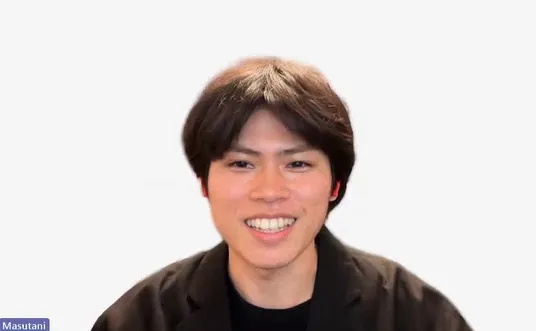
What does Mr. Masutani, a designer active in a wide range of fields, consider to be the imagination needed to arrive at the optimal solution? In this column, with the aim of identifying future trends in tourism and travel and capturing signs of change (i.e., the seeds of new tourism), we present “Exploration Reports” (i.e., interview transcripts) featuring leading experts from various fields beyond just the travel industry. This time, we spoke with Seishiro Masutani, who solves challenges for various companies through design.
We provide end-to-end design services, from planning and prototyping to mass production and operation. We have won numerous design awards both in Japan and abroad, including the iF Design Award and the GOOD DESIGN AWARD BEST 100. We are currently expanding our work into the field of healthcare and design.
The path I chose to gain freedom as a designer
Explorer Squad: What kind of work are you currently doing as a designer, Ms. Masutani?
Masutani: Primarily as a designer and planner, I handle planning, visual design, and communication design for corporate products, magazines, websites, and more. It involves working closely with companies to develop concepts and sales strategies from the ground up.
Explorer Squad: You graduated from the electrical engineering department of a technical high school and worked as an engineer at an automaker, right? After that, you enrolled at the Tokyo Designplex Institute to study design. What made you decide to pursue a career in design?
Masutani: I’ve always enjoyed drawing and painting. When I was working at the automaker, many of my colleagues quit their jobs to become photographers or went to school to learn fashion design. That really inspired me to eventually take on a challenge in a field I loved, so once I had saved up enough money, I decided to pursue a career in design. But at first, I didn’t understand design at all—I was like, “What even is design?” I was more into the art world, painting whatever I liked, collaborating with friends on projects like installations (*1) and messaging campaigns, and even organizing our own exhibitions. *1 Installation: An art form in which objects or devices are placed in a specific indoor or outdoor space to compose, transform, and alter the environment according to the artist’s intent, allowing the entire location or space to be experienced as a work of art.
Explorer Squad: After graduating from the Tokyo Designplex Institute, did you go on to launch your current design unit, “SANAGI design studio”?
Masutani: When I moved to Tokyo, I started living with a friend I’d met through fashion and music while working at a manufacturer. Although he works in a slightly different field, we shared a common interest in design, so after graduation, we started out by making things together to earn money.
Explorer Squad: I imagine there are various constraints when working at a typical design firm. Is there anything you can do specifically because you created your own organization?
Masutani: If I were working at a company, I probably wouldn’t be able to come up with ideas this freely. But lately, I’ve been thinking a lot about how “while I have the freedom to choose what to do and what not to do, I’m not really free.” When I was a company employee, I had this image that being a freelancer must be really free and great, but I’ve come to realize just how much effort you have to put in behind the scenes—like doing sales—to actually gain that freedom. I often think about how I would survive if I were stranded on a deserted island. In that situation, I believe the people who would ultimately survive are those who have the technical knowledge to work with wood or know how to catch fish. Similarly, I was very interested in how we would make a living without the “company” title and in generating our own revenue, so I deliberately chose this path.
How to imagine the user and find the optimal solution through design
Explorer Squad: So you’re deliberately choosing that challenge. What kind of design work is SANAGI design studio currently engaged in?
Masutani: We often partner with companies that want to leverage their core strengths—for example, collaborating with printing companies to create B2C products using their printing technology, or teaming up with sewing and traditional craft firms to develop new products using their sewing techniques. We’ve entered design competitions in the past, and those connections often lead to companies being introduced to us.
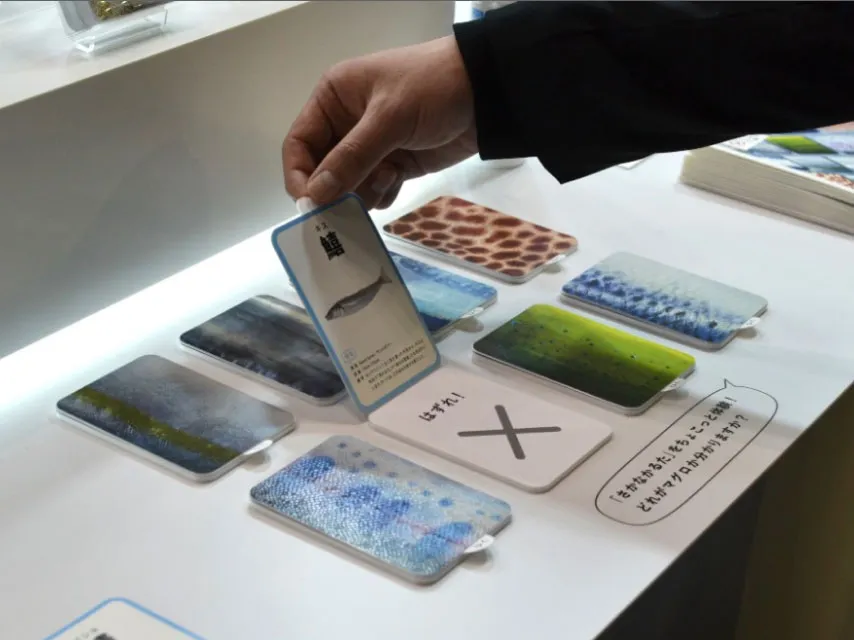
Explorer Squad: You’re referring to the “Sakana Karuta” that won the Good Design Award, right?
Masutani: That’s right. We were stuck at home with just the two of us right in the middle of the COVID-19 pandemic, and we really had nothing to do. We started wondering if there was anything we could create, so we submitted entries to various competitions just to test our skills. That’s how we ended up winning the award.
Explorer Squad: So, why did you decide to create a fish-themed karuta set that realistically replicates the look and feel of a fish’s skin?
Masutani: This might not sound very interesting when I say it… (laughs), but at the time, we just wanted to make the most of the printing company’s technology. Out of the roughly 200 ideas we came up with—which we submitted in droves—that was simply the optimal solution. It wasn’t because we particularly liked fish. The two of us would write all sorts of things on a whiteboard, using brainstorming techniques to expand our ideas. From there, we’d say things like, “This is interesting,” or “What if we developed this further?”Since the theme was already set, we carefully planned everything within that framework—the available resources, the budget, the circumstances of the COVID-19 pandemic, and how to leverage the company’s strengths moving forward.
Explorer Squad: So you developed the design while considering marketing strategies, such as researching the external environment and planning product and pricing strategies. What was the deciding factor in ultimately choosing “Fish Karuta”?
Masutani: Price and feasibility were factors, but whether the children of people close to us would enjoy it, and whether we could picture their faces, were also key elements. I think it’s easier to decide when you can conjure up that kind of image. In the end, we all agreed that this was the only option. Another major factor was how much fun we ourselves could have with it.
Explorer Squad: So you place a lot of importance on expanding your imagination regarding the customer’s challenges and the people who will use the product. You’ve also released other wonderful works, such as “Fossil Find,” an interactive picture book and sticker set where fossils appear when illuminated by a blacklight. Is there a particular project that Masutani-san found especially enjoyable?
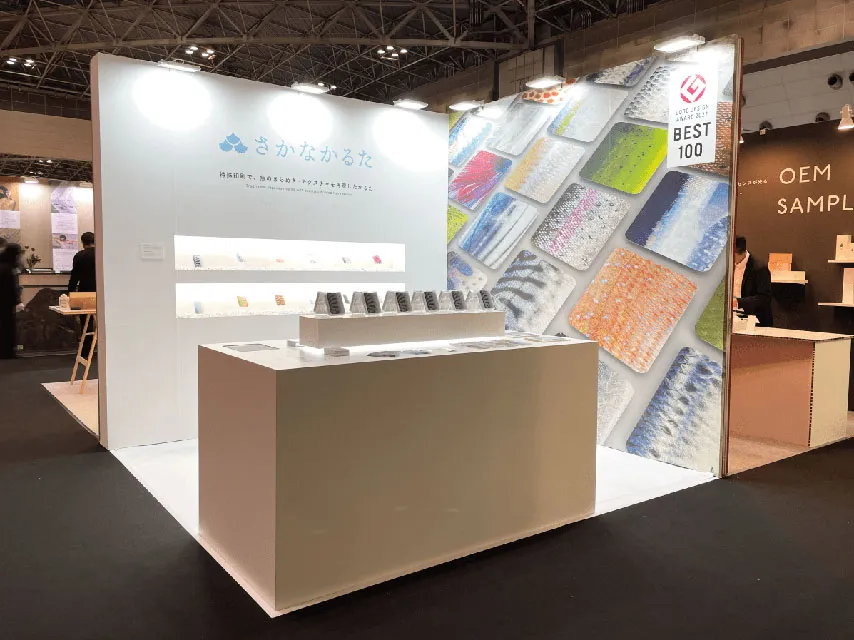
Masutani: We exhibited “Fish Karuta” at a gift show. Designing the booth layout for that event was really interesting. It’s not just about making the product—you also have to think about how to promote it. With “Fish Karuta,” we considered how to incorporate the exhibition design into the user experience and how best to convey its appeal. First, I came up with a catchphrase to grab people’s attention at a glance, printed it on a 3m x 3m wall to create an impact, displayed all the varieties side by side like in an Apple showroom, and created a space where visitors could actually interact with the products at the booth. I also included samples of products with manufacturing defects—the kind the general public wouldn’t even notice—in the pamphlets we distributed, so people could continue the experience even after taking them home.
Explorer Squad: So you’re designing not just the products themselves, but also the spaces for events and the sales approach. Are there any other challenges you’d like to take on as a designer in the future?
Masutani: I’m interested in the intersection of healthcare and design. In the medical field, there’s a reality where people don’t think about their future even though it concerns them personally. What we’re focusing on is health as it relates to the “pet-human” relationship. Since this is an area where design hasn’t really been incorporated yet, I’d like to take on the challenge of figuring out how to become healthy while having fun, under the theme of “Happy & Healthy.”
The Extraordinary Experiences We Want to Seek Through Travel, Especially in These Times
Explorer Squad: Let’s talk about travel now. Do you travel often, Mr. Masutani? Do you find yourself thinking about design when you’re traveling?
Masutani: I don’t travel all the time, but I do go overseas once or twice a year. Last year I went to Indonesia, and this year I went to Vietnam. It’s not exactly a professional habit, but I do notice the differences in design between Japan and other countries. I really notice things like, “They wouldn’t design a store like this in Japan,” or “The paper cups at the art museum have an interesting shape,” or “The spout on the takeout coffee cup is totally different. ”The shops in Bali, Indonesia, use bamboo for their interiors and are full of natural elements, so when I came back to Japan, the store interiors here felt a bit artificial (laughs).
Explorer Squad: Designs that make full use of nature are wonderful. Mr. Masutani, what is your main purpose for traveling?
Masutani: Simply put, my goal is to learn about things I don’t know. Basically, I don’t go with a set plan. I usually decide on a general destination and book a hotel for the first night, but I often don’t make plans beyond that. I like that sense of spontaneity—I actually go out of my way to create those unexpected happenings. It’s fun, in a way—I like testing myself to see how I’d handle being in a tight spot while experiencing something out of the ordinary. Once, when I was traveling without cash, I couldn’t make it to my next hotel, but a Japanophile who happened to be passing by gave me a ride there. I really enjoy those kinds of coincidences.
Explorer Squad: I get the sense that more young people these days—and people like you, Mr. Masutani, who are looking to develop their personal growth—are taking these kinds of unplanned trips. What do you think travel will look like five years from now?
Masutani: I’ve been thinking about that a lot too. The recently released Apple AirPods Pro 3 come with real-time translation capabilities. Seeing technological advancements like that, I get the feeling that travel will become much more convenient in the future. But since I think the inconvenience of travel is part of what makes it fun, I suspect we’ll see more people deliberately choosing trips that embrace that inconvenience. I had the chance to talk with a woman in her 80s the other day. She mentioned that the kind of “travel to undeveloped regions” that people of her generation used to go on when they were in their 20s is something we can’t go back to now—places where there really was nothing there. I find myself envying that experience. Nowadays, we have things like farm stays, but there’s a mindset where people are willing to pay just to have that kind of experience.
Explorer Squad: So, precisely because we live in such a convenient modern age, people want to experience the extraordinary through travel—to taste a world that’s completely different and unimaginable.
The “Seed” We Found on This Expedition
What we discovered on this expedition was a combination of logical thinking and imagination—the ability to deeply empathize with others and design optimal solutions to their challenges and needs. These activities—ranging from product design like “Sakanakaru” to spatial design such as booth planning, and future ventures into the medical field—can truly be described as regional design that contributes to society as a whole. And isn’t it precisely because we live in this era that we can hone our imagination even further by placing ourselves in situations where we are compelled to exercise our creativity within extraordinary spaces?
著者













