
Starting a Small-Scale Plant Factory - A Conversation with Mr. Sugai: What Travel Will Look Like Five Years Ahead
What does Mr. Sugai, who is working on small-scale plant factories with the goal of making agriculture more accessible, envision for the future of food and local communities? In this column, with the aim of identifying future trends in tourism and travel and capturing signs of change (i.e., the seeds of new tourism), we present “Exploration Reports” (i.e., interview transcripts) featuring leading experts from a variety of fields beyond just the travel industry. In this installment, we sat down with Tsubasa Sugai, CEO of “Spice Cube”—a small-scale plant factory that utilizes vacant homes and unused retail spaces—to discuss his passion for agriculture, his unique business model, and the future he hopes to pass on to the next generation.
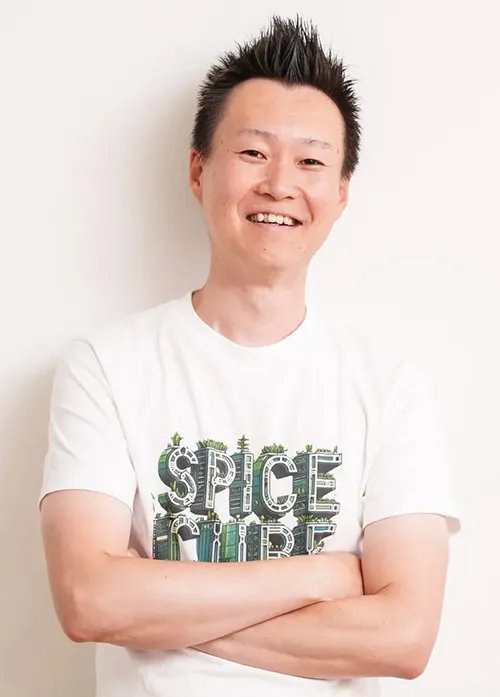
Born in Chiba Prefecture in 1983. Representative Director of Spice Cube Co., Ltd. After working as a corporate employee at a materials manufacturing company and as a part-time farmer on weekends, he experienced firsthand the challenges of being a farmer who relies on the land. Drawing on this experience, he founded Spice Cube in 2018. The company employs its own unique methods for everything from production to distribution. A self-proclaimed “agriculture geek,” he hopes to provide safe, delicious vegetables for future generations.
From Soil-Based Farming to Indoor Plant Factories
Explorer Squad: Thank you for joining us today. First, could you please introduce yourself, Mr. Sugai?
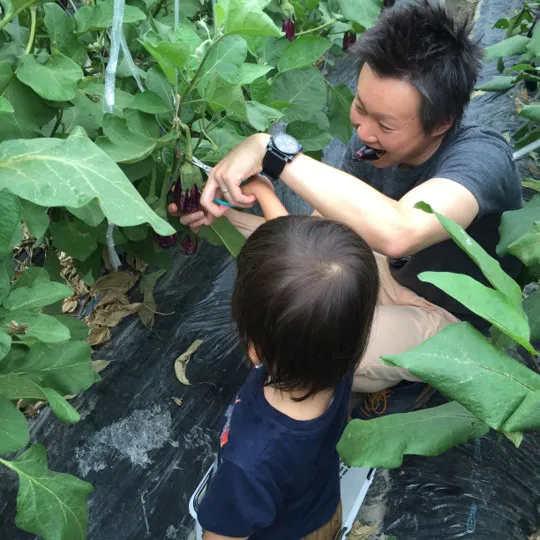
Mr. Sugai: Once again, I’m Sugai from Spice Cube. I actually started out as a part-time farmer. I’m 42 now, but I first got into farming when I was 25. For about 10 years, I worked as a salaryman during the week and a farmer on the weekends. Now, I’m an old guy (laughs) developing agricultural technology that grows vegetables indoors using water and electricity instead of soil. The reason I’m in agriculture is for the sake of the children. I’m already satisfied with my own life, but I want agriculture to continue in Japan for the next generation. I do this because I want to see delicious vegetables on people’s dining tables.
Explorer Squad: What was the journey like from being a part-time weekend farmer to launching Spice Cube?
Mr. Sugai: When I was a salaryman, I worked for a manufacturer that produced materials supporting power and telecommunications infrastructure. Since the element of “making things” has always been a part of my life, I combined that with my weekend hobby of farming to create the company Spice Cube. I have a mentor for tomatoes—an old man from Tottori—who had a huge influence on me. When the harvest was over and things were slow, he’d head to the city and spend half a year there: playing pachinko during the day, betting on horse races on weekends, and hanging out in the entertainment district at night. His wife was absolutely furious with him (laughs). He was quite a funky old guy, and I thought, “It’s great to enjoy life like that.”
Explorer Squad: Why did you choose a plant factory, where the growing environment is controlled indoors, rather than traditional soil-based farming?
Mr. Sugai: Soil-based farming is difficult as a business. First is the natural environment. It’s a daily occurrence for greenhouses to get blown away by typhoons, resulting in zero harvest, or for wild boars to ravage the fields. Second is the inability to set your own prices. What frustrated me the most was that even if I worked hard to grow delicious, pesticide-free tomatoes, they’d end up in the same box as tomatoes grown haphazardly by the farmer next door—all labeled as coming from the same region—and shipped out at the same price. It made me lose sight of why I was even bothering. That’s why I wanted to build a business where we could choose customers who truly appreciate our value and sell our produce at the price we set. A plant factory was the only way to make that happen.
Explorer Squad: Spice Cube’s plant factory is different from large-scale operations, isn’t it?
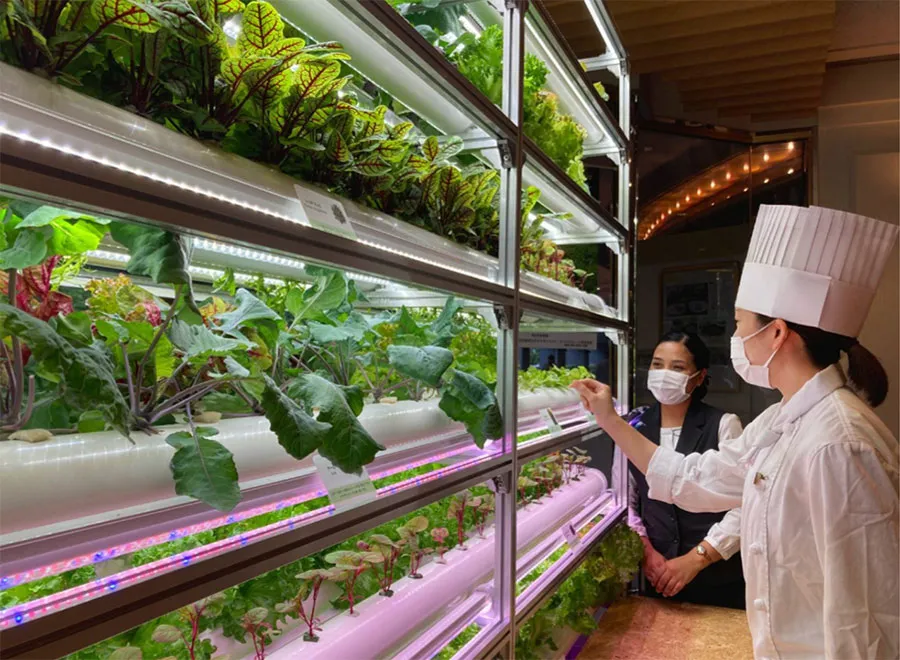
Mr. Sugai: That’s right. While the mainstream approach is to spend around 300 million yen building massive factories, we do the opposite. We utilize existing idle spaces—like vacant houses or former laundromats—to build small-scale plant factories that can be started for as little as 2 million yen. Actually, the biggest feature of this system is that it ties into the SDGs through carbon dioxide absorption. Using equipment that can sequester carbon dioxide from the air, we enable vegetables to absorb the carbon dioxide emitted from living environments. It’s a groundbreaking system that’s gentle on the planet, allowing us to contribute to carbon dioxide reduction while growing vegetables.
Explorer Squad: Does the distribution channel for vegetables harvested at the plant factory differ from the usual one?
Mr. Sugai: Yes, it is different. We mainly sell to chefs at restaurants. This allows us to keep delivery costs down, and they place repeat orders for a fixed amount every week. If we were to wholesale to retailers like supermarkets, prices might be adjusted to suit the store’s convenience.
Structural Issues in the Agricultural Industry and What Spice Cube Can Do
Explorer Squad: It’s been seven years since you founded the company. Has the business been expanding steadily?
Mr. Sugai: No, no, not at all. I worked at my previous company for 10 years and used my severance pay to start this company, but my annual income in the first year was less than 1.2 million yen. In the second year, I still couldn’t earn as much as I’d hoped, and I wondered, “What am I doing as a father?” I ended up shut in for about six months with depression. I couldn’t even talk to people. People often say, “A crisis is an opportunity,” don’t they? I don’t trust people who say that. A crisis is just a crisis. It’s only in the last two or three years that I’ve finally caught up to my highest annual income from my corporate days.
Explorer Squad: Is your company’s plant factory expanding nationwide?
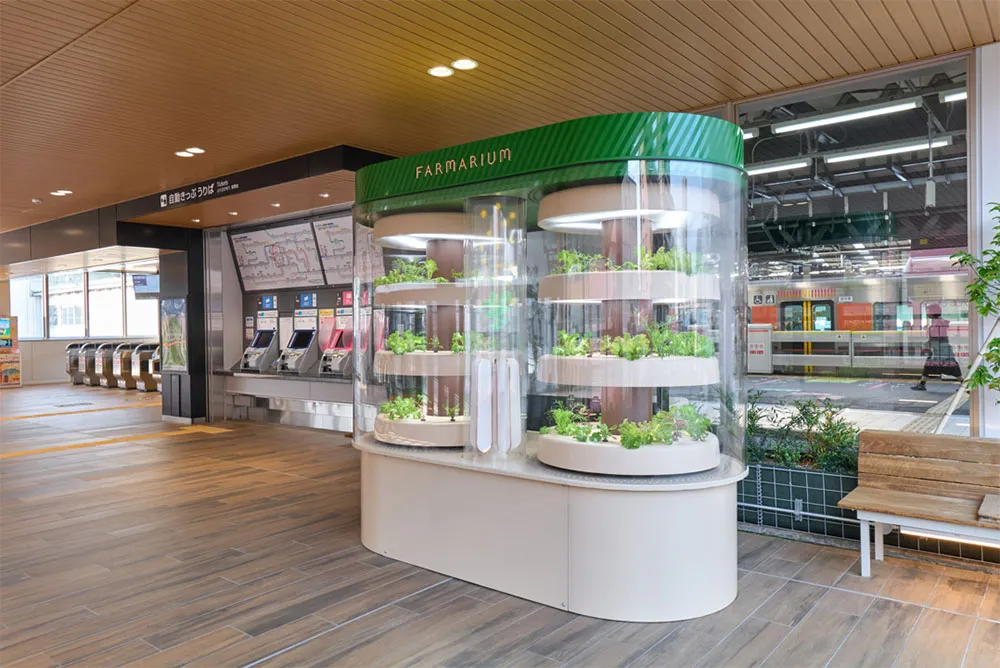
Mr. Sugai: Yes, we’ve already expanded nationwide through B2B. We have facilities in Hokkaido, and we’ve converted an entire floor of a building—one that had no buyers or sellers—into a plant factory, as well as a space inside a railway company’s building in Osaka. We’ve even set up equipment in the display windows of the Daimaru Department Store to showcase the cultivation process.
Explorer Squad: That’s amazing.
Mr. Sugai: Thank you. But what I’d like to do next is rent actual vacant homes or private residences, install our small plant factories there, and launch a service like an “agriculture subscription.” It’s like an indoor version of the “rental farms” where local governments lease out farmland. Using this as a platform, I want to make agriculture a more accessible part of everyday culture.
Explorer Squad: Mr. Sugai, you clearly have a strong desire to see the entire agricultural industry thrive. What are your thoughts on recent trends like “smart agriculture”?
Mr. Sugai: I want to see it expand, and I want the agricultural industry to get more attention. My choice is plant factories, but whether it’s drones, robotics, or whatever—I just want agriculture to thrive. Right now, the primary sector is in too much decline. In agriculture especially, the number of people entering the field is steadily decreasing because the structure makes it difficult to pursue profits. According to statistics, 100,000 farmers retire every year due to aging. By the way, how many people do you think are starting out in agriculture?
Explorer Squad: Half of that would be 50,000... or maybe around 10,000 if it’s even fewer...?
Mr. Sugai: Exactly. But if you ask whether those 10,000 will still be at it two years later, fewer than 1,000 will remain. In the summer, plastic greenhouses turn into scorching hellholes where temperatures exceed 60°C, so you have to work late at night or early in the morning. And even then, if you calculate it by the hour, you’re making only 100 or 200 yen. You can’t make a living on that. That’s why I believe we, as companies, need to create the kind of foundation that allows people to use robots and cutting-edge technology to make farming just a little bit easier—and to help them grow to like farming, even just a little bit.
Explorer Squad: That’s certainly true.
Mr. Sugai: From a broad perspective, it comes down to changing the distribution structure for agricultural products. We need to establish a culture where it’s normal to “sell at the price you want.” And from a more local perspective, we need to make agriculture feel more accessible. In our plant factories, seeds sprout the very next day after planting. I especially want children to experience that sense of wonder. The reason I’m so passionate about this is also because I feel a sense of crisis regarding food security. Japan relies heavily on food imports, but imagine if something were slipped into food imported from a country with which we have strained relations—it’s truly terrifying. Especially for vegetables eaten raw or sashimi, we absolutely must maintain the ability to produce them safely within our own country.
Explorer Squad: That’s true; “production” is becoming increasingly important. Do the people who’ve set up Spice Cube’s plant factories tend to run them as a side business? Is this small plant factory something you’d imagine setting up in a corner of a company office?
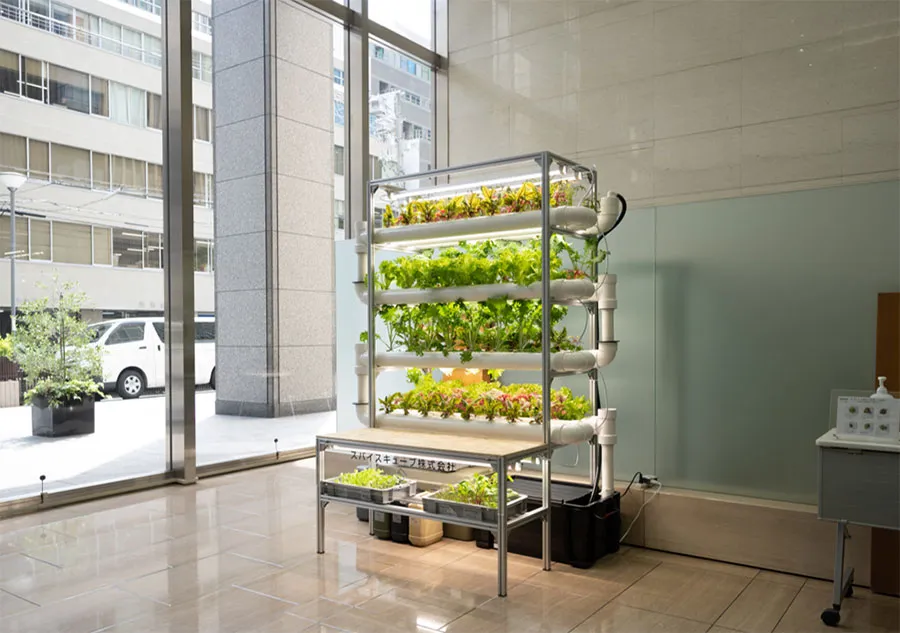
Mr. Sugai: That’s right. These days, we’re seeing more companies launching this as a new business venture, and social welfare organizations are also increasingly utilizing plant factories. Some companies set them up as an employee benefit to support their staff’s vegetable intake, while others treat it as a side business—part of the “sixth industry” model for locally grown and consumed vegetables.
Explorer Squad: On the flip side, what are the main barriers companies face when introducing your plant factory?
Mr. Sugai: Since our customers are mainly small and medium-sized enterprises, they’re very cautious about adopting our system, even though the initial cost is only 2 million yen. The biggest concern is “sales channels.” The question is, “We can grow vegetables, but where do we sell them?” We show them our sales track record through our group companies and help them develop sales channel development plans, but in the end, the real challenge is having the “courage to take on something they’ve never done before.”
What I Seek from Travel: “My Family’s Smiles”
Explorer Squad: Let’s shift the topic a bit and ask about “travel.” Do you usually go on trips?
Mr. Sugai: For the first few years after starting the company, we were in such a dire financial situation that we couldn’t go anywhere at all, but in the last two or three years, we’ve finally been able to go on family trips again. Lately, I’ve been hooked on staying at resort hotels to enjoy a break from the everyday routine.
Explorer Squad: What do you look for in a trip?
Mr. Sugai: I look for my family—especially my wife and children—to be happy. Eating foods we don’t usually get to eat, or experiencing nature in ways we can’t in Kansai. This year, we went to Nagano. The peak moments of my happiness were when I married my wife and when my children were born. I honestly don’t think there’s any happiness that could surpass those moments (laughs). Perhaps the purpose of my travels is to find those moments that make my family happy.
Explorer Squad: That’s wonderful. I imagine it was reassuring to have your family by your side during difficult times.
Mr. Sugai: That’s right.
Explorer Squad: Mr. Sugai, you’re currently working on a new initiative involving small-scale plant factories. How do you imagine your travels will look five years from now?
Mr. Sugai: I think it will be a combination of “enriching the content” and “streamlining operations.” In other words, it will be important to increase the amount of content—such as activities and meals—that leads to memorable experiences, and to make it possible to efficiently navigate through them. I hope we can make our trips even more well-planned.
Explorer Squad: I see. I imagine you’re likely planning so thoroughly because you want your family to enjoy it too. We really got a sense of your passion and the meticulous strategy behind it. Thank you so much for sharing your valuable insights with us today.
The “Seeds” We Found on This Expedition
I felt that Mr. Sugai’s challenge holds immense potential that goes far beyond a mere agricultural revolution. I feel it has presented a new solution centered on “food” for the regional revitalization efforts our company is tackling. Furthermore, the experience of growing vegetables isn’t limited to new ventures for small and medium-sized enterprises. Couldn’t it also serve as a new source of healing in the workplaces of large corporations, leading to improved employee mental health? A plant factory that enriches not only the future of food but also the hearts of people and communities, all while cherishing family. I feel I’ve caught a glimpse of a future that will continue to flourish.
著者













