
An Interview with Astronomer Kenko Tanaka: What Travel Will Look Like Five Years Ahead
In this column, with the aim of identifying future trends in tourism and travel and capturing signs of change (i.e., the seeds of new tourism), we present “Exploration Reports” (i.e., interview transcripts) featuring leading experts from a wide range of fields beyond just the travel industry. In this installment, we spoke with Mr. Noriyuki Tanaka, who is researching various mysteries of the universe through the Subaru Telescope in Hawaii.
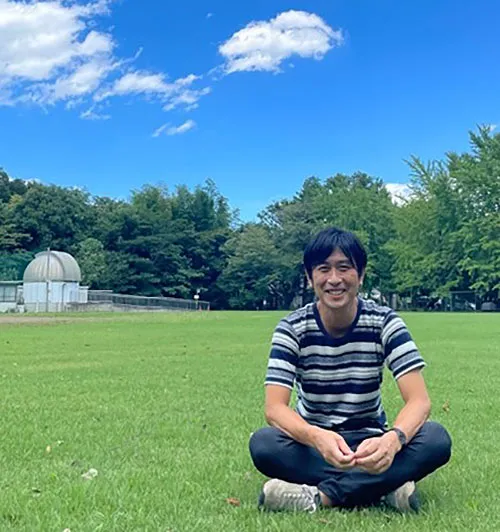
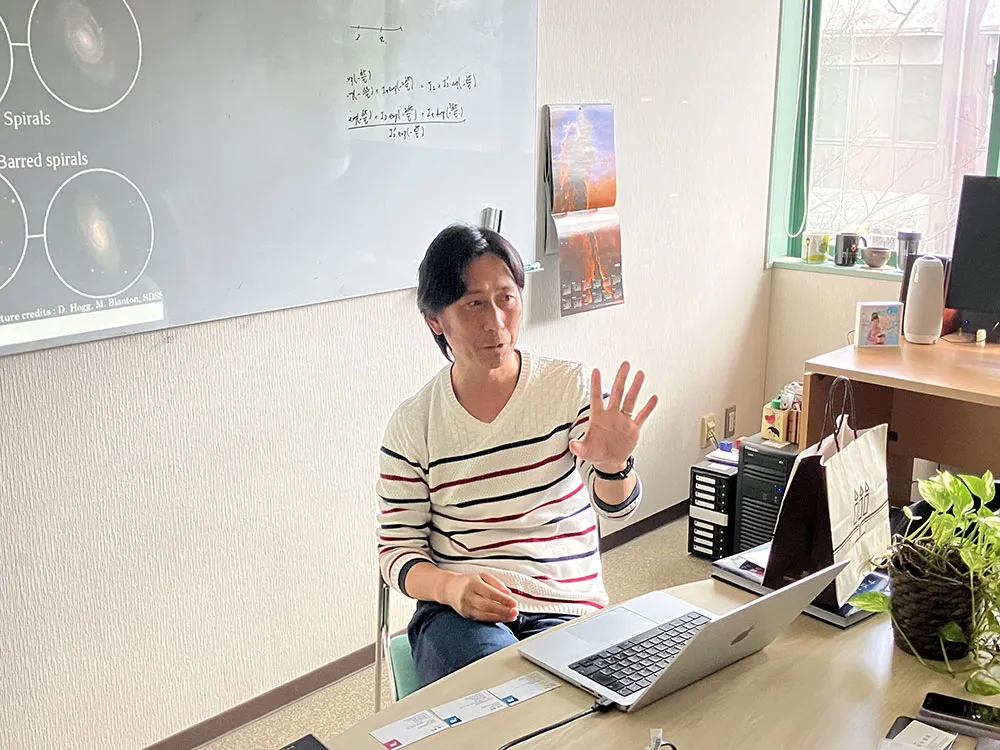
Born in 1979.Associate Professor at the National Astronomical Observatory of Japan’s Hawaii Observatory. He completed his doctoral studies in the Department of Astronomy at the Graduate School of Science, University of Tokyo (Ph.D. in Science). After serving as a Specially Appointed Assistant Professor at the National Astronomical Observatory of Japan’s Hawaii Observatory, he assumed his current position in 2018. His primary research focuses on the formation and evolution of galaxies through observational astronomy. He is also active in a wide range of fields within astronomy, including operations at the Hawaii Observatory (operating the Subaru Telescope) and leading the public astronomy project “GALAXY CRUISE.”
The Path to Becoming an Astronomer That Began with a Parent’s Mistake
Explorer Squad: Thank you for joining us today. First, could you tell us about your current research?
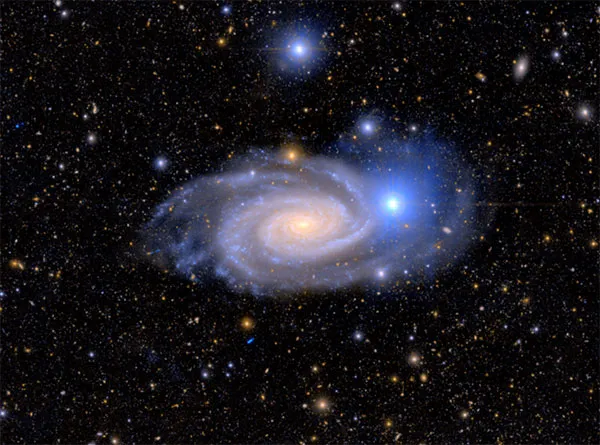
Mr. Tanaka: I study celestial objects in space known as “galaxies.” A galaxy is a massive collection of stars. As you probably know, the “Milky Way” is a massive collection of stars that forms a single galaxy called the “Milky Way Galaxy.” The Sun is also one of the stars that make up the Milky Way Galaxy. My research focuses on using telescopes to observe and understand how such collections of stars are born in the universe and how they have evolved over time.
Explorer Squad: Thank you. What initially inspired you to pursue a career in astronomy?
Mr. Tanaka: When I was in elementary school, door-to-door sales of educational materials for children were still quite common. At that time, there was a lot of excitement because Halley’s Comet was approaching Earth, and telescopes were being sold by door-to-door salespeople. My parents, for some reason, ended up buying one of those telescopes (laughs). Since we had it, they let me look at the moon through it, and I was shocked—I thought, “What on earth is this!” That was the initial spark. Thanks to my parents’ mistake, I realized how fascinating celestial objects are, and that’s how I got to where I am today.
Astronomy: A Poetic Discipline
Explorer Squad: What exactly is the field of astronomy?
Mr. Tanaka: Astronomy can be broadly divided into observational astronomy and theoretical astronomy based on methodology. My main focus is observational astronomy, which is the field of directly observing the universe through telescopes to gain insights. The “Subaru Telescope” at the Hawaii Observatory, where I work, is located at the summit of Mauna Kea on the Big Island of Hawaii, at an altitude of about 4,200 meters, and is visited by many tourists on sunset tours and the like. The Subaru Telescope can capture not only visible light, which is visible to the human eye, but also infrared light, which is invisible to the human eye. For light that is invisible to the human eye, radio telescopes like the ALMA telescope in Chile are also used. On the other hand, there is light, such as X-rays, that is absorbed by Earth’s atmosphere and does not reach the ground. To observe such light, we launch artificial satellites to observe from space. In this way, observational astronomy involves combining various observational methods depending on the wavelength of light to investigate how the universe has evolved. The other branch, theoretical astronomy, is a field that uses mathematical equations to perform computer simulations and gain insights. By incorporating the laws of physics into computer programs and using computers to calculate and recreate the formation of galaxies, we seek to understand the birth and growth of planets and galaxies.
Explorer Squad: So, astronomy isn’t just about the subject matter—the field also varies depending on the methodology. As we pursue astronomy, what kind of value can it provide to society?
Mr. Tanaka: Astronomy covers such a vast range that it’s hard to generalize, but when it comes to my specialty—galaxy research—it might be considered a “completely useless” field from a societal perspective. I know I’ll get in trouble for saying this (laughs).Even when the news reports, “A galaxy incredibly far away has been discovered,” people usually just say, “Oh, that’s amazing,” and that’s the end of it—it doesn’t make our lives any better tomorrow. So, while astronomy is part of physics, I feel that the activities we engage in are actually closer to those of literature. It’s similar to when people read a novel and everyone thinks, “That’s interesting.” We announce, “We’ve discovered a new aspect of a distant galaxy,” and the general public responds, “Oh, really? That’s fascinating.” I believe that is the value and cultural contribution astronomy can offer. On the other hand, if there is one area that will undoubtedly have an impact on society, it is the search for “extraterrestrial life.” If traces of life are found on other planets, I believe it will be a discovery with a massive long-term impact on humanity.
Explorer Squad: So, astronomy provides value by stimulating people’s intellectual curiosity. What are some current trends in astronomy?
Mr. Tanaka: One is research on “exoplanets.” The idea that there are Earth-like planets beyond our solar system, and that life might exist there, is a fascinating topic. Another is “dark matter” and “dark energy.” These are said to make up about 95% of the universe, yet their true nature remains completely unknown. The term “dark” here means “unknown.” This has been a major long-standing problem in physics and astronomy, and I believe research in this area will continue to make significant progress. Additionally, over the past two or three years, new telescopes and large-scale observation projects have been launched one after another. For example, the “Vera Rubin Observatory” has begun operations in Chile, South America. Here, they are attempting to capture “the universe as it changes over time. ”Until now, many observations were one-time events. However, the reality is that the universe is constantly changing. By repeatedly observing the same region of the sky, we should be able to discover numerous phenomena that have been overlooked until now, such as “supernovae” (exploding stars), “variable stars” (stars whose brightness changes), and active “black holes.”
Explorer Squad: Thank you. Given that trend, how do you think the fields of astronomy and space science will have evolved five years from now?
Mr. Tanaka: If asked what the situation will be like five years from now, I believe our understanding of dark matter, dark energy, and exoplanets will have deepened significantly, and the nature of a “universe that changes over time” will have become clearer. Personally, though, I find it most exciting when things happen that we don’t yet understand. It wouldn’t be very interesting if things happened exactly as we predicted they would five years from now. The true thrill of research lies in moments that surpass our imagination or when our expectations are defied. To be honest, I’d rather keep wondering, “I don’t know what will happen.”
"GALAXY CRUISE": A Citizen Astronomy Project Traveling Through Space
Explorer Squad: Mr. Tanaka, I understand you led the citizen astronomy project “GALAXY CRUISE.” Although the project concluded in 2025, could you tell us what it entailed?
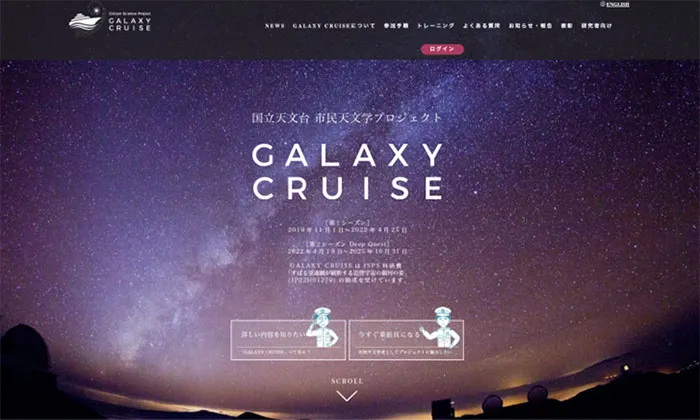
Mr. Tanaka: This project falls under the category of “citizen science,” an initiative where research is advanced not only by researchers but also with the cooperation of the general public. Specifically, it involved classifying “colliding galaxies” (celestial objects where galaxies are being pulled together by gravity, causing them to lose their shape or merge).The system presented actual images taken by the Subaru Telescope on a website, and participants used buttons to answer questions such as “Are they colliding?” and “What features can be seen?” Additionally, participants were invited to join as ship crew members, and the project incorporated game elements such as upgrading cabin classes or receiving souvenirs as they progressed with the classification.
Astronomical Observatory of Japan
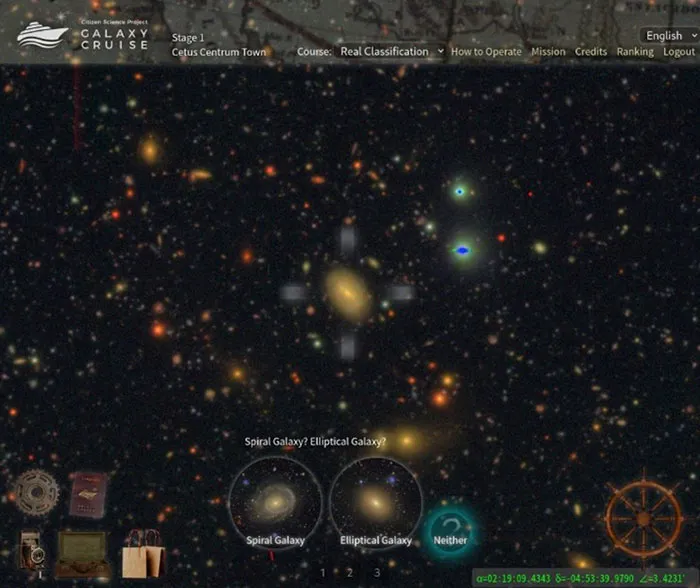
CRUISE” © National Astronomical Observatory of Japan
Explorer Squad: So you’ve incorporated game elements to make it enjoyable and sustainable even for the general public. What led you to start this project?
Mr. Tanaka: To be honest, the initial impetus was “external pressure” (laughs). During the external evaluations conducted every few years, the National Astronomical Observatory of Japan received feedback that we were “lacking in two-way communication with society.” Citizen science was cited as one example of a solution to address this. Around that time, the Subaru Telescope was equipped with a massive, ultra-high-performance digital camera called the “Hyper Supreme Cam (HSC),” which made it possible to obtain vast amounts of image data. I was conducting research on “colliding galaxies” and needed to identify them within this massive dataset, but the sheer volume of data made it impossible for me to search through it alone. That’s when I decided to ask the general public for their help. And, as I mentioned earlier, astronomy has strong cultural significance. I believe that sharing the results of our research with the general public to enhance their understanding of and interest in the universe is a major contribution to society. I felt that this project, which allows the general public to participate, would be a valuable contribution to society. That is how “GALAXY CRUISE” began.
Explorer Squad: From the name “GALAXY CRUISE” and the concept of “traveling through space,” I sensed a strong emphasis on “travel.” Was there a particular reason or inspiration behind choosing this name and concept?
Mr. Tanaka: The classification work on colliding galaxies in previous research involved endlessly repeating the process of looking at images and pressing buttons—for me, it was practically a form of spiritual training (laughs). Since people were taking the time to participate, I wanted them to enjoy it, so I decided to add the game elements I mentioned earlier. And rather than just adding game elements, I thought it would be more interesting to incorporate them within a “worldview” that participants could immerse themselves in. Looking back at the features of “GALAXY CRUISE,” we included a function on the website that lets users freely explore space, much like Google Maps. We did this with the hope that if people got tired of the classification work, they could enjoy freely navigating through the same images of space that researchers see. That’s why we adopted the concepts of “cruise” and “traveling through space.” And that’s how I came to be called the “Captain” (laughs).
Explorer Squad: Even if it’s just on a screen, the idea of being able to travel through space is truly romantic! What kind of research results have come out of “GALAXY CRUISE”?
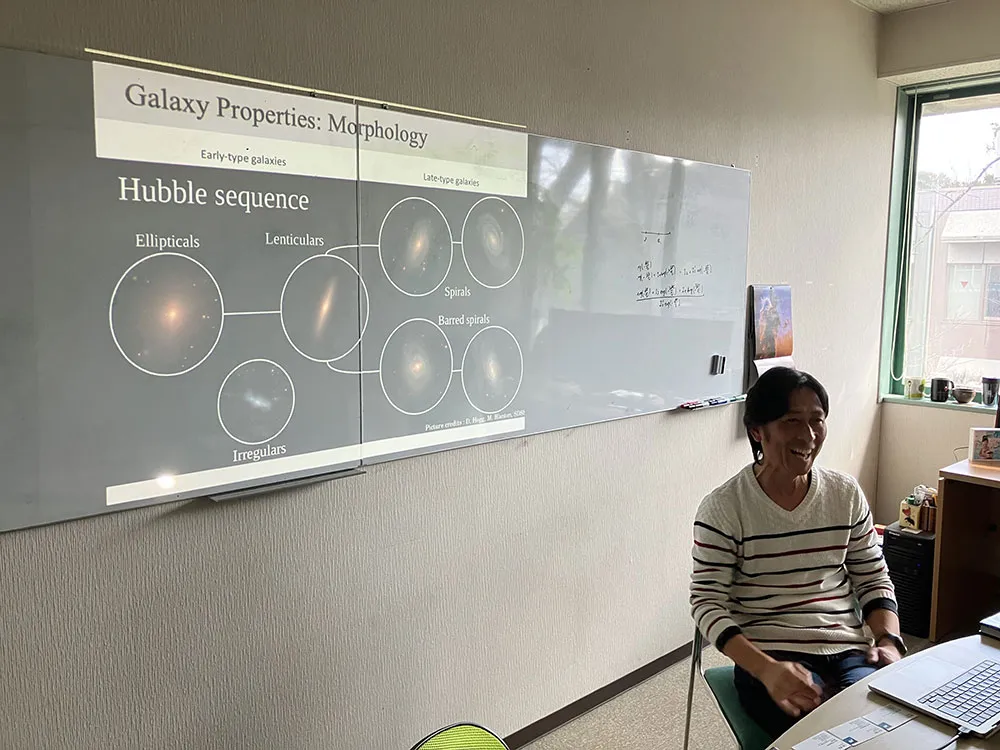
Mr. Tanaka: A major achievement was the creation of a highly accurate “Catalog of Colliding Galaxies.” When the project first began, people asked, “Why not use AI for the classification?” However, to get AI to recognize images, you need a massive amount of training data pre-labeled with the correct answer: “This is a colliding galaxy.” At the time, that data simply didn’t exist. Only when observing with extremely high-performance telescopes like the Subaru Telescope can we see the faint traces of galaxies colliding. That’s precisely why we first needed to classify them with the human eye. And when we analyzed the classification results, it became clear that when galaxies collide, star formation within them becomes extremely active, and the black holes at their centers also become active at the same time.
Explorer Squad: Do you plan to continue citizen astronomy projects like “GALAXY CRUISE” in the future?
Mr. Tanaka: Citizen astronomy has great social significance, and I’d definitely like to do it again, but to be honest, I don’t have any plans for the next project at the moment. The next step in my research will involve analyzing the “spectrum” of light—essentially a “rainbow”—to uncover the detailed properties of galaxies. However, since this research involves a lot of highly specialized terminology and graphs, it’s difficult to use citizen science methods, so for now, it feels like citizen astronomy is on hold.
Astronomy and Travel: Drawn to the “Unknown”
Expedition Team: I’d like to ask Mr. Tanaka about his thoughts on travel. Is there anything in particular you seek when you travel?
Mr. Tanaka: Lately, since I travel a lot with my family, I tend to prioritize what they want, but before I got married, I used to travel alone quite often. I’ve always liked “old things,” and I’m particularly drawn to ancient civilizations. I’ve visited places like Machu Picchu, Easter Island, and Athens. When I think about why I’m drawn to ancient civilizations, I think it’s because I want to be “overwhelmed.” Those places were once home to people whose lives we can no longer see today, so perhaps I have a desire to be “overwhelmed” by things that are “mysterious” and “hard to understand”—just like the universe.
Explorer Squad: Is it because both travel and astronomy deal with the “unknown” that you feel compelled to pursue them even more?
Mr. Tanaka: That’s right. Just like with the universe, it’s precisely because we can’t see it that we want to know more. Even though the ruins remain, we can’t see the lives of the people who lived there. That’s why we let our imaginations run wild based on what’s left behind, and we want to know more. In the universe, too, the number of stars visible to the naked eye is limited, but if you use the Subaru Telescope, you can see countless stars. It’s precisely because it isn’t immediately visible to the eye and isn’t easily understood that we want to know more. That might be where they have something in common.
Explorer Squad: This will be our final question. How do you imagine “travel five years from now” will look?
Mr. Tanaka: Just like research, I hope we’ll see new forms of travel that we can’t even imagine right now. It would be fun to have something where we can say, “We couldn’t have imagined a trip like this five years ago.” Realistically speaking, I’d be happy to see astronomy-related travel become even more popular. We already have things that combine glamping and astronomy, but something like a “tour accompanied by a real astronomer” might be interesting.
Explorer Squad: In recent years, more and more people are seeking “authentic” experiences in their travels. Since a “tour accompanied by a real astronomer” fits right into that trend, I think there would be high demand for it. Thank you so much for sharing your valuable insights with us today!
The “Seeds” We Found on This Expedition
In today’s internet-driven world, it’s become the norm to obtain detailed information about travel destinations in advance. And as AI and the metaverse continue to advance, I imagine it will soon be possible to “pre-experience” the entire trip. On the other hand, as Mr. Tanaka mentioned earlier, I believe one of the joys of travel—and one of its essential qualities—is “encountering the unknown. ”We should keep a close eye on how travel will continue to offer the “unknown” five years from now—or whether it will cease to do so altogether.













