Digital Transformation of Tourism Policies to Support the Realization of the Ideal Future for Local Communities
Digital transformation initiatives are gaining momentum in the tourism sector as well. While many stakeholders understand the importance of tourism DX, it is likely that many are unsure how to apply it effectively. In this column, we will examine case studies to explore how tourism DX should be utilized in the process of formulating tourism visions and promotion plans, as well as in the practical steps required to implement them using the PDCA cycle.
Amid the prolonged COVID-19 pandemic, digital transformation (DX) has rapidly advanced and is being applied across various sectors of society. The tourism industry is no exception. Digital technology has become indispensable when launching new tourism-related products and services.
However, opportunities to implement tourism initiatives utilizing digital technology and data remain limited, and data acquisition is often costly. Consequently, while many stakeholders may understand the importance of DX, a significant number likely do not know exactly how to proceed.
This article focuses on how to approach the use of tourism DX when formulating tourism visions and promotion plans, and when implementing practical steps to realize them through the PDCA cycle, using case studies to explore these concepts.
1. Tourism DX Initiatives That Often Lose Sight of Their Purpose
The Japan Tourism Agency is advancing DX initiatives in the tourism sector with the aim of improving convenience for travelers and boosting productivity in the tourism industry, while also striving to revitalize local communities and realize a sustainable economy and society. The Agency positions tourism DX not merely as a means to improve efficiency through the digitization of operations, but as a catalyst for transformation—such as re-examining business strategies and creating new business models—through the analysis and utilization of data collected via digitization.However, when observing the actual situation on the ground in regions promoting tourism DX, it is not uncommon to see cases where the use of digital technology itself becomes the goal, causing the original purpose to be lost sight of. Consequently, business operations and initiatives are often structured around the services or systems provided by operators, rather than the end goal.What truly matters is determining how to leverage the benefits and advantages of digital technology—or how to better utilize existing digital systems within the context of DX—to ensure that plans are reliably implemented toward realizing the tourism vision set forth by the region.
“DX” is a means and a method. Regarding specific measures to address regional tourism challenges, one approach is to categorize initiatives—determining which should be advanced through digital technology and which should be achieved through other methods—and then promote DX within each individual measure. Another perspective is to introduce DX from a management standpoint to make the entire cycle—from hypothesis building, through trial implementation, to effectiveness measurement and improvement—more effective, regardless of whether digital technology is used in a specific measure.
2. Understanding Tourism DX and the Need for Tourism Policy DX to Reflect This Vision
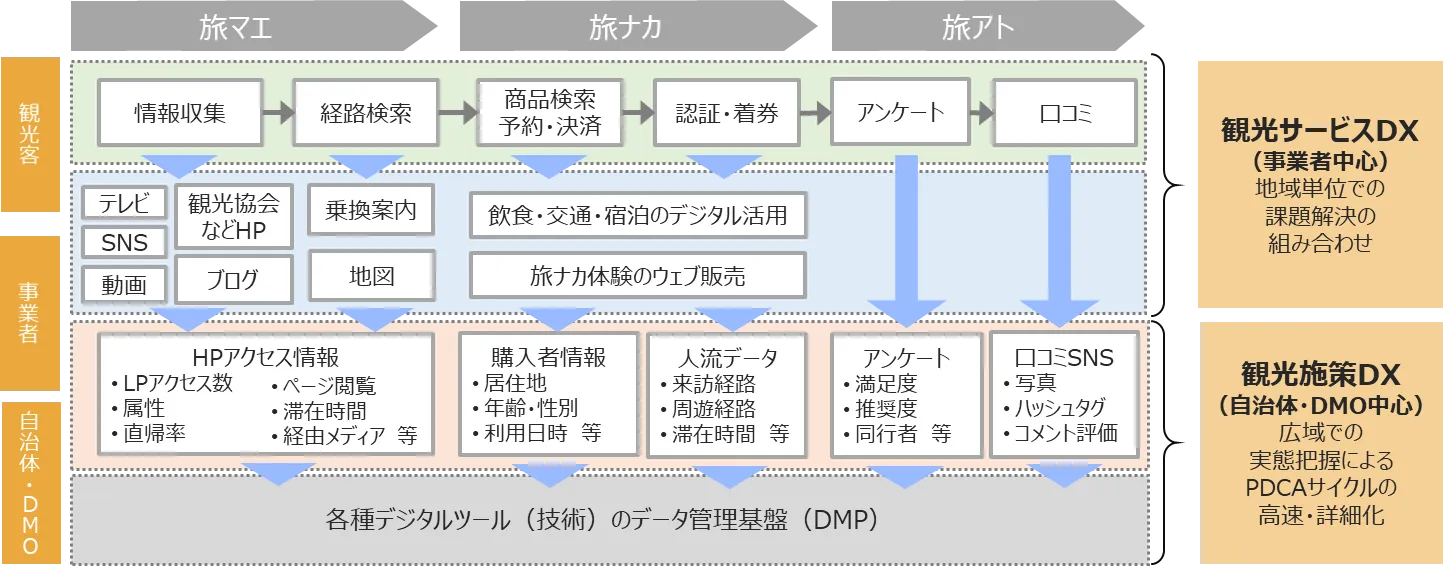
First, to clarify the concept of Tourism DX, we have broadly categorized it into two types: “Tourism Service DX” and “Tourism Policy DX.”
Tourism Service DX refers to using DX to further enhance the convenience of services provided by businesses and other entities, or to propose new ways to enjoy tourism. Initiatives such as recreating tourist destinations in VR spaces and MaaS are examples of this. It is anticipated that numerous initiatives utilizing new concepts and technologies, such as Web3, will continue to emerge in the future.
Tourism Policy DX refers to the active use of digital technology and data in formulating regional visions and tourism promotion plans, enabling local governments and DMOs to grasp and analyze the actual situation in greater detail, identify challenges, and incorporate these findings into their vision. Furthermore, we believe it is crucial to establish a system that continuously utilizes this technology and data to reflect them in annual action plans, making improvements as needed to achieve the vision.Since MaaS and other examples of Tourism Service DX mentioned earlier possess technologies and data for tracking travelers’ movements, they will play a major role in Tourism Policy DX. Figure 1 below illustrates the relationship between Tourism DX and the data that can be obtained from the sequence of tourist behaviors—from planning to post-trip—based on two classifications.
3. Initiatives in Fukui Prefecture and the Kanmon Strait Area Aiming to Create an Environment Through High-Precision Data Analysis
Here, we introduce two notable case studies regarding the promotion of digital transformation (DX) in tourism policies. One is in Fukui Prefecture, and the other is in the Kanmon Strait area spanning Yamaguchi and Fukuoka Prefectures; both are being implemented as part of the Japan Tourism Agency’s FY2022 Tourism DX Project.While the two areas differ in terms of their regional challenges and solutions, they share a common goal: to address the current situation where a lack of historical data on tourist trends has prevented accurate analysis. Both aim to create an environment where they can grasp and analyze the current situation in near real-time and immediately verify the effectiveness of specific actions, such as product planning and information dissemination. At the core of this effort lies the initiative for the digital transformation of tourism policies.
Case Study 1: Understanding Tourism Trends Using Open Data (Fukui Prefecture)
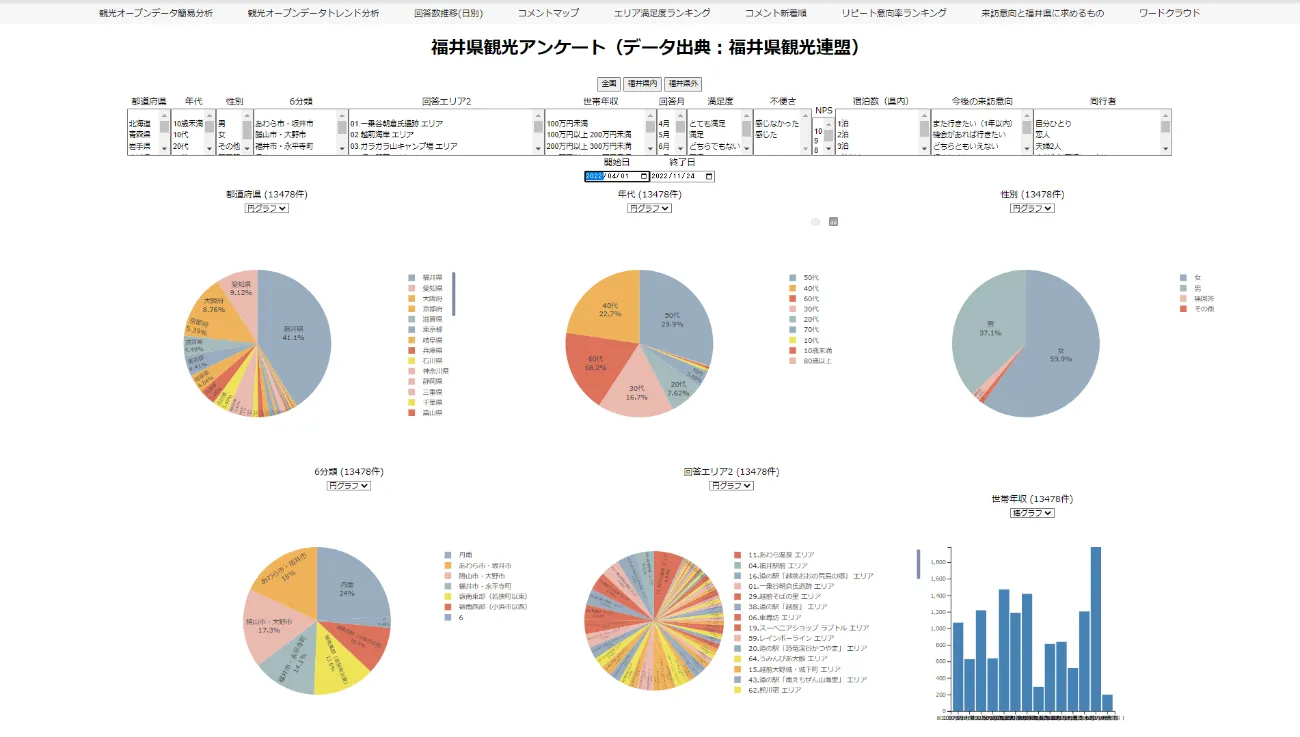
- Current Situation and Challenges: With a lack of marketing data and an unclear picture of the actual state of tourism, product development, policy-making, and business expansion have been based on intuition. It is difficult to see the effects and results of various tourism measures and promotions, making it hard to implement the PDCA cycle.
- Solution: Build a data management platform (DMP) that enables data analysis from various angles by collecting and integrating a wide variety of data.
- Data Collection and Utilization: Surveys are conducted via QR codes for tourists, and the collected response data is published as open data that anyone can view and analyze.
- Goal: By identifying tourist demographics and volume—such as “an increase in families from Tokyo visiting the Dinosaur Museum during summer vacation”—that were previously unrecognized, effective marketing becomes possible.
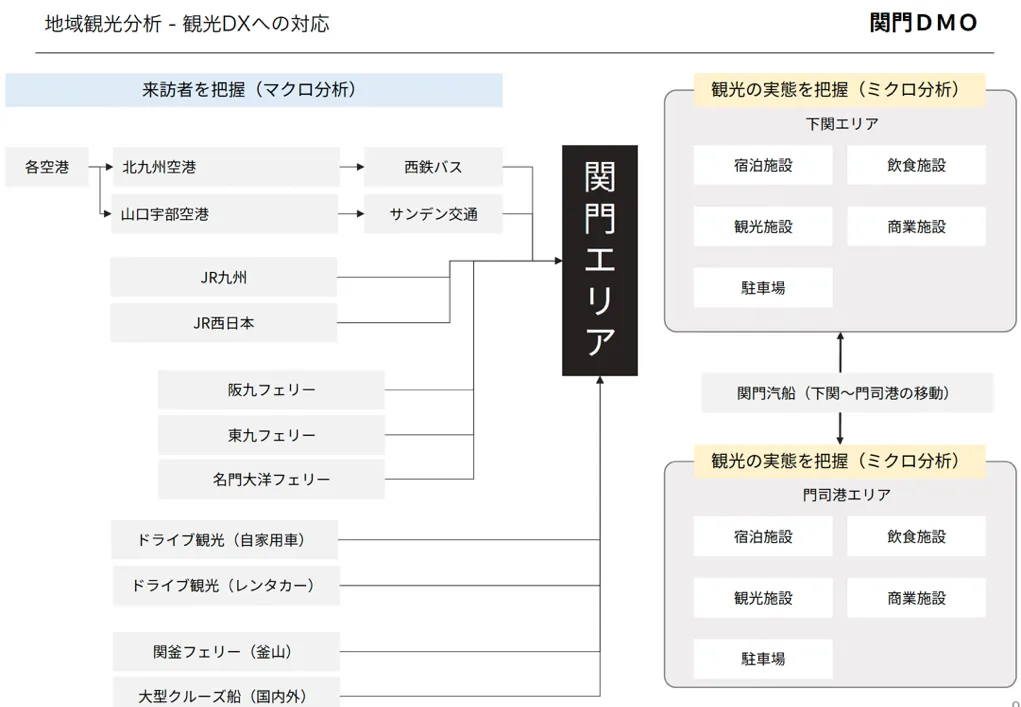
Case Study 2: Tracking Foot Traffic Data Using Foot Traffic Sensors (Kanmon Strait)
- Current Situation and Challenges: Due to jurisdictional boundaries between administrative districts, surveys and data sharing have not been possible, and the region continues to struggle to develop tourism destinations as a unified area. There is virtually no understanding of where tourists visiting the region come from or how they move around.
- Solution: Establish a shared analytical platform utilizing people flow sensors and introduce a unified information distribution system necessary to promote tourism circulation.
- Data Collection and Utilization: It will become possible to track both macro- and micro-level visitor behavior (e.g., where domestic and international tourists eating sushi outside Shimonoseki’s Karato Market come from and how they move around the area).
- Vision: Capture the behavior of tourists entering the area via various modes of transportation and moving around within it using sensors to gather people flow data; sell products designed to encourage movement within the area; and thereby improve circulation.
4. Realizing an Effective PDCA Cycle Through the Digital Transformation (DX) of Tourism Initiatives
Digital transformation (DX) of tourism policies has been implemented on a pilot basis in various regions. In the Hakone region, for example, around 2020, initiatives were tested to track visitor flow trends using mobile phone data and to conduct surveys of lodging guests to monitor satisfaction levels in real time via a dashboard.The emergence of cases like those in Fukui Prefecture and the Kanmon Strait can be attributed to technological innovations that have made data acquisition relatively inexpensive, as well as the establishment of supporting systems and increased funding for such initiatives. It appears that data-driven approaches—long standard practice in other industries—are finally becoming feasible in the tourism sector as well.
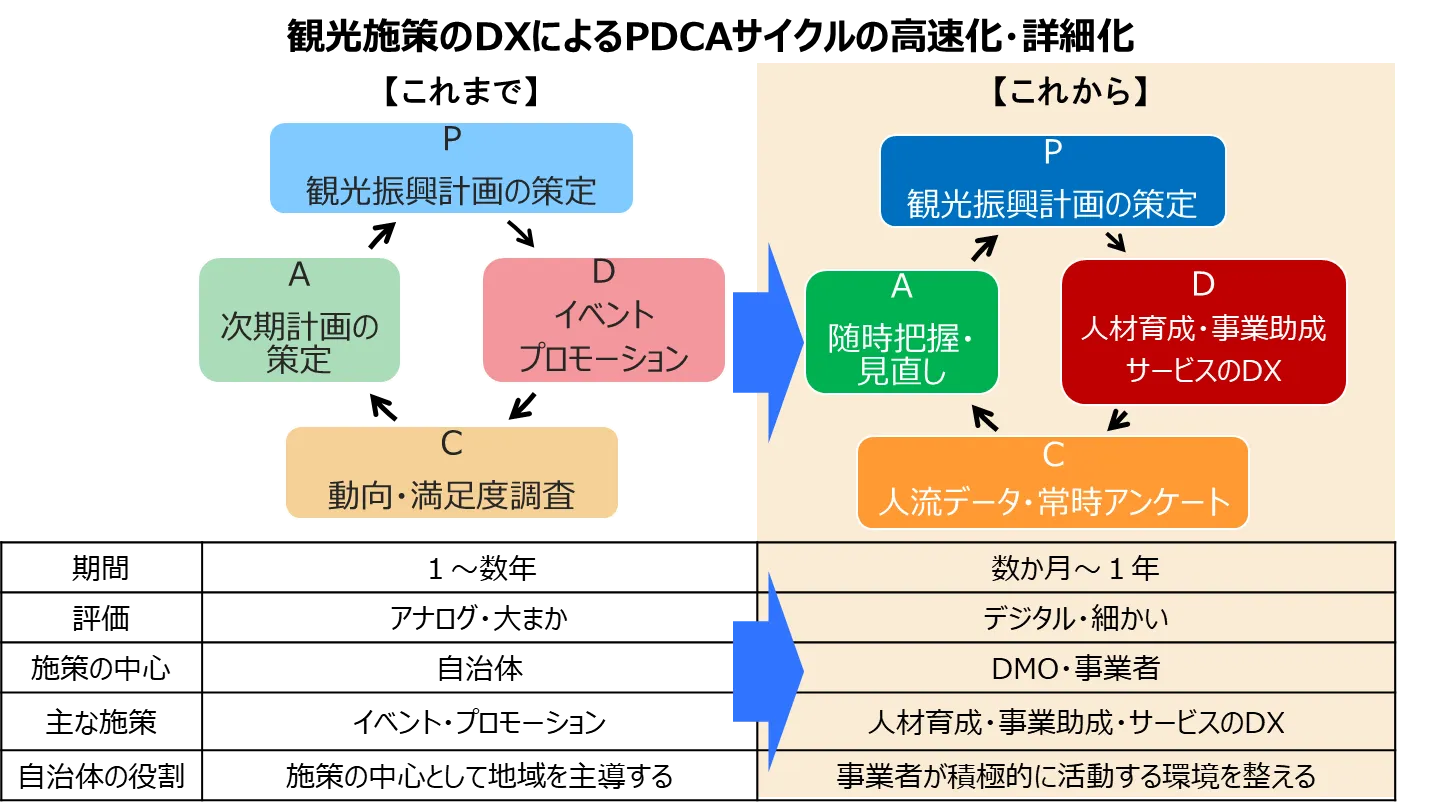
Achieving digital transformation (DX) in tourism policy will lead to a faster and more detailed PDCA cycle based on data, moving away from the long-standing reliance on intuition and experience. With people flow sensors, it becomes possible to track where tourists are coming from, what modes of transportation they are using (airplanes, bullet trains, cars, etc.), and which locations they are visiting within the region.Tourist surveys allow us to understand who they are traveling with, how satisfied they are with the destinations they visited, and how much money they spent. By utilizing these tools, we can immediately and in detail grasp the actual behavior of tourists—including quantitative behavioral data and qualitative intentions, preferences, and emotions—at each stage of the travel journey (before, during, and after), which previously could only be understood in broad terms. This enables the development of targeted products and promotions.Furthermore, since the effectiveness of these efforts can be measured in detail and in real time, methods and content can be reviewed and adjusted as needed. Given this, isn’t it time to use the shift toward digitalization—centered on the “Check” (evaluation) phase of the PDCA cycle—as an opportunity to review the entire cycle more frequently based on more accurate and detailed information, and to consider securing and training personnel capable of driving the PDCA cycle using data?
Local tourism operators will be able to analyze detailed information on tourists’ behaviors and take on new initiatives. It is also desirable for them to exchange views with local governments and DMOs on how to utilize digital technology to solve challenges in achieving the region’s vision, leading to consensus-building for implementation.
Local governments and DMOs will be able to review the entire PDCA cycle of their initiatives.Tourism policies will likely see a shift in budget priorities, with specific measures moving from government-led events and promotions toward business-led initiatives such as human resource development, business subsidies, and the digital transformation (DX) of services. If this environment is established—including in surrounding areas—cost reductions through shared maintenance expenses will become possible. Furthermore, tourism promotion on a broader regional scale, spanning existing administrative boundaries such as prefectural borders through data collaboration, is expected to be realized.