New Approaches to Community Engagement Through Online Tours in Anticipation of the Resumption of Travel After the COVID-19 Pandemic

Online tours, which began as an alternative to in-person travel, were initially expected to decline once travel resumed. However, as the COVID-19 pandemic has dragged on, they have become established as a new form of travel. As travel resumes, we will explore new ways of interacting with different regions through online tours.
Due to the impact of the novel coronavirus (hereinafter referred to as COVID-19), the use of digital tools has become widespread as a way to compensate for the inconvenience of being unable to go out or travel. Digitalization has also driven innovation in the tourism and travel sectors, leading to the emergence of “online tours” as a new form of travel.
In this article, I will outline the major trends and developments in online tours that have gained traction during the COVID-19 pandemic. Drawing on my own experience participating in these tours, I will explore new ways of interacting with local communities through online tours, with an eye toward the full resumption of travel.
1. Major Trends in Online Tours to Date
The emergence of online tours stands out as one of the major developments in the tourism and travel sectors that occurred amid travel restrictions and stay-at-home requests. It was initially thought that online tours would gradually decline once travel restrictions were lifted and in-person travel resumed. However, as the rise in infection numbers continued unabated and the period during which actual travel was impossible dragged on, various businesses began organizing online tours, leading to their establishment as a new form of travel.
The spread of COVID-19 was closely linked to the development of online tours. The overall trend is summarized below.
April 2020–: Online seminars and virtual tours began under the first state of emergency
As the COVID-19 pandemic spread, lockdowns began in many cities around the world. In Japan, a state of emergency was declared in April 2020, and Golden Week travel was canceled. Many people, including those in the tourism industry, found themselves completely out of work. Amidst this situation, HIS, in collaboration with its U.S. subsidiary, launched online seminars and virtual tours. They organized creative online tours, such as guided tours of popular tourist cities led by local guides using photos and videos, and live connections with prominent figures active in those areas. Initially offered for free, these tours eventually became paid services. For participants, while the content itself was certainly engaging, I believe they also felt a sense of support for those working hard overseas despite the pandemic.
July 2020–: The Go To Travel Campaign began, but COVID-19 cases continued to rise
With the lifting of the state of emergency and the launch of the GoTo Travel Campaign, the number of people actually going on trips increased. However, the rise in infections continued unabated, leading people to refrain from traveling long distances. As people began traveling within their local areas, domestic online tours organized by businesses other than travel agencies—such as tourism operators on remote islands and bus companies—began to emerge. Many of these online tours became paid services, and subscription services offering unlimited access to online tours and seminars for a flat fee also emerged. Even for travel agency products that traditionally attracted many senior participants, families with children began joining, leading to the acquisition of new customers.
December 2020–: Second State of Emergency Declared
With the resurgence of COVID-19, people were urged to strictly stay home during the year-end and New Year holidays. People also began to refrain from traveling even to nearby areas. As the period during which people could not travel prolonged, demand for online tours rose again.
February 2021–: Comparison sites for online tours appear
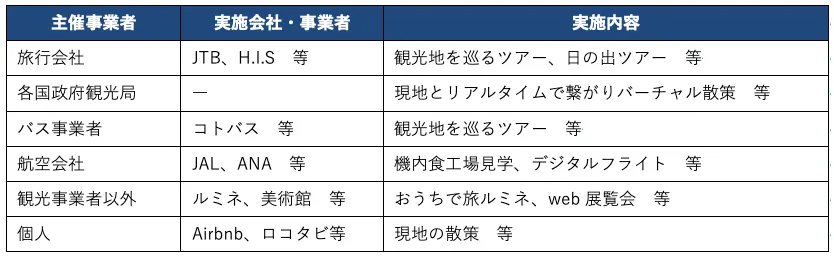
Currently, businesses outside the tourism and travel sectors are also hosting online tours (Table 1). Against the backdrop of the emergence of a wide variety of online tours, websites have been launched that allow users to search across the online tours offered by various companies. In February 2021, Torch Inc. launched “WaTrip,” and in April 2021, Travelzoo Japan Inc. launched “ONTABI.” Online tours began to be treated in the same way as in-person travel. Although online tours initially emerged as a substitute for in-person travel, it is clear that they have evolved beyond being mere substitutes and are now establishing themselves as a new form of travel.
2. What Are Online Tours from the User’s Perspective?
To what extent have online tours penetrated the market? Let’s examine this from the user’s perspective.
(1) Experience with Online Tours
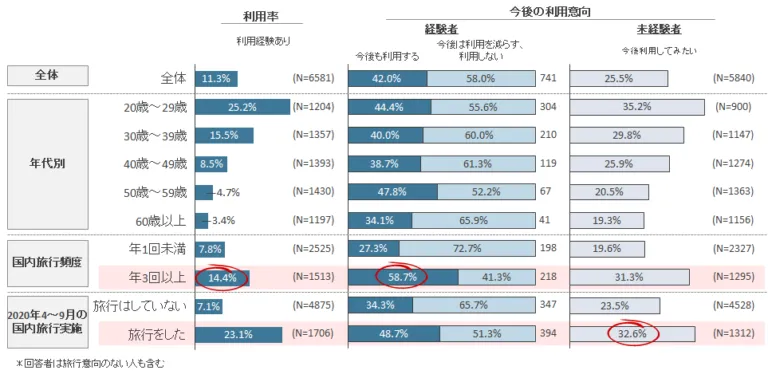
According to a survey conducted by our company, the overall usage rate for domestic online tours was 11.3%. The usage rate among those who traveled domestically three or more times a year before the COVID-19 pandemic was 14.4%, which was higher than the rate for those who traveled less than once a year (7.8%). Additionally, 42.0% of those who have used domestic online tours expressed an intention to use them again in the future. Among those who travel domestically three or more times a year, the intention to use online tours in the future was 58.7%, indicating that approximately 60% intend to actively participate in online tours going forward. Looking at the future usage intentions of those who have never used domestic online tours, the rate was 32.6% among those who traveled domestically between April and September 2020—during the COVID-19 pandemic—which was higher than the rate among those who did not travel during that period (23.5%) (Figure 1).This suggests that online tours are particularly well-suited for people who enjoy traveling, such as those who travel domestically frequently or those who continued to take domestic trips even during the COVID-19 pandemic.
Source: Survey on the Novel Coronavirus (COVID-19) (September 2020) (Screen Survey)
(2) Insights from Participants’ Feedback
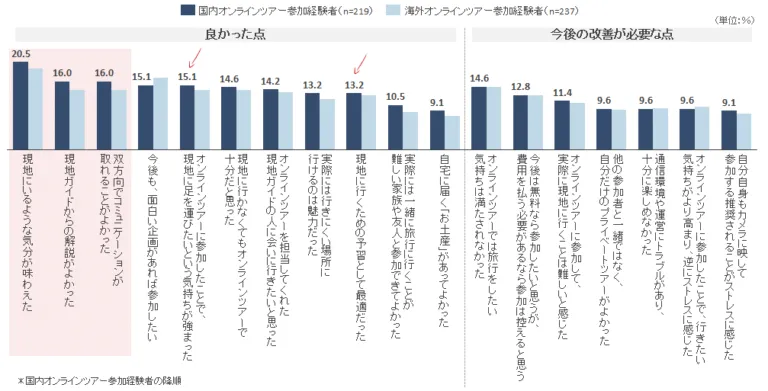
In a survey we conducted targeting people with overseas travel experience, we asked for their impressions of participating in online tours. Among those who actually participated in domestic online tours, the most common response was “I felt as if I were actually there” (20.5%), followed by “The commentary from the local guide was good” (16.0%) and “It was good to be able to communicate interactively” (16.0%) (Figure 2).It appears that for online tours set in Japan, providing content that enhances the feeling of being there—while emphasizing two-way communication with the destination—increases satisfaction. Next, when asked how their intention to travel to the destination had changed as a result of participating in an online tour, the highest response was “I want to actually go because I’ve been interested in the place for a while” (25.1%) (Figure 3). It appears that participating in an online tour before taking an actual trip has increased their intention to travel in the future. Online tours are not merely a substitute for travel; they are also expected to serve as a point of connection between travelers and the destination.
: Survey on Japanese Attitudes Toward Overseas Travel During the COVID-19 Pandemic (Conducted in February 2021)
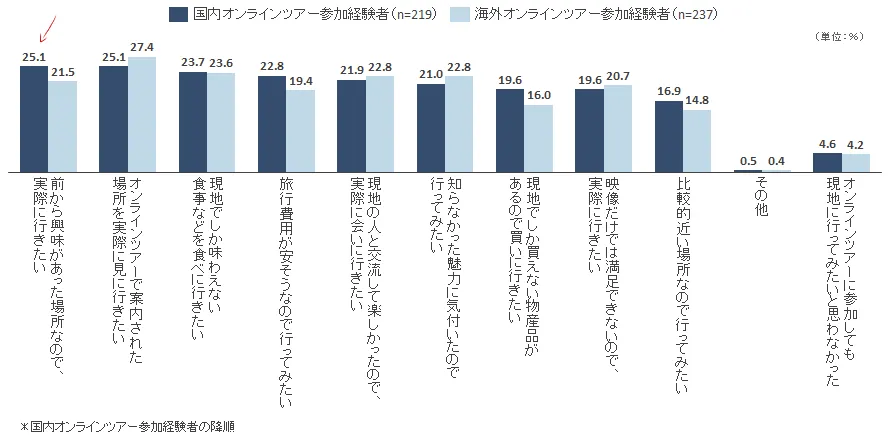
: Survey on Japanese Attitudes Toward Future Overseas Travel During the COVID-19 Pandemic (Conducted in February 2021)
3. Interaction with Local Communities Through Online Tours: Insights from Domestic Online Tour Experiences
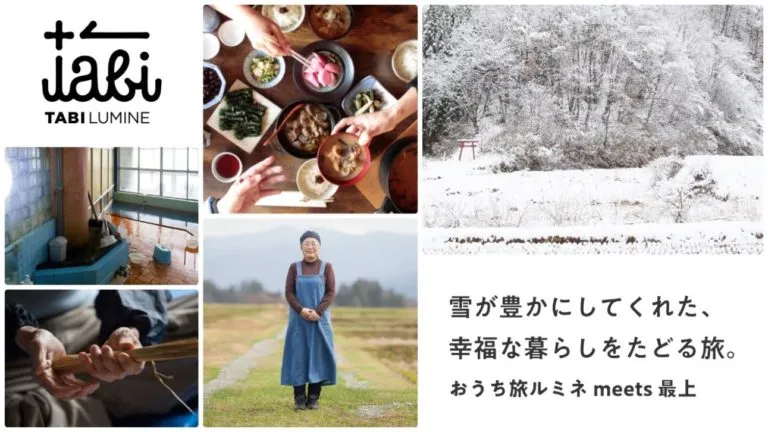
What kind of online tours could serve as a point of connection between travelers and local residents? There is one tour that the author personally experienced and found deeply thought-provoking: “Ouchi Tabi Lumine,” organized by Lumine Co., Ltd., a company primarily engaged in the management and operation of shopping centers. The author participated in “Ouchi Tabi Lumine meets Mogami,” held at the end of March 2021.Okura Village, located in the Mogami region of Yamagata Prefecture, is the hometown of my grandmother, who currently lives in Tokyo. I have visited there since childhood during family trips, so it is a place I know well. Since it is difficult to visit in person right now, I participated in the tour with my family and relatives, including my grandmother, hoping it would help her reminisce about her hometown. Based on my experience participating, I will discuss the potential of online tours and community engagement.
(1) Participating in “Ouchi Tabi Lumine Meets the Mogami Region”
・The “Tabi Lumine” Concept
Lumine launched the “Coco Lumine Project” in June 2013 as a cultural initiative aimed at conveying the excellence of Japanese craftsmanship, with the themes of “supporting production areas,” “regional coexistence,” and “reconstruction support. ”In February 2021, the project was rebranded as the “Tabi Lumine Project.” Its goal is to “connect people across Japan through travel and create a community where participants can encounter new discoveries and values.” One of the initiatives under the “Tabi Lumine” project is “Ouchi Tabi Lumine,” which has previously been held on Sado Island in Niigata Prefecture and in Nakanojo Town, Gunma Prefecture. The third installment took place in the Mogami region of Yamagata Prefecture.
・Overview of “Ouchi Tabirumine meets Mogami”
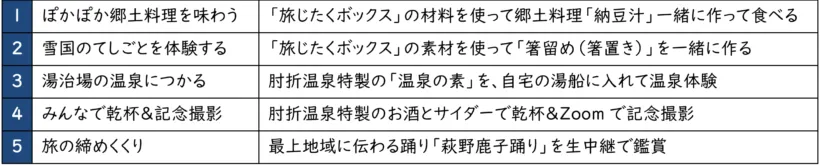
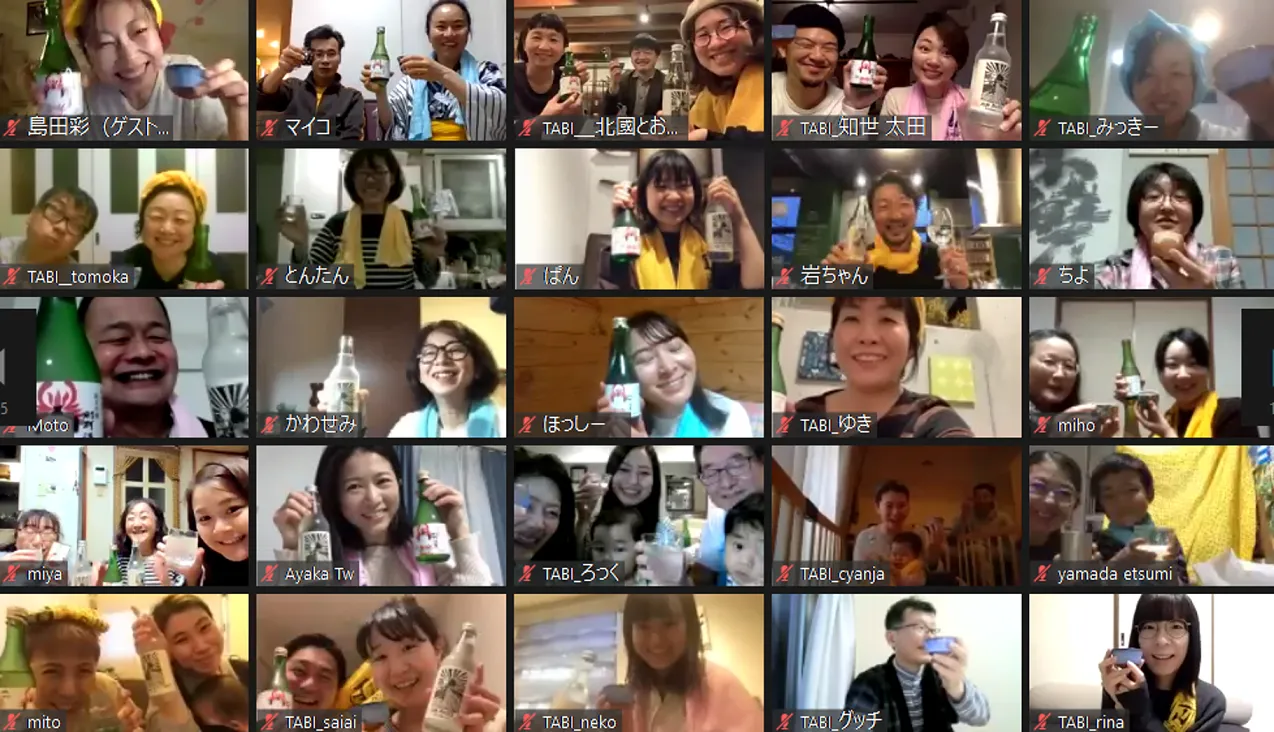
The Mogami region of Yamagata Prefecture is one of Japan’s heaviest snowfall areas, blessed with mountains over 1,000 meters high and clear rivers. The online tour offered a [3-Hour Plan for a Deep Immersion (Limited to 50 participants)] and a [2-Hour Plan for a Casual, All-Around Experience (Limited to 100 participants)]. I participated in the 2-hour plan (the 3-hour plan was sold out at the time of registration).The program details for the 2-hour plan are as follows (Table 2, Figure 4). Using Zoom, participants connected online with residents of the Mogami region and could post questions and comments in the chat at any time. The session proceeded as participants opened the “Travel Preparation Box” they had received in advance together, and since everyone had their cameras on, I could see the faces of all 100+ participants at all times.
(2) What Lumine’s Tour Revealed About Online Interaction with Local Communities
The following are three key insights gained from actually participating:
- “Close to ‘people’ even though it’s online?”… Discovering new regional charms through people
- “Empathy and Sharing”… Spending time together creates “interaction”
- “The Travel Experience Through ‘Experiences’”… You don’t have to visit tourist spots to get that travel feeling
“Close to People Even Online?”… Discovering New Charms of the Region Through People
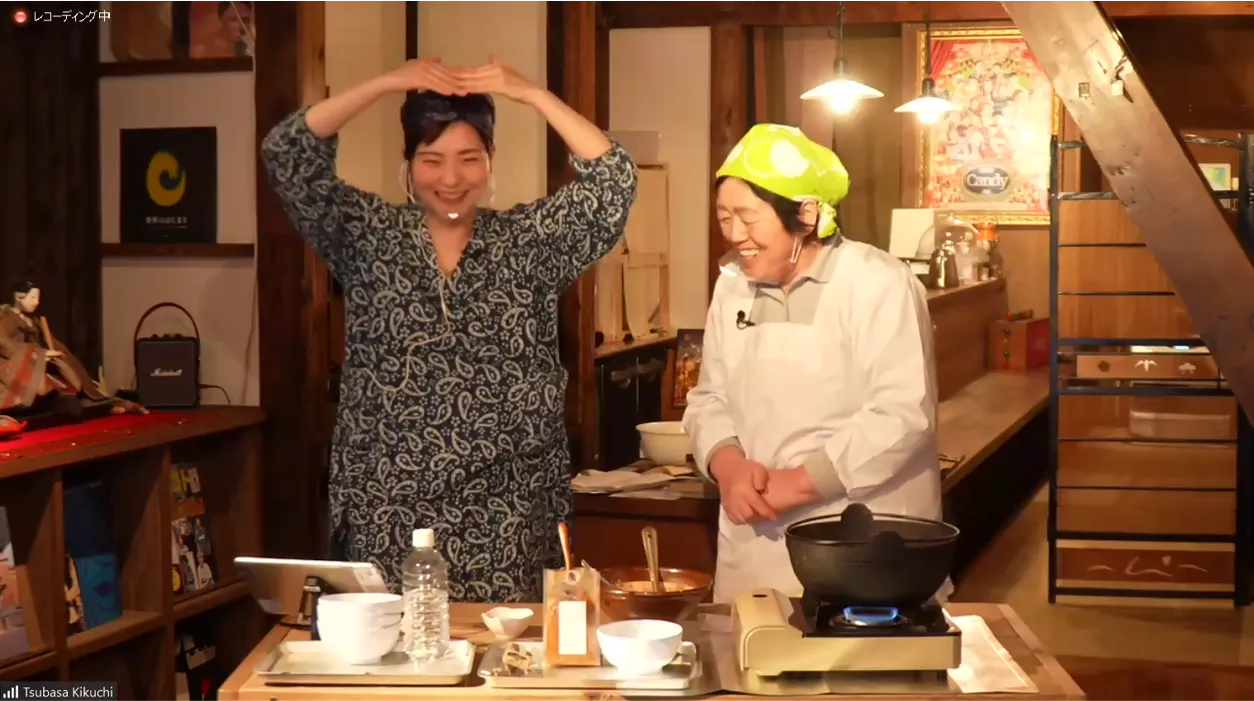
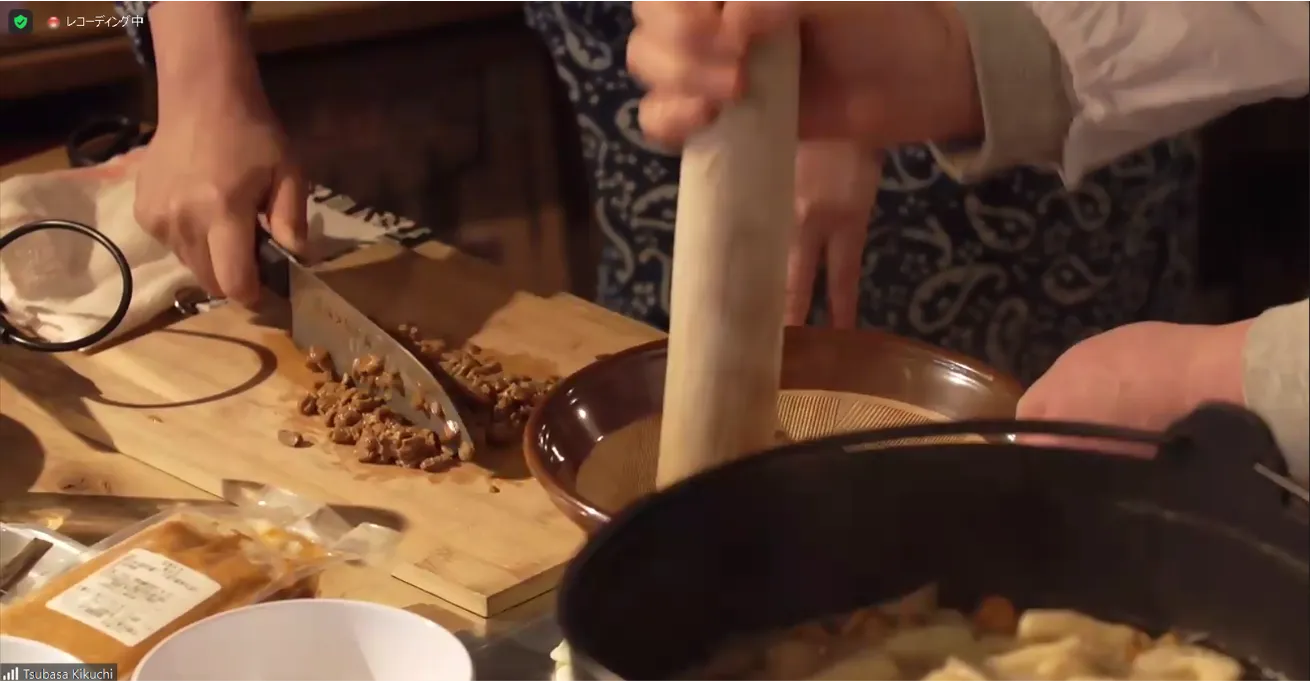
During the tour, we made natto soup—a local specialty—together with a local woman and her aunt, who taught us the process. Their banter, laced with the Yamagata dialect, left a lasting impression with its unpretentious nature and warm atmosphere. Rather than listening to them speak from a slight distance during an in-person tour, I felt a greater sense of closeness through the online connection, as if I were right there with them. We were also introduced to ingredients produced in the Mogami region, allowing us to discover a side of the area that we wouldn’t have encountered during our usual visits home, all through the eyes of the locals. It reaffirmed my belief that experiencing the warmth of the local people and encountering the region’s unique lifestyle and culture are what truly make a place appealing.
“Empathy and Sharing”… Spending time together creates “connection”
Since participants had their cameras on, we could always see how everyone was doing. We shared moments like eating dishes made from the same ingredients at the same time, or wrapping Hiji-ori Onsen’s special hand towels around our heads and toasting after a hot spring experience. It wasn’t exactly “eating from the same pot,” but it was an experience close to real-life interaction. Being able to constantly check on each other’s status via Zoom made me realize that simply spending time together—even without active interaction—can itself be a form of connection.
“A Travel Experience Through ‘Activities’”… You don’t have to visit tourist spots to get that travel vibe
The casual, two-hour “Be Greedy” plan didn’t include much time to enjoy the scenery of the Mogami region; instead, it focused on “experiences” such as making natto soup and chopstick rests, and soaking in the hot springs. Online tours where a local guide takes you around tourist spots and provides commentary are a valuable opportunity to get a taste of the travel experience. On the other hand, I felt that “learning about the local area and interacting with locals and fellow participants through shared experiences” is also a sufficient way to get that travel vibe, and represents a new form of online tour.
4. New Ways to Connect with Local Communities Through Online Tours, with an Eye Toward the Resumption of Travel
Online tours emerged as an alternative during the COVID-19 pandemic when travel was restricted, and they have gained popularity, particularly among travel enthusiasts. Various organizations are now organizing and offering creative online tours. For now, online tours do not appear to be in direct competition with in-person travel; rather, they seem to be helping to boost interest in actual travel.
Currently, the “OMO (Online Merges with Offline)” concept is gaining traction, where all customer touchpoints originate online, with in-person (offline) interactions integrated within that framework. I believe online tours will be expected to fulfill dual roles in the future: serving as a “substitute for travel” while also “boosting travel.” Now that our daily lives have changed completely, this is an opportunity to rethink how we interact with others. Interacting with locals is not limited to visiting a destination in person. Connecting with locals online before the trip and continuing those connections online after the trip—isn’t this the new way of engaging with local communities that online tours offer?
Source: Tabiru Lumine website
著者