Taking on the Challenge of the Expanding Healthcare Services Market
This column was published in the June 5, 2021, issue of the Tourism Economy News as part of a series titled “Proposals for the New Era of COVID-19.”
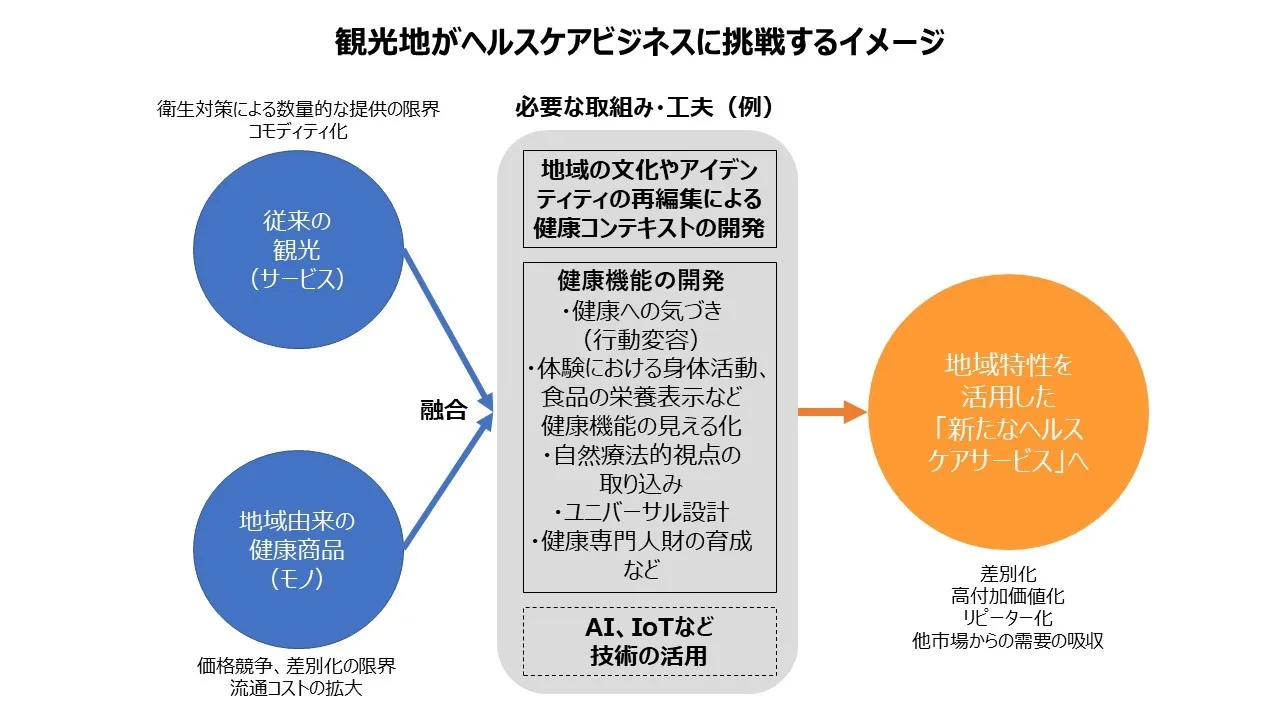
The spread of COVID-19 has led to severe restrictions on traditional tourism, and society now demands tourism that implements advanced hygiene measures. In this context, one approach is to turn these hygiene measures to our advantage, rebuild services around the keywords of "safety" and "security," and take the next strategic step. However, enhancing hygiene measures comes with its own challenges: compared to traditional services, it requires reducing the number of guests handled, lowering turnover rates, and incurring additional costs related to labor and hygiene measures. On the other hand, these costs cannot simply be passed on to customers through price increases.
Therefore, I propose venturing into a new market: the tourism industry should take on the challenge of providing healthcare services. According to estimates by the Ministry of Economy, Trade and Industry, the healthcare industry—excluding services covered by public insurance—is a rapidly expanding market worth approximately 33 trillion yen (up from about 25 trillion yen in 2016). Notably, these estimates predict that health-oriented travel and health tourism will account for about 10% of this market. This is not merely about offering “health-like” services or simply walking around hot springs or tourist spots. What is needed are services that genuinely contribute to health promotion—that is, services that pursue the effect of “behavioral change.” “Behavioral change” refers to incorporating “triggers” or “motivation” into tourism services that transform tourists’ behaviors into “health-promoting behaviors.”
Consumer health consciousness is also on a steady upward trajectory. For example, in the food industry, the number of notifications under the Functional Food System administered by the Consumer Affairs Agency has tripled from FY 2015 (when the system began) to FY 2020, and there has been a rapid increase in products designed to meet health-conscious consumer demands. Is the tourism industry keeping pace with this rapidly expanding health-conscious lifestyle among consumers?
Furthermore, the trend toward a super-aging society—where people aged 65 and older account for nearly 30% of the population—cannot be overlooked. For the elderly, services based on healthcare are essential. Within this context, a new area of focus has emerged: the market for services that foster “human connections. ”According to the Institute of Gerontology at the University of Tokyo (2016), a decline in social interaction—such as reduced connections with others, a narrowing of daily life, and fewer opportunities to eat with others—can lead to a deterioration in mental and psychological well-being, a decrease in physical activity, and a decline in oral function, ultimately potentially resulting in sarcopenia (low muscle mass, reduced physical function, etc.). In particular, it is becoming increasingly clear that “human connections” are crucial for preventing frailty. As single-person households increase and “social connections” are rapidly being lost, hopes are pinned on tourism services.
Although the economic environment remains challenging and restrictions on tourism persist, might we not find a ray of hope precisely in the challenge of developing healthcare services?