Perfect for events! "Trailer-Style Tourist Information Center"
~Tourist Information Services Where and When You Need Them~ Tourist information centers play a vital role as the "face of the community." This study examines how to utilize the "Info Box" mobile tourist information center, as well as ideal methods for training local guides and leveraging local talent.
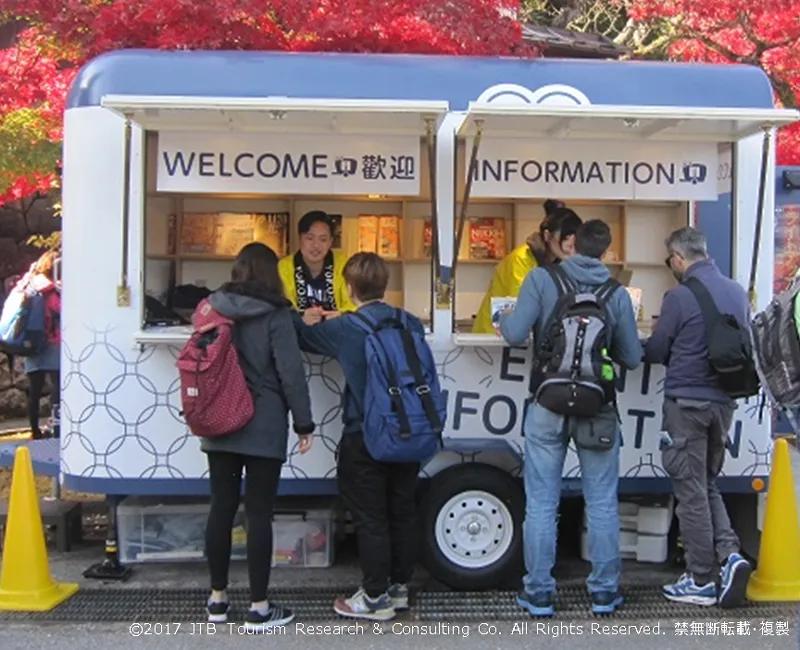
With the increase in international visitors to Japan, the number of tourist information centers offering multilingual services is growing throughout the country (*1). At the same time, however, some regions have expressed a need for information centers that provide multilingual support only during specific times of the year—such as festivals, cherry blossom and autumn foliage seasons, or special events—rather than maintaining a permanent facility.
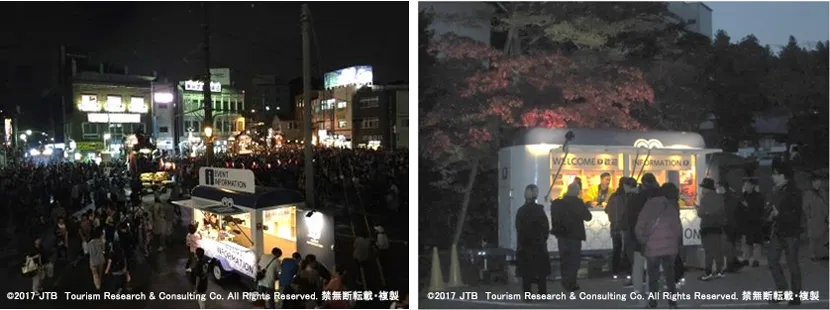
Therefore, with the aim of providing flexible guidance to foreign tourists when and where it is needed, we devised a service package (tentatively named “Info Box”; Hereinafter referred to as such) was devised. We dispatched this service to various events across the country to evaluate the service content, facilities, and operational methods (*2). The trailer-type booth, developed by our research partner Tanseisha Co., Ltd., features a food truck-style design with fully open sides to make it easy for travelers to approach, and is equipped with brochure display shelves and spot lighting.
Overview of the Installation and Evaluation of the “Trailer-Type Tourist Information Center”
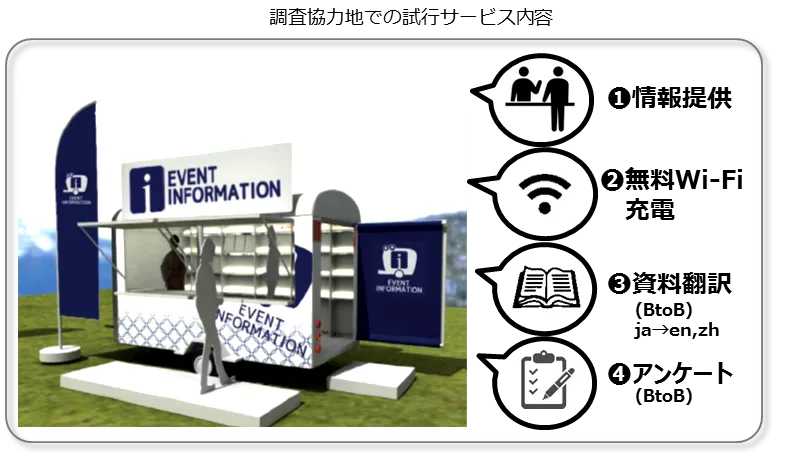
From September to November 2016, with the cooperation of four events (*3) held in Ishioka City, Nikko City, Gifu City, and Shizuoka City, we dispatched “Info Boxes” to three of these locations. We provided the following services and conducted a questionnaire survey among foreign visitors.
(1) Services for Users (Foreign Tourists)
- Provision of information in English and Chinese: event details, nearby amenities, local sightseeing and transportation, etc.
- Free Wi-Fi service
- Free charging service
(2) Services for Clients (Event Organizers)
- Editing and translation of event guide materials: Translated into English (and Simplified or Traditional Chinese upon request), used as a guide manual, and then presented to the organizer/local government.
- Survey: Conduct a survey targeting foreign visitors to the event. Incorporate questions requested by the event organizer and present the survey results.
80% of foreign tourists visiting events used the information booths; foreign residents in Japan also used them
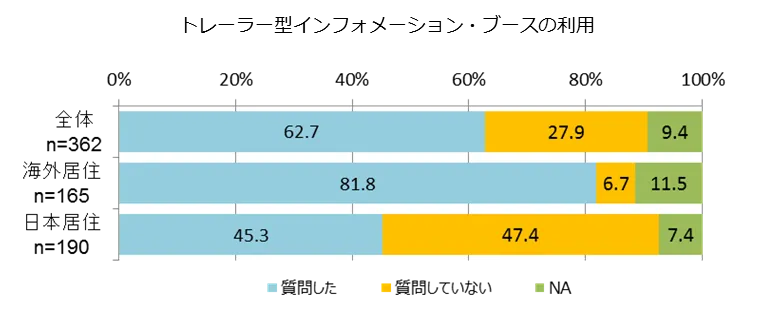
In a questionnaire survey targeting foreign visitors (362 people from 46 countries and regions) who attended events at the survey partner locations, 62.7% of respondents reported using the “Info Box.” When broken down by residence, 81.8% of “Overseas Residents (Visiting Foreigners)” used the service, compared to 45.3% of “Residents in Japan (Foreign Residents in Japan),” indicating a greater need for the service among visiting foreign tourists (Figure 1).
On the other hand, foreign residents in Japan also appear to have a need for this service when visiting events held outside their usual living areas. When interviewed, international students who had used the service reported that even though they understood Japanese to some extent and were accompanied by Japanese friends, they stopped by the “Info Box” for reasons such as “I couldn’t understand unfamiliar festival terminology,” “It was my first visit, so I didn’t know my way around,” “I wanted to know the detailed event schedule in English,” and “The Japanese person accompanying me didn’t know the history or highlights of the festival either.”
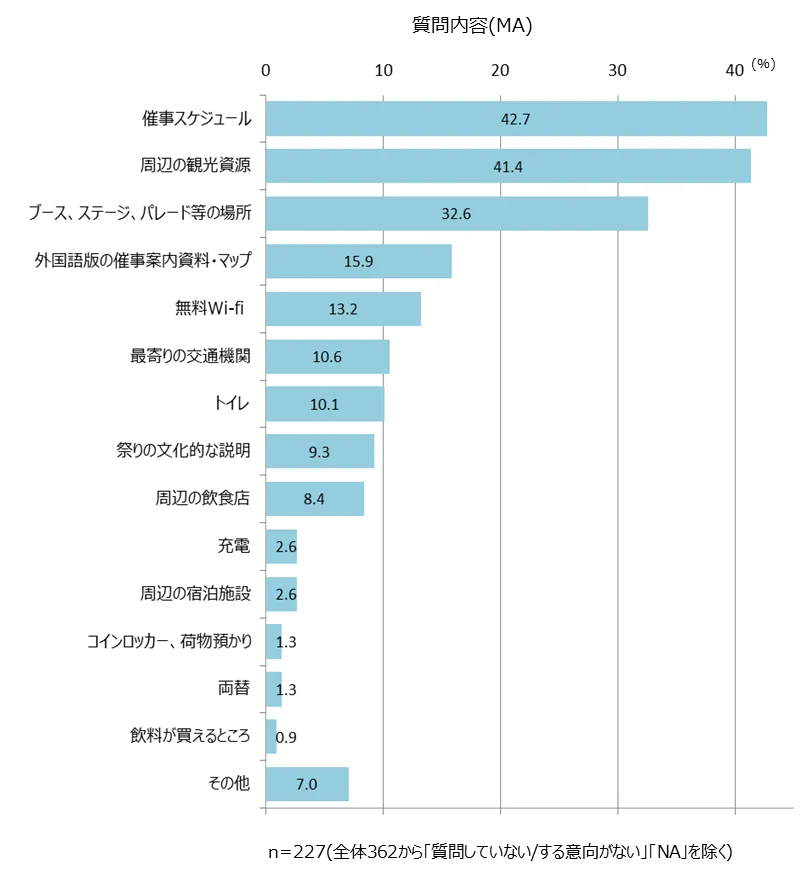
The most common questions were “event schedules (42.7%),” “nearby tourist attractions (41.4%),” and “locations of booths, stages, parades, etc. (32.6%)” (Figure 2), which matched the content and trends recorded in the daily reports by the “Info Box” staff.
(Figure 1) Usage Status
(Figure 2) User Inquiries (multiple responses)
Benefits and Roles of Being Located Where Needed
The survey results revealed that placing “Info Boxes” in “necessary locations” where information centers could not previously be established yields benefits beyond simply improving convenience for event attendees and travelers through the provision of information.
One benefit is that operators gain opportunities for merchandise sales. At the survey sites, foreign tourists asked, “Do you sell souvenirs or drinks?” and similar comments were found in the “Other” section of the questionnaire. Since “Info Boxes” allow operators to easily establish a “base” at the location attracting the most people in the area during events, they can be utilized not only for providing information but also as a showcase for local products and for test marketing.
Another benefit is the creation of safe and secure spaces at night for events and tourist destinations. When we tested nighttime operations, we observed that travelers felt reassured by the “official presence” of the Info Box. In areas where shops close early and the surroundings become pitch-black by 5:00 PM, the Info Box functions as a “lighthouse.” Foreign tourists participating in night tours naturally gathered around the brightly lit Info Box, chatting with staff and guides while waiting for the tour to begin. Having staff on standby at a well-lit “official” booth at night—even at tourist spots or event venues away from the city center—is likely to provide a sense of security not only to foreign visitors but to all travelers.
Aiming for Coexistence and Mutual Prosperity with Existing Tourist Information Centers
Tourist information centers play a vital role as the “face of the town.” Even for temporary installations like the “Info Box,” training staff is essential. The staff training for this project emphasized the principle that “travel memories are shaped by the feelings experienced during one-on-one interactions with local people (i.e., staff).”The ideal training method moving forward is to utilize local talent. For example, this could involve collaborating with local universities to create programs for students and international students that combine lectures on the benefits of inbound tourism with hands-on guidance experience at “Info Boxes.” When developing such programs, it is essential to seek guidance from local tourism associations, DMOs, certified tour guides, and tourism volunteer groups—individuals with a wealth of experiential knowledge about the region—to enhance the quality and quantity of the information provided.
We aim to develop the “Info Box” so that it can be utilized in the future as: (1) a means to supplement existing tourist information centers during peak periods; (2) a hub for promoting the region during the busiest times; and (3) a tool for local human resource development.