Collecting and Sharing "Local Information" by Information Desk Staff: The Digital and Physical Sides of Tourist Information Centers
Ten years after the Great East Japan Earthquake, the tourism industry in the Tohoku region suffered a severe blow not only in coastal areas but also in inland regions. We will examine successful examples of social media-based promotional campaigns aimed at conveying the current situation and encouraging tourists to return, drawing on the activities of the “Mogami Information Center” (Shinjo City, Yamagata Prefecture).
Hiromi Numazawa (Shinjo Tourism Association), who works at the information counter at the “Mogami Information Center” (Shinjo City, Yamagata Prefecture), began sharing information about local attractions on Twitter following the Great East Japan Earthquake, as part of efforts to revitalize domestic tourism.
Now, as domestic tourism garners attention amid the "living with COVID-19" era, we will examine useful insights regarding how tourist information centers—which are uniquely positioned to encourage visits to rural areas—collect local information and manage organizational operations to support their staff.
1. Taking the post-Great East Japan Earthquake domestic tourism recovery as an opportunity, she tentatively began using social media
The Mogami Information Center is a tourist information center serving the eight municipalities*1 of the Mogami region, located in the northeastern part of Yamagata Prefecture (JNTO-certified Category 1 Tourist Information Center for Foreign Visitors). Located approximately three hours from Tokyo via the Yamagata Shinkansen, it is situated within the JR Shinjo Station terminal, and its operation is entrusted to the Shinjo Tourism Association by the Mogami Wide-Area Municipalities Administrative Union.
Surrounded by mountains on all sides and home to extensive virgin forests, the Mogami region is one of Japan’s leading “villages of giant trees.” It boasts tourist attractions such as the “Jomon Goddess” clay figurine (now a National Treasure), boat rides on the Mogami River, the Shinjo Festival’s float processions, and the Hijiori Onsen hot springs, which have been in use for 1,200 years.
One year after the Great East Japan Earthquake, tourist arrivals in the inland prefecture of Yamagata had fallen by 10% year-on-year, while the Mogami region saw a 15% decline*2. Utilizing a dedicated account for the Tohoku Tourism Revitalization Project launched by the Japan Tourism Agency around the same time, the Mogami Information Center began posting regional information on Twitter to promote domestic tourism within the area.
The person in charge was Hiromi Numazawa (Shinjo Tourism Association), who still assists travelers at the information counter today. At the time, Ms. Numazawa was in her late 40s and had no experience with social media; it was a trial-and-error start for the small tourism association, which lacked the necessary know-how.
2. Taking on the Challenge of Figuring Out What a Tourist Information Center Can Do to Attract Visitors
The basic duties of the information counter are to accurately answer questions from travelers during their trip and offer suggestions for enjoying the local area. On the other hand, when it came to sharing information before a trip, it was difficult to determine who to target and what to convey, and the lack of response to posts made for many discouraging days. Ms. Numazawa believed that unique information that captures the interest of travelers, along with consistent sharing of that information, was essential.
(1) Finding themes that spark interest in the entire region
Based on the role of a tourist information center, we created a series of posts covering information relevant to the entire region. The “Dialect Rankings”*3 series tended to attract comments like “interesting” or “nostalgic,” and even drew responses from tourist information centers in neighboring areas, serving as a catalyst for collaboration where staff members shared local information with one another.
For the “Mogami Traditional Vegetables” series, which introduced restaurants serving seasonal local cuisine, we assigned sequential numbers to the posts to encourage interested readers to view both the preceding and following entries.
(2) Creating Experiences Everyone Can Enjoy at the Tourist Information Center
We received a donation of a "Mogamiru" costume—a regional mascot created by the Yamagata Prefecture Mogami General Subprefectural Office—and utilized it as a prop for travelers visiting the tourist information center to take commemorative photos. With the travelers’ permission, we posted photos on Facebook—a skill learned at a workshop in Shinjo City—right on the spot, adding the travelers as “friends.” The striking images, which required no language, drew reactions from foreign travelers, welcoming visitors from Taiwan and Southeast Asia who said things like, “My friend’s photos looked fun, so I came to visit,” or “I came back so my family and friends could experience it too.”
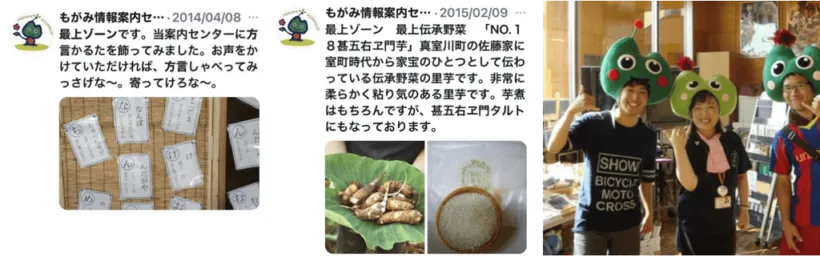
courtesy of the Mogami Information Center
(3) Delving Deep into Local Resources to Accumulate Authentic Information
Whenever new tourist facilities or programs opened in the Mogami region, Ms. Numazawa would visit them on her days off at her own expense to experience them firsthand and identify features that would resonate with travelers. Regarding local festivals and traditional crafts, she spoke with the local people involved and made an effort to convey their passion. This in-depth research allowed her to convey the “genuine feelings of the locals” both in her face-to-face guidance at the counter and in her online communications. She also searched for photo subjects near her home and workplace. During the season when people were eager to know the status of cherry blossom blooms, he would take a detour before his commute to conduct regular observations of cherry trees he had marked as points of interest and post updates.
3. The Organizational Structure That Supported Daily Information Gathering and Dissemination
Ms. Numazawa is a true “idea woman,” but I also want to learn from the organizational structure that allowed her to fully demonstrate her capabilities.
(1) Understanding and Commitment from Her Superiors
During the first few years of the initiative, Ms. Numazawa was able to continue posting daily on her own, squeezing it in between her busy work schedule, because Mr. Koichi Orui, Secretary General of the Shinjo Tourism Association, understood the viral potential of Twitter and, as Ms. Numazawa put it, “let me do what I wanted freely.”
When it comes to the official social media account of a tourist information center, it is natural for a supervisor to want to review the content before it is posted. However, after aligning on the overall direction, Mr. Orui made the decision to entrust the content of the posts entirely to Ms. Numazawa, enabling her to share timely updates that captured the “here and now.” Mr. Orui also maintained a personal account, checking Ms. Numazawa’s posts daily, offering encouragement, and providing guidance to support her.
(2) Cooperation with Volunteer Guide Groups
The Mogami Information Center, open year-round, operates with the cooperation of a local volunteer guide group, with a staff member from the tourism association and one volunteer guide working in shifts to provide counter services. This system offers two benefits to the staff member in charge of information services.
First, it allows them to secure time to engage in various tasks beyond face-to-face guidance, enabling them to build a career as a tourism association staff member. Second, while stationed at the information center, they can learn specialized knowledge—such as stories about the Mogami region’s giant trees, historical anecdotes, and the allegories embedded in folk tales—that stimulates travelers’ curiosity through communication with volunteer guides. This serves as a valuable opportunity to accumulate topics for conversation.
(3) A Network of Personal Connections Within and Beyond the Region
When the information center receives questions or requests that cannot be answered immediately, staff can rely on personal relationships of trust with representatives from local tourism businesses, government agencies, and transportation providers. This allows them to verify detailed and up-to-date information not found on official websites. People associated with the Mogami Information Center—such as the Shinjo Tourism Association and guide groups—contribute their own networks to support the operations at the information counter.
Furthermore, through national and prefectural tourism initiatives and JNTO training programs, we maintain connections with tourist information centers across the Tohoku region. We share local tourism information with one another to facilitate guidance on wide-area tours.
Through these interactions with people we know personally, we have been able to obtain accurate and up-to-date information to share.
4. Disseminating attractive “local information” is key to stimulating demand for short-distance travel in the “With Corona” era
Currently, Miki Imada, a junior staff member, is primarily responsible for our social media outreach on Instagram and Twitter. Compared to the years following the earthquake, there are now more local topics to cover, and Ms. Numazawa’s series has run its course. While this did not lead to an explosive increase in followers or a surge in tourists, during a period when tourism was stagnant, it allowed for the development of talent—including herself—and the establishment of networks outside the region, fostering an atmosphere within the Tourism Association that embraces new challenges.
Ms. Numazawa’s firsthand knowledge and accumulated understanding of the region have been highly valued, leading to increased opportunities for her to engage in tourism-driven community development alongside her regular duties at the tourism association. In addition to serving as an instructor for orientation and guide training programs organized by Shinjo City, Yamagata Prefecture, and the national government, she has recently been involved in developing stylish processed agricultural products for “Shinjo Iinnya Fudo,” a brand dedicated to preserving Shinjo’s food culture.
Nine years ago, domestic tourism promotion in the Tohoku region primarily targeted travelers from the Tokyo metropolitan area, as well as residents within the prefecture and neighboring prefectures. Rather than assuming that “we have no resources as glamorous as those in the Tokyo metropolitan area” or “there are no resources that would feel novel to residents of this prefecture,” the Mogami Information and Guidance Center took a positive view of its assigned region, continuously discovering and promoting the unique aspects that shine through the daily lives and livelihoods of its people.
Now, amid the COVID-19 pandemic, micro-tourism*4 is gaining attention due to local government-sponsored accommodation discount programs for residents and requests for people in major metropolitan areas—where states of emergency have been declared—to refrain from traveling. To stimulate demand for short-distance travel, it is believed that information dissemination that conveys the region’s appeal to local residents through new approaches and raises their interest will be crucial.
Furthermore, when re-examining local resources to uncover new sources of enjoyment, having tourism information center staff participate in brainstorming sessions with local tourism stakeholders may lead to the discovery of hidden treasures in unexpected places and generate new visitor traffic.
Since the functions and information required of tourist information centers vary depending on their location and the size of their coverage area, the example of the Mogami Information Center cannot be applied universally. However, the approach to gathering and disseminating information about nearby attractions, as well as the structure of the organization supporting these efforts, may serve as a useful reference.
5. Creating Region-Specific Strategies for Attracting Visitors Through Tourist Information Centers
In 2020, the Mogami Information Center launched a project called “Letters to Travelers.” This is a relay-style communication initiative where visitors to Shinjo write their travel impressions in a letter, which the next visitor receives and then writes their own message in response*5. Amid travel trends requiring social distancing due to COVID-19 measures, this initiative provided an experience where visitors could connect with others by expressing their feelings about the destination through handwritten words. The initiative provided materials for writing in three languages—Japanese, English, and Traditional Chinese—and was featured in the JNTO’s VJ Information Center Network.
Since tourist information centers serve as physical hubs where travelers, local residents, and fellow travelers meet, this initiative taught us that while methods to sow the seeds of feelings like “I enjoyed my visit” or “I want to come back” can be created locally—even through handmade efforts—we can also convey those sentiments digitally and foster new connections.
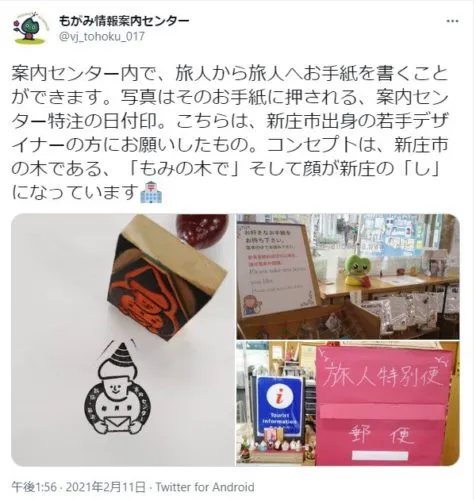
Image courtesy of Mogami Information Center
*1 Shinjo City, Kanayama Town, Mogami Town, Funagata Town, Mamurogawa Town, Okura Village, Sakegawa Village, Tozawa Village *2
From the “FY2011 Yamagata Prefecture Tourist Count Survey. ”The number of tourists in Yamagata Prefecture decreased from 39,433,700 (FY2010) to 35,398,600 (FY2011). In the Mogami region’s eight municipalities, the number fell from 2,497,700 to 2,115,800.The survey report analyzes
the reasons for the decline, stating, “We believe the suspension of some transportation services, people refraining from travel, and the impact of reputational damage caused by the accident at the Tokyo Electric Power Company’s Fukushima Daiichi Nuclear Power Plant played a significant role.”*3 Words were selected and introduced
from the *New Shinjo Dialect Ranking Chart*, compiled in 2012 by students of the Shinjo City history course “Shinjo Han-ko Meirindo.”*4 "Short trips of one or two hours from home," a concept proposed by Yoshiharu
Hoshino, CEO of Hoshino Resorts Co., Ltd.*5 After the Shinjo Tourism Association verifies the contents of the letter, it is sealed in an original envelope with a date stamp.