Business partnership with "Japan Travel Guide +Connect," an app that provides personalized information to travelers during their trips
While the use of digital tools has completely transformed the way people live and work during the COVID-19 pandemic, the tourism sector has also seen remarkable growth in recent years in information services utilizing smartphone apps and other technologies. Based on an analysis of traveler behavior from a pilot study using our smartphone app, “Japan Travel Guide +Connect,” we will introduce the challenges we face in disseminating information and the initiatives we are undertaking to address them.
1. Introduction
The pace of digitalization in society is accelerating year by year, allowing us to enjoy a wide variety of products and services that we could never have imagined before. The tourism sector has also reaped significant benefits from digitalization. For example, the sharing economy has led to the expansion of vacation rentals as an alternative to traditional hotels and inns; big data analysis enables demand forecasting; and virtual and augmented reality are enhancing travel experiences. These developments are giving rise to services that not only offer convenience and cost savings but also contribute to improving the quality of individual experiences. On the other hand, precisely because of this digitalization, a new challenge has emerged: many people feel overwhelmed by the flood of information.
Our company has developed a smartphone application called “Japan Travel Guide +Connect,” focusing on how travelers can obtain “stress-free” and “immediately useful” information during their trips—a period often referred to as “travel time”—to fully enjoy their journeys. By providing tourism information and various features, the app is designed to meet users’ needs based on their specific travel situations, such as “I want to try local specialties” or “It suddenly started raining, so I want to go to an indoor tourist spot.”
Currently, while enhancing convenience for travelers, we are conducting a pilot project in collaboration with local tourism operators and various industries. By analyzing traveler behavior, we aim to help solve challenges faced by both travelers and businesses. In this article, we will introduce some of the insights gained from our efforts to explore the optimal way to provide information during travel.
2. An Application That Provides Relevant Information Based on Current Location to Stimulate Potential Needs
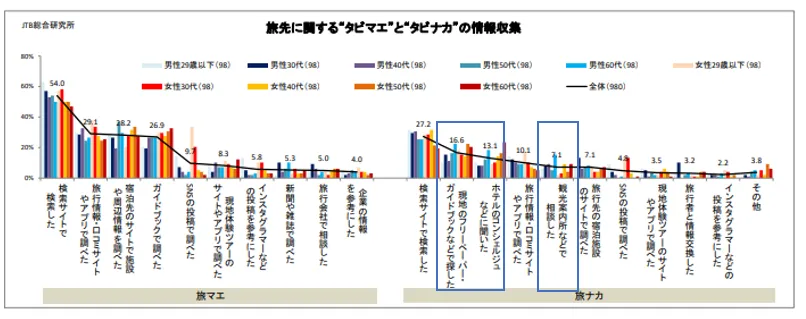
We have entered an era where it is commonplace to obtain travel destination information from websites and social media. However, the way people access information differs between the “pre-trip” phase and the “during-trip” phase, and the dynamics are slightly different. In our past surveys asking about information sources before and during travel, we found that during travel, “searching on search engines” accounted for 27.2%—roughly half of the 54% recorded for the pre-trip phase. In contrast, “reading local free pamphlets or guidebooks (16.6%)”, “asking hotel concierges or similar staff (13.1%)”,"asked at a tourist information center (7.1%)"—all of which are real-world sources involving local people or printed materials—followed closely behind. This shows that travelers seek up-to-the-minute information that can be obtained "right then and there" during their trip. (See Figure 1).
Figure 1: Gathering Information at the Destination (Regarding information gathering in the immediate vicinity)
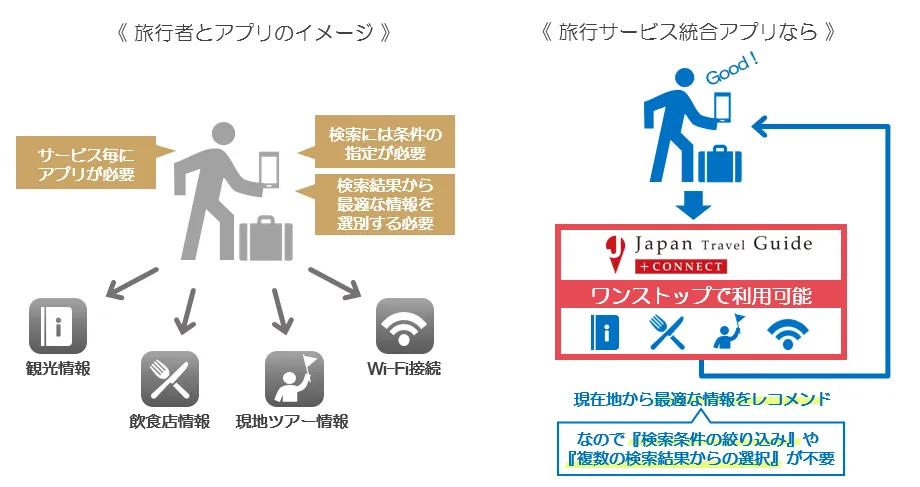
Japan Travel Guide+Connect is an application specialized in providing travelers with information tailored to their current location. It contains content such as nationwide tourism information, experiential programs, and restaurant listings. Furthermore, it integrates Wi-Fi connectivity, translation features, and multilingual product descriptions into a single platform, allowing users to access information tailored to their individual preferences in the vicinity of their current location without having to use multiple applications. (See Figure 2).
Figure 2: Application Concept Diagram
3. Marketing Features for Effective Application Utilization from a Business Perspective: Japan Travel Bridge
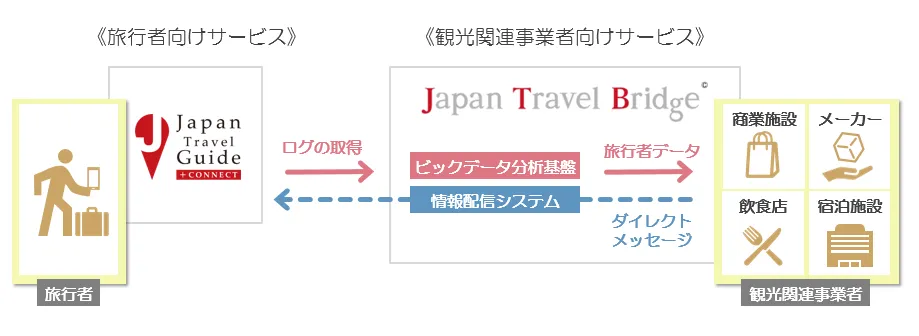
We offer a service called Japan Travel Bridge to businesses seeking to contribute to regional economic revitalization through travelers. This service uses Japan Travel Guide +Connect—our user-facing service—as the customer touchpoint, enabling businesses to directly distribute information to app users and collect behavioral data for analysis (see Figure 3).With this information distribution system, tourism businesses can deliver information tailored to travelers’ movement patterns to promote store visits (or event attendance), increase average spending per customer, and attract repeat visitors. For example, by sharing information about local shops known only to locals—which are not featured in tourist magazines or websites—or about locally sourced specialties harvested that very day, businesses can convey the lesser-known charms of the region to travelers.
By collecting and analyzing non-personally identifiable data—such as users’ nationality, region of residence, gender, age group, and base of stay during their trip—this app enables the identification of previously vague user profiles and the refinement of targeting.
Figure 3: Architecture of the Japan Travel Bridge Solution
4. Initiatives to Explore Optimal Methods for Providing Travel Information Using Japan Travel Bridge
(1) Initiative with Fukuoka International Airport Co., Ltd.
In collaboration with Fukuoka International Airport Co., Ltd., we verified the impact of providing information during travel by creating customer touchpoints with airport users. While Fukuoka International Airport aims to “expand its international network and contribute to regional revitalization by increasing the number of visitors,” its operations are limited to Fukuoka Airport, meaning the timing of information dissemination has been restricted to within the airport.
To explore the potential for airport-based customer touchpoints to contribute to the revitalization of the Kyushu region, this pilot project issued discount coupons redeemable at airport duty-free shops to users who downloaded the app at the airport, and verified the effect on purchasing behavior. Compared to a blanket announcement made regardless of timing, this initiative—which provided information at the moment users were considering purchasing souvenirs—was found to double the usage rate.In addition to confirming the importance of the timing of information provision, we were able to verify the usefulness of airport-based information delivery methods during travel. Although this initiative was limited to the airport premises, we believe that by collaborating with tourist facilities, retailers, and restaurants within the Kyushu region to expand these efforts, we can identify opportunities to revitalize visitor traffic and generate economic ripple effects within the region.
(2) Initiative with Sapporo Holdings Ltd. in Sapporo
In collaboration with the Sapporo City Tourism Association, we conducted a pilot project with Sapporo Holdings Ltd. aimed at promoting consumption, encouraging visitors to explore the area, and gathering data on visitor trends. As Hokkaido is the company’s home region, we aim to contribute to the revitalization of the local economy.
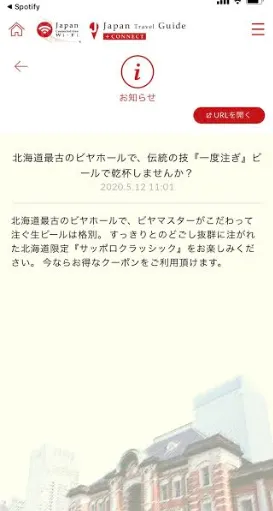
For this initiative, we sought the cooperation of the Sapporo Tourist Information Center at JR Sapporo Station (operated by the Sapporo City Tourism Association), the Sapporo Beer Garden, the Sapporo Beer Museum, and restaurants such as Ginza Lion and Aburiya. We promoted app downloads and distributed information to Wi-Fi users at these locations encouraging them to visit partner facilities (see Figure 4).
Figure 4: Example of information distributed to encourage visits
Since this initiative began in mid-January 2020, it was affected by the COVID-19 pandemic, and while we were unable to verify its effectiveness in promoting visitor circulation, we were able to establish a system that utilizes push notifications to drive traffic between facilities.
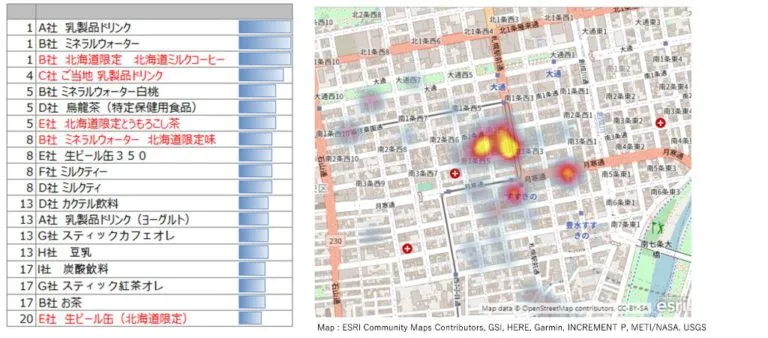
In addition, by analyzing the app’s usage logs, we conducted an analysis to identify purchasing trends—specifically, where in Sapporo, who (by nationality, gender, and age group), and what types of products people were interested in. We found that purchase intent was high for products clearly labeled as Hokkaido-exclusive or made with local specialties, and that purchasing opportunities were most frequent along Tanukikoji Street (see Figure 5). This demonstrated that the data can be utilized as objective information when considering product development and sales promotions.
Figure 5: Data on purchasing intent obtained from application usage logs
Through these two initiatives, we verified that providing information in a planned manner aligned with travelers’ behavior can lead to changes in their behavior during their trip. Furthermore, we found that GPS data and usage logs obtained from the application can be used as objective evidence for measures that lead to economic revitalization—such as formulating strategies for sales promotion, product development, and PR; refining tourism content; and promoting circulation—by identifying users’ travel purposes, behavior during their trip, and purchasing intent.
5. Challenges Identified Through These Initiatives and Future Directions
On the other hand, we have identified the following two issues that require attention moving forward.
The first is the creation of a system to identify each user’s daily lifestyle and preferences and optimize the delivery of information at their travel destination on an individual basis. In this initiative, the timing of push notifications was set manually based on hypotheses derived from attribute information and location data registered in the application. By accumulating non-personally identifiable data and identifying individual preferences, we can, for example, for users who frequently visit campgrounds on weekends, we could send information about fresh fish just landed at a local fishing port, encouraging them to stop by the market on their way to the campground. Similarly, when promoting traditional folk arts events, we could target users who regularly attend theaters. We need a system that allows us to easily narrow down segments based on individual preferences.
Second, to ensure that travelers visiting a region enjoy their experience to the fullest, the delivery of personalized information should not be the sole responsibility of a few tourism-related businesses. Instead, various local businesses across different sectors must collaborate to collectively promote the region’s appeal. We believe that as this initiative spreads nationwide, it will lead to new discoveries about the region not only during travel but also in everyday life.
Finally, as part of tourism in the “New Normal” era, the Japan Tourism Agency has compiled “New Travel Etiquette,” which emphasizes “contactless” and “distributed” travel.
In this so-called “new normal” era, Japan Travel Guide +Connect and Japan Travel Bridge aim to optimize the promotion of regional appeal by providing information tailored to individual preferences. By encouraging the “decentralization” of people’s activities, we hope to contribute to the realization of satisfying travel experiences for everyone, even amidst the COVID-19 pandemic.