What New International Routes Will LCCs Launch with Their New Aircraft?

Low-cost carriers (LCCs) have become firmly established in Japan. Many of you have likely flown with them already. The main aircraft used by LCCs are short-haul, small-body models such as the Airbus A320 series and the Boeing 737 series. Aircraft manufacturers have been working to develop models with high fuel efficiency and long range to meet the needs of airlines. This article focuses on the “A320neo,” the latest model in the Airbus A320 series—which holds the largest market share among LCC aircraft—and explores the potential for new international routes that this new aircraft, which can no longer be called merely a “short-haul” aircraft, is opening up for LCCs.
During the 2017 Golden Week holiday period, Citylink, the low-cost carrier (LCC) division of Indonesia’s major airline Garuda Indonesia, operated charter flights between Fukuoka and Denpasar (Bali, Indonesia).
Since small aircraft such as the A320 and Boeing 737 do not have sufficient range for this route, it is typically operated by large aircraft with longer range. However, for this charter flight, Citylink introduced the “A320neo,” a new model in the A320 series developed by Airbus. Compared to conventional models, this new aircraft significantly extends range, making long-haul flights like the Fukuoka–Denpasar route possible.
The world’s two major aircraft manufacturers are Boeing in the U.S. and Airbus in Europe. Both companies have achieved success by introducing small aircraft with a seating capacity of around 180 passengers: the Boeing 737 and the Airbus A320.Japanese airlines currently operate a combined total of 256 aircraft of these two types, with the A320neo and Boeing 737 in service not only at low-cost carriers (LCCs) but also at full-service carriers like ANA and JAL. In particular, the A320 series accounts for 56% of the fleet used by LCCs on international routes to and from Japan, and a staggering 91% of the fleet used by LCCs on domestic routes. So, how will the introduction of the A320neo—with its significantly extended range—impact the future route expansion of LCCs?
The Airbus A320neo: Improved Fuel Efficiency Leads to Increased Range
The existing model of the A320 series is known as the A320ceo (current engine option). Airbus announced the development of the new A320neo (new engine option), which improves fuel efficiency and range primarily through the installation of new engines, and has secured orders for over 5,000 aircraft worldwide. Deliveries to airlines have already begun.
Improved fuel efficiency not only reduces operating costs but also means the aircraft can fly farther on the same amount of fuel. The manufacturer-stated range for conventional CEO aircraft is 5,950 km (for the A321), but this figure represents the maximum distance under specific conditions. In actual operations, factors such as flight routes, passenger and cargo weight, weather conditions, and reserve fuel requirements come into play, so the actual operational range is almost always shorter. To date, the longest route operated by an LCC using CEO aircraft has been the 3,724 km route between Fukuoka and Bangkok, and it is realistic to consider this the de facto longest route.
The NEO’s range is approximately 900 km greater than that of the CEO. The sum of the CEO’s maximum range (3,724 km) and the NEO’s increased range (900 km) means it is now possible to launch routes covering distances of up to 4,624 km. As mentioned at the beginning, long-haul routes have traditionally relied on large aircraft, but the increased range of the new aircraft model has opened up the possibility of launching long-haul direct flights using smaller aircraft, such as the A320 series. Furthermore, because these aircraft have fewer seats than large aircraft, the likelihood of achieving profitability even on routes with a small market size is higher. Furthermore, for airlines that have been operating the A320, the introduction of the A320neo will allow them to embark on developing new routes while maintaining and utilizing their existing route networks, airport facilities, and crew. In other words, they can expect to expand business opportunities while limiting new investments and the need to secure other management resources.
Projected New Direct Routes for the A320neo
So, with the arrival of the A320neo, which cities will become new targets for LCC direct flights? The author first identified potential cities for direct flights originating from Narita Airport.
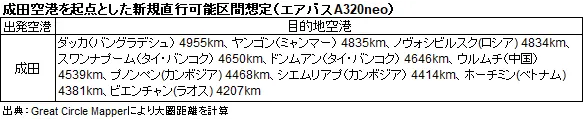
The results indicate that Bangladesh, central Russia, and Southeast Asia fall within this range. It is particularly noteworthy that the possibility of operating flights to the Indochina Peninsula—specifically Vietnam, Laos, and
Cambodia—as well as Thailand has emerged. The Japan-Thailand and Japan-Vietnam routes, with their large market sizes, appear especially promising.
There is no doubt that Thailand is an extremely popular tourist destination. The number of Japanese tourists visiting Thailand already surpassed the 1 million mark in 2010 and increased to 1.44 million by 2016. Furthermore, against the backdrop of economic development in Southeast Asia, overseas travel has become a boom in Thailand, with trips to Japan being particularly popular. The number of Thai tourists visiting Japan, which stood at 210,000 in 2010, more than tripled to 900,000 by 2016. This growth was partly driven by the Japanese government’s decision in July 2013 to abolish tourist visas for Thai passport holders, and further increases are expected in the future.
In the 2017 summer schedule, the annual number of airline seats between Japan and Thailand was approximately 2.7 million, representing a nearly twofold increase compared to 2010. Of these, 76% were operated by legacy carriers such as JAL, ANA, and Thai Airways, while 22% were operated by long-haul LCCs using large aircraft, such as AirAsia X. The share of LCCs using smaller aircraft remained at just 2%.
In Thailand, the use of LCCs has become well-established, particularly for domestic and short-haul international flights. According to the Bangkok Post, a leading Thai newspaper, approximately half of the passengers using Thailand’s six major airports in the first half of this year were LCC users. Peach Aviation, a Japanese LCC, is conducting aggressive promotional campaigns targeting the inbound travel market from Thailand, where LCCs have become well-established. Currently, the company operates only the Naha-Bangkok route under the leadership of its CEO, but with the future delivery of NEO aircraft, it will be possible to launch new routes connecting other Japanese cities with Bangkok.
Similar to Thailand, economic development in Vietnam has sparked a boom in overseas travel. Combined with measures by the Japanese government, such as significantly easing the conditions for issuing tourist visas, the number of Vietnamese tourists visiting Japan has increased substantially. The Japanese LCC Vanilla Air currently operates a route from Narita to Ho Chi Minh City (Vietnam) via Taipei. Once deliveries of the NEO aircraft to the company begin, direct flights between Japan and Ho Chi Minh City will also come into view.
Let’s also take a look at routes to and from Fukuoka. This will make it possible to operate flights to Kuala Lumpur (Malaysia) and Singapore, which previously relied on larger aircraft. It will also enable the launch of direct flights to popular tourist destinations such as Kathmandu (Nepal) and Phuket (Thailand).

LCCs Are Actively Ordering New Aircraft
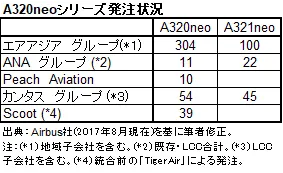
According to the ANA Group’s mid-term management plan, a large-scale expansion of its LCC operations is planned. Recently, the group’s LCC, Peach Aviation, applied to the Ministry of Land, Infrastructure, Transport and Tourism for a reservation of registration to introduce new aircraft. The plan calls for the delivery and commencement of operations of 30 A320 aircraft, including the A320neo series, over the next four years.
Although the AirAsia Group withdrew from the Japanese domestic LCC market four years ago, it has recently re-entered the market as the “new” AirAsia Japan. The group as a whole has placed orders for approximately 400 neo aircraft, and we can expect it to strengthen its routes to and from Japan in the future. In addition, the Australian Qantas Group, which operates Japan’s largest LCC, Jetstar Japan, and Scoot, the LCC of the Singapore Airlines Group, have also placed large orders for neo aircraft.
In Conclusion
In recent years, the number of foreign tourists visiting Japan has shown significant growth, reaching approximately 24 million in 2016. LCCs are particularly expected to serve as a key transportation solution to accommodate the increasing number of tourists from ASEAN countries, which are experiencing remarkable economic development.
In an interview with an industry publication, an executive from an LCC operating the A320ceo commented on the aircraft’s size and range, stating, “The A320’s 180 seats are just the right size,” and “The A320neo (with its longer range) opens up various possibilities; if it can fly an additional hour and a half (compared to the A320ceo), we could operate routes to destinations like Bangkok and Denpasar,” expressing optimism. He also suggested that range, rather than seat capacity, has the potential to transform the LCC business in the future.
In any case, the increased range of these smaller aircraft is expanding the possibilities for LCCs to launch new routes. While this poses a threat to competing legacy carriers and other LCCs, it also means consumers will have a wider range of choices for affordable travel.
*1 Calculated based on great circle distance. Charter flight routes excluded.
*2 Source: “LCC’s bite into legacy carriers’ air traffic,” Bangkok Post, August 21,
2017 *3 Covers orders placed by both Peach Aviation and the ANA Group.
*4 Source: Aviation Wire, December 12, 2015, Yu Kataoka of Jetstar Japan.
著者