Initiatives to Position National Parks as Travel Destinations by Enhancing the Value of Nature-Based Experiences

In this paper, we examined the meaning of the “high value-added” content that the guidelines aim to achieve, based on the “Guidelines for Nature Experience Content in National Parks” (*1) formulated by the Ministry of the Environment and case studies of content development initiatives that incorporate the guidelines’ perspectives.
1. Developing National Parks as Travel Destinations
In 2016, the Ministry of the Environment launched the “National Parks Enjoyment Project.” Aiming to transform national parks into world-class travel destinations, the project has been implementing measures to improve reception facilities—such as renovations geared toward inbound tourists—and conducting promotional activities in eight parks (later expanded to 11).
While the idea of utilizing national parks as tourism resources for inbound visitors appears to have been envisioned since the parks’ inception, efforts to meet the rapidly expanding domestic demand for recreation and tourism following World War II—such as the development of National Holiday Villages—were implemented. However, the “National Park Enjoyment Project” can be considered the first initiative specifically positioned to target foreign tourists (*2).
Following the project’s launch, and against the backdrop of growing numbers of foreign visitors to Japan, the number of visitors to national park areas increased steadily until 2019. However, this growth primarily reflected increased visits to national park areas containing popular inbound destinations such as Nikko and Hakone; the actual situation regarding domestic and international travelers visiting national parks specifically as destinations to stay and experience them was not fully understood.
In 2020, when both inbound and domestic travel came to a standstill due to the COVID-19 pandemic, the Ministry of the Environment conducted a review of the five-year project and outlined the direction for promoting tourism to national parks in the post-pandemic era as the “Policy for Initiatives from 2021 Onward” (*3).The policy outlined measures to enhance the brand power of the national parks themselves, improve the quality of park use, and develop content centered on human activities—such as the history and culture nurtured within the natural environments that characterize Japan’s national parks. It confirmed the importance of not merely increasing the number of visitors to national park areas, but rather increasing the number of visitors who come specifically to stay in the parks, thereby fostering a “virtuous cycle of conservation and use.”
2. Overview of the "Guidelines for Nature Experience Content in National Parks"
To increase the number of visitors who come specifically to stay in national parks—that is, to position national parks as travel destinations—it is necessary to improve the “quality” of the nature experience content offered within the parks, or in other words, to “enhance their value.”In accordance with the “Policy for Initiatives from 2021 Onward,” the Ministry of the Environment formulated guidelines (*3) aimed at branding national parks and revitalizing local communities through the high-value-added enhancement of nature experience content. These guidelines are directed at stakeholders such as businesses, local governments, and regional tourism promotion organizations that develop and provide various nature experience content within national parks.
Based on a review of domestic and international literature, as well as discussions with experts and practitioners in fields such as “ecotourism” and “adventure tourism,” the guidelines outline the perspectives necessary for creating content and developing communities that allow visitors to national parks to fully experience the unique appeal of each park.
The content is designed to help businesses providing nature experience programs conduct self-assessments of their initiatives and identify any missing perspectives, thereby improving the quality of their offerings. It also broadly outlines the perspectives necessary to facilitate communication with tourism promotion organizations—such as government agencies and Destination Management Organizations (DMOs)—as well as regional offices of the Ministry of the Environment, and to link these efforts to broader regional initiatives.
The introduction to the guidelines illustrates a circular model within the region that the guidelines aim to achieve through their use by content providers. (See Figure 1)
By providing high-value-added content that leverages resources unique to national parks—such as their natural environments and the local lifestyles and cultures nurtured within them—travelers can gain highly satisfying experiences that lead to a transformation of their own values through inspiration, joy, and learning. Meanwhile, content providers can enhance the sustainability of their businesses by increasing the unit price of their content and encouraging repeat visits from travelers, thereby contributing to the local community and economy.Furthermore, within local communities, the revaluation of the region’s natural environment and culture fosters a desire to preserve and pass on these assets, leading to the creation of regions that continue to be chosen by travelers.
This framework outlined in the guidelines aligns with the “VICE Model” presented by the United Nations World Tourism Organization (UNWTO) in 2007. The “VICE Model” emphasizes the need to evaluate regional tourism promotion efforts not only from the perspective of the tourism industry but also from four key dimensions: visitors (Visitor), local industries (Industry), the local community (Community), and the natural and cultural environment (Environment and Culture).Only by considering these elements and clearly articulating a regional vision that leverages tourism and exchange can we weave the region’s “story”—the cornerstone of high-value-added development—that defines who we want to reach, what regional charms we wish to convey, and what we want visitors to see and experience.

The specific content of the guidelines breaks down checklists for each of the three perspectives—"Content Creation," "Safety Measures and Crisis Management," and "Environmental Contribution and Sustainability"—and further divides these items into two main phases (see Figure 2).
Phase 1 covers basic items that ensure the quality of content through individual initiatives by content providers. Phase 2, building on Phase 1, focuses on proactive engagement in safety measures and crisis management—such as adding narrative depth to content, providing advanced guiding,establishing criteria for deciding whether to conduct activities, and contributing to the local community and economy. These items are organized with examples to illustrate how providers can achieve them by building relationships with various local stakeholders to further improve content quality.
As shown in Figure 1, in order to create a virtuous cycle where content providers, travelers, and local communities mutually benefit from the high-value-added nature of nature experience content—while preserving the natural environment and local culture and contributing to the branding of national parks—it is necessary for more providers to implement Phase 2 initiatives, namely community-oriented initiatives.

3. Initiatives for Adding Value Using the Guidelines: A Case Study of Winter Content Development in Togakushi
In FY 2022, a project was implemented to support the creation of high-value-added content that incorporated the perspectives of these guidelines, particularly those of Phase 2. This section introduces initiatives in the Togakushi area of Myoko-Togakushi Mountain Range National Park, in which the author also participated.
Set against a backdrop of rugged mountains featuring a series of eroded rock cliffs, Togakushi has been a site of mountain worship where myths have been passed down since ancient times. By the Kamakura period, it was counted among the major sacred sites, rivaling Mount Koya and Mount Hiei. The number of shukubo (temple lodgings) where pilgrims could rest and recover increased, and the area once bustled with a cluster of lodgings so extensive it was known as “Togakushi’s Three Thousand Lodgings.”This cluster of temple lodgings, which encapsulates Togakushi’s history and living culture, was designated as a Preserved District of Important Traditional Building Groups—the first such designation for a group of temple lodgings in Japan.
For this project, we targeted foreign tourists—primarily from Europe and the United States—who possess strong intellectual curiosity and an interest in the natural environment, local history, and culture, as the primary audience for high-value-added content. Under the theme of “experiencing the history and culture nurtured by nature, and the very essence of people’s lives since ancient times,” we developed a program centered on winter temple lodging experiences and snowshoe trekking, designed to allow visitors to deeply appreciate the harshness and bounty of the natural environment, as well as the daily lives of the people of Togakushi.
The town of Togakushi is centered around Togakushi Shrine, which consists of five shrines: Okusha, Nakasha, Hokosha, Kuzuryusha, and Hinomikosha. The owners of the shukubo are all Shinto priests affiliated with Togakushi Shrine. Consequently, community ties are strong, and the Togakushi Tourism Association—which took the lead in developing this content—had already established good relationships with the shukubo, local tourism businesses, and other community stakeholders.Nevertheless, given existing customs and horizontal connections, taking on the new challenge of creating high-priced products designed for inbound tourists required careful consideration of the stakeholders involved.The Tourism Association’s decision to focus on winter content stems from a desire to implement the initiative during the winter season—when tourist numbers decline and it is easier to build consensus around new initiatives—and to expand these efforts into broader regional initiatives by steadily accumulating tangible results. Such meticulous consideration from a medium- to long-term perspective is a crucial process for realizing the vision within the region.
While there is already a wealth of literature on Togakushi—a region rich in history and culture—and its charms have arguably been exhaustively described, we developed a three-day, two-night program by discussing the value of Togakushi we wish to convey to participants and crafting a cohesive narrative that weaves together the appeal of each individual winter activity. Below, we reflect on the monitoring tour.
On the first day, we arrived in Togakushi leisurely in the early afternoon and gathered in the serene interior of the historic “Miyazawa Ryokan” to hear an explanation of the program’s narrative and the schedule for the three-day, two-night stay. We walked along the snow-dusted approach to the Nakasa Shrine. After the shrine priest offered a prayer for the tour’s safety, we stepped outside to find that the sun had already set.Togakushi is synonymous with soba. While soba is a staple of the temple lodging’s meals, we added a soba-making experience before dinner. Using fresh soba flour blessed at Togakushi Shrine and the cold, ultra-soft water of Togakushi—which is also an object of worship—we made soba using the traditional Togakushi technique of “Ippon-bō Maru-noboshi” (rolling with a single rod) while listening to the soba master’s explanations.Meals at Miyazawa Ryokan feature seasonal ingredients harvested in Togakushi, and each dish—carefully prepared one by one—is served alongside an explanation from the skilled innkeeper. Finally, the soba noodles made by three participants are served one by one in bamboo baskets—a traditional Togakushi craft—using the local “botchimori” serving style.Guests are invited to guess who made each bowl of soba. The differences in kneading, rolling, and cutting techniques result in distinct textures and flavors, making it a delightful experience that highlights each participant’s unique style. After the meal, guests enjoy a performance of Gagaku (traditional Japanese court music). The performers include the innkeeper and Shinto priests who each run their own temple lodgings. Sacred sounds resonate through the quiet temple lodgings, blanketed in deep snow.The landlady took out a bronze mirror from the room, and as we all looked at it, it rolled out of its wooden frame. We discovered that the back of the frame bore the name of a donor and the era name from the Edo period. The guesthouse is so full of historically significant items that even today, new discoveries like this are still being made.

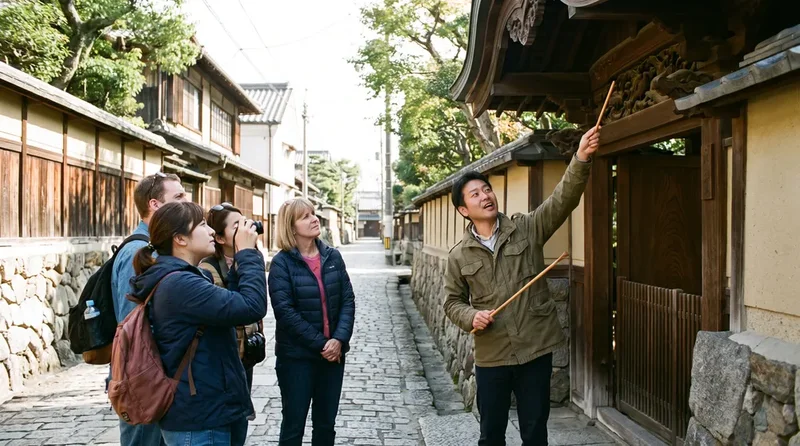
to content and providing support using the National Park Nature Experience Content Guidelines (Photo by the author)
The next morning, after savoring an exquisite rice porridge, we set out on snowshoes through the forest alongside the approach leading to the Okusha Shrine—a path covered in powder snow that can only be walked at this time of year—while listening to the guide’s explanations. We emerged at the Zuishinmon Gate, located halfway along the approach, took in the sight of the path lined with massive cedar trees leading to the Okusha Shrine, and then re-entered the forest to trek to Kagami Pond.Upon arriving at the ice-covered Kagami Pond and looking back, the magnificent snow-capped Togakushi mountain range spread out before us, captivating everyone’s gaze. We gathered snow to build a table and, gazing up at the Togakushi mountains, warmed ourselves with hot soup made from mushrooms harvested in the fall and coffee slowly brewed using a bamboo dripper.
On the final day, after some free time, the program concluded with a prayer service led by the host, who had changed into ceremonial robes at the shrine within the temple lodging. While traditional program planning inevitably tends to focus on efficiently filling every spare moment, creating high value-added experiences requires “subtraction rather than addition.”

4. The Significance of "High-Value-Added" Initiatives
Led by the Tourism Association and created in collaboration with the temple lodgings, Togakushi Shrine, soba artisans, trekking guides, and restaurants, Togakushi’s content—built around a single theme and narrative—can be considered a model that incorporates many elements of Phase 2 of the guidelines, which emphasize a community-oriented approach. However, several challenges remain. In particular, a shortage of guides is a common challenge faced by regions aiming to create high-value-added content.To enhance the satisfaction of travelers—who are the target audience for high-value-added content and possess a strong intellectual curiosity to learn more about the region and interact with local people—guides must do more than simply convey specialized knowledge. They must engage in regular fieldwork and communication with local residents so they can respond to travelers’ unexpected perspectives. This requires the skills of a “value interpreter” who can flexibly convey the region’s appeal in a way that aligns with travelers’ interests.
Furthermore, building consensus with local stakeholders regarding high-value-added content initiatives and ensuring the continuity of regional efforts through the setting of targets require a reevaluation of traditional tourism concepts and the very nature of current hospitality practices. Even in Togakushi, where the tourism association maintains strong ties with the community, these hurdles are by no means low.
The COVID-19 pandemic has served as an opportunity to reexamine the various challenges inherent in traditional tourism promotion, which was based on quantitative metrics such as “visitor numbers × spending.” In recent years, a sustainability perspective has become an international requirement for regional tourism promotion.Furthermore, in an era where “value” is consumed and the “meaning” of visiting a region is questioned, rethinking regional value and creating high-value-added tourism content that aims to contribute to local communities is not merely one option for future tourism promotion and regional development—it is an essential undertaking.
<References>
1: Ministry of the Environment, 2023, "Guidelines for Nature Experience Content in National Parks (ver. 3.0)"
2: Yusuke Mizuchi, 2018, “The Genealogy of Inbound Tourism in National Parks: From Seiroku Honda and the Birth of National Parks to the ‘National Park Enjoyment Project’” Forest Science, Vol. 82
3: Ministry of the Environment, 2020, “Policy Directions for the National Park Enjoyment Project from 2021 Onward”
* Katsutoshi Yoshiguchi, 2023, “Adding High Value to Nature Experience Content in National Parks: Toward World-Class Travel Destinations,” *Transportation and Economy*, January 2023 Issue, Institute of Transportation Economics
著者