Changes in the Environment Surrounding School Trips

Starting in FY 2020, the COVID-19 pandemic led to the cancellation or rescheduling of school trips. After a period of recovery, what is the current state of school trips? We will examine the future of school trips based on the current situation and recent examples.
1. The COVID-19 Pandemic and Recent Changes in School Trip Implementation
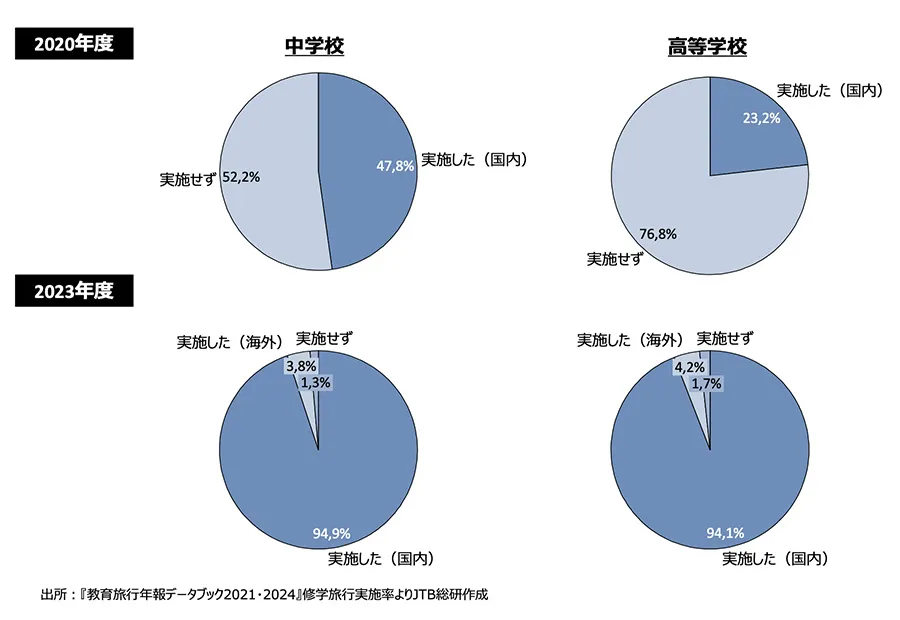
Looking at changes in the implementation of school trips during the COVID-19 pandemic in FYs 2020 and 2023, a high percentage of both junior high and high schools postponed their trips in FY 2020. In the case of high schools, which often travel relatively far from their home prefectures, nearly 80% of schools were unable to hold their trips.
In contrast, the situation changed dramatically in FY 2023, with most schools holding their trips, effectively returning to conditions similar to those before the COVID-19 pandemic. (Figure 1)
So, were there any changes in the destinations?
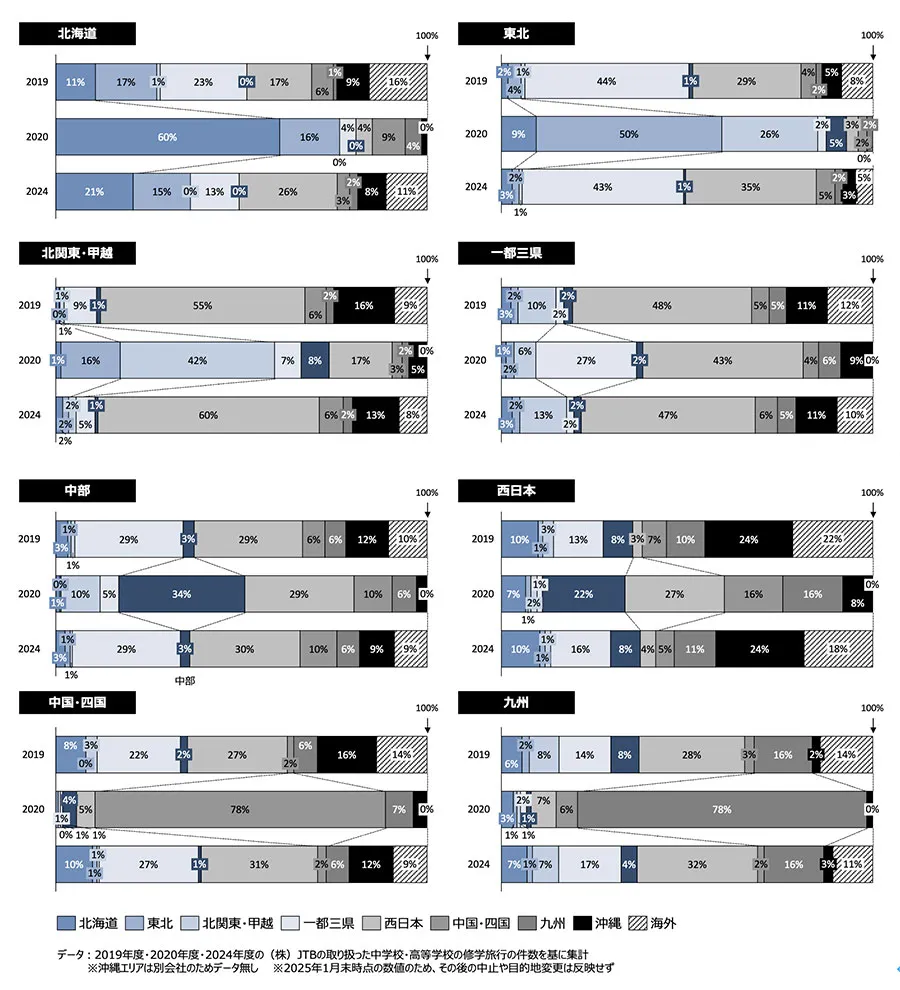
Looking at the destinations by departure location for the FY 2020, as reported by JTB Corporation, many schools—as mentioned in my previous column—shifted from previously chosen distant destinations to destinations within their own prefecture or neighboring prefectures. However, for the most recent FY 2024, we can see that the situation has returned to a state quite close to that of the FY 2019, before the COVID-19 pandemic.
However, overseas destinations have not yet recovered to FY 2019 levels in any region, likely due to the impact of the weak yen, rising prices, and changes in the aviation industry. Additionally, a slight decline in trips to Okinawa is a common trend across domestic destinations. (Figure 2)
2. Challenges Following the Recovery
While both the implementation rate and destination trends appear to have returned to pre-pandemic levels, it is also true that new challenges are emerging due to changes in the economic situation and the tourism environment.
Issues such as soaring travel costs, overtourism driven by the rapid increase in inbound tourists to Japan, and a reduction in the supply of buses and accommodation due to a shortage of staff have begun to have a significant impact on school trips as well.
Let me share a few examples from our own experience.
(1) Soaring Hotel Rates in Tokyo
On January 22, 2025, the Tokyo Hotel Association (Chairman: Hikoji Takabe) announced the Average Daily Rate (ADR) and Revenue Per Available Room (RevPAR) for its approximately 260 member hotels over the past four years. According to the announcement, the ADR, which was approximately 10,000 yen in January 2020, had increased to approximately 20,000 yen by December 2024—effectively doubling.(Figure 3)
Recently, there have been reports that business travelers on trips cannot find hotels that fit within their company’s accommodation budget and are forced to look for hotels outside the city center. I believe the same can be said for school trips, which are subject to pre-set travel expense limits.
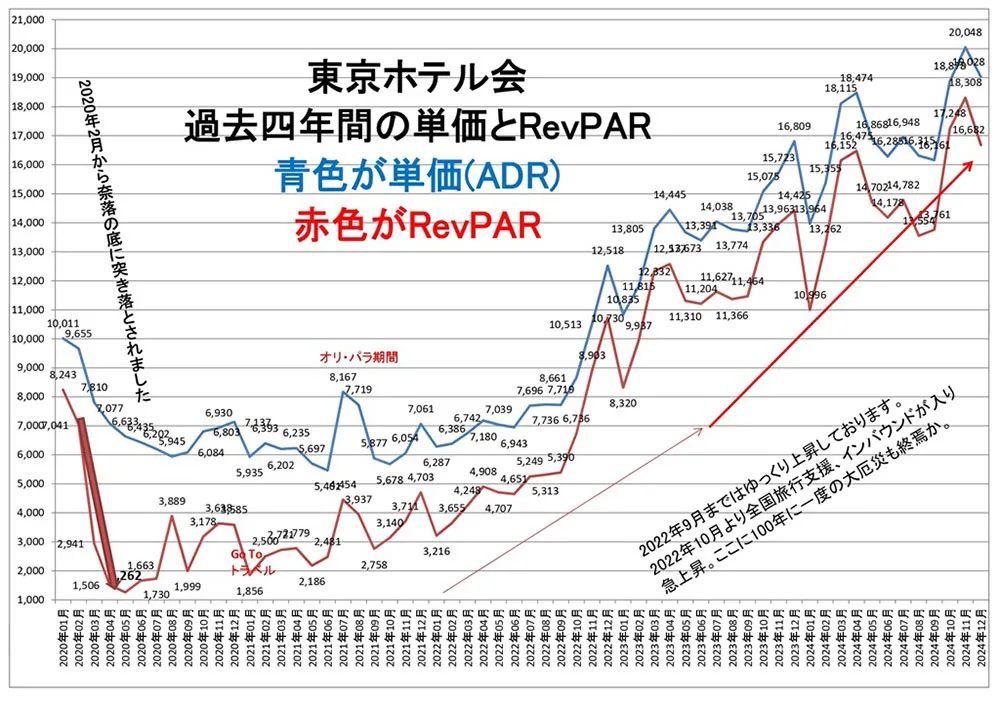
COVID-19 Pandemic to the Present (Source: Tokyo Hotel Association, “Report on Four-Year Trends During the COVID-19 Pandemic (December 2024)”)
(2) Shortage of Drivers Makes It Difficult to Arrange Chartered Buses
According to estimates by the Japan Bus Association in 2023, if the 2022 level of transportation volume is to be maintained through 2030, there is expected to be a shortage of approximately 36,000 drivers. Indeed, as referred to as the “2024 Problem,” a shortage in bus supply is becoming apparent due to reduced driver working hours resulting from limits on overtime work.
Furthermore, combined with the rapid increase in demand from foreign tourists visiting Japan, some travel agencies have actually been unable to arrange chartered buses, leading to situations where parts of school trip itineraries had to be changed at the last minute or participants were switched to alternative modes of transportation, such as trains.
The departments within travel agencies responsible for arranging accommodations and transportation are constantly scrambling to manage the peak season when demand for school trips peaks. They must carefully balance supply from neighboring prefectures, and the situation can be described as a constant balancing act.
(3) Restrictions on travel and sightseeing time due to overtourism
Kyoto and Nara are popular destinations for school trips, but due to overtourism issues, even local residents are unable to board city buses, leading to a trend where school trip students are switching to group activities using trains and taxis.While group-based activities are intended to maximize learning outcomes by having students meticulously plan their destinations and learning objectives in advance and act independently, constraints on transportation options, coupled with congestion and delays, often result in students being unable to reach their destinations or having their sightseeing time drastically shortened, making it difficult to achieve the original objectives.
3. To Achieve the Essential Purpose of School Trips
Despite these supply-side challenges and an increasingly difficult environment, the value of school trips remains unchanged. The unexpected events and new interpersonal interactions that occur during school trips provide a special, out-of-the-ordinary experience that requires students to proactively confront and solve problems on their own.
The Ministry of Education, Culture, Sports, Science and Technology (MEXT) and other bodies have emphasized, through revisions to the curriculum guidelines and reforms to the transition from high school to university, that students need to engage in more active learning to enhance their diverse academic skills and abilities. Is it not precisely the experience of a school trip that can contribute significantly to the objectives called for by MEXT and others?
Local governments also recognize this value. In fiscal year 2024, Minato Ward in Tokyo changed the destination for its ward-run junior high school field trips from Kyoto and Nara to Singapore. The ward capped the cost to parents at 70,000 yen and covered all other expenses with public funds.Minato Ward has a track record of conducting the “Minato Ward Elementary and Junior High School Student Overseas Dispatch Program” since 2007 as part of its efforts to foster English communication skills. This program provided opportunities to learn about foreign cultures through homestays in Australia and trial enrollment in local schools. However, since not all students could participate in the dispatch program, the ward concluded that school trips were the most appropriate way to provide an experience accessible to all students and to further enhance international understanding education.
Regarding the implementation, there have been mixed opinions from parents, residents, and the assembly regarding public funding and the destination, and I believe it is difficult to make a definitive judgment on its merits. However, as the ward is promoting the “International Citizenship Development Program” and has been implementing English education starting in the first grade of elementary school, I believe the school trip will be beneficial if it is positioned as a practical setting for students to demonstrate their English communication skills.
Furthermore, a system has been developed to quantify the changes in students’ competencies and abilities as they engage in extracurricular activities. If the benefits of these activities—including school trips—which were previously understood only intuitively, can be made visible, their importance will surely be recognized even more.This is expected to bring about a shift in how school trips are planned—which has traditionally focused primarily on schedules, destinations, and itineraries—and lead to a redefinition of their value, such as determining which activities lead to the most effective learning.

Unlike individual travel, school trips must be conducted within the various constraints of the school education framework.As environmental constraints become increasingly severe, I hope that schools and tourism-related businesses will put their heads together to carefully examine which activities can achieve the original objectives and determine the most appropriate timing, locations, and itineraries to make them a reality. I look forward to the day when changes appear in the implementation rates of school trips by destination or month, resulting in positive “outliers” that break from past trends.
著者