Demand for travel to Japan is shifting toward a more sustainable growth rate

The growth rate of short-term visitors from China—who drove the rapid expansion of inbound tourism in 2015—has slowed, and spending has also declined. I do not believe this marks the end of a fleeting boom in interest in Japan. I will examine the reasons behind this slowdown in demand for travel to Japan.
Slowdown in Inbound Tourism Demand Becomes Apparent
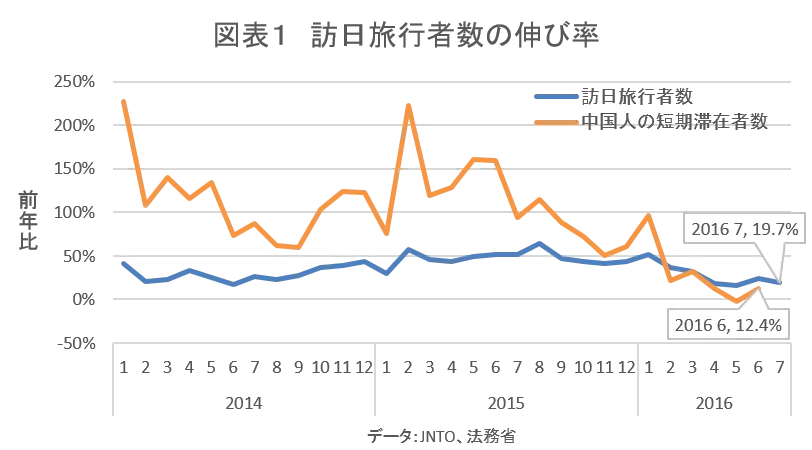
Signs of a slowdown in the growth of inbound tourism are becoming apparent. The growth rate from January to July of this year was 26.7%, falling short not only of the 47.1% recorded in 2015 but also of the 29.4% recorded in 2014. According to data from the Ministry of Justice, the growth rate of short-term visitors from China—who led the rapid growth in inbound tourism in 2015—dropped to 12.4% in June of this year. Spending by visitors to Japan is slowing down even more rapidly than the number of visitors. Per-visitor spending has fallen below the previous year’s level for two consecutive quarters since the first quarter of 2016 (Q1: -5.4%, Q2: -9.9%).
(Figure 1)
The Slowdown in Visitor Numbers Is “Within Expectations”
Why has the growth in visitor numbers slowed? Does this mean the temporary Japan boom is coming to an end? The author does not believe so. This level of decline in the growth rate is within the expected range.
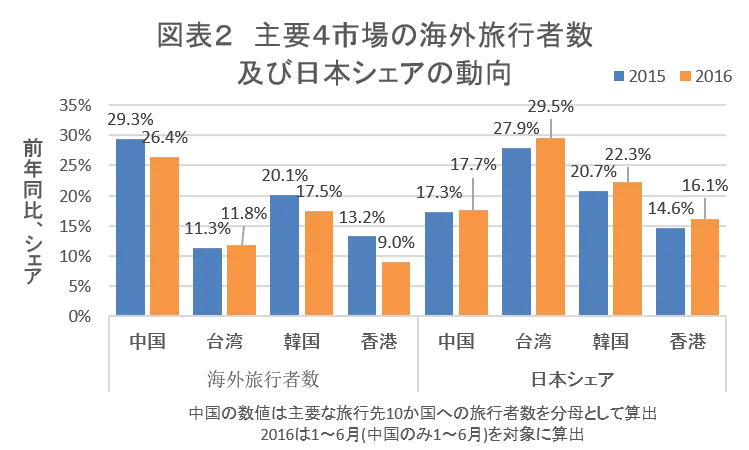
Last December, JTB announced that the number of inbound travelers to Japan in 2016 would reach 23.5 million, a 19.0% increase from the previous year. This figure is lower than the 26.7% growth rate recorded from January to July of this year. At that time, the primary reason for anticipating a decline in the growth rate was the high probability that economic growth in Asian countries, led by China, would slow down compared to 2015.The logic is that if economic growth rates decline, the growth in the number of outbound travelers from each country will slow, which in turn will affect the number of visitors to Japan. In fact, the current slowdown in growth can be largely explained by the decline in the number of outbound travelers from these countries, which has slowed as expected. JTB Tourism Research & Consulting is closely monitoring trends in the number of international travelers from each country and the proportion of those travelers visiting Japan (Japan’s share). So far, Japan’s share in major markets such as China has remained at a higher level than last year, making it unlikely that Japan’s popularity is waning.
(Figure 2)
Shifts in Shopping Spending, but Purchases of Cosmetics and Perfumes Remain Steady
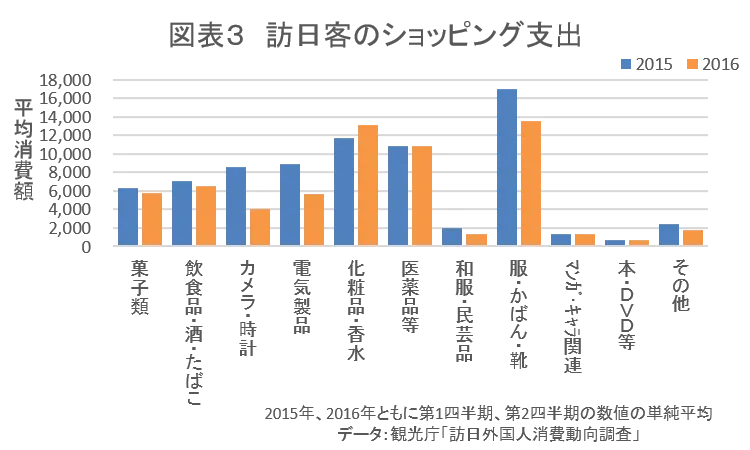
On the other hand, changes in spending by visitors to Japan—particularly in shopping—are occurring at an unexpectedly rapid pace. While the strong yen has led to a noticeable decline in purchases of high-end goods, spending on daily necessities is said to be relatively steady. The fact that per-visitor spending has fallen below the previous year’s level is due to the decline in high-end goods consumption, a trend that appears to have been influenced by stricter taxation on returning travelers in China.
Comparing unit prices by product category for January through June of this year with the previous year, based on data from the Japan Tourism Agency, shows a significant drop in spending on clothing, bags, and shoes (including brand-name items), as well as cameras and watches. Spending on popular electronics has also declined. While there is no doubt that consumption is slowing, particularly for high-end goods, unit prices have fallen across a wide range of product categories, suggesting that the shift in sales is not simply a matter of demand moving toward lower-priced items. For example, spending on cosmetics and perfumes has continued to grow this year. This likely relates to the fact that the proportion of female visitors to Japan is gradually increasing. Additionally, the ratio of individual travelers has risen compared to group tours since the start of this year. Unlike group tourists, who tend to buy a wide range of souvenirs and items requested by others, individual travelers are more likely to purchase items they personally like or intend to use themselves. I believe this trend is indirectly contributing to the increase in purchases of cosmetics and perfumes.
(Figure 3)
Given the current environment, marked by exchange rate fluctuations and the growth of cross-border e-commerce, what should we be selling to visitors to Japan going forward? This may be a bit of a stretch, but I suspect one reason for the steady demand for cosmetics and perfumes is that sales staff at department stores and other retailers can assess each customer’s skin type, offer personalized advice, and allow customers to try products to confirm their quality. Perhaps the products worth traveling all the way to Japan to buy are those that offer this kind of added value in the form of personalized service.
Future growth is expected to be more moderate than in the past
The fact that growth in 2015 was so rapid has made the slowdown in demand since the start of this year all the more striking. The phenomenal growth in tourist numbers from 2014 to 2015 is believed to have been driven by a combination of factors, including visa liberalization, high growth in Asian markets, and a weak yen. The fact that the number of inbound tourists to Japan was still relatively low at the time is also likely one of the reasons why tourist numbers nearly doubled in a single year. While demand for travel to Japan is expected to continue growing, it is unlikely that the high growth rates seen in 2015 will be sustained every year. Even a 10% annual growth rate in inbound visitor numbers would still be classified as high growth on a global scale. The author believes this represents a realistic and sustainable growth rate.
One could also argue that the 2015 level of spending was simply too high. Over the two-year period from 2014 to 2015, the average spending per visitor rose by more than 40,000 yen. The majority of this was driven by shopping, and it is well known that this was supported by the somewhat unique phenomenon of “massive buying” by Chinese tourists. The uniqueness of “mass buying” lies in the fact that a wide range of items—from luxury goods to daily necessities—were purchased, and that not just a handful of high-spending individuals but many travelers actively shopped. Factors such as the rapid rise in China’s consumption levels and the nascent development of cross-border e-commerce contributed to this unique situation, and the weak yen was also considered an important backdrop. It can be said that some of the elements that constituted the uniqueness of “mass buying” are already beginning to fade.
While spending on transportation and local leisure activities has been gradually increasing this year alongside a sharp decline in shopping expenditures, this growth is nowhere near sufficient to offset the decline in shopping spending, given that the consumption levels during the “spending spree” were exceptionally high. The author speculates that we may never again see per-visitor spending in Japan exceed the levels seen in 2015.
It appears that demand for travel to Japan in 2016 is shifting toward a more sustainable growth rate.
著者