Reflections on "Buy Local" Tourism
What is needed for tourism spending to generate economic benefits for local businesses? We examine this question based on a survey conducted in collaboration with Miyakojima City. *This column is a reprint, with permission, of an article originally published in the “Real Estate Economy FAX-LINE” (September 18, 2019 issue) by the Real Estate Economic Research Institute Co., Ltd.
Tourism has become one of Japan’s leading industries
With the number of foreign visitors to Japan exceeding 30 million, expectations for the tourism industry as a leading sector of the 21st century are rising. At the same time, however, challenges have emerged: the increase in tourist spending is not sufficiently trickling down to local businesses, and its benefits are limited to certain sectors. Even in areas considered to be suffering from overtourism, there are scattered instances where data for agriculture, fisheries, manufacturing, and retail are declining, and there are concerns that tourism is failing to realize its potential as a comprehensive industry.
The objective of promoting tourism policy is to ensure that tourism spending generates economic benefits for local businesses and to increase the rate of local procurement among them. The basic policy of the Basic Plan for Promoting Japan as a Tourism Nation, revised in 2017, states the following.
[Basic Plan for Promoting Japan as a Tourism Nation]
Under this Basic Plan, the government will promote measures aimed at realizing a tourism-oriented nation based specifically on the following policies.
- Development of the National Economy — Tourism drives the Japanese economy and revitalizes regions —
- Promotion of International Mutual Understanding —Tourism creates a truly open nation—
- Stabilization and Improvement of People’s Lives —Tourism Generates Vitality for Tomorrow—
- Preparedness for Risks Such as Disasters and Accidents
"A surge in tourists does not automatically equal regional economic development"
In other words, tourism is undertaken with the aim of contributing to the regional economy, and naturally, the economic benefits for local residents and businesses are a fundamental prerequisite.
In Miyakojima City, Okinawa Prefecture, where I supported the formulation of a tourism plan, the Irabu Bridge connecting Miyakojima and Irabu Island opened in January 2015. This led to a surge in tourists, with the number rising from 400,391 in FY 2013 (the year before the opening) to 1,143,031 in FY 2018.In March 2019, Shimojishima Airport—formerly a pilot training facility—began operations as an airport dedicated to low-cost carriers (LCCs) and charter flights, and a new cruise terminal is scheduled to open in FY 2020. Consequently, investment in tourism facilities—primarily lodging facilities funded by capital from outside the island—has been spurred, creating a scene reminiscent of Japan during the bubble economy.
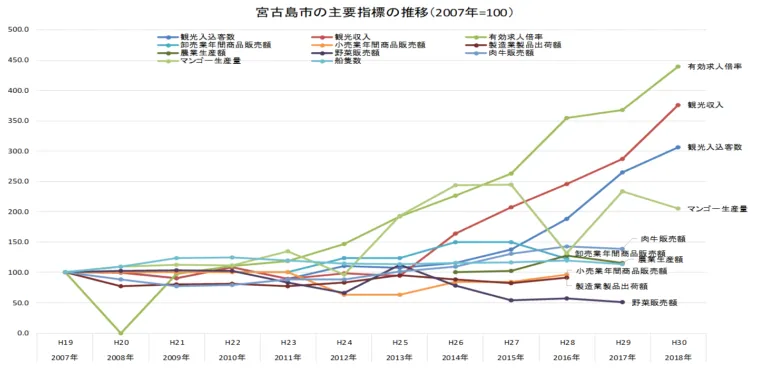
While things may appear to be going smoothly, major challenges that threaten the very foundation of tourism policy are becoming apparent. While the number of visitors and tourism spending continue to grow, manufacturing shipments and annual retail sales have remained virtually flat. In other words, the increase in tourists is not sufficiently contributing to the local economy.
The serious challenges facing tourism in Miyakojima City—which has even been described as suffering from “overtourism”—can be summarized as follows:
- The local procurement rate is low, and economic benefits are not trickling down to local businesses. Residents’ incomes are not increasing.
- Many shops are shortening their business hours due to labor shortages.
- Housing and land prices are skyrocketing; even for a one-room apartment in a new building, rent exceeds 100,000 yen. Rents have risen by 15% over the past year.
- Measures such as capital investment to address the mismatch between the seasonal fluctuations of tourism and those of the primary sector are lagging behind. Large hotels are requiring local primary sector producers to ensure a stable year-round supply of food ingredients, necessitating investment in high-performance refrigeration and freezing equipment. Currently, a significant amount of food ingredients from outside the prefecture and the island are purchased from wholesalers off the island.
- Although cruise ship calls have increased significantly, sales have not risen for businesses other than bus and taxi companies.
- Only 17% of local residents have a favorable impression of tourism businesses.
(FY 2018 JTB Tourism Research & Consulting Survey)
"Buy Local" Tourism to Boost the Local Economy
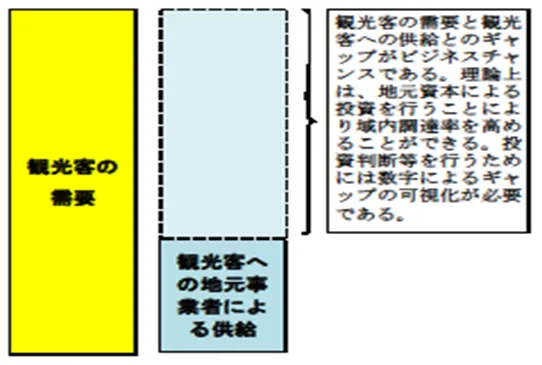
I believe the time has come for the nation to work together to promote “Tourism Buy Local” in order to foster sound economic development through tourism. “Buy Local” is a phrase used in the United States when large supermarket chains expanded into various regions, and local shopping districts and other groups joined forces to launch a campaign emphasizing that “buying from local shops fosters quality commerce and enhances the region’s appeal. ”The “Tourism Buy Local” initiative I advocate is based on the understanding that tourists’ fundamental needs lie in products sourced locally, processed locally, and sold locally. It involves public-private collaboration to increase the local procurement rate of tourism-related consumption. To achieve this, we must move away from the traditional “product-out” approach. Instead, we need to quantify the gap between tourist demand and supply from local businesses, and use that gap as a business opportunity to serve as a benchmark for investment by local capital and lending by regional financial institutions.
JTB Tourism Research & Consulting, in collaboration with Miyakojima City, has conducted a “Survey on the Supply and Demand of Miyakojima Food Ingredients.” By quantifying the gap between tourist demand and supply from local businesses, we will promote “Tourism Buy Local” to maximize the ripple effects for local businesses.
著者