What Is the "Relational Population"? ~A New Regional Strategy That Is Neither Tourism Nor Permanent Residency~
National policies aimed at revitalizing regions facing population decline—known as “Regional Revitalization”—have traditionally centered on two key strategies: expanding the “visitor population” through tourism promotion, and attracting a “resident population” by improving living environments and conducting city promotion campaigns. Recently, however, the concept of the “related population”—which explores diverse ways of connecting with people from outside the region that go beyond tourism or permanent residency—has been gaining attention. In this article, I will first provide an overview of this “relational population” and then introduce the efforts to build a “relational population” in Takamori Town, Nagano Prefecture, where I have been participating as a facilitator since last year.
1. What Is the “Relational Population”?—A New Regional Strategy That Is Neither Tourism Nor Permanent Residency
Fundamentally, “diverse interactions with people from outside the region” could be considered the domain of tourism*1. However, the term “visitor population,” as used in recent tourism policies, seems to have taken on a narrow connotation that focuses solely on direct economic effects derived from tourist arrivals multiplied by tourist spending—in other words, treating travelers merely as units of consumption.
On the other hand, as part of efforts to attract new residents and increase the “permanent resident population,” local governments implement measures to promote relocation, such as improving living environments and city promotion. However, the region’s strong expectation—asking, “Are you prepared to make this your permanent home?”—seems to present a very high hurdle for those who are considering living in the area or contributing their skills there in the future. The "related population" initiative is discussed as an effort to explore diverse and ongoing ways for people outside the region to engage with the community, bridging the gap between this narrow definition of tourism—the "visitor population"—and relocation—the "resident population"—which presents a high psychological barrier.
Professor Tokumi Odagiri of Meiji University’s Faculty of Agriculture defines “related population” as “a general term for people who have diverse interests in and engage with rural areas in various ways,” and explains it through “stages of engagement”: (1) purchasing local specialty products ⇒ (2) donating to the region ⇒ (3) frequent visits ⇒ (4) volunteer activities in the region ⇒ (5) quasi-residence (such as living in two regions) ⇒ (6) relocation and permanent residence. In short, this initiative can be described as an effort to expand networks with people outside the region—people who are fans of the area and willing to help solve its challenges.
2. The Social Background of the “Relational Population” — The Increase in Young People Interested in Rural Areas
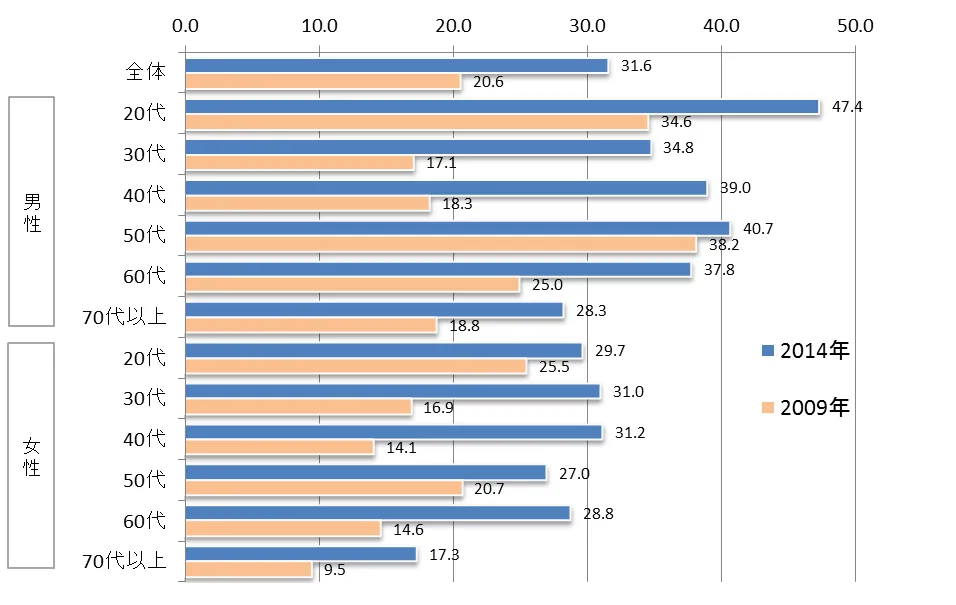
So, how many urban residents actually want to build relationships with rural communities? According to the results of a 2014 Cabinet Office public opinion survey*2 on agricultural, mountainous, and fishing villages, 31.6% of urban residents expressed a desire to settle in these areas, significantly exceeding the FY 2009 survey result (20.6%). This intention was more prevalent among men than women, with a particularly high rate of 47.4% among men in their 20s.
Local journalist Terumi Tanaka (2017) notes that interest in rural areas as places to engage with—particularly among the younger generation in cities—is growing, and that a “social” orientation has become a defining characteristic of young people. Furthermore, Kazumasa Shitsuge (2016), editor-in-chief of the magazine “Sotokoto,” describes the values of the generation that grew up after the bursting of the economic bubble as those of the “Social Native Generation”—a group that places value on the attributes of small communities, diverse preferences, and a sense of empathy with peers—and notes that these values have become particularly evident since the Lehman Shock.
The book *Creating a Hometown: A Life Where You Have a Place to Return to and Never Go Hungry*, published in 2014 by Hiroshi Ito and pha (2014), became a hot topic as it coincided with the “Regional Revitalization” movement.
Drawing on their experience of establishing a shared house in Kumano and living a dual-residence lifestyle—after both having graduated from Kyoto University—they discussed how “having multiple bases fosters more flexible thinking, ”and “We want to consider ways of living that transcend the binary choice between city and countryside.” They discuss the nature of ongoing relationships with regions that go beyond permanent residency—a concept embodied by the “relational population”—and present flexible, thought-provoking ideas regarding the perspective of urban dwellers as part of this “relational population,” as well as the role of regions seeking to attract such a population.
3. “Relational Population” as a Platform for Incubation
In FY 2018, the Ministry of Internal Affairs and Communications recruited participating municipalities for its “Relational Population” Creation Project. This initiative provided opportunities for people with existing ties to a region (such as those with local roots or “hometown tax” donors with a certain level of interest) and those wishing to establish some form of connection with a region to engage in creating opportunities for connection with the community and to provide a starting point for continuous involvement in solving local issues. While various initiatives are being carried out in each municipality, as new keywords emerge and high-profile projects are replicated as best practices in other municipalities, we must be careful not to lose sight of the original meaning of the concept of “related population” or the flexible, region-specific ideas that accompany it. The same applies to tourism.
As Mr. Shichijo (2017)“What matters is not the whole, but firmly welcoming each individual as an individual. Perhaps it is time to bid farewell to an era of talking about people in terms of numbers, and the next step in ‘regional revitalization’ may be an era of remembering faces and names,” I, too, feel it is important for each region to explore how to connect diverse characters and human resources from both within and outside the community, and thereby cultivate an environment where various initiatives can emerge. I believe this will also be a key point when considering the future of regional tourism.
4. Initiatives for the “Relational Population” in Takamori Town, Nagano Prefecture — Ensuring Local Initiatives Do Not Become a Formality
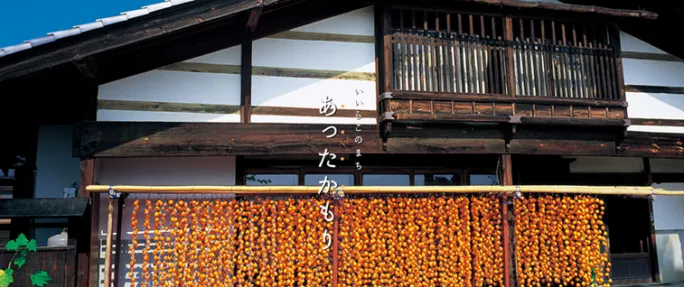
Takamori Town is located adjacent to Iida City, the central city of the Minami-Shin region in Nagano Prefecture. It is a lush, green town spread across a river terrace overlooking the Tenryu River. Currently, it takes about 3 hours and 40 minutes by express bus from Shinjuku Bus Terminal, but in 2027, a Maglev station is scheduled to open in neighboring Iida City, connecting Tokyo and Iida in just 40 minutes—a development expected to significantly improve access. The town is known for its thriving fruit cultivation, including persimmons, apples, and peaches. Its persimmons have even become a premium brand of dried persimmons known as “Ichida-gaki,” so many of you may have heard of them. Additionally, as the hometown of Manager Yoshiro Shimaoka—who was known as “Oda” during his time with the Meiji University baseball team (a manager who produced numerous professional baseball players, including Senichi Hoshino)—the town serves as the summer training camp location for the Meiji University baseball team. Canoeing is also a popular activity on the Tenryu River.
Last year, a group of volunteers in their 30s to 60s who are active in the community was assembled in this town. Under the title “Formulation of a Town Promotion Plan—To Increase the Number of Residents Who Love This Town and the ‘Relational Population’,” they gathered at the town hall once a month from 6:00 PM to 9:00 PM to discuss how to build the “relational population” envisioned by the mayor. I participated in these meetings as a facilitator and observed the process through participant observation.
A woman who regularly sets up a stall at local markets and engages in mutual exchanges with tourism associations in the Tokyo metropolitan area; a woman involved in managing the town’s only hot spring inn who is contemplating ways to better convey the town’s charm to visitors; the head of the Chamber of Commerce and Industry’s Youth Division, who is deeply rooted in the community and well-versed in all aspects of town life;a fruit orchard owner with deep knowledge of local agriculture; a handsome young producer of Ichida persimmons who hosts agricultural experiences; and a man in his 60s who is well-versed in local history and culture and serves as the leader of volunteer guides—these members, who have already established various relationships with people outside the region, were brought together at the invitation of the town’s Industry Division. The meetings, which began with the head of the Chamber of Commerce and Industry’s Youth Division introducing himself by saying, “I don’t know why I was called here. If this isn’t interesting, I won’t come next time,” have been held consistently every month, including social gatherings at local izakayas. By continuing discussions based on the idea of “what we can do” rather than “what the government will do for us,” a direction gradually began to emerge.
Ultimately, they organized content to serve as a point of contact for the “related population,” finalized an action plan—including the creation of a hub to aggregate and provide timely information—and decided to launch the initiative in FY 2023, with each member taking on a role based on their area of expertise. In April, the town mayor presented them with letters of appointment.
Another key player in building a community of people connected to the town is the “Takamori Town Youth Special Mission Unit,” formed at the town’s invitation to local students and others. They have become an indispensable presence at local events and in PR efforts, and they are eager to continue promoting the town’s appeal even after graduating from college.
Takamori Town “Youth ☆ Special Mission Unit” Instagram
In Takamori Town, projects focused on solving local challenges and revitalizing the town are being led primarily by young staff members. These include the “Terrace Forest Project,” which addresses the issue of overgrown trees and bamboo groves on the slopes of river terraces that have become overgrown due to lack of maintenance, the “Panorama Farm Project,” which envisions a residential agricultural park as part of efforts to visualize the region’s future (landscape design); and the “River Town Project,” which explores town development utilizing the bustling banks of the Tenryu River. Young staff members have visited advanced examples and conducted thorough deliberations, and the keyword “related population” is central to all of these projects. While it is common to see many municipalities pursuing numerous projects in isolation, isn’t it crucial for government initiatives to link these diverse efforts through a unifying keyword and share a common vision? I believe that for “related population” and town promotion (including tourism initiatives and regional branding), the most important indicator is the number of residents who participate in the projects. Although these projects are still in their early stages, I am very much looking forward to seeing how they develop.
Note)
*1 Odagiri (2018) notes that while the term “exchange” was originally intended to convey a diverse and multifaceted concept, it came to be discussed primarily in terms of short-term tourism over time. Consequently, the term “related population” emerged to combine the original meaning of “exchange population” with new elements.
*2 2014 Survey / Survey Overview: Population: Japanese nationals aged 20 or older residing in municipalities nationwide
Sample size: 3,000 / Valid responses: 1,880 (response rate: 62.7%)
Number of locations: 210 municipalities Sampling
method: Two-stage stratified random sampling Survey
method: Individual interviews conducted by surveyors
References
- Terumi Tanaka, 2017, *Creating a "Relational Population": Local Innovation That Is Neither Settlement Nor Exchange*, Kirakusha
- Hiroshi Ito, Pha, 2018, *Creating a Hometown: A Way of Life Where You Have a Place to Return to and Never Go Hungry*, Chikuma Bunko
- Kazumasa Shitsuge, 2016, *We Find Happiness in the Regions: The Sotokoto Approach to Local Revitalization*, Poplar Shinsho
- Tokumi Odagiri, 2014, *Rural Villages Will Not Disappear*, Iwanami Shinsho
- Tokumi Odagiri, 2017, *Rural and Mountain Villages Will Not Disappear*, Iwanami Shinsho
- Tokumi Odagiri, 2018, “The Future of the ‘Relational Population’—Background, Significance, and Policy,” *Monthly Governance 2018.2*, Gyosei
- Ministry of Internal Affairs and Communications, 2018, “Report of the Study Group on Future Migration and Exchange Policies”
- Ministry of Internal Affairs and Communications, 2018, Project Materials for Creating a “Relational
Population” Cabinet Office, 2014, “Public Opinion Survey on Rural Communities” - Ministry of Agriculture, Forestry and Fisheries, 2014, Analysis of the “Public Opinion Survey on Rural Areas”
- Ministry of Internal Affairs and Communications: “Related Population” Portal Site—A New Gateway to Regional Communities
著者