The Tourism Industry as a Key Sector: As Outlined in the Interim Draft of the 2040 Industrial Structure Vision

In April 2025, the Ministry of Economy, Trade and Industry released the fourth interim draft of its “Vision for the Industrial Structure in 2040.” The tourism industry is projected to become a key industry by 2040, and high expectations are being placed on it. *This column is a reprint, with permission, of an article originally published in “Real Estate Economy Focus & Research No. 1525 (Real Estate Economy Research).”
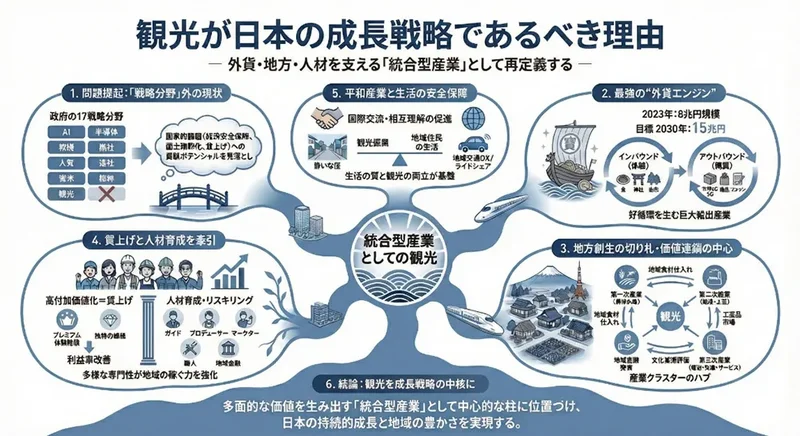
On April 22, 2025, the Ministry of Economy, Trade and Industry’s Subcommittee on New Economic and Industrial Policy held a meeting and presented the fourth interim draft of the “Vision for the Industrial Structure in 2040.” The draft indicates that the tourism industry will become a core industry by 2040, assuming a greater role than ever before.
Spending by Inbound International Tourists Exceeds 8 Trillion Yen
In 2024, the number of international visitors to Japan reached 36.869 million (up 47.1% from 2023 and up 15.7% from 2019), while spending totaled 8.1257 trillion yen (up 53.1% from 2023 and up 68.8% from 2019), both reaching record highs.Per-person travel spending also showed significant growth, reaching 227,000 yen (up 6.6% from 2023 and up 43.1% from 2019). Even in 2025, the cumulative total through March stood at 10.537 million visitors, exceeding the 2024 figure by 23.1% and maintaining strong momentum.
International tourism is often referred to as “invisible trade.” While it falls far short of the top export category—automobiles (18.326 trillion yen)—it surpasses the second-ranked category—semiconductors and other electronic components (6.1543 trillion yen)—and accounts for 7.5% of total exports (108.8939 trillion yen). Tourism spending by international visitors to Japan is expected to remain a valuable source of foreign currency earnings.
2040 Industrial Structure Vision (4th Interim Draft)
In November 2021, the Ministry of Economy, Trade and Industry (METI) established the Subcommittee on a New Framework for Economic and Industrial Policy and has been holding repeated discussions on the necessity of a new approach to economic and industrial policy. Interim reports have been issued in June 2022, June 2023, and June 2024, and the Subcommittee on a New Framework for Economic and Industrial Policy discussed the 4th Interim Draft on April 22, 2025.
At the subcommittee meeting, it was noted that “the Third Interim Report presented a qualitative scenario outlining the direction of the future that could be achieved by continuing the new policy approach of strengthening industrial policy,”The fourth interim report aims to refine these scenarios and enhance predictability through quantification, taking into account relevant policies from the past year (such as the GX 2040 Vision and the 7th Basic Energy Plan). It will identify necessary additional measures to realize this future outlook."
The draft scenario collection identifies scenarios for each major mission, focusing on GX, DX, global and economic security, and comprehensive growth in health and regional development.It also presents future outlooks for changes in existing individual industries, including semiconductors and computing resources, automobiles and mobility, storage batteries, industrial machinery and robots, aircraft and next-generation air mobility, space, raw materials, chemicals, iron, medical devices, pharmaceuticals, healthcare, nursing care, logistics and distribution (wholesale and retail), and content and tourism.
The Tourism Industry: Growing Expectations as a Core Industry
Let’s take a look at the proposed scenario for the tourism industry in the 2040 Industrial Structure Vision.
It states, “Global tourism demand will expand in response to increased global economic capacity and leisure time resulting from economic growth in emerging nations such as those in the Global South, as well as the progress of industrial serviceization and digitalization.” While competition among companies to attract affluent consumers is intensifying, the report asserts that the tourism industry “will become the most important foreign exchange-earning industry in countries with a declining working-age population, and—centered on the diverse cultural and artistic resources(including crafts, fashion, and design) in non-Tokyo areas, it will secure its status as a core national industry by generating the greatest positive ripple effects on economic and social standards (such as wage levels and infrastructure sustainability).”
It also states that “the market competitiveness of Japan’s tourism-related industries and companies will grow by leveraging cultural and artistic resources such as design and art, as well as sports, with a focus on diversifying, making unique, and adding high value to customers and services.” Furthermore, it notes that “Japan’s unique characteristics that differentiate it from other countries—such as good public safety, the reliability of infrastructure including the punctuality of public transportation, a geopolitical location that allows it to gain the trust of both developed nations like the U.S. and Europe and emerging economies, and experiences offered by buildings and traditional regional performing arts that embody non-religious but spiritual(SBNR: Spiritual But Not Religious) values found in architecture and traditional regional performing arts, a longing for real-world objects and experiences that have served as subjects for globally renowned content, and sports viewing that allows people to experience Japan’s unique cheering culture and witness the success of their home country’s athletes). The report states that “by leveraging these as sources of competitiveness, diverse regions and players will build strong relationships with a unique and loyal customer base, growing into an industry that continues to provide high-value tourism and accommodation experiences.”
According to data released by the Japan Automobile Manufacturers Association, the value of manufactured goods shipped by the automotive manufacturing industry in 2022 was 62.7942 trillion yen. The automotive manufacturing industry accounted for 17.4% of the total value of manufactured goods shipped by all manufacturing industries and 39.3% of the total value of manufactured goods shipped by the machinery industry as a whole. The report also states that the workforce in the automotive-related industry reached 5.58 million people in 2023.Given the sheer scale of its economic activity, the automotive industry has countless ripple effects on other industries. A core industry is defined as a vital sector that forms the foundation of a nation’s economic activity, such as the automotive industry, and is expected to play a significant role in the development of other industries.
Over the next 15 years, the tourism industry must achieve a dramatic improvement in profitability through high value-added activities and, as a result, raise wages to secure talented personnel amid intensifying competition across industries. The Fifth Basic Plan for Promoting Japan as a Tourism Nation, set to begin in FY 2026, will serve as a roadmap for becoming a core industry.
Source: Real Estate Economics Research Co., Ltd., "Real Estate Economics Focus & Research No. 1525"
*This column is a reprint, with permission, of the original article published in “Real Estate Economy Focus & Research No. 1525.”
著者