The Reality of "Travel Experienced Through the Five Senses" in the New Normal Era

This column is a reprint, with permission, of an article originally published in the Journal of Cultural Resources Studies, Vol. 19 (FY 2020) (published June 30, 2021).
Due to the impact of the novel coronavirus, many people around the world have been enduring significant stress for over a year, stemming from financial burdens and changes in their daily lives. While “escapism” and “rejuvenation” are consistently cited as top motivations for travel, people are unable to go out simply to take their minds off things. Under these circumstances, various services have emerged, giving rise to new needs. That said, it is important to note that these “new needs”—with the exception of those related to hygiene management—have largely come to the surface because the pandemic has accelerated gradual shifts in market demand at a dramatic pace.
1. Domestic Travel in 2020 Supported by Young and Older Adults
JTB Tourism Research & Consulting conducted an online survey of domestic consumers from February 2020 to January 2021, tracking their attitudes toward the novel coronavirus and their travel needs on a regular basis.
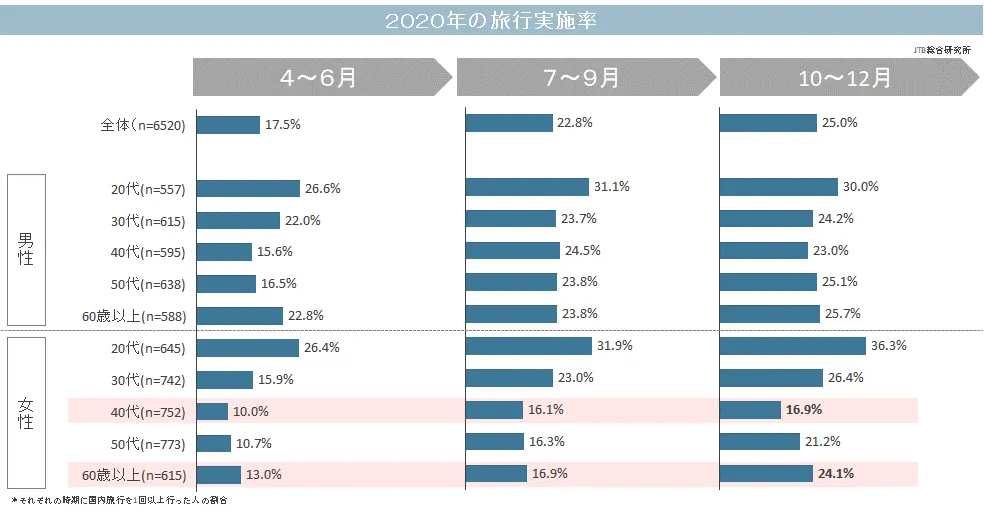
The travel participation rate from April to December of last year—the period following the first state of emergency declaration—was 36.0%, with a high proportion among those in their 20s and 30s. The participation rate among seniors aged 60 and older was also high; in particular, women in their 60s saw a recovery, with a rate of 32.4% during the October–December period. Factors contributing to this include the fact that many people aged 60 and older have already retired and are therefore less affected by income reductions caused by the novel coronavirus. Additionally, the Go To Travel campaign expanded nationwide in October when Tokyo joined the program, providing both financial incentives and a sense of “official approval” to travel, which likely coincided with the autumn travel season.
On the other hand, the travel participation rate for women in their 40s from April to December was 26.5%, the lowest among all gender and age groups. Similarly, the travel participation rate for men in their 40s from October to December decreased compared to the previous quarter. This is likely due to the fact that this is a period when they are busy with child-rearing and work, and expenses such as education costs are high. Additionally, since a high proportion of women in their 40s are in non-regular employment, they have been significantly impacted by the deterioration of the employment environment caused by the COVID-19 pandemic.
2. Will the need for “hygiene measures” become widespread, evolving into a basic precaution on par with disaster preparedness?
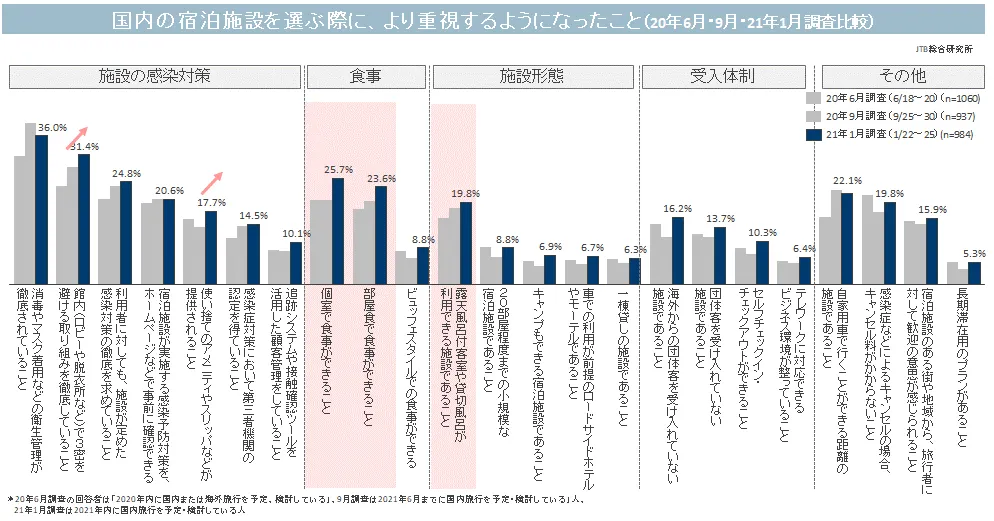
Regarding specific preferences for infection prevention measures at facilities, the percentage in the December survey was higher than in the June and September surveys for nearly all items. There was a notable increase in demand for “provision of disposable amenities,” “meals in private rooms or in-room dining,” and “rooms with open-air baths or private baths,” indicating a growing desire to avoid contact with others. On the other hand, there was almost no increase in the importance placed on “having obtained certification from a third-party organization for infection control measures.” This suggests that consumers prioritize items they can verify with their own eyes over “third-party certification.” Going forward, hygiene measures are likely to be recognized as fundamental, just like disaster prevention measures.
A recent trend in the lodging market has seen the emergence of various accommodation formats, such as guesthouses, subscription-based monthly rental services, and farm/forest/fishery homestays. However, many of these small-scale facilities find it difficult to separate traffic flow and minimize contact between guests and owners or other facility users, and many operators are currently struggling to implement thorough countermeasures.
3. Online tourism and in-person tourism will become mutually complementary
To maintain connections with people unable to travel, services such as “online tourism programs” and “virtual tours” have expanded. On March 26, 2021, the Louvre Museum in Paris, France, announced that it would make images and data of all works in its collection available for free on its website. In Japan as well, numerous programs combining product purchases with guidance from local guides—such as the online Tsugaru apple tasting tour conducted by “The Ringomafia,” a group of women who relocated to Aomori Prefecture—have been sold, and major travel agencies have also entered this market.
These programs are not intended to replace actual travel. They are expected to create opportunities for visitors to eventually visit in person by allowing them to experience the scenery, atmosphere, and sounds of the journey—which cannot be captured in travel guidebooks or brochures that focus only on “highlights”—and by fostering connections with the region (or maintaining existing ones) through real-time interactions with guides, even if only online. While most programs currently involve users staying at home while a guide moves around the site or switches camera angles to provide explanations, once the market recovers, it may be possible to expand this model to have guides at home provide online tours to users who are actually sightseeing on-site. By exploring this as a separate approach to address local guide shortages, it could help resolve challenges related to regional hospitality infrastructure.
On the other hand, “hands-on exhibits” (exhibits that allow visitors to learn by touching), which have become widespread in museums, have been forced to suspend operations across the board. Experiences that stimulate the senses other than sight—such as “touching” and “smelling”—to foster understanding and a sense of reality are considered irreplaceable by digital technology.
4. Common Ground Between Microtourism and “High-Value Tourism Experiences”
Micro-tourism refers to short-distance travel to local or nearby areas within approximately an hour’s radius of one’s home. It was proposed by Yoshiharu Hoshino, CEO of Hoshino Resorts, as one means of rescuing the hard-hit tourism industry. The significance of micro-tourism lies in “rediscovering one’s neighborhood” and “engaging in economic activity there.” In other words, the goals are “further personalization of the travel experience (creating unique discoveries and experiences for oneself)” and “the formation of local economic circles,” making it clear that this goes beyond mere local tourism.
Traditionally, regional tourist destinations have relied on “foreign currency”—in the form of trade with metropolitan areas and visits from urban residents—to sustain themselves. With this balance disrupted by the COVID-19 pandemic, the importance of local economic circles has been brought into sharp relief.
Even before the pandemic, in an environment where all kinds of information could be easily and freely accessed online, travelers had come to place a high value on “personal, one-of-a-kind experiences. ”Travelers seek value in “personal discoveries” made by viewing local resources through the filter of their own accumulated experiences, as well as in doing things that most other people cannot easily experience. Consequently, programs such as “one-night stays in castles for 1 million yen” and “exclusive use of a deserted island limited to one group per day” have emerged in recent years. All of these can be seen as phenomena based on the common need for the “personalization of travel experiences.”
5. Conclusion
In the wake of the COVID-19 pandemic, while consumers desire contact-free travel arrangements, they are also increasingly seeking the personal experiences that constitute the true essence of travel. However, for travelers to have personal experiences and discoveries at their destination, meticulous preparation by local individuals is essential—and this inevitably involves the involvement of “strangers” whom they would otherwise prefer to avoid. Since consumers themselves have not yet experienced travel in the post-COVID era, their desires are a mixture of the unchanging needs they seek from travel and the need for methods to alleviate anxiety, creating an inherent contradiction. This very contradiction is evidence that both the tourism industry and the market are currently in the midst of change.
A global society is one in which ultimate local distinctiveness stands out and is sustained through mutual respect for that distinctiveness. The unique value of each region lies precisely in that local distinctiveness; and because technology and information are becoming increasingly homogenized worldwide, the gap between the homogenized and the local emerges as the unique charm and value of each region. And to truly experience that value, there is no alternative but to travel.
Source: Society for Cultural Resources Studies, “Cultural Resources Studies No. 19 (FY 2020)” (published June 30, 2021)
著者