[Guest Article] Are Employees on Workations Your Company’s Greatest Asset? — The Current State of Workations Based on Survey Results from Participants, and the Characteristics of “Workation-Type” Talent
It has been nearly a year since the government announced its initiative to promote workation. While enthusiasm for attracting workation participants is growing in local communities, the reality is that corporate response has been somewhat lackluster. Why are companies slow to adopt these programs? We examine the current state of workation based on the results of a survey of 1,000 people who have experienced it.
1. Promoting Workations and Expectations for New Growth in Demand
The term “workation” has spread rapidly since July of last year, when then-Chief Cabinet Secretary Suga announced the government’s policy to promote it. A portmanteau of “work” and “vacation,” workation is a flexible work style that allows people to work in locations suited to their individual lifestyles—such as while traveling, at a base for their hobbies, or at a volunteer site.
Until now, the government has approached vacation reform from the perspective of “increasing the number of extended breaks,” such as through the “Happy Monday” initiative creating three-day holiday weekends and the regional decentralization of long holiday periods. However, workation—which allows people to enjoy tourism and leisure while continuing to work on weekdays without taking time off from their jobs—represents a new paradigm shift.
According to a survey by Yano Research Institute (Footnote 1), the domestic workation market is projected to reach 362.2 billion yen by FY 2025. Expectations are high for it to create new demand in the “with-COVID” era, and the Japan Tourism Agency is strengthening its support by allocating a new budget of over 500 million yen to promote related initiatives under the banner “New Travel Styles: Workation & Bleisure.”
2. The Unbridgeable Gap Between Host Regions Eager to Attract Visitors and Companies Hesitant to Adopt the Model
There are four key stakeholders in workation: (1) individual users (employees), (2) companies implementing the system, (3) local communities and governments hosting users, and (4) private-sector businesses involved in workation. However, differences in the intentions and levels of enthusiasm among these four parties are often cited as a problem.
Among these, the most enthusiastic are ④ “regions and local governments.” They are driven by a strong desire to increase the number of people with ties to the region, attract corporate satellite offices, and create pathways from dual-residence living to permanent relocation, as well as to foster interaction with local residents and revitalize local businesses. In some regions, there are signs that excessive expectations are being placed on the effectiveness of workation initiatives, positioning them as a trump card for solving regional issues, and excessive competition between regions is already beginning to emerge.
Conversely, the group said to have the least enthusiasm is (2) “Companies.” According to a survey conducted by “Monthly General Affairs” in May of this year (Footnote 2), 85.4% of companies stated they had “never considered introducing” a workation system, highlighting their reluctance to adopt it.
Two main “excuses” have traditionally been cited for why companies cannot move forward with introducing workation programs: (1) inadequate telework environments and security concerns, and (2) labor management issues.
However, regarding point ①, a survey conducted by the Tokyo Metropolitan Government in late March 2021 (Footnote 3) shows that the telework adoption rate among companies with 300 or more employees has reached 84.3%. Furthermore, regarding point ②, the Ministry of Health, Labour and Welfare’s Telework Guidelines (Footnote 4), revised this past March, clearly define workation, thereby largely resolving the gray areas surrounding labor management.
Nevertheless, why has the adoption of workation systems by companies not accelerated?
The author attributes this to the national character of the Japanese people, many of whom are reluctant to mix work and vacation within a corporate culture that values “clear boundaries and distinctions,” such as the “switch between on and off” mindset. Furthermore, companies are currently overwhelmed by an unprecedented array of challenges, including prolonged COVID-19 countermeasures, leaving them unable to spare the resources to introduce new systems like workation. Furthermore, the lack of clear benefits for companies is a major factor. Since there is little data or information on the actual experiences of people who have participated in workation programs, it is difficult to gain the internal understanding necessary to actively promote their adoption.
3. Insights from a Survey of 1,000 Workation Participants
Therefore, in March of this year, Yamanashi University, in collaboration with Cross Marketing, conducted a survey of 1,000 employees (individuals) who had “actually experienced workation.” Additionally, comparisons were made by dividing respondents into a group that had “only experienced remote work from home and had no workation experience” and a group with “no remote work experience” (Footnote 5). Since previous surveys of this type had focused on “intentions to implement” workation, the results of this survey attracted significant attention. Here, we present some of the findings.
(1) Work Styles During Workation—How Do They Spend Their Days?
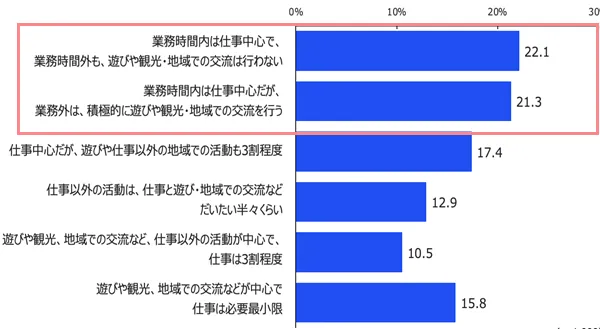
While workation is often described as a “hybrid of work and vacation,” when asked about how they spent their time during workation in this survey, approximately 40% of respondents reported working nearly full-time, while another 40% stated that vacation-like activities accounted for more than half of their time. This indicates that the “work-focused + extras” type and the “vacation-focused + work as needed” type are roughly equal in number. Furthermore, the finding that the average daily working hours were 5.4 hours suggests that more people spend their time focused on work rather than vacation.
(Source: Joint survey results by Yamanashi University and Cross Marketing)
(2) Nature of Work During Workation
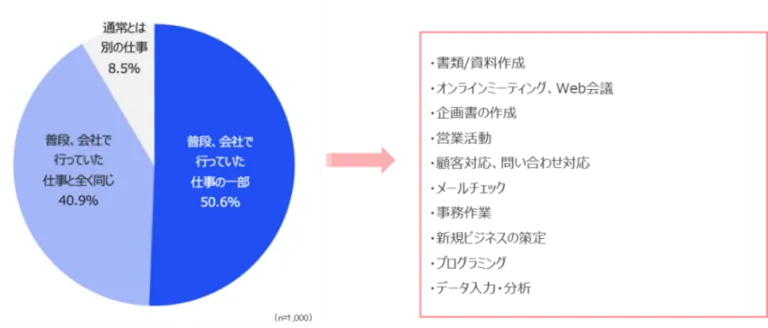
Regarding the nature of work during workations, over 90% reported performing “part of their usual work” or “exactly the same work as usual.” Common tasks such as “web conferences, responding to inquiries, checking emails, and administrative work” were frequently cited, as were specialized tasks such as “preparing documents/proposals, planning new business initiatives, data entry/analysis, and programming.”
Furthermore, while workation is often perceived as involving more creative tasks or work requiring greater concentration than usual, the survey found that over 90% of participants engaged in a “satellite office-style” approach, simply performing their daily tasks in a different location.
(Source: Joint survey results by Yamanashi University and Cross Marketing)
(3) Is there a difference in productivity between working on a workation and working in a regular office?
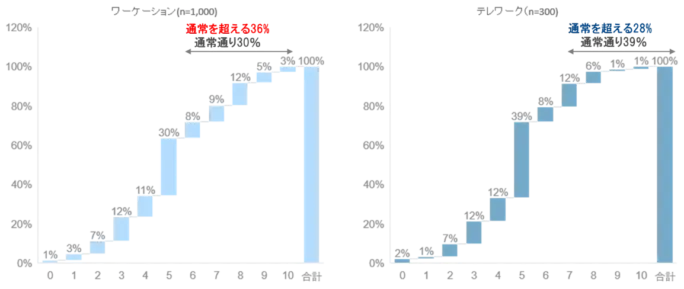
Figure 3 shows the results of a survey asking respondents to select the figure that best represents their hourly workload during “workation” and “telework” compared to their usual office work, with the standard hourly workload at the office set as “5.”When on a workation, 36% of respondents perceived that they were handling a greater workload than when working in the office; this result is 8 percentage points higher than when working remotely. On the other hand, approximately one-third felt that their workload was lower than usual.
versus working at the office (Source: Joint survey by Yamanashi University and Cross Marketing)
(4) Work Engagement and Attitudinal Characteristics of Workation Participants
The results in Figure 4 also show that workation participants exhibit higher levels of work engagement, which indicates employees’ mental well-being (Footnote 6). Higher scores suggest a positive and fulfilling psychological state toward work, which is said to have a positive impact on the organization by spreading to those around them.
Furthermore, to examine differences in behavior and mindset between workation participants and non-participants, we conducted an analysis using seven custom-defined indicators of orientation: (1) autonomous work style, (2) experience and orientation toward cross-boundary learning, (3) experience and orientation toward “relationship population” (active interaction with the local community), (4) experience and desire for side jobs (multiple jobs), (5) experience and desire for volunteer work, (6) emergence and innovation, and (7) acceptance of work styles that blend work and personal life. The results showed that those with workation experience scored higher on all seven indicators. In particular, they demonstrated higher levels of orientation toward (2) cross-boundary learning (self-growth in new environments and a mindset oriented toward change), (3) “related population” (such as “intentions to relocate or live in multiple locations” and “experience participating in activities that contribute to regional revitalization”), and (4) side jobs or multiple careers. This suggests that they actively expand the scope of their capabilities and interactions beyond their primary jobs and daily environments, and consistently engage in behaviors that involve taking on new challenges with a broad perspective.
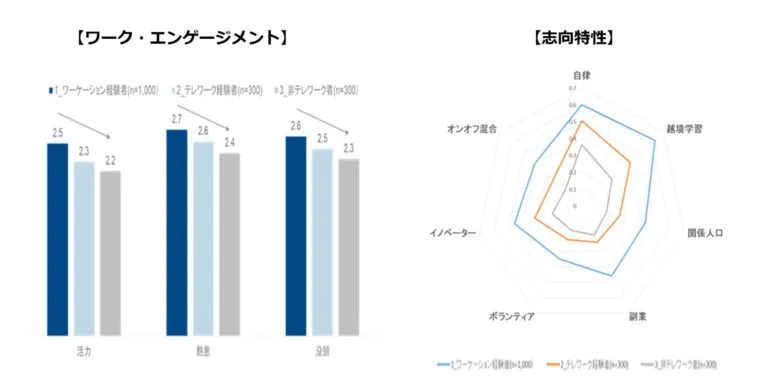
Those with and Without Workation Experience (Source: Joint Survey Results by Yamanashi University and Cross Marketing)
4. What Are the Effects of Introducing Workation in Companies? – Unraveling the Potential of Workation-Oriented Talent Based on Survey Results –
This survey revealed that many workation participants, while focusing on their regular duties, achieve productivity levels equal to or higher than usual in environments where they find it easier to work. Additionally, responses indicating that they were able to refresh and relax during their workation suggest a high level of satisfaction with the experience.
Despite experiencing these benefits, the survey revealed that regarding the “status of workation program implementation at their workplace,” over half of respondents were engaging in workation without obtaining permission from their employer. Furthermore, it was found that approximately 20% of these individuals were conducting workation even though their workplace had an established program, choosing not to utilize it. Possible factors contributing to this include difficulty in gaining sufficient understanding from colleagues and superiors, as well as the psychological barriers of hesitation or guilt associated with publicly declaring their participation in workation.In essence, workation is intended to increase flexibility in where telework is performed, foster mutual recognition of diverse work styles and values, and enable individuals to achieve results and create new value. However, even when recognized as an official company policy, the atmosphere often makes it difficult to participate openly, leading people to engage in workation covertly—a clear indication of their desire for a more comfortable and efficient environment and communication.
Furthermore, this survey revealed that, based on the high levels of work engagement and personality traits of those with workation experience, these “workation-oriented professionals” hold great potential to align with the ideal employee profile most sought after by companies in the VUCA (Volatility, Uncertainty, Complexity, Ambiguity) era—a time when predicting the future has become increasingly difficult for both society and business.
Having spoken with many workationers over the years, my impression is that, on the whole, they are self-directed individuals with a strong desire for growth and a spirit of challenge. They are not averse to changing companies or jobs if they become dissatisfied with the lack of flexibility and freedom in their work style.
By implementing management practices that support these talented employees with such mindsets and actively recruiting “workater-type talent” from outside the company, organizations can foster a “cross-organizational learning” effect, leading to the development of autonomous and creative talent as well as open innovation. In fact, in the job market for new graduates and career changers since the COVID-19 pandemic, companies that offer flexible work arrangements—such as telework and flex-place options that allow employees to work from anywhere—have become highly popular. Information sites report that there is now a significant difference in page views depending on whether these keywords are included in search results.
Furthermore, as workations in regional areas increase, they will generate a “chemical reaction” resulting from the interaction between the local communities and workers from urban centers. To ensure a steady stream of repeat workation visitors, host regions must proactively engage in marketing and make efforts to cultivate attractive communities that serve as expansive “third places” for visitors to stay in.
Witnessing this diverse expansion of workation, what will be required of companies in the future is to fully understand and embrace the characteristics and benefits of the “workation-style work” and “workation-type talent” discussed above, and to make it standard practice for employees to flexibly choose their work locations according to their circumstances and preferences. Your company’s workation-type talent may well be treasures or raw gems capable of creating new value.
<Footnotes>
1: “Survey on the Workation Market (2020)” (Yano Research Institute
Ltd.) 2: “Survey on Workation” (Monthly General Affairs)
3: “Survey on Telework Adoption Rates in Tokyo”
4: “Guidelines for the Appropriate Introduction and Implementation of Telework” (Ministry of Health, Labour and Welfare)
5: “Survey on Workation (March 2021)”
6: The survey was conducted using the Utrecht Work Engagement Scale (9-item version)
<REFERENCES>
Tanaka & Mikasa (2020) A Study on Employees’ Evaluations of and Intentions to Use Workation Prior to the COVID-19 Pandemic. Proceedings of the National Conference of the Japan Society for Tourism Studies 35, 313-316, December 2020