Growing Interest Among China's Citizen Runners in Overseas Races
In recent years, marathons and running have become a major trend in China. In 2018, 1,581 marathon events*1 were held in China (a 43.5% increase from the previous year), marking a dramatic rise from the 22 events held in 2011.In Japan, the “Tokyo Marathon,” which began in 2007, sparked a marathon boom, leading to the widespread hosting of marathons and running events in regional areas as well. However, regional events currently face fierce competition, particularly in securing participating runners and operational funding. In this column, based on a survey conducted by our company, we examine whether China’s growing number of amateur runners are interested in participating in marathons overseas, including those in Japan.
1. Growing Interest Among Chinese Amateur Runners in Overseas Races
In 2018, the total number of participants in marathon-related events held in China reached 5.83 million, a 17% increase from the previous year. Of these, 2.656 million participated in full marathons and 1.884 million in half marathons. The government is actively supporting the sports industry, and in 2018, marathon-related consumer spending reached 17.8 billion yuan, the economic impact of hosting marathon events was 28.8 billion yuan, and the market size of related industries reached 74.6 billion yuan, a 7% increase from the previous year*2.
Are Chinese amateur runners interested in overseas marathon events? We conducted a survey of running enthusiasts in Beijing and Shanghai*3.
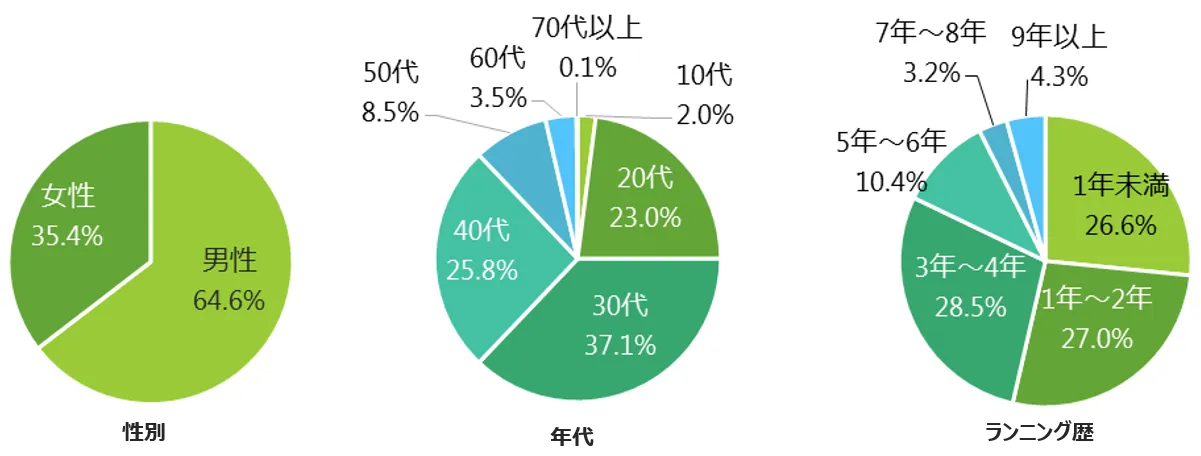
The demographics of the 884 respondents are shown in the figure below. The number of male respondents was approximately twice that of female respondents. 86% were in their 20s to 40s, overlapping with the age group most interested in traveling to Japan*4. The length of running experience was roughly evenly divided among those with less than one year, one to two years, three to four years, and five or more years.
(1) Growing Interest in Overseas Races Among China’s Expanding Base of Recreational Runners
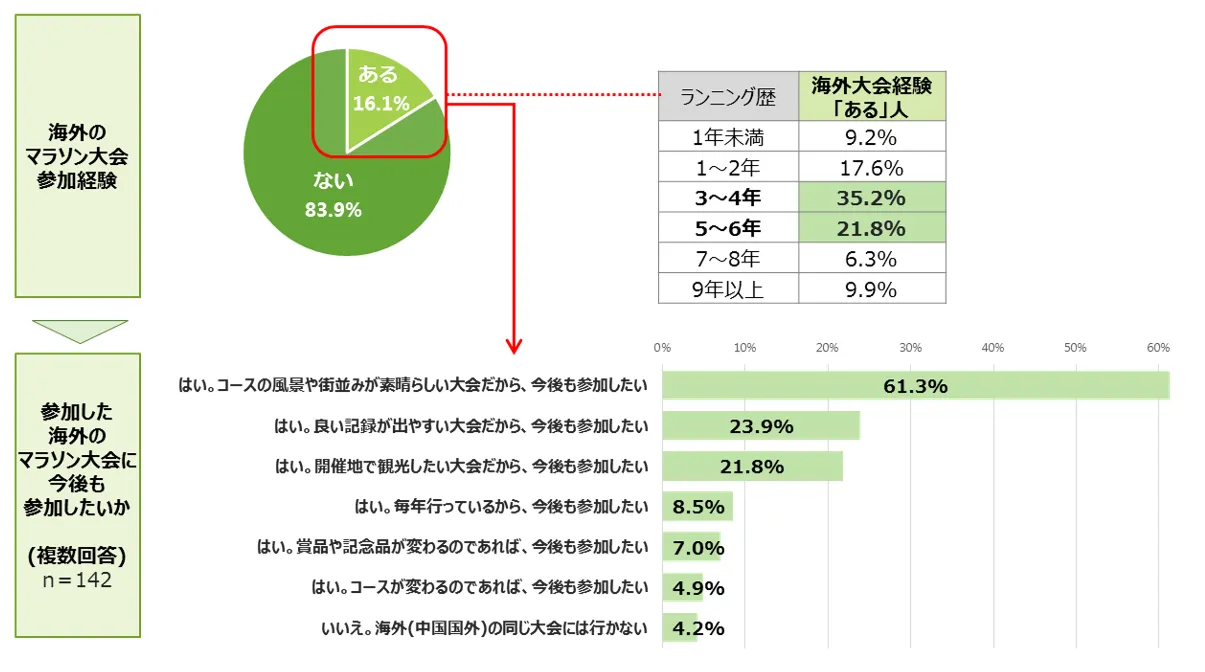
Among the survey respondents, 16.1% had “some” experience participating in overseas marathon events. When broken down by running experience, those with “3–4 years” of experience were relatively numerous. It may be that the 3–6 year mark is when runners begin to consider participating in overseas events.
When asked if they would like to participate again in an overseas marathon they had previously run, 61.3% responded, “I want to participate again because the course scenery and cityscape were wonderful,” indicating that they are drawn to the beautiful scenery of foreign courses and wish to revisit them.
(2) How to Choose an Overseas Marathon and What Runners Want from Local Programs
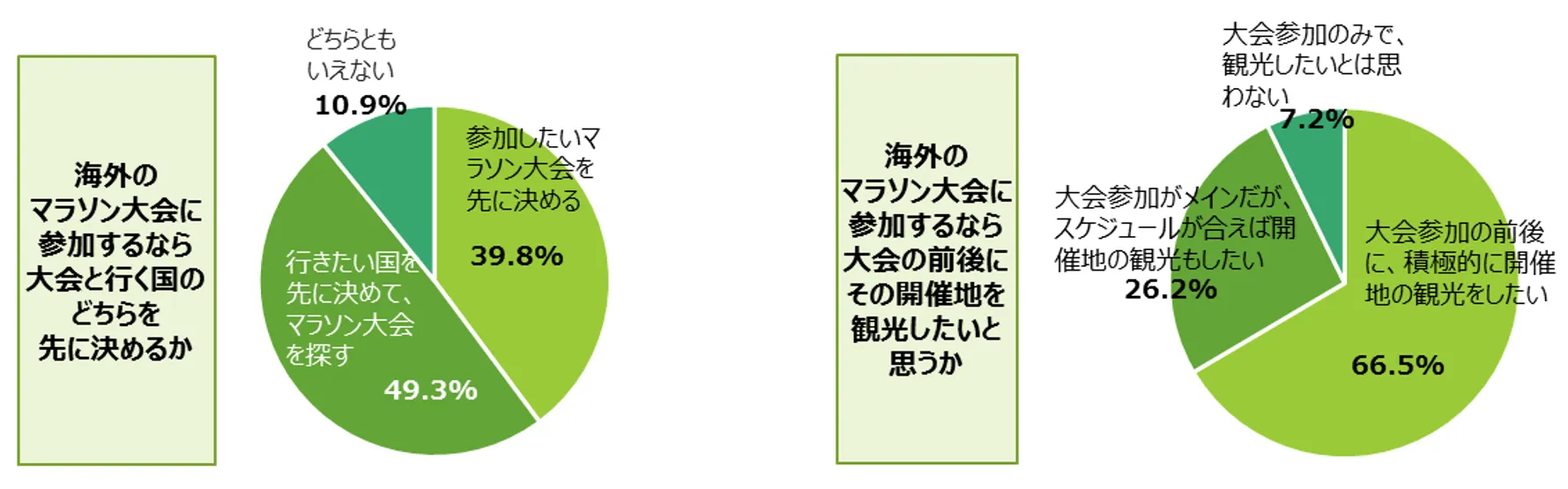
Regarding how to choose an overseas marathon, about half of respondents said they “decide on the country they want to visit first and then look for a marathon.” Additionally, when asked if they wanted to sightsee in the host city before or after the race, 66.5% said they “actively want to sightsee in the host city,” with no significant differences across gender, age group, or running experience. This indicates that, regardless of demographic, participants in overseas marathons have a high level of interest in sightseeing in the host city.
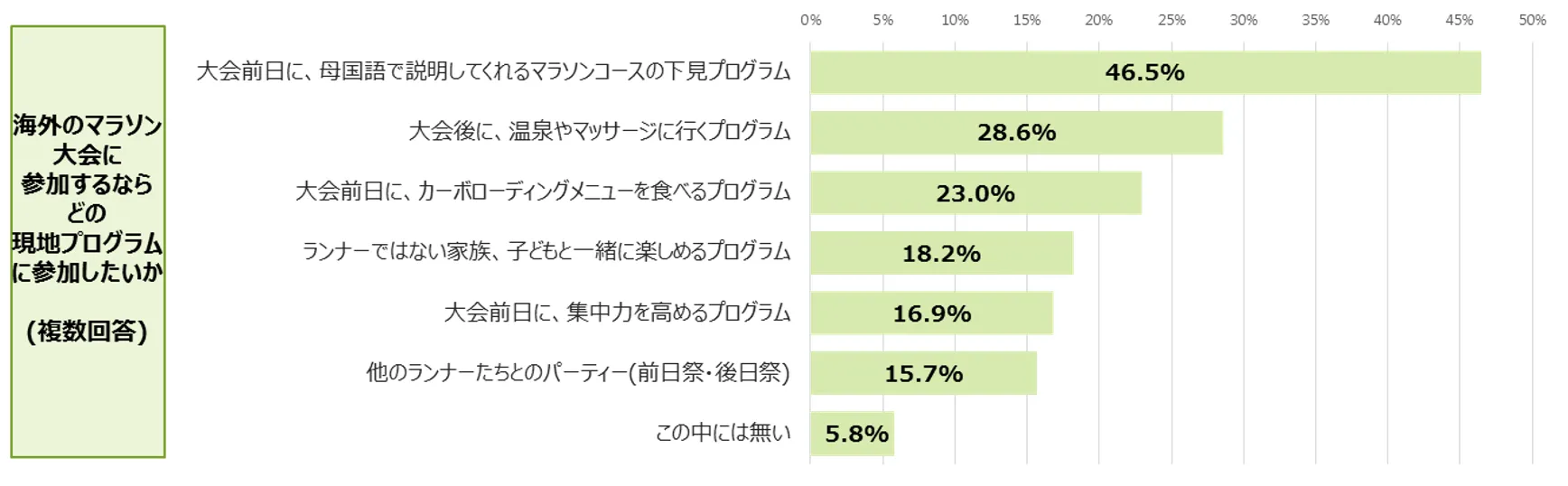
Regarding local programs participants would like to join on the day before or after the race, “a pre-race course walkthrough in their native language” was the most popular choice at 46.5%, indicating a desire to confirm the running route, aid stations, and medical stations. For “post-race programs involving hot springs or massages,” the percentage was 9 points higher among women than men.
(3) 40% Express Interest in Participating in Japanese Marathons
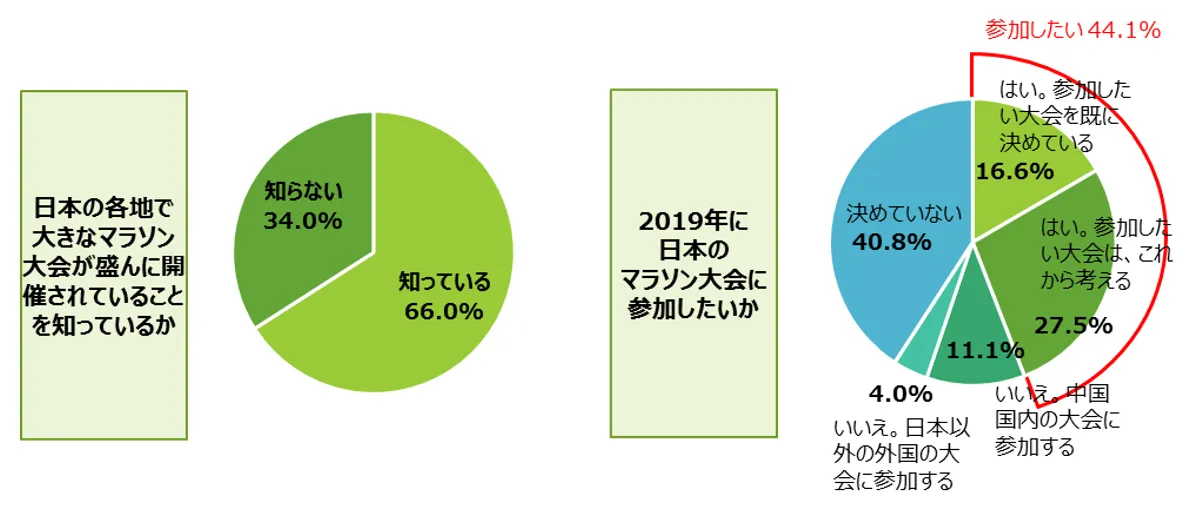
Next, we asked about Japanese marathon events. 66.0% of respondents “knew” that “major marathon events are actively held not only in major cities but throughout various regions of Japan,” exceeding the percentage who “did not know.”
As of October–November 2018, when the survey was conducted, 44.1% of respondents said they wanted to participate in a Japanese marathon in 2019. Of these, 16.6% had “already decided which race to enter,” while 27.5% said they would “decide which race to enter later.”
2. How Japan Can Become a “Destination for Marathons” for Foreign Runners
(1) Tips for Creating Stay-of-Life Experiences for Foreign Runners
Based on the survey results, local programs that provide the information and experiences Chinese runners seek are considered effective in promoting their participation and extended stays at host locations. In particular, half of the respondents said they would “like to participate” in “course preview tours conducted in their native language.”
Consequently, when our company collaborated with multiple race organizers to pilot “course preview tours in their native language” for foreign runners, one key to success was collaboration among the departments responsible for race operations, tourism, and promotion. This is because, in order to explain course details to foreign runners on the bus, answer questions about event operations along the way, and highlight seasonal tourist attractions on the course to generate excitement, it is necessary to consolidate information across departments in advance and create a well-structured explanation script based on that information.
Furthermore, when we surveyed 40 runners from Hong Kong, Taiwan, and China who participated in regional marathons around the same time as the questionnaire, asking about their experience participating in overseas events, a surprisingly large number of famous marathons were cited. Within Japan, 18 events were mentioned, including the Tokyo Marathon and the Mt. Fuji Marathon. Outside Japan, 27 events across 13 countries were cited. Among Chinese runners, some had even participated in the Chicago Marathon and the Berlin Marathon.
Given that foreign runners from East Asia are likely to have already experienced large-scale urban marathons both domestically and internationally, as well as events at famous resort destinations, when they choose regional marathons, they are comparing the event organization, accommodation, and local sightseeing opportunities to those of global events to decide whether to return or recommend the event to others. For regional events in particular, it is essential for event organizers to collaborate with tourism-related departments to develop accommodation and leisure options that will satisfy foreign runners accustomed to participating in international events.
(2) Foreign Runners: A Source of Hope for Both Event Sustainability and Tourism Promotion
In Japan, the “Tokyo Marathon,” which began in 2007, sparked a marathon boom, leading to an increase in marathon races and running events nationwide. Depending on which category is used as a benchmark, the current number of events is said to be as high as 2,000 or 3,000. While famous races are flooded with applicants, regional events in particular appear to face fierce competition in securing both participants and operational funding—as evidenced by the discontinuation in 2017 of the “Tane-gashima Rocket Marathon” (Kagoshima Prefecture), which had been held for 30 consecutive years.
Consequently, it is not uncommon for events to actively seek to attract foreign runners by conducting overseas promotions or setting aside priority slots for international participants. In local governments hosting marathons, the sports departments aim to increase participation and secure operational funds to ensure the event’s survival, while the tourism departments aim to boost tourism revenue and increase the number of foreign visitors to Japan through these events.
Survey results indicate that amateur runners in China are also interested in overseas marathon events and show a strong willingness to engage in tourism at the host locations. Regarding Japan, there is widespread awareness that marathons are actively held across the country, and 40% of respondents expressed interest in visiting Japan to participate. Following runners visiting from Taiwan and Hong Kong, this market appears to be one where participation is expected to grow in the future.
*1: Road races with over 800 participants; cross-country races with over 300
participants *2: “2018 China Marathon Big Data Analysis Report,” Chinese Athletics Association
*3: Surveys conducted in Beijing and Shanghai.(1) October 13, 2018: 525 runners participating in the Beijing Hard Rock Marathon (2) November 16–17, 2018:
359 visitors to the “China Run” booth at the Shanghai Sports Show*4:In the “Survey of Chinese Travelers by Place of Residence” (JTB Tourism Research & Consulting, September 2016), when respondents living in Chinese cities with a household annual income of 120,000 yuan or more who were planning to travel to Japan within the next three years were selected, those in their 20s to 40s accounted for 97% of the sample.