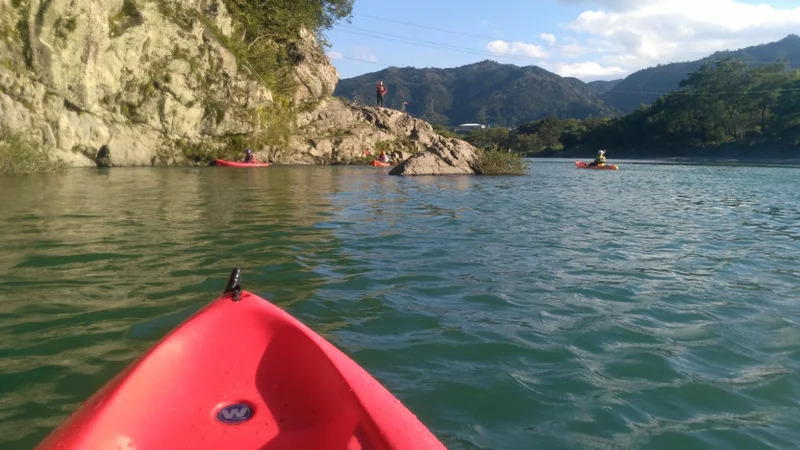
Live a life full of adventure!

Adventure tourism (AT) is a sector that holds great promise for the future, as the nature of tourism evolves alongside the diversification of people’s interests. However, there are still not many international travelers who think of Japan as a destination for AT.
Jules Verne’s novels, such as *Around the World in 80 Days*, which depict thrilling adventures into new worlds, have been read by generations of readers, and many of the concepts he described—such as round-the-world travel, space travel, and underwater travel—have since become a reality.
According to one theory, 20% of the world’s population possesses the “adventurer gene” that makes them love to travel. Many people likely have unforgettable memories of climbing mountains while traveling, trekking through forests, exploring unfamiliar lands on dog sleds, horses, or elephants, or experiencing the thrill of bungee jumping or skydiving. When you think about it, adventure may be like a tonic that brings happiness, satisfaction, and a little adrenaline rush to people’s lives.
Adventure tourism (hereinafter AT) is by no means a new concept in the world of tourism, but as traditional tourism evolves alongside the diversification of people’s preferences, it is a field in which great expectations are placed for the future. According to a report by the global research firm Allied Market Research (January 2018), the global AT market size in 2016 was approximately 45 trillion yen. It is estimated to grow at an average annual rate of 17.4% and reach 134 trillion yen by 2023.While Asia is expected to see the highest growth rate, Japan—blessed with exceptional natural features such as four distinct seasons, the sea, and mountains—is believed to possess immeasurable potential for adventure tourism. There are countless examples, such as the “Ice Horizon Walk” across Hokkaido’s vast ice plains, diving to underwater ruins in Yonaguni, and the Jomon Sugi cedar on Yakushima. Unfortunately, however, it is also a fact that not many overseas travelers currently think of Japan as a destination for adventure tourism. While Japan has recently become a popular tourist destination attracting many visitors from abroad, its recognition as a destination for adventure is still insufficient.
To get adventurous travelers from around the world to pin Japan on their maps, we need to take a more proactive approach—one that goes beyond simply advertising and providing information on websites or participating in trade shows. One idea would be to develop products and promotions in partnership with overseas travel agencies or organizations specializing in AT-related travel. While activities in Japan tend to be light, lasting a few hours to half a day, creating plans that allow travelers to take their time and fully experience the destination over several days—as is popular overseas—could help tap into previously untapped demand.
It is also crucial to effectively leverage the rapidly evolving internet and social media. For example, Instagram features a function that allows users to tag and search for the location of posts they view. Instagram users can book flights to a destination without even knowing its exact location. While such trends could fundamentally transform the concepts of travel and booking, if utilized effectively, there is potential for this information to directly translate into actual travel—provided it reaches the right audience.
While AT is often discussed in the context of nature and wildlife, it is not limited to that. Personally, I believe that every trip is an adventure that brings some kind of new discovery. As long as you have the desire and willingness to “experience” something, you can view AT in a broader sense—and perhaps even embark on a wonderful adventure right in the city.
著者