How to Communicate Travel Information in the Wake of the COVID-19 Pandemic
With the rise of social media, the way information flows has changed, and the world is now flooded with vast amounts of information—ranging from posts by individuals to content from mass media. As the COVID-19 pandemic has restricted in-person activities and led to the widespread adoption of various digital communication tools, we will examine what kinds of information people trust and rely on, and consider the future of travel information dissemination.
More than a year has passed since the global outbreak of COVID-19. Not a day goes by without COVID-related news, and a massive amount of information is being disseminated through various media outlets. However, hasn’t everyone at some point felt anxious about this information or struggled to discern what is reliable? The spread of social media has already transformed the way information circulates, leading to an increase in the volume of information surrounding us. We now live in an era where we can freely share information ourselves as media outlets, while also accessing information from a diverse range of sources—from public figures to ordinary individuals. So, to what extent do people rely on the information they obtain in this way? There are many ways to acquire travel information, and it is interesting to see what kind of information is being used and how.
On April 9 of this month, JTB released a “Survey on Attitudes Toward Information and Travel from the Internet and Social Media in Life During the COVID-19 Pandemic.” Our company was involved in this survey, drawing on our past research, our own public relations experience, and our current media relations activities. Given the current situation where many regions have identified “communication capabilities” as a key challenge, this article—with JTB’s approval—highlights key points, incorporates some unpublished data, and provides an overview of future information dissemination in the tourism sector.
1. Reference Value by Information Source and the Role of Social Media
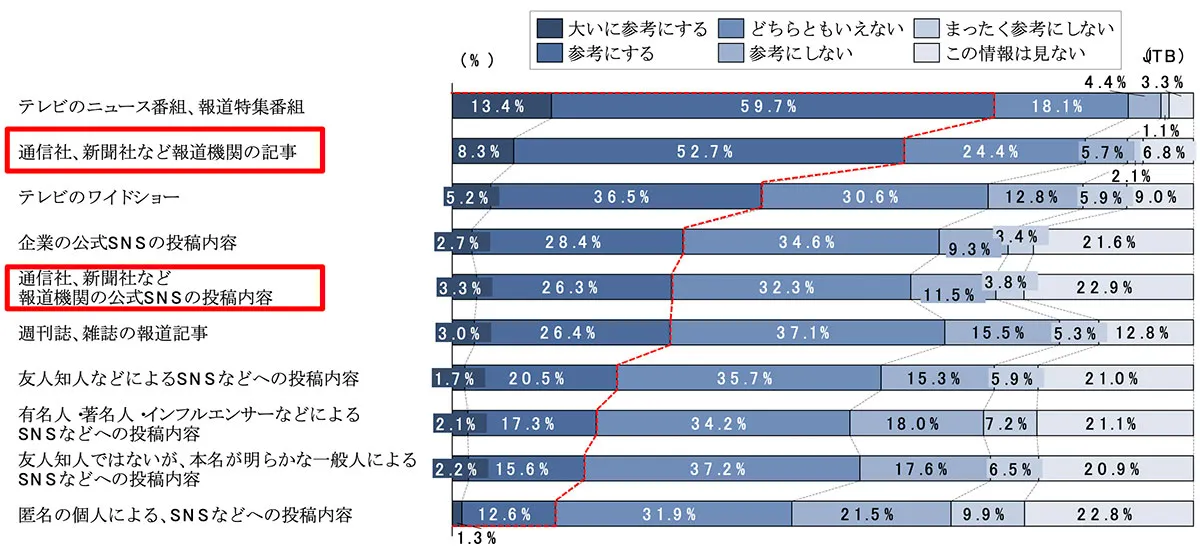
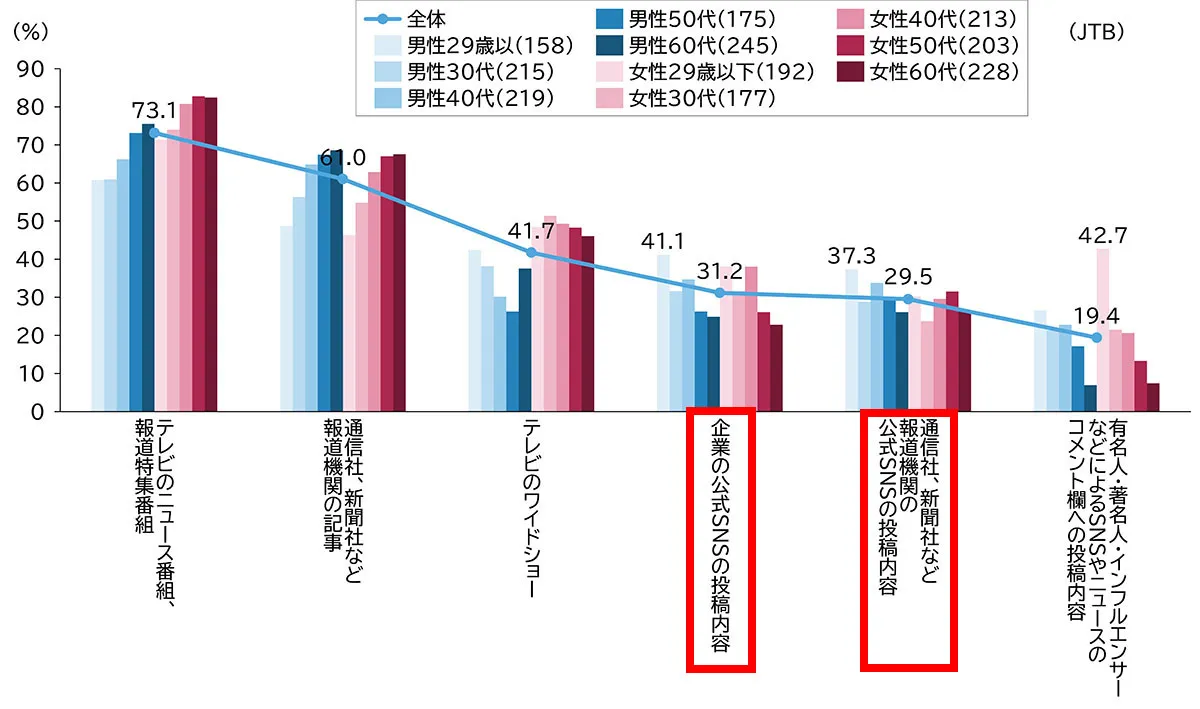
Figures 1 and 2 present the results of a survey asking respondents (*Note) to what extent they rely on information obtained from TV programs, news reports from news agencies and newspapers, and social media in their daily lives. The highest percentages of respondents who find such information useful (combined total of “very useful” and “useful”) were for “TV news programs and special news programs (73.1%)”, “articles from news agencies and newspapers (including print and online) (61.0%)”, and “TV talk shows (41.7%)”—meaning that so-called mass media coverage ranked at the top.
Regarding social media information, the highest percentages of those who find it helpful were “posts on companies’ official social media accounts (31.2%)” and “posts on the official social media accounts of news agencies and newspapers (29.5%),” with roughly 30% of respondents citing these sources. “Posts by friends and acquaintances” and “posts by celebrities, public figures, and influencers”—where the poster’s identity is known—accounted for about 20%, while anonymous posts yielded even lower results. This indicates that the use of social media information is heavily influenced by “who is posting it.” Furthermore, even regarding information from “news organizations such as news agencies and newspapers,” there was a significant difference between articles (including print and online) and official social media posts. While the proportion of people using social media information decreases with age, this is likely also due to the fact that there are fewer social media users in older age groups.
Among men aged 29 and under, the percentage relying on “posts from official social media accounts of news organizations (37.3%)” and “posts from official corporate social media accounts (41.1%)” was notably higher than in other age and gender groups. Similarly, among women aged 29 and under, the percentage relying on “posts by celebrities, public figures, and influencers (42.7%)” was significantly higher than in other groups. It is no exaggeration to say that younger generations use social media as their default platform; for companies, the benefits of social media—including its reach through retweets and its immediacy—are likely significant. As generational change progresses, social media, with its high level of trust, is expected to become the standard for accessing information.
2. Tourism Association Websites, Which Have Been Gaining Prominence in Recent Years
Local tourism stakeholders often mention that they lack outreach capabilities and need to strengthen their social media presence, but how exactly do travelers utilize tourism information? When asked about the “sources of information used to decide on specific activities at the destination” for their most recent trip, the prominence of “tourism association websites” had increased compared to previous surveys. While “tour operator and OTA travel information” and “travel review sites” are the sources travelers consult most frequently, tourism association websites ranked next, scoring higher than guidebooks and magazines. As tourism gains attention as a means of regional revitalization and infrastructure for welcoming foreign travelers continues to develop, many regions are reevaluating their tourism resources and advancing branding efforts. Consequently, the quality of DMO and tourism association websites has improved, and these resources have become better known to Japanese travelers as well. These websites are particularly strong in the areas of “tourist attractions,” “festivals and events,” and “souvenirs and shopping,” suggesting that travelers expect local information provided by locals, as well as high-value, seasonally relevant content. On the other hand, “experiences and tour information” is consulted less frequently than “tourism information from travel agencies and OTAs” or “travel review sites. ”Figure 4 shows the points of dissatisfaction regarding tourism association websites at the time of the 2017 survey. While many of these issues have been addressed and the websites are now becoming established as reliable sources of information, even back then, younger age groups were more likely to express a preference for being able to “book experiential tours in addition to accessing information.” To drive local consumption, efforts such as linking content to “tourist attractions” or incorporating booking functions are expected.
Social media and blogs were not widely used as tools for making concrete travel decisions. As shown in the previous chapter, leveraging their immediacy and reach to raise awareness, and using photos and videos to enhance the destination’s image, appears effective in shifting the perception of the indifferent segment from “awareness” to “favorability.” However, it is difficult to say that they provide rational access to the information necessary for taking action; it is also important to post necessary information on the website and direct users there. Our survey indicates that there is a growing demand to know infection control measures at travel destinations in advance during the COVID-19 pandemic. However, some businesses have simply posted this information on Facebook, and in some cases, as time passes and updates accumulate, the information becomes difficult to find. It is important to understand the functions of websites, social media, and blogs and utilize them effectively.
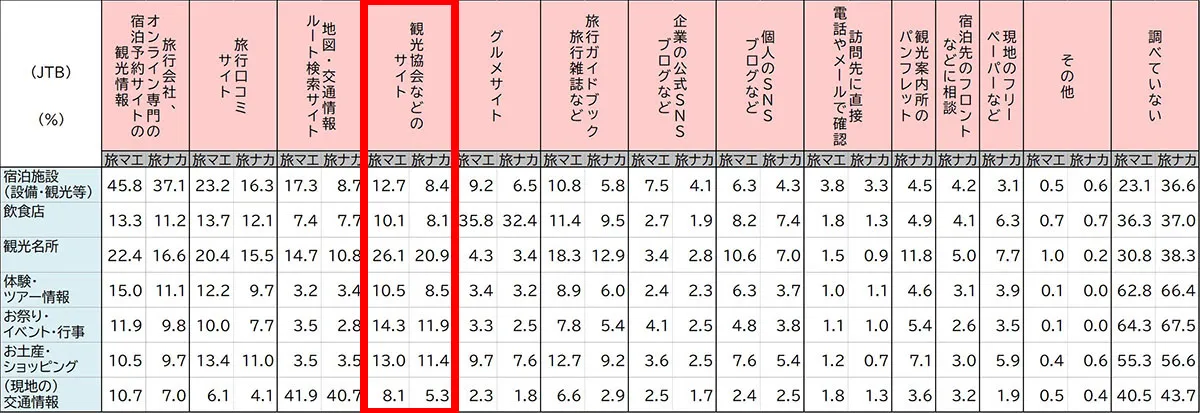
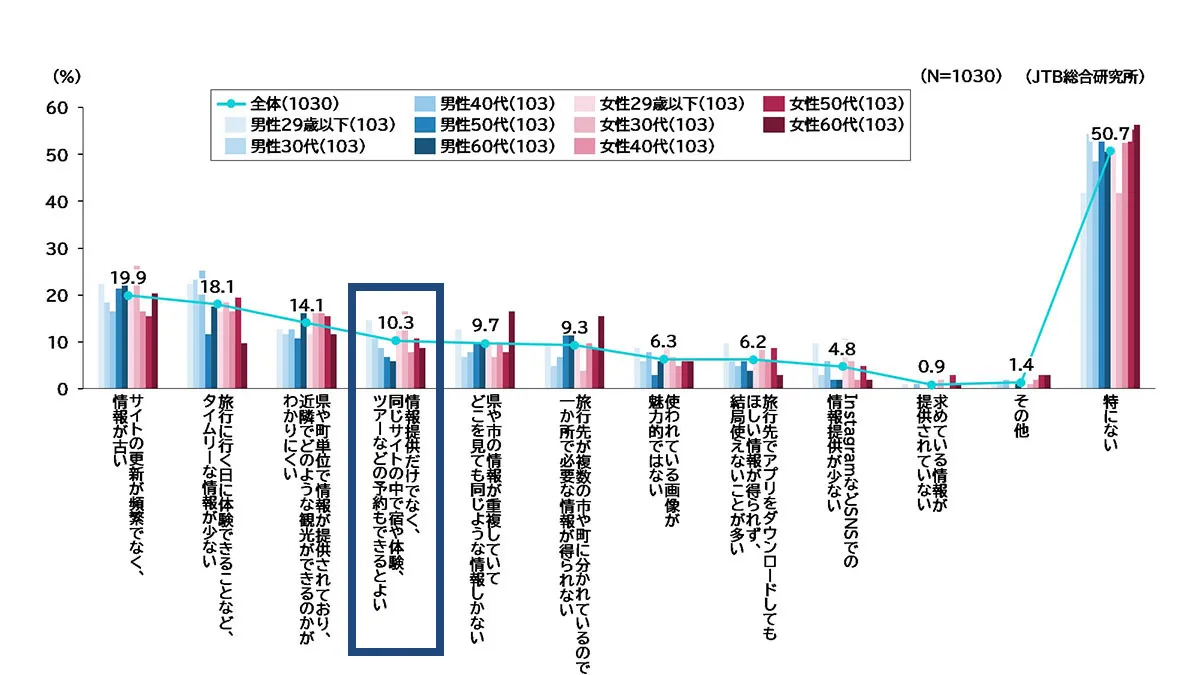
Source: JTB Tourism Research & Consulting, Survey on Smartphone Use and Travel (2017)
3. Effectively Utilizing Videos, Photos/Illustrations, and Text
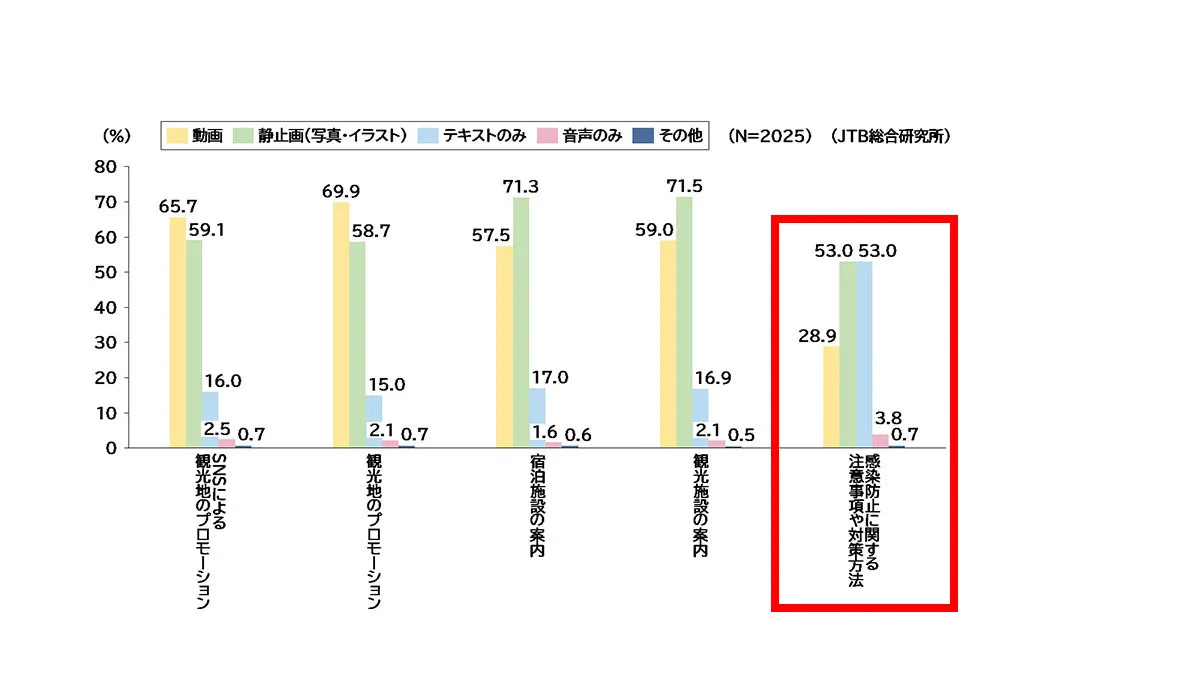
Websites providing travel and tourism information feature a variety of content using videos, photos/illustrations, and text. During the state of emergency declared last April, foreign-owned hotels were quick to upload videos detailing infection prevention measures to their websites, which became a hot topic, prompting others to follow suit. However, after travel resumed, some argued that videos were not always the most practical way to provide information. Therefore, we asked users, by category, which medium they preferred for the information they wanted to know. The results showed that for precautions and measures regarding infection prevention, 53% of respondents preferred still images (photos, illustrations) and text alone, while 28% preferred videos. For tourism promotion, videos received the highest rating on both social media and websites, though still images also garnered support from about 60% of respondents. For information on accommodations and tourist facilities, still images received over 70% support in both cases, making them the most preferred format. While videos are effective for PR that stimulates the imagination, they are perceived as difficult to understand relative to the time required to watch them.
4. Approaches to Travel Information Dissemination Ahead of the Full Resumption of Travel
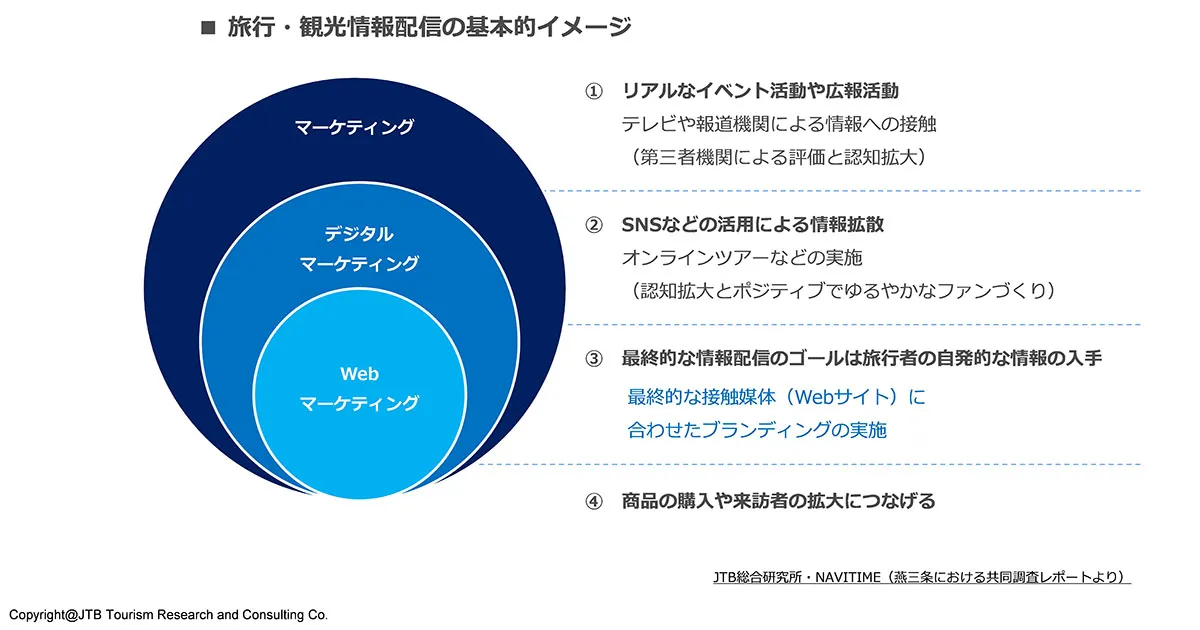
Amid the COVID-19 pandemic, various digital communication tools have emerged to compensate for the inconvenience of travel restrictions. However, from the traveler’s perspective, as shown in Figure 6, the fundamental image of tourism information distribution does not change frequently.
I believe there are two major roles required within the travel cycle. The first is to disseminate information that understands what travelers need and conveys it without causing stress or misunderstanding. The second is to disseminate information that raises broad awareness and improves favorability, thereby converting the uninterested segment into the interested segment. The methods and content of information dissemination will vary depending on which of these two purposes is being served. The same is true for inbound tourism.
Public relations activities that leverage the power of the media are also important, as they differ from advertising in that the perspective of a third-party media organization provides a “seal of approval” and “trust,” ensuring that information reaches a broader audience. However, with the ongoing digitalization of the media landscape, public relations activities can no longer rely solely on the traditional relationship between “announcements” and “interviews” through press releases. As shown in Figure 6, this can be viewed as one of the roles within basic information distribution. Consequently, information dissemination will likely center on solidifying the information infrastructure through web marketing and advancing digital marketing by utilizing not only social media but also online tours. Recently, there has been an increase in cases where news organizations turn topics trending on social media into articles. Articles have influence, for better or worse. Precisely because we live in an era where anyone can publish content, I believe everyone needs a “public relations perspective” to cultivate the ability to view the big picture—including branding—and the imagination to anticipate the impact of content, including risks, in order to deliver the most effective messaging.
Furthermore, the fact that traffic to DMO and tourism association websites is being monitored is also crucial for future marketing efforts. Travelers during the COVID-19 pandemic are seeking real-time information more than ever before, and a trend has emerged where they place greater importance on information distributed directly by local regions as a primary source. As the information travelers seek continues to evolve, we are moving away from an era where people relied on media and word-of-mouth for travel information toward an era where they actively seek it out themselves. Given this, DMOs and tourism associations need to reevaluate not only how they respond to the “visible travelers” who have already visited but also how they approach marketing and information distribution for the “invisible tourists” who will visit in the future.
*Note: Figures 1–3 and 5
are from JTB’s “Survey on Attitudes Toward Travel and Information from the Internet and Social Media During the COVID-19 Pandemic (2021).” Survey
respondents: 2,025 people who had traveled (domestic or international) between 2019 and February 2021 and owned a smartphone.