Reflections on Travel Among Generation Z, Who Reached Adulthood During the COVID-19 Pandemic (Based on a Survey on Young People and Lifestyles)
In this column, drawing on my experience working in the tourism industry at JTB Tourism Research & Consulting and my current role as a university professor preparing students for the workforce, I will examine—based on survey findings—how the preferences of young people as travel consumers are changing and where the attitudes and lifestyles of future generations are headed.
1. Are there differences in travel styles between Generation Z members who came of age after the COVID-19 pandemic and those from the earlier generation?
I am currently on secondment from JTB Tourism Research & Consulting to the Faculty of Service Management at Seibu Bunri University in Saitama Prefecture, where I teach “Tourism Theory.” At the company, I have conducted research on how social changes and technological advancements influence people’s lifestyles, values, and travel habits. I have also focused on generational trends, particularly the behavior and influence of young people—often referred to as Generation Z—who are digital natives. Therefore, the university serves as a valuable opportunity to engage with the behaviors and perspectives of today’s youth that go beyond my own expectations.
Although we often use the term “young people” as a general category, their thoughts and behaviors differ depending on the social and economic environment of their time.In the early 2000s, it was said that “young people don’t travel,” but from around 2015–2016, the rate of outbound travel among those in their early 20s—particularly women—skyrocketed, and young people’s desire to travel both domestically and internationally began to grow. At that time, the economic environment remained relatively stable, employment conditions were improving, and this coincided with the period when the first members of Generation Z were just reaching adulthood.
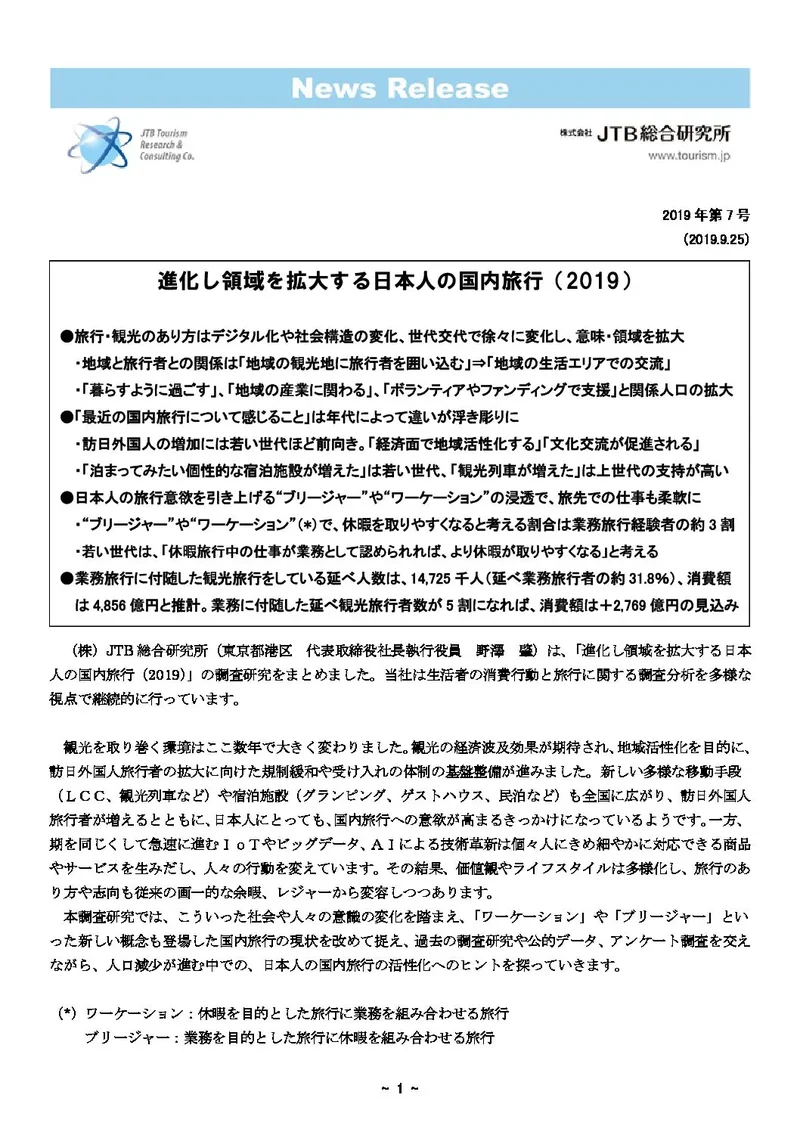
Nearly 10 years have passed since then, during which time we experienced a three-year COVID-19 pandemic. A survey* on travel conducted during the pandemic revealed that people in their 20s were driving travel trends. When I took up my post at the university in the spring of 2023 and asked students about travel, I found that—partly due to the pandemic—their travel experience was indeed limited, and their awareness of information sources, travel-related companies, and products and services was lower than I had imagined. The early members of Generation Z are now in their late 20s.Believing that there are differences between the Generation Z cohort now reaching adulthood and older generations following the COVID-19 pandemic, I conducted an online survey to gauge their attitudes.
Currently, according to the Ministry of Education, Culture, Sports, Science and Technology’s “Basic Survey on Schools,” the enrollment rate in higher education institutions (universities, junior colleges, the fourth year of technical colleges, and vocational schools) exceeds 80%.For 18- to 19-year-olds, entering higher education is often a catalyst for actively seeking new experiences, and travel is one of them. The objectives of this survey were twofold: first, from the perspective of the tourism industry, to understand the preferences of young people as travel consumers; and second, from the perspective of institutions sending students out into society, to grasp the direction in which the younger generation’s mindset and lifestyle are heading.
This article presents a selection of the survey results related to travel; findings regarding lifestyles and values will be covered in a future publication.
Note: *JTB Tourism Research & Consulting: Survey on Changes in Daily Life, Mental Well-being, and Attitudes Toward Travel Due to the Spread of COVID-19 (2020–2023)
2. Student Life During the COVID-19 Pandemic and Survey Overview
Today’s university graduates in their first year of employment are a generation that was significantly impacted by COVID-19 during their student years. Following the nationwide state of emergency declared in April 2020, many universities canceled entrance ceremonies, students were unable to attend campus until summer, and classes shifted to online formats. While conditions began to normalize in mid-2022 and border restrictions on international travel were eased, job hunting and graduation research soon began in earnest, and these students entered the workforce in the blink of an eye. This year’s first- and second-year students enrolled in 2023 and 2024, following the subsidence of the COVID-19 pandemic. They have been fortunate to have opportunities to gain a wealth of experience—including domestic and international travel and internships—without restrictions on movement, and many are actively engaged in campus activities at their home universities.
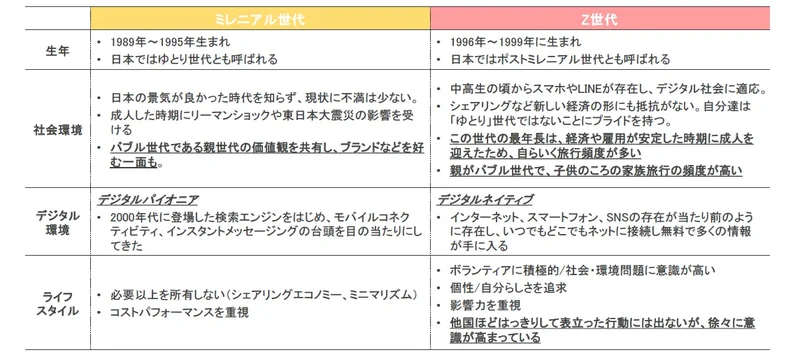
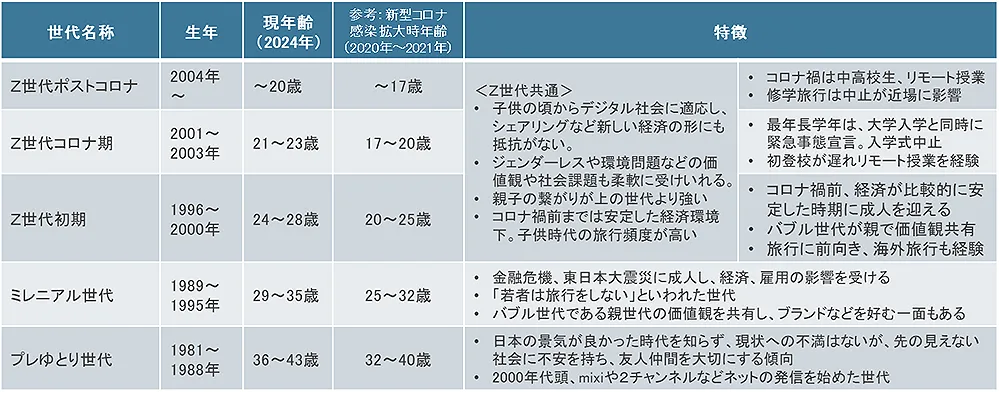
In this survey, to gain a more detailed understanding of the changes and differences among young people, we divided Generation Z into three groups—“Early Gen Z,” “Gen Z COVID Era,” and “Post-COVID Gen Z”—and analyzed the data accordingly (Table 1). We defined “Gen Z COVID Era” as the generation that was 18–19 years old during the COVID-19 pandemic (2020–2022) and experienced some form of travel restrictions. In terms of four-year universities, this group includes current first-year working professionals, fourth-year university students, and third-year university students. “Post-COVID Gen Z” refers to the generation that turned 18–19 years old in 2023 or later, after COVID-19 was reclassified as a Category 5 infectious disease. Note that regarding the question on whether they traveled, we included 2022—when the “Prevention of Spread” measures ended and travel demand increased—in the “Recovery Phase.” The survey overview and characteristics of each generation are as follows.
[Survey Overview]
Survey Title: Survey
on Young People’s Lifestyles and Travel (Ikuyo Namigata / Hiroshi Takase, Seibu Bunri University; Masashi Fujisawa, Navitime Japan)
Survey Method: Online survey
Survey Period: March 8–14, 2024
Survey Participants:
<Preliminary Survey> 6,881 men and women
aged 19–69 residing nationwide
<Main Survey> 987 respondents aged 19–39 from
the preliminary survey who took a trip involving an overnight stay in either 2022 or 2023, or both years (domestic or international, including trips home to visit family, but excluding business trips)
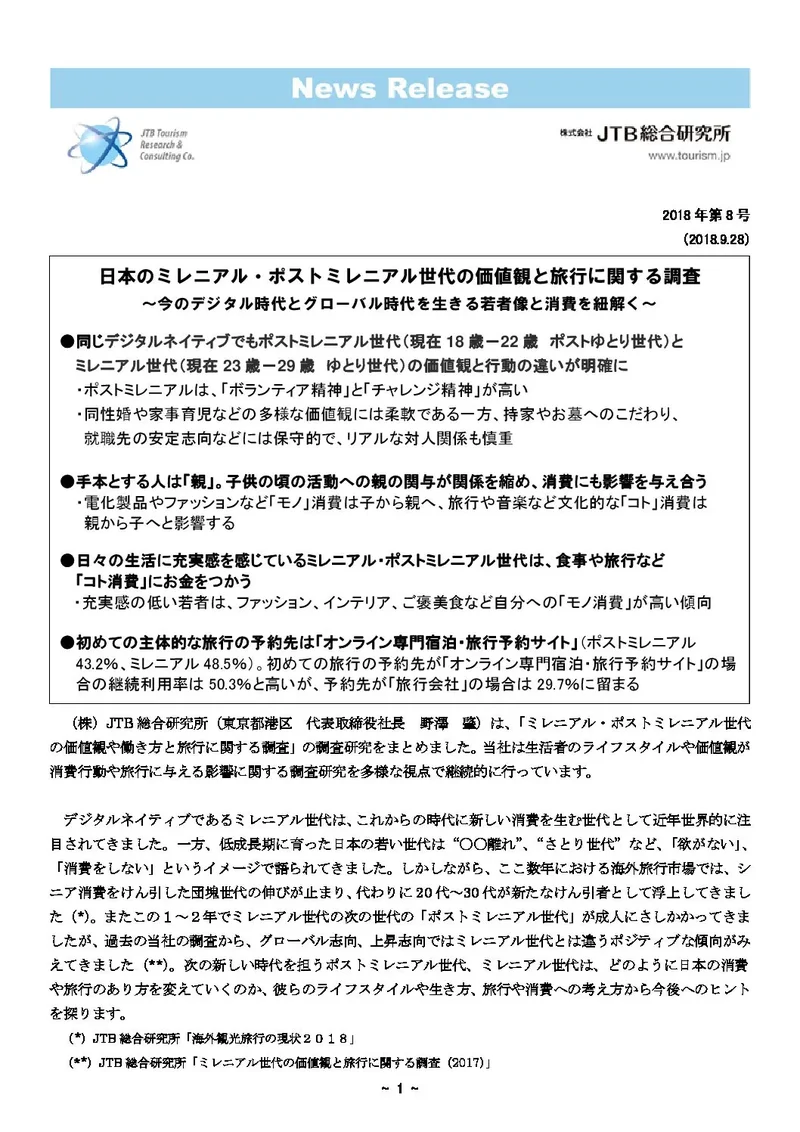
. JTB Tourism Research & Consulting, “Survey on the Values and Travel Habits of Japan’s Millennial and Post-Millennial Generations,” 2018
3. Generation Z’s Consistently High Desire to Travel Before, During, and After the COVID-19 Pandemic
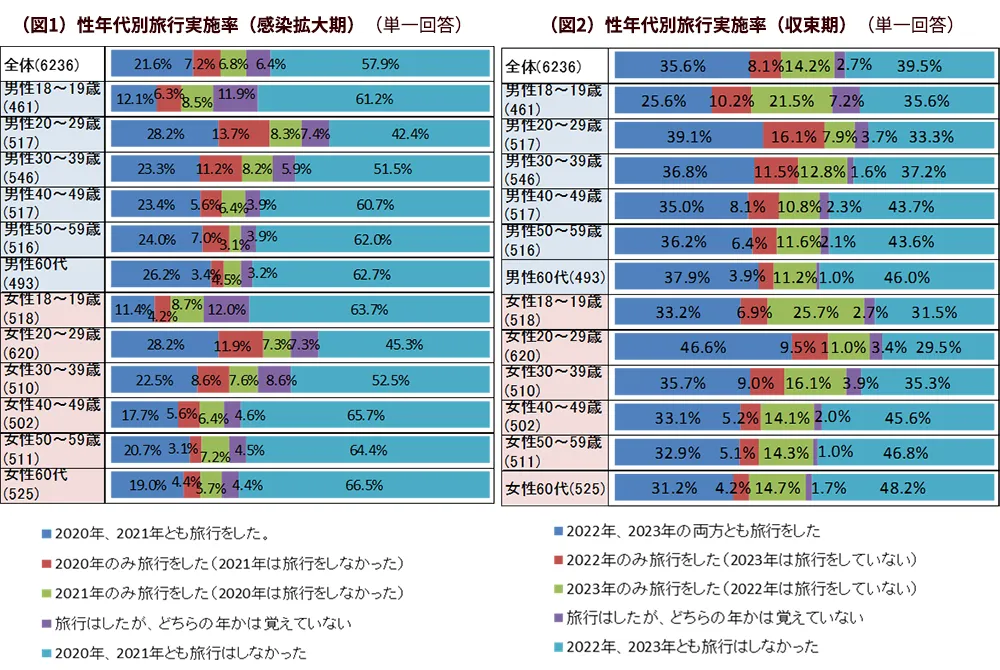
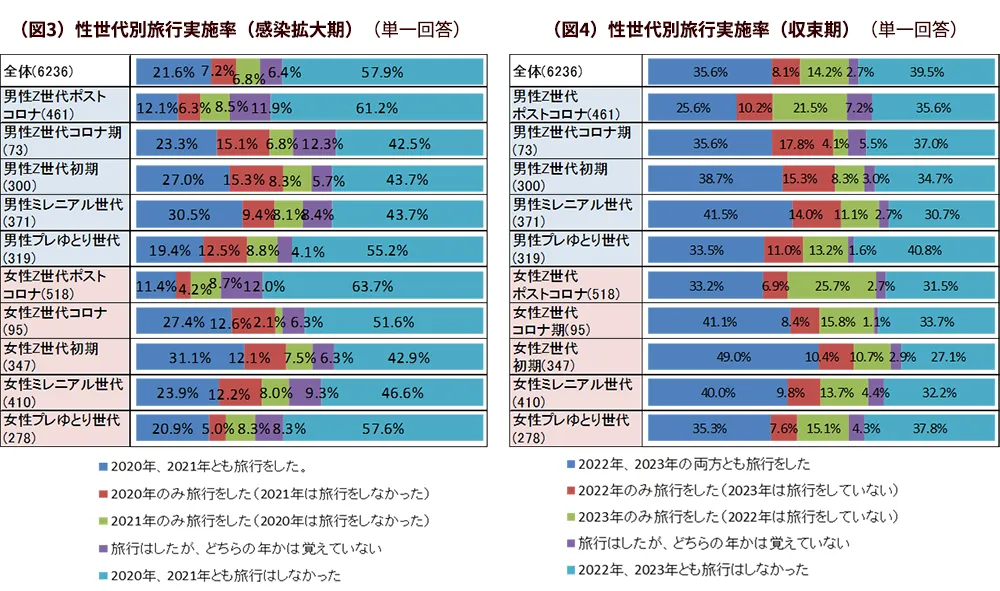
Regarding travel activity, a preliminary survey examined whether travel took place during two periods: the “spread of infection period (2020–2021)” and the “post-pandemic period (2022–2023)” (specifically, whether respondents traveled in both years or in either year).In both periods, people in their 20s had the highest travel rate for both men and women. The next highest group was people in their 30s during the pandemic period and 18–19-year-olds during the post-pandemic period, indicating that young people consistently drove travel (Figures 1 and 2).
To examine young people in more detail, we recalculated the participation rates according to the generations shown in Table 1. During the pandemic surge period, men tended to have higher rates in all groups except “Early Gen Z.” For men, “Gen Z (Post-COVID),” “Early Gen Z,” and “Millennials” were the top three groups with nearly equal rates, while for women, “Early Gen Z” had the highest rate, followed by “Millennials” and “Gen Z (Post-COVID).”
During the recovery phase, women tended to have higher participation rates in all groups except “Generation Z.” Looking specifically at Generation Z, “Early Generation Z” had the highest participation rate for both men and women, followed by “Post-COVID Generation Z” and “Generation Z during the Pandemic” (Figures 3 and 4). For “Post-COVID Generation Z,” who were high school students during the pandemic and faced challenges such as college entrance exams and job hunting, participation rates were relatively low; however, during the recovery phase, they ranked second highest for both men and women, following “Early Generation Z. ”Now that the impact of COVID-19 has subsided, it is clear that “Post-COVID Gen Z” has reached adulthood and begun traveling freely on their own.
Regarding travel participation rates, while overall rates were low for “Gen Z during the Pandemic,” their rates were not lower than those of other generations during either the pandemic surge or the recovery phases; therefore, it cannot be definitively stated that this generation alone was significantly impacted.
Women in the “Early Gen Z” cohort came of age after 2015–2016 and are the generation that drove up the outbound travel rate for women aged 20–24.They have consistently maintained a higher desire to travel than other groups throughout the pre-pandemic, pandemic, and post-pandemic periods. Although they are already in their late 20s, the outbound travel rate for women aged 25–29 in 2023 was higher than that of other age groups (Ministry of Justice Immigration Statistics). The period when they reach adulthood is considered a valuable time to begin accumulating travel experiences of their own volition, which is likely to influence their subsequent desire to travel.
4. After experiencing life during the COVID-19 pandemic, the desire to travel domestically has increased by about 50%
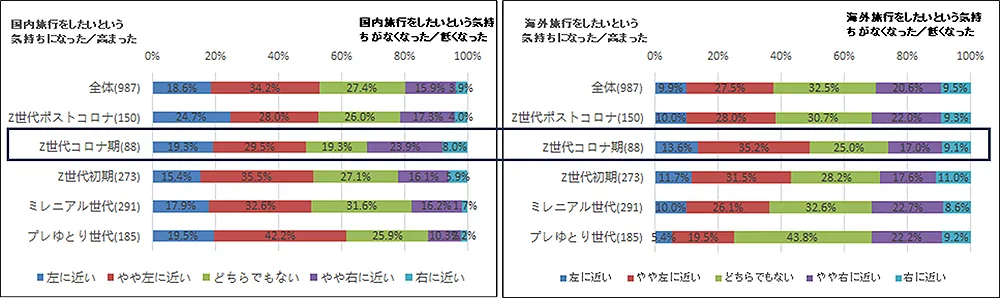
In this survey, we asked those who had traveled during the recovery phase (2022 and 2023) about their travel and lifestyle. Note that due to the small sample size for “Gen Z during the COVID-19 era,” the data was aggregated for both men and women.
When asked to select the statement that best reflected their feelings regarding life during the COVID-19 pandemic, 52.8% of the total respondents (combined figure) answered that they “agreed” or “somewhat agreed” with the statement “I felt like taking a domestic trip or my desire to do so increased.” The “Pre-Yutori Generation” had the highest percentage (61.7%), while the “Gen Z COVID Era” group had the lowest (48.4%).On the other hand, “Gen Z (COVID Era)” showed a high percentage (31.9%) for “My desire to travel domestically has disappeared or decreased.” “Gen Z (COVID Era)” also had the highest percentage (48.8%) for “My desire to travel overseas has emerged or increased.” It is conceivable that many in “Gen Z (COVID Era)” experienced travel restrictions during the period when they most wanted to travel, leading to a waning desire for domestic travel or, conversely, a growing interest in overseas travel as conditions normalized more quickly there.
5. Trends and distinctions in information sources that trigger travel are clearly evident by generation
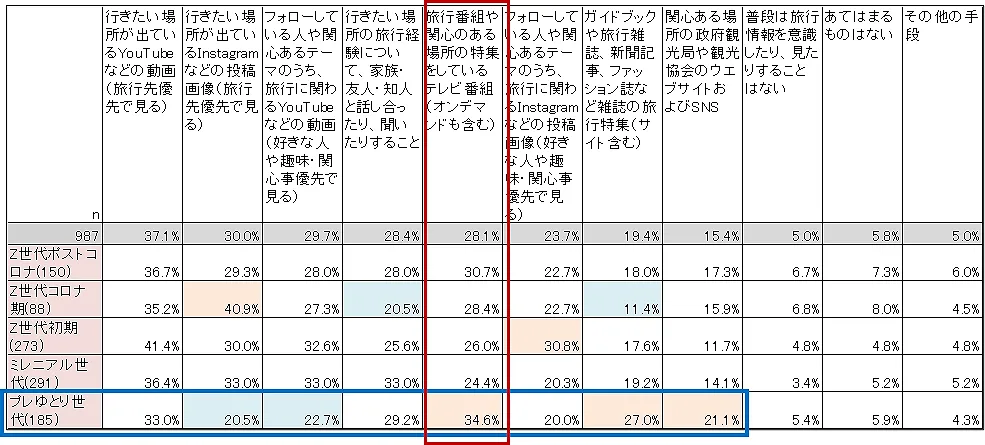
Video content is now the dominant medium for information that inspires travel and influences destination choices. In this survey, “YouTube videos featuring places I want to visit (viewed primarily for travel destinations)” was the most common response overall at 37.1%, while “YouTube videos related to travel from people I follow or topics I’m interested in (viewed primarily based on favorite people, hobbies, or interests)” accounted for 29.7%.
Regarding television, “TV programs about travel or places of interest (including on-demand)” accounted for 28.4% of the total, which was lower than user-generated videos or images. However, television was significantly higher only among the “Pre-Yutori Generation” (34.6%), making it the primary trigger for them. Conversely, the “Millennial Generation,” the generation immediately below them, had the lowest percentage by generation (24.4%), widening the gap with the “Pre-Yutori Generation. ”It is believed that the Millennials were among the first generations to be influenced by online videos, which began to spread when they were in their teens and twenties.
Similar to television, the gap between the “Pre-Yutori Generation” and the “Millennial Generation” also widened for “travel features in magazines (including websites), such as guidebooks, travel magazines, newspaper articles, and fashion magazines” and “websites and social media of government tourism bureaus and tourism associations for places of interest. ”These media, including television, are what are known as mass media. While they provide general travel information curated by professionals, unlike user-generated videos and images, they tend to offer broad, general content. This may make it difficult for them to capture the interest of Millennials and younger generations when it comes to sparking the desire to travel.
6. The younger the generation, the more they rely on search engines rather than specialized travel information sites when planning trips
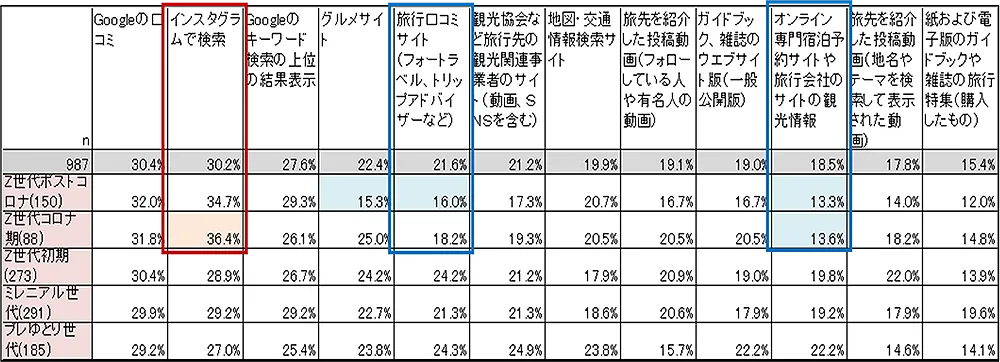
Regarding sources of information for making specific travel plans (excluding booking and purchasing products), the top responses overall were those utilizing search functions: “Google reviews (30.4%),” “searching on Instagram (30.2%),” and “top results from Google keyword searches (27.6%).” Instagram searches were particularly high among “Gen Z during the COVID-19 era” and “Gen Z post-COVID-19.”
While younger generations use Google reviews more than other generations, their use of specialized travel information sites—such as “travel review sites”—is low. Similarly, usage of “websites operated by tourism-related businesses at the destination, such as tourism associations” and “tourism information on online travel agencies (OTAs) and travel agency websites” also tended to be low. In particular, “Gen Z Post-COVID” showed low usage of guidebooks and magazines (including websites, print, and digital editions), suggesting that younger generations do not rely heavily on specialized travel media when planning trips. It may be that they are either unaware of the existence of these media, or that despite their high reliability due to professional editing, the content is too comprehensive and generic, making it difficult for them to decide how to proceed on their own. Video usage was low overall and appears to be more effective for raising awareness and interest rather than for concrete planning (Table 3).
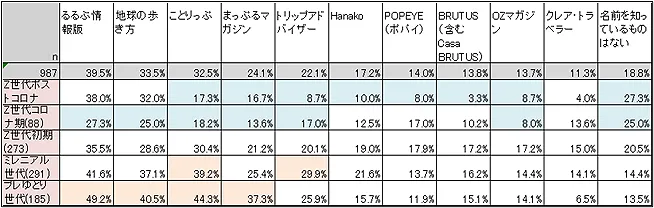
While awareness of traditional information sources—such as television, guidebooks, magazines, and tourism associations—decreased among younger generations, we also investigated the specific recognition levels of each medium. Recognition of “Gen Z (COVID era)” and “Gen Z (post-COVID era)” was low, and the percentage of respondents who answered “I don’t know any of these by name” was high. Awareness of magazines varies depending on the target readership, but in many cases, there was a gap in awareness between “Early Gen Z” and “Gen Z During the Pandemic.” It is presumed that for “Gen Z During the Pandemic,” this is influenced not only by their limited travel experience due to their age but also by the lack of experience resulting from the COVID-19 pandemic. It appears that the younger the demographic, the more they rely on search engines and do not fully utilize specialized travel information media. While details are omitted here, awareness of OTAs and travel agencies showed similar trends to those of information media.
travel products and tickets used for booking or purchasing
7. Can Travel Be a Means of Embodying an Ideal Way of Life?
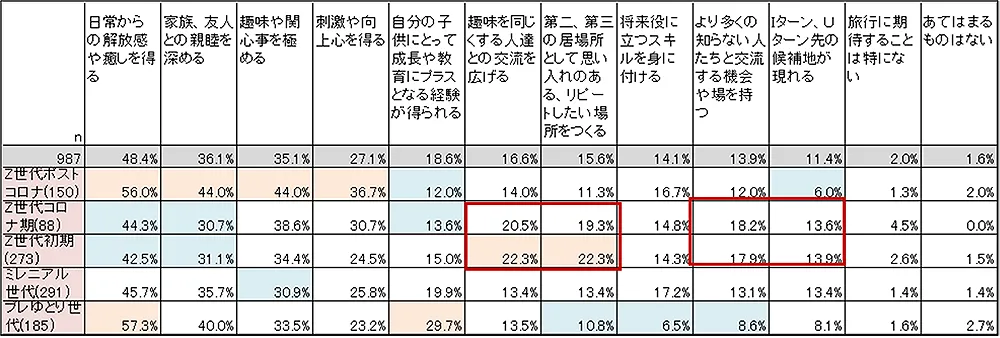
Now that the COVID-19 pandemic has subsided and people can travel freely again, Table 5 presents the survey results on what people expect from travel. The top four items can be interpreted as expectations regarding the emotions and effects directly experienced during travel; these were high across all generations, with “Post-COVID Generation Z” scoring more than 5 points higher than the average.
As the generation gets older, expectations related to their children’s growth and education, interactions at travel destinations, and creating places to return to as second or third homes increase, revealing expectations for travel as a means of embodying an ideal way of life and lifestyle. In particular, “Gen Z during the COVID-19 era ”While “feeling a sense of liberation from daily life and finding healing” and “deepening bonds with family and friends” ranked high among the “Early Gen Z” group, they were lower than in other generations. Conversely, “expanding interactions with people who share the same hobbies,” “creating meaningful places they want to revisit as second or third homes,” “having opportunities and venues to interact with more strangers,” and “identifying potential destinations for I-turn or U-turn moves” were higher than in preceding and subsequent generations.
In recent years, efforts to reform work styles have progressed, and remote work has become more widespread following the COVID-19 pandemic. Coupled with the diversification of values, there is a growing trend toward lifestyles that move away from a work-centric existence toward creating a sense of belonging outside of work—engaging in favorite activities, spending time in favorite places, and participating in local communities. This can be said to reflect the defining characteristics of Generation Z. The awareness that we are living in an era where we can—or must—choose from a variety of lifestyles may also have contributed to these results. It will be interesting to see how “Post-COVID Generation Z” evolves in the future.
8. Fostering a momentum among students to voluntarily seek out meaningful, high-quality experiences
These are the results of this survey. We plan to continue conducting longitudinal surveys to observe changes in young people’s lifestyles and their attitudes and behaviors regarding travel.
Incidentally, when I consider whether these results apply to the students I work with, I find that the situation largely matches my observations. Now that the summer vacation of my second year on the job has passed, I have noticed through my interactions with students that there are more students eager to travel than before. Regarding overseas travel, there is a trend toward polarization: once students go abroad, they realize the enjoyment and learning opportunities it offers and tend to travel abroad again. On the other hand, for students who do not travel abroad, while factors such as the weak yen and financial constraints play a role, the suspension of university study abroad programs due to COVID-19 and the lack of people close to them—such as seniors or friends—who can share their overseas travel experiences seem to have raised the barriers to traveling abroad.
In Table 2 of Section 4 mentioned earlier, the fourth most common factor motivating travel is “discussing or hearing about travel experiences to places they want to visit from family, friends, or acquaintances (28.4% overall).” However, this figure was lower only for “Gen Z during the COVID era,” at 20.5%.It is possible that, coinciding with the COVID-19 pandemic, there were fewer people and opportunities to casually discuss travel experiences, both domestic and international. Perhaps because of this, when I teach classes, I feel that many students listen with curiosity to case studies of regions both in Japan and abroad, even if they are not particularly interested in the academic content.
Recently, I invited representatives from the “Echigo-Tsumari Art Triennale,” currently being held in Niigata Prefecture until November 10, to serve as guest lecturers for my university class. The response from students was overwhelming; I received reports such as “I actually went to see it” and “I saw a connection between the wedding theory I’m studying and site-specific art. ”On the other hand, when I observe my students researching travel information, I notice they rely heavily on search engines and social media. Even when viewing content from top-ranking sites, they often pay little attention to the source of the information. This can be inefficient, and I frequently wonder whether they are actually able to obtain a comprehensive and accurate overview. I feel this issue extends beyond just travel information. That is precisely why I believe it is crucial to provide students with accurate information and foster an environment where they can proactively seek out high-quality experiences.
The term “moratorium” is used in university life to refer to the “preparation period” or “period of self-discovery” between graduation and entering the workforce. I believe that by actively gaining diverse experiences during this time, students can broaden their horizons, narrow down their career goals, and build a foundation of knowledge to inform the various decisions they will face in their future lives. Travel, even for leisure purposes, can be seen as one of the foundations for this. Currently, the job-hunting process for university students has begun earlier, and unfortunately, the “moratorium” period during which they can gain a wealth of experience has become shorter than before. I hope students will view travel as a means to this end—so that when they graduate and enter the workforce, they can be confident that their diverse experiences will help alleviate any anxiety they may feel. I encourage them to travel as much as possible now, to see and learn from their experiences.
[Reference Materials]
Ministry of Internal Affairs and Communications, “Survey on Information and Communication Media Usage Time and Information Behavior, FY2024”