What You Need to Prepare Now for the Introduction of the Digital Nomad Visa System: An Overview of the Digital Nomad Visa and the Characteristics of Digital Nomads
The COVID-19 pandemic has led to a rapid rise in remote work, and the concept of “digital nomads” is gaining traction worldwide as a new lifestyle. In Japan, the FY 2023 “Basic Policy” includes provisions for establishing a system to introduce a digital nomad visa, which has drawn significant attention. However, there is a lack of information and discussion needed to actually attract digital nomads and prepare for their arrival, and only a very small number of regions have begun taking concrete steps.In this article, we will examine the similarities and differences between this trend and traditional workation programs, as well as their potential and challenges, drawing on the results of the latest international surveys.
With the rapid spread of remote work due to the COVID-19 pandemic, “digital nomads” have garnered global attention as a new lifestyle. In Japan, too, the “Basic Policy on Economic and Fiscal Management and Reform FY 2023 (Basic Policy)” (*1) included provisions for establishing a system to introduce a digital nomad visa.While digital nomads can be described as foreign workers staying for extended periods, there is insufficient discussion on the receiving end regarding their relationship to traditional workations, expected benefits, anticipated challenges, and global trends.In this article, the first part will cover the characteristics of digital nomads and an overview of the digital nomad visa, while the second part will report on field research conducted in locations renowned as digital nomad villages, such as the Madeira Islands in Portugal, Bulgaria, and Bali, and discuss the future of hosting digital nomads.
1. Characteristics of Digital Nomads
Digital nomads are “people who utilize IT technology to work while traveling like nomads, unbound by a specific location” (*2), and their numbers have been growing rapidly due to the spread of remote work following the COVID-19 pandemic.According to a survey by A Brother Abroad, the global digital nomad population was estimated at over 35 million as of 2021, and is projected to double within the next three to four years. Furthermore, while the economic impact is estimated to reach 787 billion USD worldwide (approximately 114 trillion yen, or about 3.26 million yen per person, based on an exchange rate of 1 USD = 145 yen), the exact scale remains unclear.
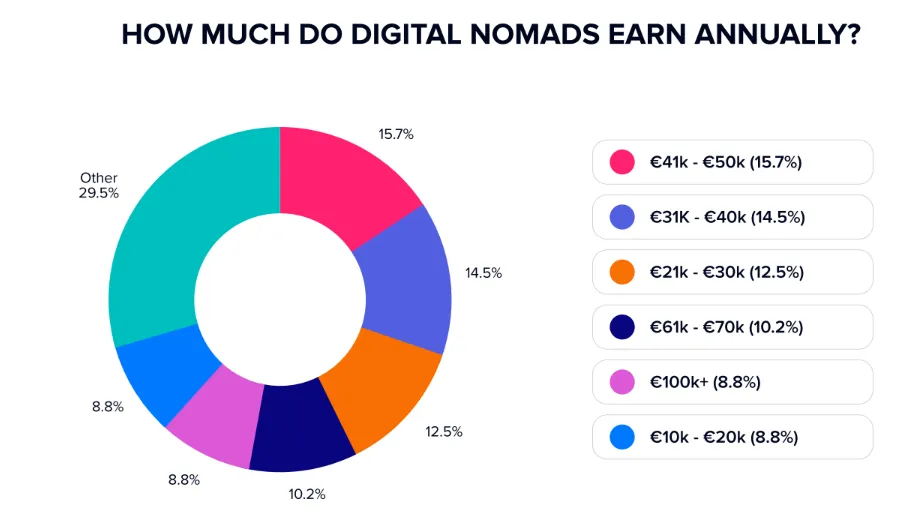
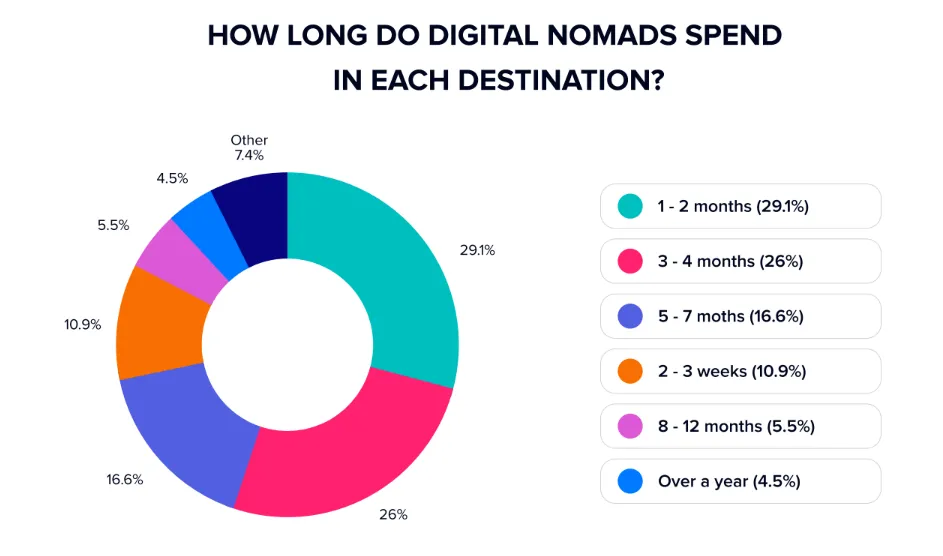
The primary reason digital nomads are attracting attention is that many are high earners who stay for extended periods, resulting in significant economic ripple effects.According to a 2023 survey report (Note 3) released by Flatio, a company providing vacation rental and short-to-medium-term rental platforms, 49.2% of digital nomads have an income of 31,000 euros or more (Figure 1), and 55.1% of respondents stated that they stay in one location for 1 to 4 months (Figure 2).
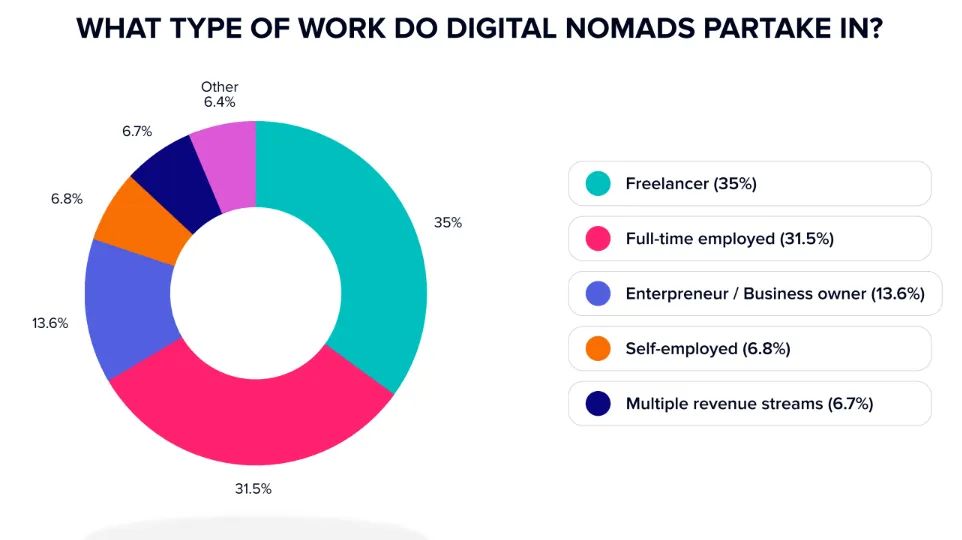
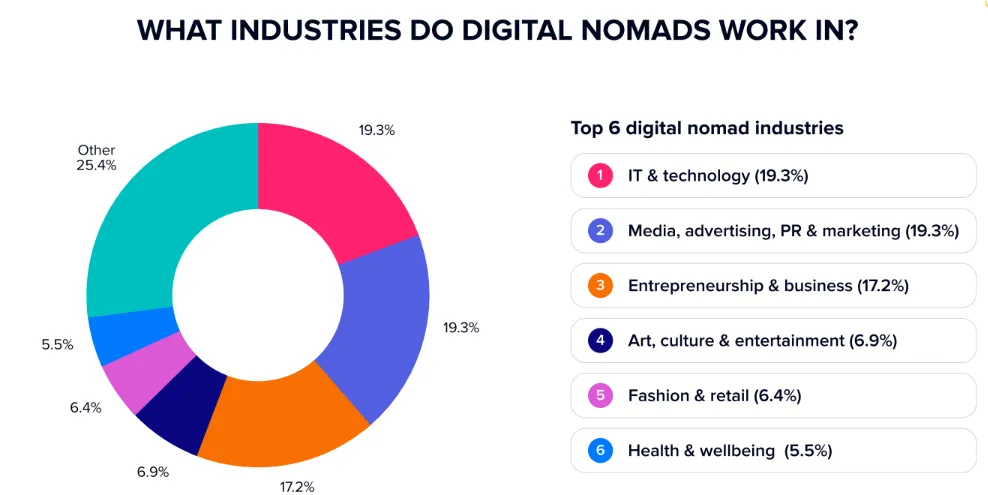
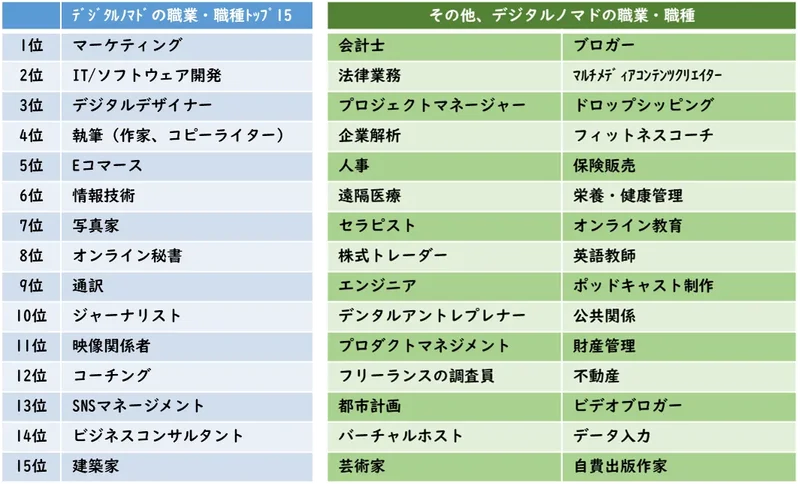
According to this report by Flatio, the gender ratio among digital nomads is nearly equal at 55.3% male to 44% female. By age group, those aged 29 and under account for 22.4% and those in their 30s account for 52.6%, indicating that younger generations are the mainstream, though those in their 40s also make up 19.7%.By occupation, “IT and Technology” and “Media, Advertising, PR, and Marketing” are both the most common at 19.3% each. However, due to the spread of WFA (Work From Anywhere), “Digital Nomadic Employees”—those employed full-time by companies while practicing a digital nomad lifestyle—account for 31.5% of the total. It is noteworthy that the mainstream has shifted from the traditional freelance model.(Figure 3) Additionally, entrepreneurs and business owners account for 13.6%, and those engaged in startup-related work account for 17.2%, indicating that many digital nomads are involved in the startup ecosystem. (Figure 4)
2. The Rapid Increase in Countries Issuing Digital Nomad Visas and Their Benefits
There is a rapidly growing global trend to attract digital nomads with these characteristics to their countries. According to Tracey Johnson, owner of the digital nomad information site Nomad Girl, the number of countries that had introduced or were preparing to introduce digital nomad visas stood at 21 as of February 2021, but by June 2023, this number had nearly tripled to 58 (*4).Most recently, South Korea made headlines by announcing plans to introduce a “workation visa” (tentatively named the “Digital Nomad Visa”) by December 2023, allowing high-income, high-net-worth foreign nationals to stay in the country for one to two years (*5).
In her report, Tracey Johnson points to the following five reasons for the rapid expansion of digital nomad attraction efforts across various countries.
- To counter the sharp decline in inbound tourists caused by the COVID-19 pandemic, countries focused on and targeted digital nomads, who stay for long periods even if their numbers are small
- During the pandemic, working from home (WFH) became a new standard, and as a result of the ease of remote work across borders, this gave rise to higher-income techpats (remote technology workers) and digital nomads
- Since the pandemic, homeschooling and online schooling have become socially accepted, making it possible for more families to stay abroad for extended periods
- High-income digital nomads are expected to contribute to tax revenues—including value-added tax, import duties, and application fees—in addition to their contribution to the local economy through spending during their stay (though there are issues such as their minimal contribution to health and social costs).
- In particular, some countries actively courting digital nomads have long experienced a “brain drain”—the exodus of highly educated individuals—and view this as an opportunity to reverse that trend and attract talent back home
Furthermore, Prithwiraj Choudhury (*6), an associate professor at Harvard Business School, points out that digital nomads can help solve local challenges and bring many benefits, such as the sharing of new knowledge and the emergence of seeds for innovation and new business creation.In short, there are high expectations for the positive impact generated by “knowledge recombination”—the process of combining the insights brought by digital nomads with local communities’ existing knowledge and experience.
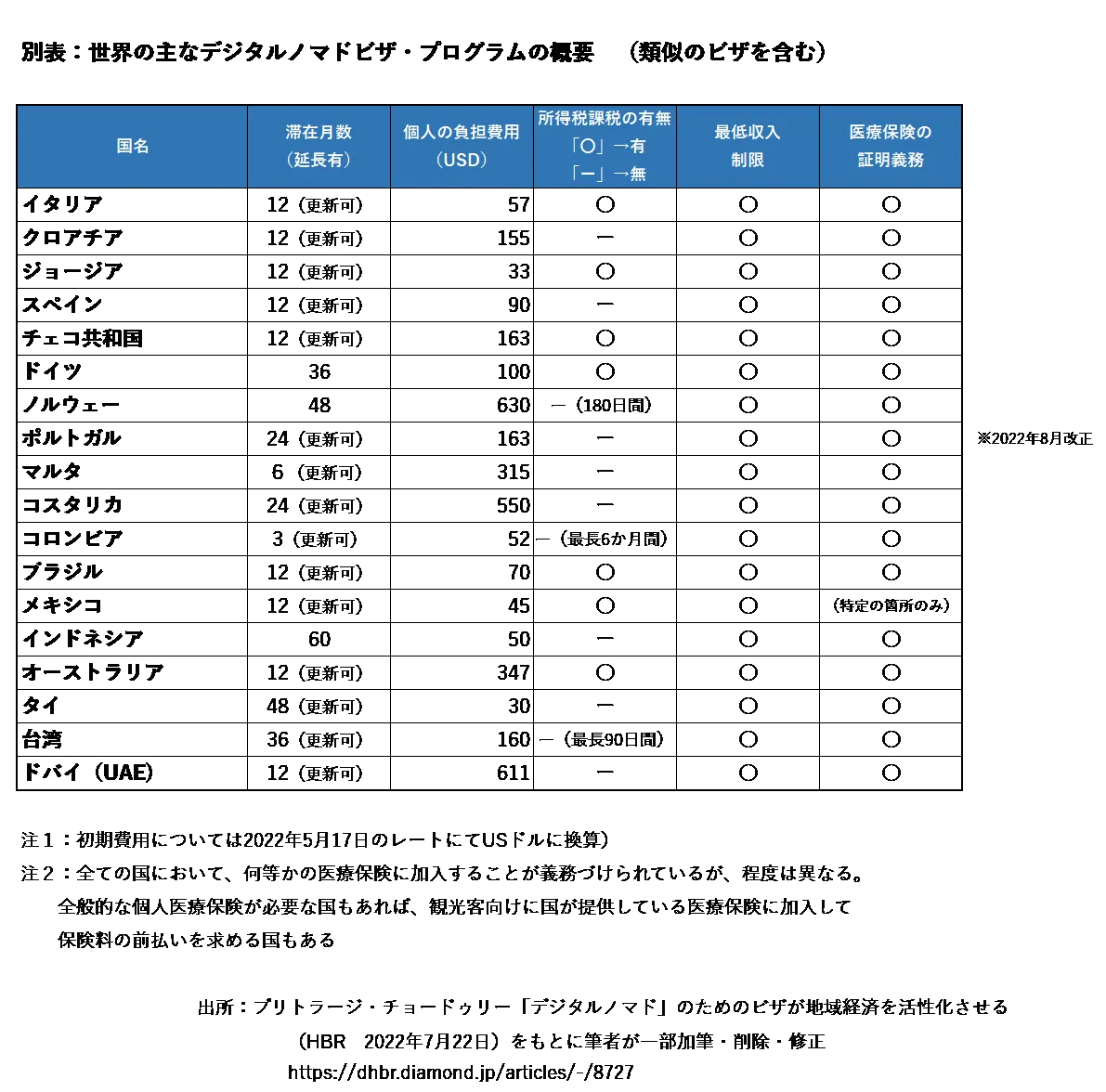
The table below summarizes the characteristics and requirements of digital nomad visas in major countries. It shows that income requirements and mandatory health insurance are common requirements. Additionally, many countries stipulate conditions such as the duration of stay and whether extensions are available, the costs required to obtain the visa, asset requirements such as savings and deposits, required activities, proof of working using telecommunications technology, proof of an employment contract with a foreign company or proof of self-employment, and whether spouses and family members may accompany the applicant (*7).
On the other hand, while visa requirements vary, the treatment of digital nomads’ income tax differs significantly by country. For example, in Malta, local income tax is fully exempted for holders of a remote work visa. In Malaysia, income earned from employment with overseas companies or from freelance work is also tax-exempt. Countries such as Spain have established various preferential measures, including applying preferential income tax rates for non-residents for up to six years.
For digital nomads, tax conditions—particularly regarding income tax—are of great interest and serve as a powerful incentive when choosing a place to stay. At the same time, the tax treatment of “residents” (for tax purposes) versus “non-residents” is a complex issue tied to international tax treaties and other agreements, and it is expected to be the subject of various discussions in the future.
3. Moves Toward Establishing a Digital Nomad Visa System in Japan
Recognizing this trend and aiming to attract digital nomads—people who work while traveling across borders—to Japan, the government has begun considering the introduction of a digital nomad visa in Japan, subject to certain requirements.The “Action Plan for Expanding Inbound Tourism in the New Era,” decided upon by the Cabinet Council for the Promotion of a Tourism-Oriented Nation on May 30 of this year, addressed the development of an institutional framework to attract digital nomads. It clearly stated the policy: “To attract international remote workers (so-called ‘digital nomads’), we will identify and examine issues related to visas, residency status, and other institutional aspects, and implement the system within FY 2023.”At the LDP’s Parliamentary League for the Promotion of Workation (*8) on June 18, which I attended as an expert, it was confirmed that preparations would be advanced by a cross-ministerial team comprising the Cabinet Secretariat, the Cabinet Office, the Digital Agency, the Ministry of Justice, the Ministry of Internal Affairs and Communications, the Ministry of Finance, the Ministry of Health, Labour and Welfare, the Japan Tourism Agency, and the Ministry of Foreign Affairs.
While details of the Japanese digital nomad visa are still pending, it is expected that requirements will include: (1) a track record of employment or contract work abroad, or involvement in the management or administration of a foreign company; (2) income requirements; (3) a substantial amount of savings or deposits at the time of application; and (4) enrollment in medical insurance, such as overseas accident insurance.
The promotion of accepting digital nomads is also mentioned in the Basic Policy on Economic and Fiscal Management and Reform 2023 (Basic Policy), and it is expected to serve as a catalyst for Japan’s development as a tourism-oriented nation. Furthermore, following the adoption of the “Action Plan to Attract Foreign Talent and Capital” in April 2023, it is anticipated that an environment will be established to make it easier for highly skilled workers to stay in Japan, thereby contributing to the modernization and innovation of Japanese society.
4. The Potential for Overseas Digital Nomads as Long-Term Workers in Japan
Many digital nomads have already begun “roaming” the world, and interest in Japan appears to be high. Surveys conducted by major online digital nomad communities, such as Nomado List (*9), rank Japan and various regions within the country among the top destinations people wish to visit.
Recently, when I visited “SECOND HOME,” Lisbon’s largest coworking space, and spoke with the manager, I learned that many of the approximately 200 members do not hold digital nomad visas, and most stay for only about one to three months before moving on.
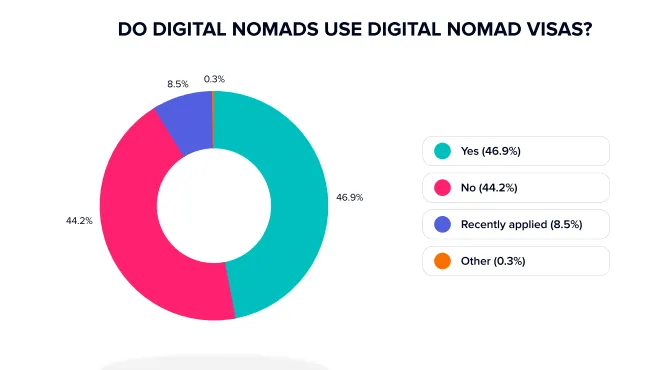
A survey by Flatio also found that more than half of digital nomads do not hold a digital nomad visa (Figure 5). Although Japan has not yet begun issuing digital nomad visas, it is believed that a significant number of foreigners are visiting Japan as “hidden digital nomads,” working while enjoying their travels during their three-month stay.
In this sense, the arrival of long-term workers from around the world—who have been unable to visit Japan for over three years due to the COVID-19 pandemic—can be seen as a grand rehearsal for the full-scale acceptance of digital nomads. It also presents an opportunity to build a new “Japanese-style digital nomad” model by leveraging the know-how cultivated through workation initiatives, fostering connections with local communities, and promoting innovation through global cross-border learning.
In Fukuoka City, initiatives targeting global long-term workers are steadily progressing, such as “COLIVE FUKUOKA, JAPAN” (*10), a one-month program to attract digital nomads from around the world, which will be held this October.There are still many unknowns surrounding digital nomads. For Japan to become a new hub for them, it is crucial to strategically gather feedback from host communities, businesses, and long-term workers who have actually stayed in Japan for extended periods, and use this as an opportunity to improve reception systems and attract more visitors.
*1 Basic Policy on Economic and Fiscal Management and Reform 2023 (Basic Policy): It explicitly states, “To attract international remote workers (so-called ‘digital nomads’), we will identify and examine issues—including those related to visas and residency status—and establish a system within FY 2023.” (P. 15)
*2 Katsuno (2022), “Considering the Potential for Attracting Digital Nomads Traveling the World,” JTB Tourism Research & Consulting
*3 Flatio launches its first Digital Nomad Report 2023
*4 nomadgirl Digital Nomad Visas
*5 Korea.net: Ministry of Culture, Sports and Tourism Announces Measures to Stimulate Tourism Demand
※6 DIAMOND Harvard Business Review: "Visas for 'Digital Nomads' Revitalize Local Economies"
*7 Overseas, countries such as Portugal, Spain, Estonia, Malaysia, and Croatia allow digital nomads to bring their families
※9 Go nomad
※10 Colive Fukuoka