Exploring the Potential for Attracting Digital Nomads Who Travel the World

With the spread of remote work during the COVID-19 pandemic, we are seeing changes in attitudes and styles toward work. A work style known as “flex-place,” which does not restrict where one works—whether at home or in an office—is also gaining popularity. Meanwhile, looking globally, there are reportedly many people known as “digital nomads” who use IT to work in their favorite locations for periods ranging from a few days to several months before moving on to a different place to continue working.This article examines who these so-called digital nomads are and how they work, while also exploring the potential for attracting them to Japan and the challenges involved, based on overseas research and other sources.
1. Who are digital nomads?
Digital nomads are people who utilize IT technology to work while traveling, unbound by location, much like “nomads. ”While the reality of this lifestyle is not widely known in Japan, A Brother Abroad—a U.S. travel information site that frequently features digital nomads and backpackers—estimates that there are approximately 35 million digital nomads active globally, with a market size of $787 billion (approximately 110 trillion yen; about 3.148 million yen per person*1).The company also conducted a survey targeting English-speaking digital nomads active globally, receiving over 4,000 responses. The following profile emerged from the results.
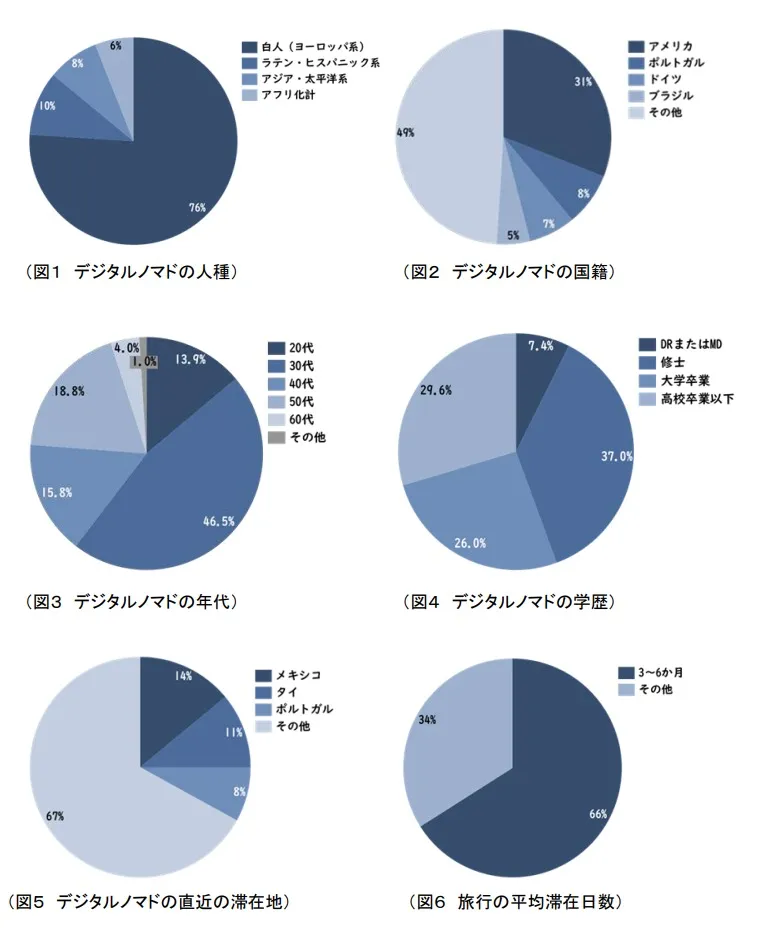
Respondents’ Race and Nationality: By race, the top categories were 76% White (European), 10% Latinx/Hispanic, 8% Asian/Pacific Islander, and 6% Black. By nationality, the United States accounted for 31%, Portugal 8%, Germany 7%, and Brazil 5%, with these four countries comprising 51% of the total (Figures 1 and 2).
Respondents’ gender and age: By gender, men accounted for 50.19% and women for 49.81%, with the two groups being nearly equal in number. The age group with the highest proportion was those in their 30s (46.5%). This was followed by those in their 50s (18.8%), those in their 40s (15.8%), and those in their 20s (13.9%) (Figure 3).
Educational Background: Master’s degree holders were the largest group at 37.0%. This was followed by bachelor’s degree holders (26.0%) and those with a doctorate or medical degree (7.4%), with university graduates and above accounting for approximately 70% of the total. This indicates a generally high level of education among the respondents (Figure 4).
Most Recent Location: Mexico accounted for 14%, Thailand for 11%, and Portugal for 8%, with locations distributed across Central and South America, Southeast Asia, and Europe (Figure 5).
Average length of stay: 66% of digital nomads stayed in one location for 3 to 6 months (Figure 6).
Abroad: 63 Surprising Digital Nomad Statistics in 2022” https://abrotherabroad.com/digital-nomad-statistics/
3. Digital Nomads’ Work Styles and Travel Programs
How do digital nomads work? The aforementioned survey yielded the following results.
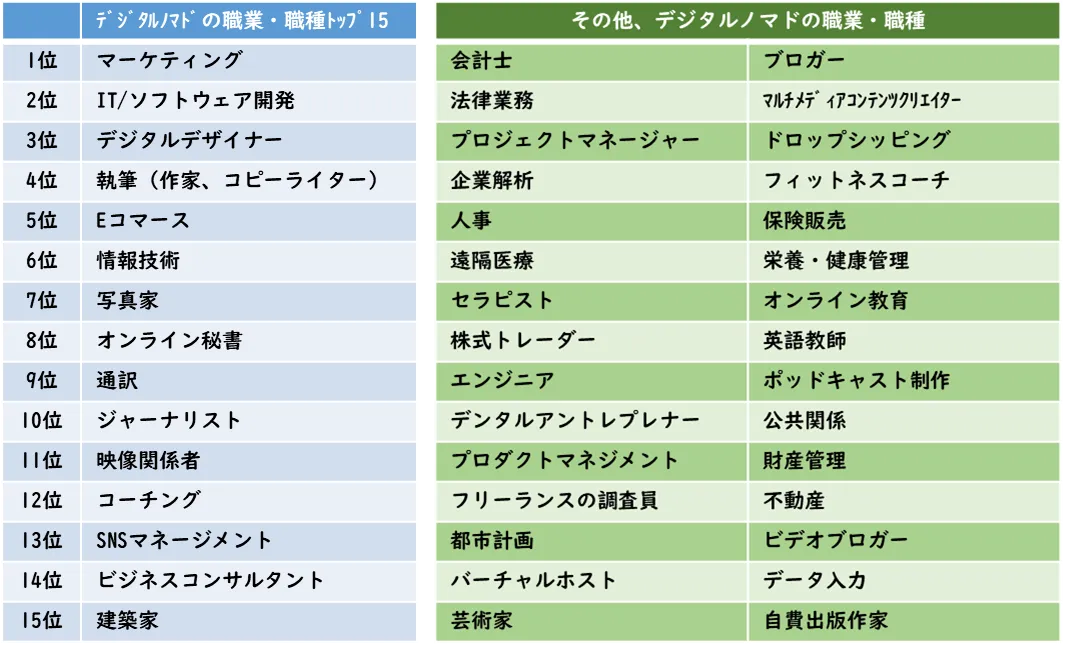
Respondents’ Occupations and Job Types: The most common job type was “Marketing,” accounting for over 15%, followed by “IT/Software Development,” “Digital Designer,” “Writing (Author, Copywriter),” and “E-commerce” (Figure 7). It appears that the barrier to becoming a digital nomad is relatively low for those in skilled trades.
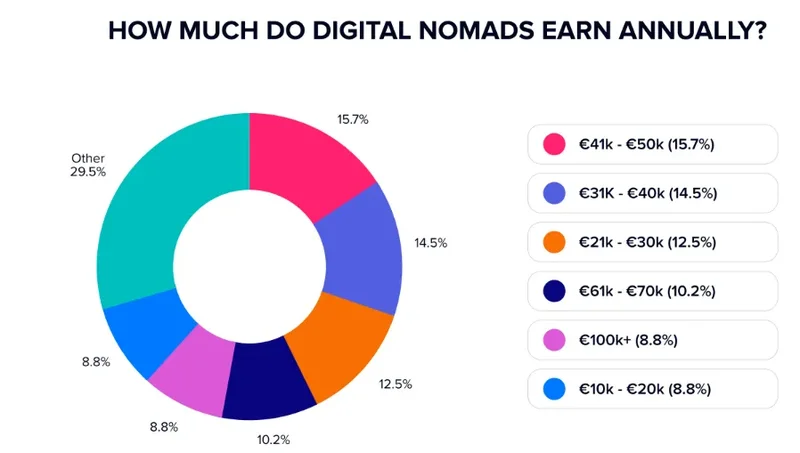
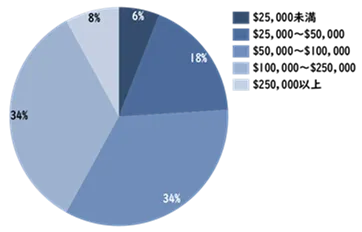
Annual Income: The highest proportion (34%) fell into the income brackets of $50,000–$100,000 (7 million–14 million yen) and $100,000–$250,000 (14 million–35 million yen).This was followed by 18% earning between $25,000 and $50,000 (3.5 million to 7 million yen), 8% earning $250,000 or more (35 million yen or more), and 6% earning less than $25,000 (3.5 million yen).The average annual income is $119,423 (16.72 million yen), while the median is $80,000 (12 million yen) (Figure 8).
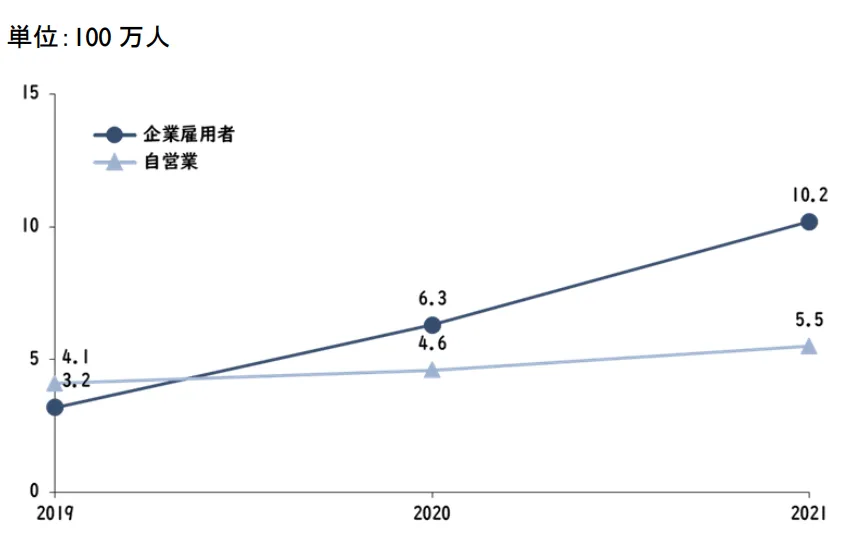
Regarding employment status, the results showed that approximately 80% are self-employed, while about 20% are employed by companies. Looking at the results of a separate survey conducted by the U.S. staffing firm BPO Partners, it is evident that the number of digital nomads employed by companies has been on the rise in recent years (Figure 9).
Next, looking at the travel and mobility of digital nomads, while some travel independently, others participate in travel programs designed for digital nomads. In recent years, travel programs for digital nomads have become increasingly robust. The U.S.-based company “Remote Year” (*2) offers travel packages for digital nomads, providing services that assist with travel arrangements and daily living.
These travel programs specify the countries and cities where participants will stay for periods ranging from 4 to 12 months. Participants move to a new location every month, working remotely as a team while living the digital nomad lifestyle. To date, these programs have been held in over 40 cities worldwide.
In July 2017, Kyoto City was added to the program. In partnership with a hotel that had just opened in Sanjo Kawara, participants were provided with opportunities to interact with locals, such as through talk sessions, while utilizing the hotel’s coworking space.
The travel package includes the following. Please note that job placement services are not provided.
- Airfare between cities and transportation to the destination
- Accommodation costs (at highly rated hotels or apartments in the city center)
- Access to a 24-hour coworking space
- Medical support
- Local activities
- Coordinator fees
By participating in the company’s program, participants gain access to services that allow them to attend webinars and events held around the world, connect with other professionals in fields of interest, and build a community. Participants leverage this information to secure job opportunities.
Given the long duration of the company’s programs, participants are often self-employed professionals such as software engineers and designers, though employees of major tech companies also participate. The company actively enters into corporate contracts as part of corporate employee benefits. The increase in the number of digital nomads employed by companies is partly due to companies actively fostering talent by having employees participate in such programs for digital nomads—allowing them to live a nomadic lifestyle while improving their skills as digital natives and learning about startups.
Source: JTB Tourism Research & Consulting, based on "63 Surprising Digital Nomad Statistics in 2022" by A Brother Abroad
Source: Created by JTB Tourism Research & Consulting based on "A Brother
Abroad: 63 Surprising Digital Nomad Statistics in 2022" https://abrotherabroad.com/digital-nomad-statistics/
Source: Prepared by JTB Tourism Research & Consulting based on MBO Partners’ 2021 State of Independence research study
3. Developing a Supportive Environment to Attract Digital Nomads
With the widespread adoption of remote work and the rise of the digital-native Generation Z, the number of digital nomads is expected to continue growing. Pieter Levels, founder of “NomadList” (*3)—a portal site that provides authentic local information to digital nomads worldwide—predicts that “by 2035, there will be 1 billion digital nomads globally.”
So, what kind of infrastructure is needed to accommodate digital nomads? On “NomadList,” digital nomads who have actually visited a location rate various criteria and provide the latest information, and the site publishes city rankings based on this data. As of August 2022, the top-rated cities overseas were Lisbon (1st), Bali (2nd), and Budapest (3rd).An analysis of the top 50 cities in the rankings to identify factors contributing to high overall ratings revealed the following six key elements and criteria:
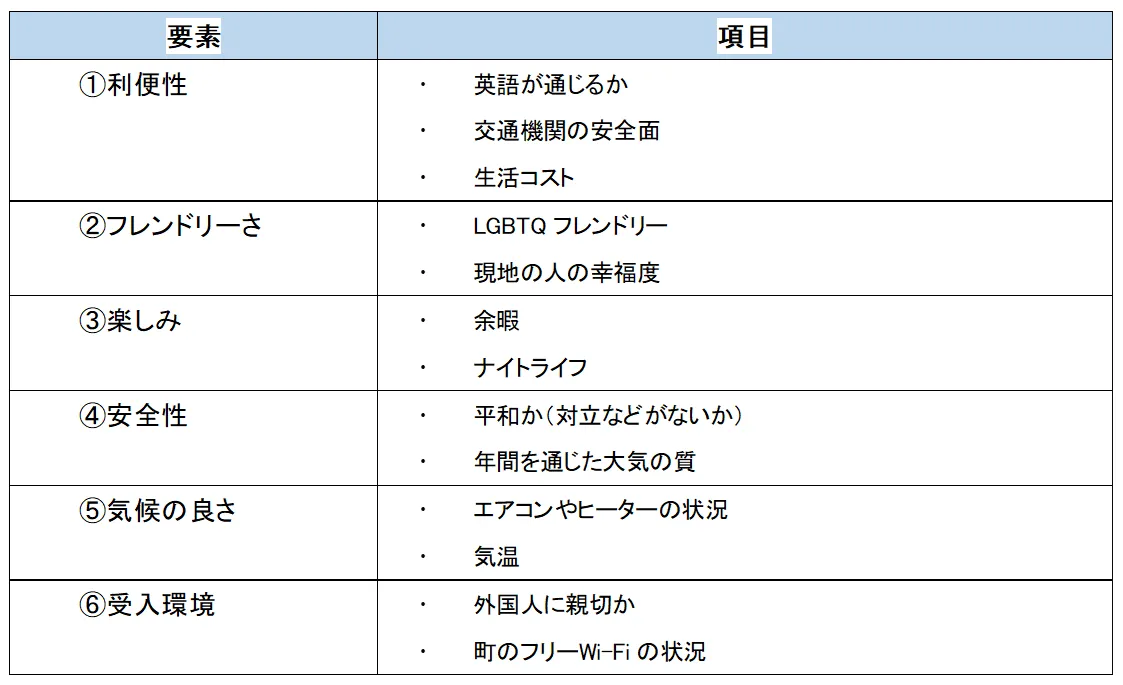
The results showed that cities with higher scores in these areas were more popular. While Tokyo and Osaka were included in the list for Japan, they received low ratings in categories such as “English proficiency” and “availability of free public Wi-Fi.” To attract digital nomads, it is essential to focus on addressing these specific needs—aspects that are often overlooked even in Japan’s infrastructure for inbound tourism.
4. Growing Globally: Nationwide Efforts to Attract Digital Nomads
Digital nomads tend to stay for extended periods if they find a place they like. They generally enter a country for tourism purposes, and it is believed that many leave before their visa-free short-stay period expires. In recent years, several countries have begun initiatives to attract digital nomads, and an increasing number are issuing visas that allow for long-term stays. When examining the countries issuing such visas, they can be broadly divided into two categories: (1) resort-style destinations, such as Caribbean nations, and (2) urban-style destinations, such as those in Europe.
The former, resort-style countries, are targeting the affluent for long-term stays as vacations. Generally, resort-style visas are expensive; for example, in Barbados in the Caribbean, the visa fee is $2,000 (approximately 280,000 yen), but this allows you to spend a full year on the resort island. Additionally, in Aruba, a Dutch territory in the Caribbean, there is a program called “One Happy Workation.”By booking accommodation at a participating facility, you can stay for up to three months (compared to the standard one-month tourist visa). Accommodations range from hotels and villas to pet-friendly options, allowing you to choose based on your preferences. Many work spaces are located by the beach or poolside, providing an elegant environment that perfectly fits the concept of “remote work in paradise.”
A prime example of the latter, urban-style approach is Estonia, an IT-advanced nation that was among the first in Europe to issue digital nomad visas. The rationale behind this goes beyond simply expecting economic benefits from long-term stays; there is also an expectation that digital nomads will attract high-quality foreign visitors who bring benefits such as startups and innovation to the country. In Europe, other countries such as Georgia, Germany, and Croatia also issue digital nomad visas, and popular tourist destinations like Spain and Italy, as well as countries with resort areas, are considering issuing them as well. Furthermore, these destinations are characterized by the presence of communities where digital nomads can connect, as well as coworking spaces that offer programs to address local issues.
Applying this to Japan, resort-style destinations could include beach or mountain resorts that fully utilize beautiful scenery and offer a relaxing atmosphere, while urban-style destinations could include major cities and their surrounding areas, which have good transportation access and many long-term accommodation options.
In the future, young people with great potential—who are seeking to broaden the scope of their travel experiences—may begin visiting these areas as if they were living there. To ensure Japan can welcome digital nomads from various countries and regions in the future, it might be worthwhile to start exploring options now. This could include reviewing Japan’s visa system, developing and supporting comfortable coworking spaces in city centers and accommodation facilities (including the provision of free Wi-Fi), and creating opportunities for dialogue with local residents.
*1: Calculated at the September 2022 exchange rate of 1 USD = 140 JPY
*2: Remote Year
*3: NomadList
著者