A Look at Future Travel Trends for the Elderly in the "Age of Longevity," Based on Data

Japan is currently experiencing a rapidly aging population due to the simultaneous occurrence of an aging society driven by increased life expectancy and a declining birth rate. As part of measures to address the decline in the working-age population and rising social insurance premiums, last year saw the adoption of a policy to “expand the acceptance of foreign workers” and the formulation of the “100-Year Life Vision Council” initiative. In this column, using travel by the elderly in the “age of longevity” as a case study, I will combine open data and survey data to analyze how the market is likely to change.
1. The Future Environment for the Elderly
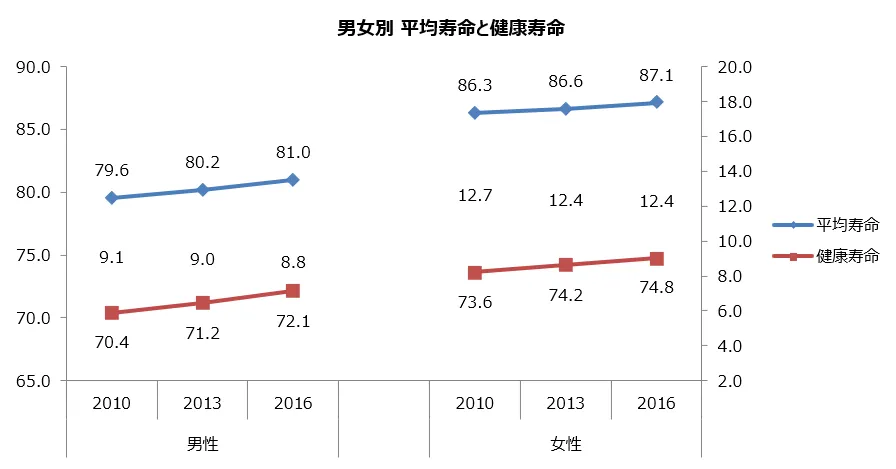
Current life expectancy continues to rise year by year (Figure 1), reaching 81.09 years for men and 87.26 years for women in 2017 (Ministry of Health, Labour and Welfare Press Release: July 20, 2018).According to the National Institute of Population and Social Security Research, life expectancy is expected to continue increasing for both men and women, with estimates indicating that by 2065 (approximately 45 years from now), average life expectancy will reach 84.95 years for men and 91.35 years for women.
In preparation for the arrival of the “era of longevity,” the Japanese government included measures to promote employment for the elderly in the “Basic Concept for Human Resource Development Reform,” announced in June 2018 as a summary of the “Conference on the Vision for the 100-Year Life.” Furthermore, the interim report of the Future Investment Conference in November 2018 stated that it would “smoothly advance efforts to secure employment opportunities up to age 70,” clearly indicating that legal systems would be developed in stages while allowing for flexibility for companies and individuals.
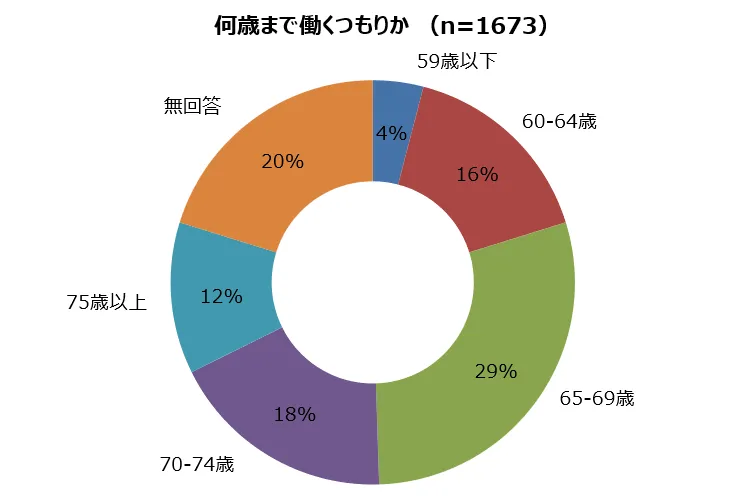
According to a mail-in public opinion survey conducted by Nikkei Research in October–November 2018 (reported in the Nikkei Shimbun on January 21, 2019), it was reported that 30% of people expressed a desire to continue working even after turning 70 (Figure 2). It is expected that labor participation among the elderly will increase, and in the near future, working until age 70 will become the norm in society.
As the working period extends, income will increase, creating greater financial leeway and potentially leading to a virtuous cycle of consumption. However, regarding healthy life expectancy, if we define “retirement” as beginning at age 70 based on current averages, the period during which people can live independently and in good health after retirement is only two years for men and four years for women. This point must be taken into account when analyzing the market.
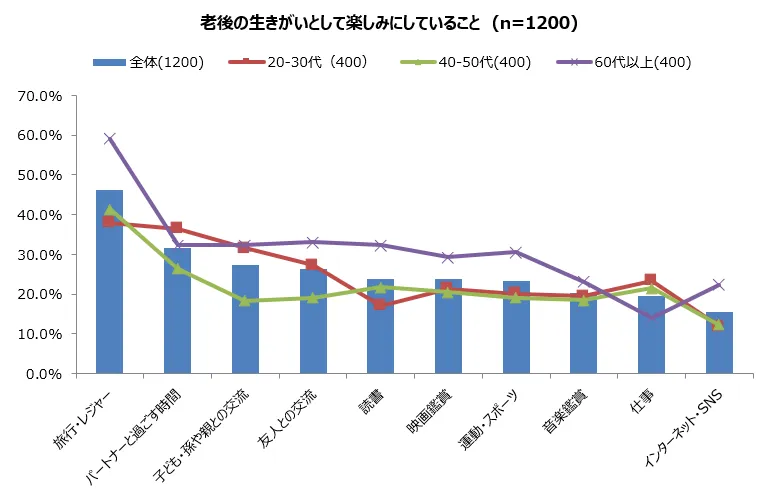
According to a survey by the Japan Financial Planning Association, travel and leisure rank highest among the activities people in their 60s and older enjoy in retirement (Figure 3), indicating that older adults have a strong interest in “travel and leisure.” In the next chapter, we will examine behaviors related to “travel,” a topic of high interest.
2. The Future of Travel for the Elderly
While the senior market has long been considered an important market, based on the results of our proprietary survey, we would like to examine how the characteristics of “travel”—a topic of high interest among today’s seniors—are likely to change in the future.
*While there is debate regarding the definition of “seniors” due to factors such as the extension of healthy life expectancy (the World Health Organization defines seniors as those aged 65 and older), for the purposes of this report and in line with the previous chapter, we will define seniors as those aged 70 and older.
(1) Travel Destinations
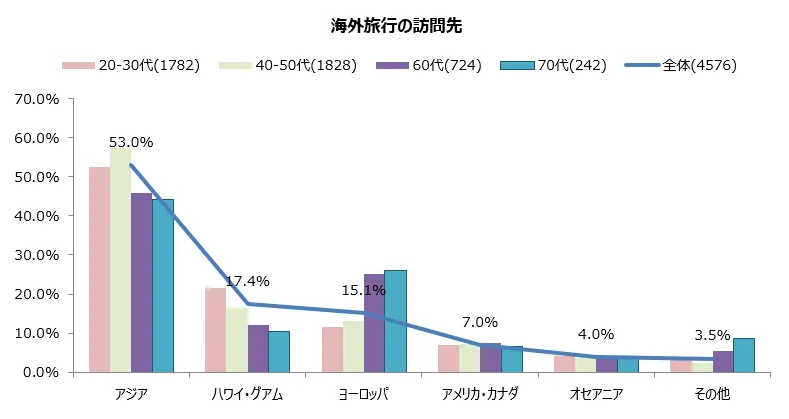
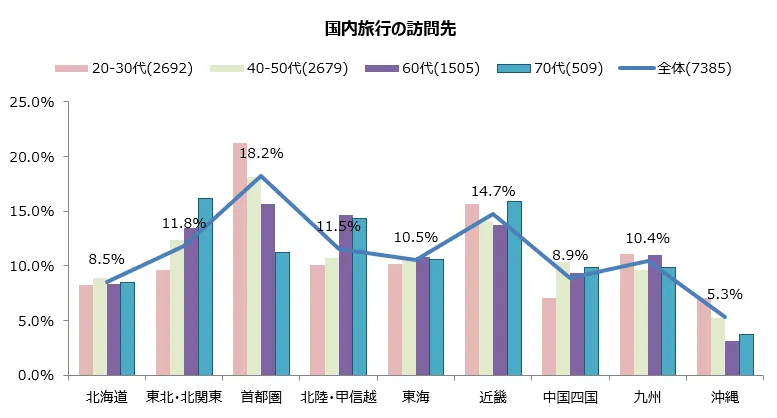
Regarding travel destinations, for overseas travel, there is a tendency to prefer Europe—which is farther away—over Asia or Hawaii, where the number of outbound travelers is high. For domestic travel, there is a tendency to avoid major cities (the Tokyo metropolitan area) (Figure 4).While this trend is likely influenced by the “historical context”—such as the diversification of travel preferences and the dispersion of destinations according to individual interests—it is also thought to be influenced by “life stage” factors related to age, such as whether they have school-age children or their own employment status.We speculate that this is because, without school-age children, travelers are not constrained by school schedules or their children’s preferred destinations, allowing them to travel to distant locations or destinations of personal interest during periods when travel costs are relatively affordable. Since life stage-related circumstances are unlikely to change dramatically in the future, we can expect the generation now entering old age to exhibit similar trends regarding popular travel destinations.
(2) Travel Season
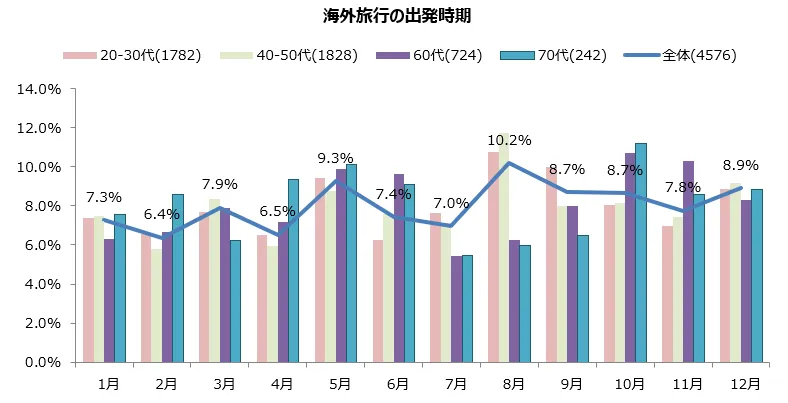
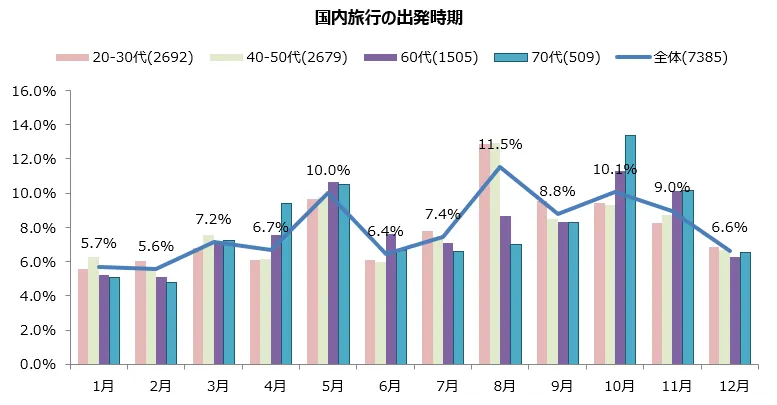
Regarding travel timing, many older adults tend to avoid the peak season in August and travel in October and November. A notable characteristic is that many choose to travel overseas in June to avoid peak crowds, while domestic travel is popular in May when the weather is pleasant (Figure 5). As with travel destinations, we believe that “life stage”—such as whether they have school-age children or are still employed—plays a significant role in these choices.
(3) Travel Products
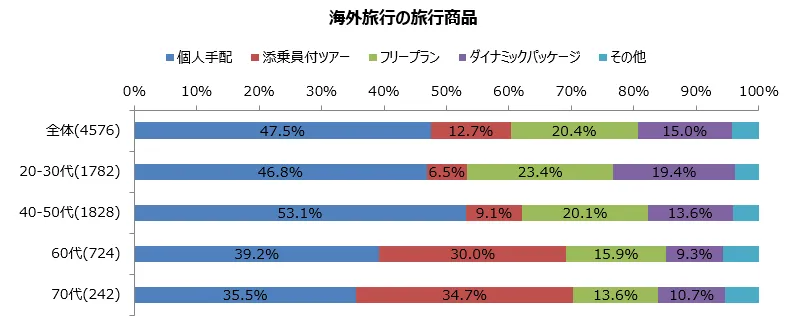
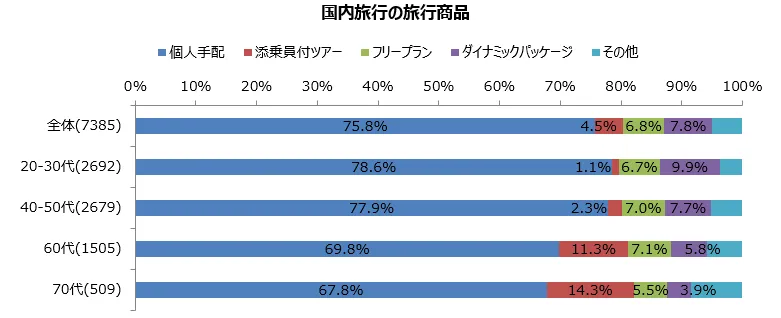
Regarding travel products, while the highest proportion involves self-arranged travel where accommodations and transportation are booked individually, people currently in their 60s and older show a stronger preference for guided tours—both for domestic and international travel—compared to other age groups. In particular, for international travel, guided tours account for just over 30% of the market, a share comparable to that of self-arranged travel (Figure 6).
We believe that the choice of travel products is influenced not only by the prevalence of guided tour products for seniors and destinations in Europe—which are popular among the elderly—but also by generational factors. Compared to today’s 40- and 50-somethings, who enjoyed overseas travel since their student days, driven by the bubble economy, the current generation of people aged 60 and older has a lower rate of experience with overseas travel for leisure purposes. We believe this is partly due to the fact that many of them feel anxious about traveling abroad without a local guide.
Given that the generation now entering their senior years has a high rate of overseas travel experience and that booking processes are becoming increasingly convenient, we speculate that the proportion of independent travel arrangements will rise further, while the proportion of guided tours will decline.
(4) Methods of Travel Booking
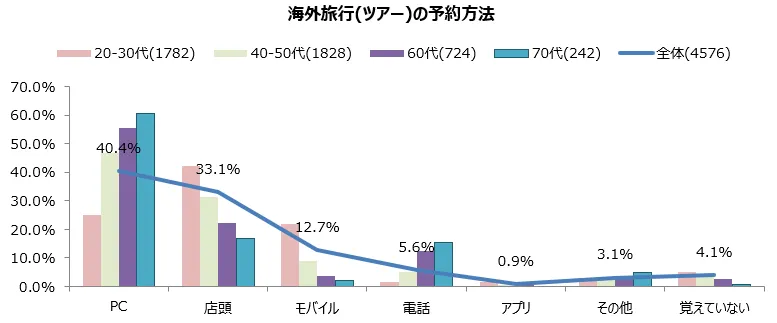
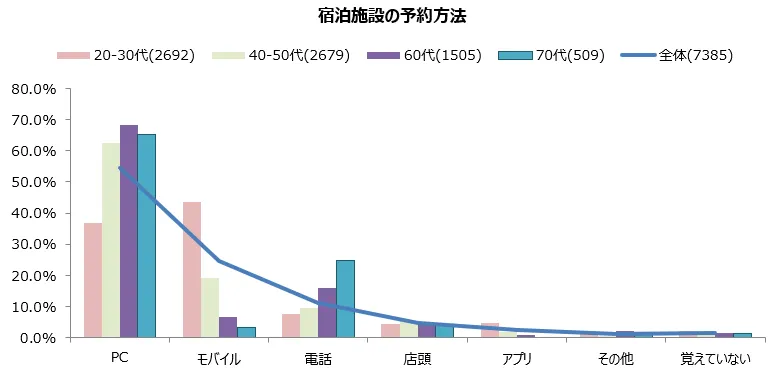
Regarding travel booking methods, booking via the internet using a PC is the most common method for both domestic and international travel. A notable characteristic among the elderly is that, compared to other age groups, they prefer booking by phone and tend to avoid booking in-store or via mobile devices (Figure 7).We believe this difference is influenced by “historical context” (such as the widespread adoption of PCs and the expansion of web channels), the impact of “generation” (increased IT literacy), and “life stage” (physical challenges), such as declining physical stamina (making visits to stores burdensome).
Since the generation that will soon become the elderly is one that is familiar with the internet, we speculate that the number of users making reservations via the internet—such as through PCs or mobile apps—will increase, while reservations made by phone or in-store will decrease.
(5) Summary
A survey targeting people aged 60 to 74 (Hakuhodo Institute of Life and Living News Release: June 24, 2016) found that people’s perceived age was, on average, 14 years younger than their actual age, their physical age was 7 years younger, and their perceived appearance was 5 years younger. Additionally, research papers have been published indicating that the physical functions of older adults, such as walking speed, are equivalent to those of people about 10 years younger. When you actually speak with people in the age group commonly referred to as “seniors,” aren’t you often surprised to find that they feel and look younger than their actual age?
Furthermore, in the rapidly expanding field of IoT—which is having a significant impact on our living environments—the area of “going out” is said to be one of the most closely watched sectors. Older adults in the future can also expect to benefit from technology. Given the background described above, we believe that the travel market, which is already a major focus of interest for older adults, will become even more vibrant in the future.
| Section | Today’s Elderly | Factors Driving Change | The Elderly of the Future |
|---|---|---|---|
| Travel Destinations | They tend to prefer Europe for overseas travel and avoid major cities for domestic travel. | Since their "life stage" (personal circumstances) has a significant influence, it is presumed that current trends will continue. | It is believed that there will be no major changes in popular travel destinations. *1 |
| Travel Season | Travelers prefer to avoid peak seasons and opt for periods with milder weather. | ||
| Travel Products | While independent travel is the norm for domestic trips, guided tours are preferred for overseas travel. | Since the influence of "generation" (past experiences) is significant, it is presumed that trends will differ from current ones. | It is expected that independent travel will become the mainstream for overseas travel as well. |
| Booking Methods | Preference is for booking via PC and phone. For overseas travel, in-store booking is also utilized. | Since trends are heavily influenced by "generation" and "historical context" (the current environment), it is anticipated that trends will differ from the present. | It is expected that in-store and telephone channels will decline, while web channels (PC, mobile, etc.) will increase. |
*1 Limited to factors attributable to aging. Popular travel destinations are influenced by the length of long weekends and GDP; for overseas travel, they are affected by exchange rates and flight availability; and for domestic travel, they are influenced by trends in popular tourist destinations.
3. Conclusion
While market and customer segments and characteristics vary by industry and product, I believe it is crucial to break down and analyze the factors contained within aggregated data, and to construct logical narratives based on hypotheses in order to deepen our understanding of the market and customers.
I believe that even simply combining simple cross-tabulations, news articles, and open data—as we have done here—can help generate various hypotheses at the conceptual level. I hope this serves as a useful reference for marketing professionals in developing their own hypotheses and ideas.
"Overview of Our Original Survey"
Survey Method: Online questionnaire Survey
Period: December 18–22, 2018 Survey Participants:(Screening Survey) 40,000 men and women aged 20 to 79, selected based on Japan’s demographic data (Main Survey) Respondents from the screening survey who had traveled within the past year.7,385 respondents with domestic travel experience; 4,576 respondents with overseas travel experience
著者