Can MaaS Help Boost the Appeal of Tourist Destinations?—Lessons from a Pilot Project in Yamanashi
MaaS (Mobility as a Service) initiatives are being implemented across Japan. These initiatives vary widely depending on location and purpose. In this article, we will discuss the challenges many travelers face regarding transportation in regional tourist destinations, as well as potential solutions, based on a tourism-focused MaaS demonstration project conducted in Yamanashi Prefecture in November 2021, in which our company was involved.
MaaS (Mobility as a Service) initiatives are being implemented across Japan. These initiatives target a wide range of locations, including major cities, regional cities, rural tourist destinations, and mountainous areas, and serve diverse user groups such as residents and tourists. Expectations for MaaS are growing as a solution to future regional transportation challenges and as a driver of regional revitalization amid the COVID-19 pandemic. In this article, drawing on our involvement in a tourism-oriented MaaS demonstration project conducted in Yamanashi Prefecture in November 2021, we will discuss the challenges many travelers face regarding transportation in rural tourist destinations and our approach to addressing them.
1. The Shift Away from Cars and the Demand for Flexible, Affordable, and Efficient Transportation
Since many tourist destinations in rural areas are scattered across the region, travelers often face the dilemma of deciding how to get around and which routes to take. Due to population decline and the widespread use of cars, many public transportation services have reduced their schedules or discontinued routes, leaving both residents and travelers with little choice but to rely on cars. Meanwhile, in recent years, the rate of domestic driver’s license acquisition has been on a downward trend, particularly among younger generations (Figure 1).A few years ago, the trend of young people turning away from cars was a hot topic, but at that time, since a driver’s license also served as a form of identification, the acquisition rate remained higher than it is today. Furthermore, among the senior population—who lived through an era of increasing motorization and serve as a key driver of travel spending—the number of cases where drivers voluntarily surrender their licenses (resulting in license revocation upon application) is on the rise due to aging demographics. Given these circumstances, it is expected that the need for regional tourist destinations to develop environments that offer affordable, efficient, and flexible transportation options—allowing visitors to explore freely without having to drive—will become increasingly critical in attracting tourists.
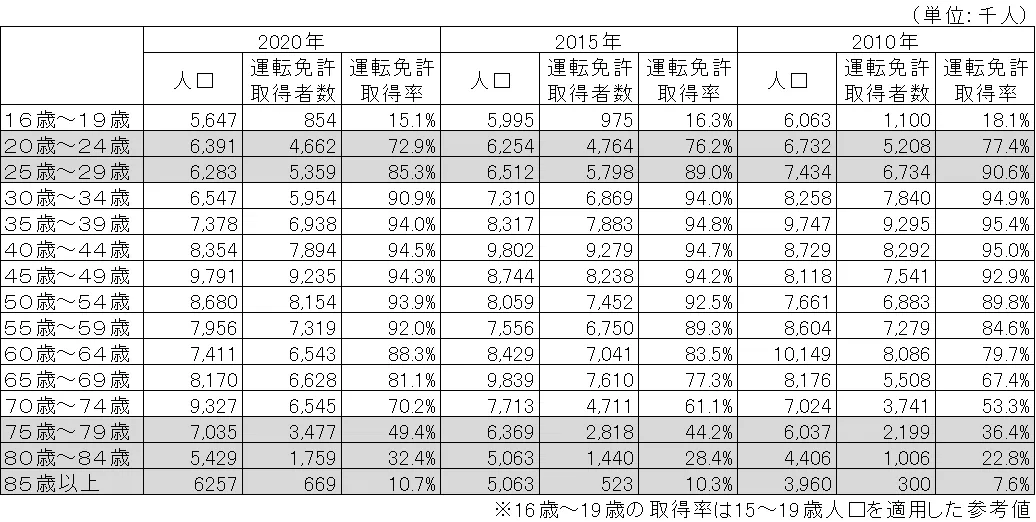
of Driver’s License Holders (Compiled by the author based on population statistics from the Ministry of Internal Affairs and Communications and driver’s license statistics from the National Police Agency)
2. What Does Building the Infrastructure for Mobility Services Entail?
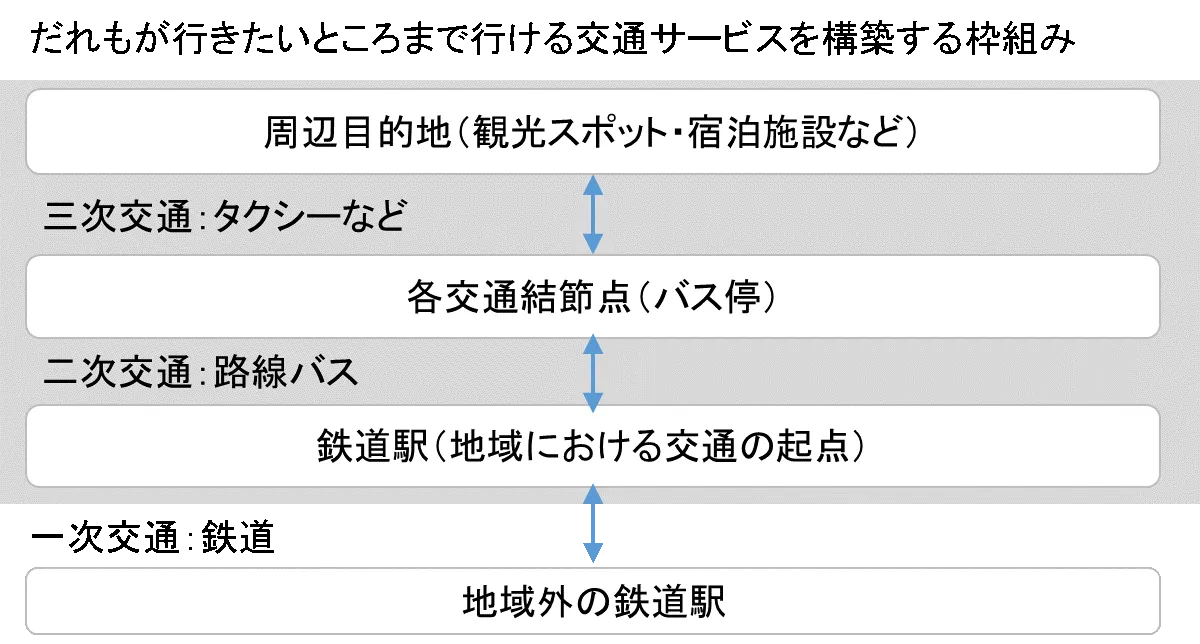
In tourist destinations where cars are the only option for moving freely anytime and anywhere, it is necessary to establish a system that efficiently connects primary transportation—such as railway stations serving as gateways from the point of departure—with secondary and tertiary transportation, such as buses and taxis, to reach the destination. Additionally, a system is needed to smoothly provide information to both users and transportation operators so that users can find the best means of transportation to their destination. Operators are expected to provide mobility services tailored to user needs based on information such as the seasons, daily weather, and events. Since digitalization is a prerequisite for such systems, the following points must be considered to build the best possible system for users.
(1) Creating a one-stop service provision system
- Provide information such as local destination details, travel routes, bus schedules, and fares in a single location on the web (currently, information is often scattered across multiple sources rather than being centralized)
- Create a more convenient environment by offering online functions for route searches and ticket purchases—tasks traditionally handled via paper materials (system development costs will be required)
(2) Focus on “presentation” from the system development stage, keeping “communication” with users in mind
- Provide a unified visual identity across all elements, from the system’s display of local destination information, route search, and ticket purchase functions, to external materials such as flyers, posters, and staff uniforms
- When implementing promotions, devise ways to ensure that the information users need is conveyed at the appropriate time, such as providing information on secondary and tertiary transportation options inside primary transportation vehicles (e.g., trains)
3. Yamanashi Tourism MaaS Initiatives Aimed at Revitalizing Tourism Across the Prefecture
In November 2021, a Tourism MaaS demonstration project was conducted on weekends and holidays in Kofu City and the three cities of the Kyo-to region (Yamanashi City, Fuefuki City, and Koshu City) in Yamanashi Prefecture, and our company participated. Yamanashi Prefecture is close to the Tokyo metropolitan area and boasts many attractive tourist resources; however, 70% of tourists use private cars, and visitors are concentrated in the northern foothills of Mount Fuji. However, in the case of winery tours—one of the prefecture’s attractive tourist activities—there is a challenge: “If you go by car, the driver cannot drink alcohol on-site, and participants cannot enjoy the experience together.” If these challenges can be resolved, it is expected that more tourists will visit Yamanashi Prefecture as a whole.
The demonstration project was carried out in the designated area named “Shingen Land” according to the following outline.
<Services Provided During the Demonstration Project>
(1) Transportation Services
- Increased frequency of route buses and operation of sightseeing buses departing from major stations (Kofu Station, Isawa Onsen Station)
- Operation of AI-based shared taxis from bus stops in the Katsunuma area
(2) Mobile Information Provision and Ticket Purchase Services
- Provision of information on tourist attractions and transportation services
- Introduction of a system that allows users to complete the entire process—from gathering information to route search to ticket purchase—on their mobile devices
(3) Enhancing the appeal of tourist destinations and utilizing events
- Implementation of test rides for the new mobility service “PiiMo” in the Shosenkyo area
- Collaboration with local events such as “Wine Tourism Yamanashi” and “Kofu! N-Yokocho Bar Hopping Week,” offering ticket bundles and discount services to event participants
- Organizing activities such as quiz rallies and bingo games led by local university students, including those from Yamanashi Gakuin University (see Figures 3–6)
In addition, we disseminated information via our website and in physical venues to raise awareness among a wider audience.
<Activities to Increase Awareness>
(1) Online Information Dissemination
- Providing information on the official website “Shingen Land”
- Guidance on how to use the service via the official blog, and introductions to the attractions of the destinations through images, videos, and text
- Grassroots dissemination of information via our official Twitter account
(2) Information Dissemination in Physical Spaces
- Displaying advertisements on the seat backs of limited-express trains bound for JR Kofu Station
- Guidance provided by staff in the JR Kofu Station concourse
- Promotional activities at major JR Chuo Line stations such as Shinjuku, Tachikawa, and Hachioji (see Figures 7 and 8)
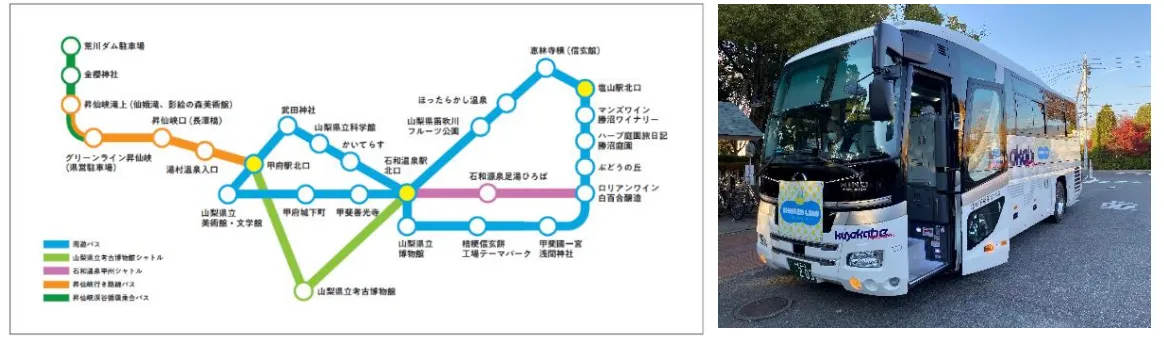
(Image: Courtesy of Shingen Land website; Photo: Taken by the author)
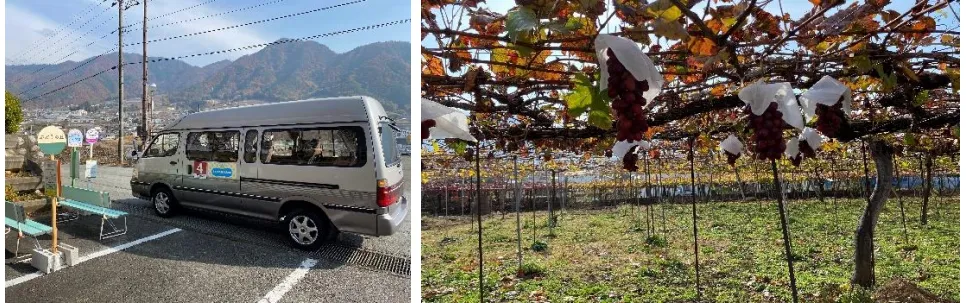
Katsunuma Area (Photo: Taken by the author)
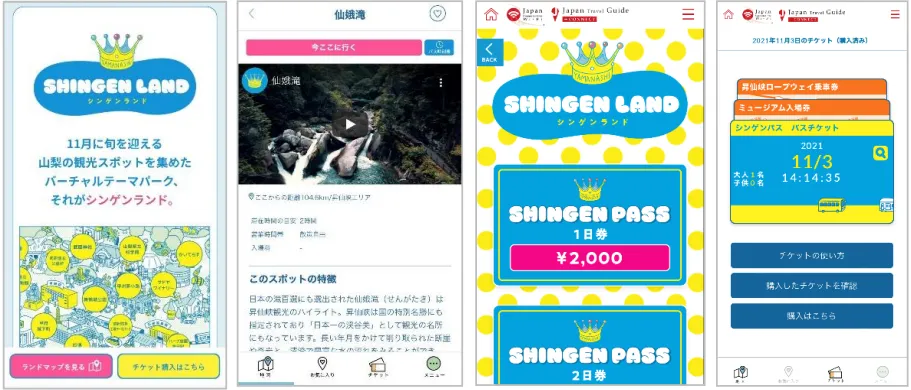
search, and reservation/payment (Image: Courtesy of Shingen Land website)

(Image: Courtesy of Shingen Land website; Photo: Taken by the author)
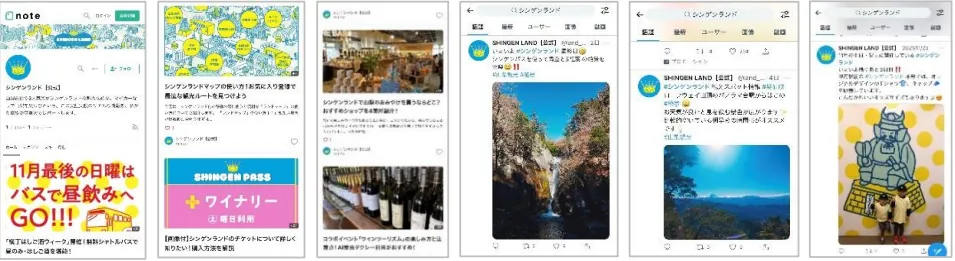
(Image: Courtesy of Shingen Land Official Blog and Twitter)
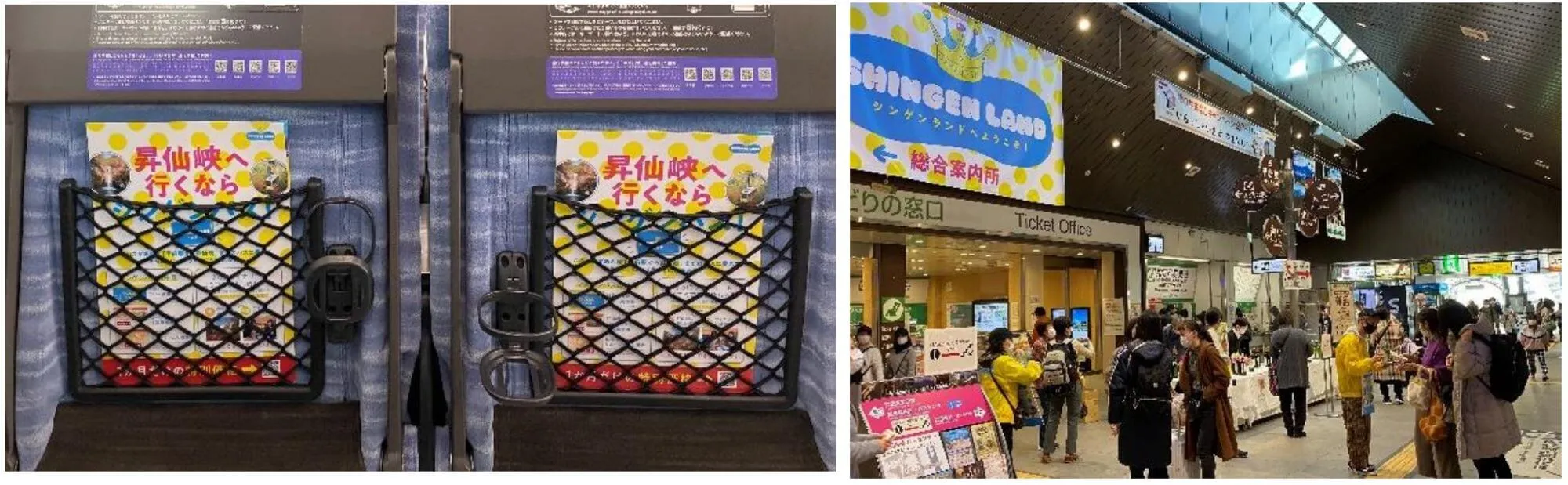
physical spaces (Photo: Taken by the author)
4. How to Shape the Future of Tourist Destinations Through the Digitalization of Tourism and Transportation Services
Through this pilot project, conducted amid an ongoing COVID-19 pandemic with no end in sight, we have reaffirmed the importance of the following points:
(1) Providing services tailored to varying demand conditions based on seasons and events
While it is certainly important to streamline travelers’ movements within the region by consolidating information provision and reservation/payment processes under a single domain, it is equally crucial to utilize data obtained through digitalization to provide services tailored to mobility needs based on location, season, and target audience. Even within the same region, tourism resources vary by season—such as trekking and camping (spring to fall), fruit picking (spring and fall), and skiing (winter)—and the businesses offering these activities and the modes of transportation also differ. Currently, in many regions, these services are sold separately, even if only online. If these services could be sold both on a single platform and in person, travelers could avoid the stress of gathering information and spend more time enjoying their experiences.
(2) Adopt a mindset that doesn’t limit users to individual travelers
Even during sports and academic events such as national sports festivals and international conferences, as well as school trips, there is time for individuals to spend freely on their own. Even when dealing with group demand, providing transportation services that cater to the needs of each individual within specific market segments can enhance regional branding and appeal.
While I believe the ultimate vision for MaaS is the widespread adoption of autonomous vehicles that cater to the needs of every individual traveler, before that becomes a reality, we aim to maximize the value of regional resources in the tourism sector and bring vitality and prosperity to local communities. To achieve this, I believe it is necessary to create a virtuous cycle that maximizes the unique appeal of each region, based on the premise of streamlining through the use of digital technology (Figure 9).
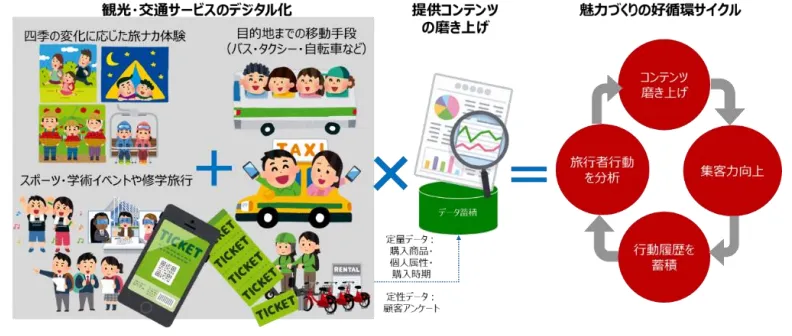
digitalization and content refinement (Created by the author)