[Special Contribution] “Tourism × Non-Tourism”: How Is Tourism Perceived from the Outside?

With the resumption of accepting international visitors to Japan beginning on June 10, a major step has been taken toward the full-scale restart of travel. While the tourism industry suffered significant damage—losing demand for over two years due to the COVID-19 pandemic—I believe there are many measures that need to be taken not only to overcome the current crisis but also to address structural challenges and foster growth through self-reflection.In this article, Yasuko Goto—a leader in Japan’s tourism administration who is also widely active in other fields—examines the current state and future of tourism from an objective perspective.
1. Introduction: My Perspective—How Is Tourism Perceived from the Outside?
I believe that the tourism sector is one in which a region’s comprehensive strengths can be harnessed—by uniting and leveraging those strengths through the lens of tourism—to enrich the region. This belief was formed nearly 30 years ago when I met and learned from the “godfather of town planning” in Yufuin, an experience that laid the foundation for my subsequent work.
At that time, the concept of tourism was narrow; it was generally understood that only the so-called travel industry, lodging, souvenir shops, and similar facilities were considered tourism-related industries, while other sectors—such as agriculture, forestry, fisheries, manufacturing, and culture—were viewed as unrelated to tourism. This new perspective was a real eye-opener for me.
A quarter-century has passed since then, and tourism’s economic significance has steadily grown. Public-private initiatives, such as those targeting inbound tourism, have also advanced by leaps and bounds.
So, has the view that “the tourism sector has the power to foster regional development, so let’s all work together on it” become mainstream? This is something that has been on my mind for a long time.
This is because, when I look at initiatives on the ground—including my own—I see many instances of struggle. Of course, conflicts of interest exist in any field, and it goes without saying that we must overcome them; however, there have been many moments when I’ve thought, “If there were just a little more understanding and empathy toward tourism, wouldn’t motivated individuals be able to fully unleash their potential?”
Therefore, I’d like to use this article as an opportunity to examine how the tourism sector is viewed from outside the industry. I hope that more people will come to support the tourism sector, and I want tourism to become a field that contributes to the realization of a prosperous society; I’d like to explore the path toward achieving that.
2. Has the recognition and consensus that “tourism has the power to revitalize many industries” become widespread?
(1) The answer is probably yes.
Take agriculture, for example. A trend is spreading nationwide in which local inns and restaurants are creatively incorporating local produce into their dishes. There is a growing body of evidence showing that the development of tourism contributes to the development of agriculture.There is no doubt that many people are making efforts to connect tourism with the region’s diverse industries, way of life, and local culture, and that this is becoming a source of appeal for travelers. I believe that the positive feedback from these travelers, in turn, serves as economic and psychological support for the local community. Furthermore
, the Japan Tourism Agency’s focus on statistical analysis has been highly significant.Being able to explain the economic ripple effects across the entire region—not just in qualitative terms but with concrete figures—is a powerful tool for presenting a persuasive case to local communities. In particular, the economic circulation within the region—that is, the extent to which local products are being consumed within the region—is a crucial factor.
(2) However, conflicts still exist in individual situations.
I believe there is a gap between the benefits to individual stakeholders and the goal of enhancing the region’s overall appeal. Furthermore, there are often differing perceptions of what “enhancing the region’s appeal” actually means, and it is common in local contexts for these differing views to become obstacles when implementing specific initiatives. For example, here is a familiar scenario:
・Large structures or billboards are erected in the midst of a region’s beautiful scenery, completely blocking the view.Although many stakeholders made efforts to address the issue, it was difficult to resolve even under the Landscape Preservation Act, and the remark made at the time was, “Can you put food on the table by preserving the landscape?” ・The main street of a
popular tourist destination was suddenly filled with identical national chain stores, causing the town to lose its original tranquil atmosphere and unique character.
From the perspective of those who want to make the region attractive and promote tourism, it goes without saying that preserving the landscape is essential. But what if we look at it from the opposite perspective? People might ask, “Why should we be criticized for increasing our income? We have to make a living, too.” Can we really blame them one-sidedly for that?
For both sides, their respective perspectives are true, and the reality is that what constitutes the “right answer” varies depending on one’s standpoint. Conflict is inevitable. Amidst this, I want to be able to demonstrate that initiatives taken from a tourism perspective can certainly contribute to the region’s development and well-being. To achieve this, the tourism sector must also become capable of making more effective proposals.While many examples of tourism initiatives are being shared across industry, government, and academia, I also look forward to the accumulation of case studies that provide the “accumulated wisdom and persuasive power” needed to overcome situations where benefits appear, at first glance, to be contradictory.
(3) To raise the profile of tourism: Respect and empathy.
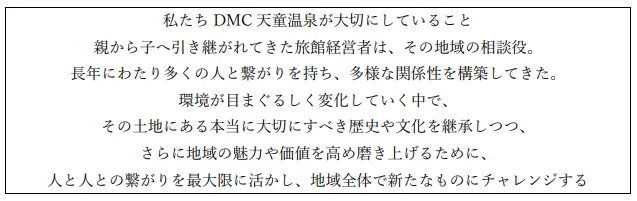
Furthermore, I believe the attitude—or conduct—of the tourism industry itself is a crucial factor.I believe whether or not there is empathy for tourism within a region depends on whether the individuals involved in tourism have adopted an attitude of working together to address the challenges facing the local economy and local communities. If the tourism industry remains detached from the region—as it was in the past—it will be difficult to foster respect for the tourism sector.I feel that local residents are watching to see whether those in the tourism sector take the initiative to connect the region’s diverse industries and enable each to demonstrate its strengths through tourism that attracts visitors. Mr. Atsushi Yamaguchi of
Yamagata Prefecture (Representative Director of DMC Tendo Onsen Co., Ltd.) has stated the following. I believe these words capture the essence of the matter, so I will quote them directly.
3. How Does the Tourism Industry Compare to Other Industries?
(1) Let’s shift our perspective slightly and examine the relative standing of tourism as an industry.
Since data on economic impact and other factors is available separately, here I will focus on how the industry addresses key challenges—specifically, popularity among job seekers, diversity (women’s participation), and the SDGs—as reflected in various rankings.
① Popularity:
“2023 Graduate Employment Popularity Ranking” (published in the Nikkei Shimbun on April 7, 2022).
Among liberal arts majors (both men and women), the JTB Group ranked 19th out of 50, and Oriental Land ranked 22nd. (Others included JR East, JR Tokai, and JAL.) No science majors appeared on the list. Notably, among female liberal arts majors, Oriental Land ranked 12th and JTB ranked 18th, demonstrating enduring popularity.
② Diversity; Women in the Workplace
: “Top 100 Companies for Women” (“Corporate Survey on the Utilization of Women” conducted by *Nikkei WOMAN* and the *Nikkei Womenomics Project* (*Note 1*).
Shiseido tops the list. Among the top 100 companies, JTB ranks 13th in the tourism sector (ANA ranks 24th, JAL 31st). While tourism is an industry that gives the impression of relying heavily on women, aren’t these results somewhat disappointing?
③ SDGs:
The Nikkei’s “SDGs Management Survey” (November 17, 2021, Nikkei Shimbun (*Note 2))
—80% of all companies surveyed reported that the COVID-19 pandemic had prompted them to further advance their efforts toward the Sustainable Development Goals and addressing related challenges.This represents an increase from the 60% reported in the previous survey. Asahi Group Holdings topped the rankings, followed by companies from a diverse range of industries, including food, manufacturing, finance, and services. Unfortunately, no tourism-related companies made the list (though several transportation-related companies did).
*Note 1 (Survey targeted listed companies and unlisted companies with 100 or more employees. 535 companies
responded. The survey examined two perspectives: “job satisfaction” and “workplace comfort.”)
Note 2 (Survey targeted listed companies and unlisted companies with 100 or more employees. 846 companies responded.
The survey consisted of questions in four areas: “SDGs Strategy and Economic Value,” “Social Value,” “Environmental Value,” and “Governance.”)
Note 3: In addition to this, there are various other indicators for gauging corporate trends, such as the “Nikkei Smart Work Awards” (Nikkei Shimbun, February 17, 2022).
(2) I do not believe that these corporate rankings are definitive.
Since the surveys primarily target listed companies, the relatively small-scale tourism industry tends not to appear prominently in the rankings, and I am well aware that companies in this sector are making various efforts. Nevertheless, I believe it is worthwhile to examine these indicators because they allow us to conduct regular assessments of where we stand in comparison to other industries.There are lessons to be learned, and my view is that these metrics can serve as a guide when discussing the direction of the tourism sector.The environment surrounding
society and businesses has changed significantly, and attitudes are shifting as well. In the wake of the COVID-19 pandemic, many companies—in a bid to survive and grow—are strengthening their financial foundations, working to improve productivity, reviewing their portfolios with reference to various metrics (such as profit margins, capital efficiency, and carbon neutrality achievement rates), and pushing forward with structural reforms.Furthermore, as exemplified by the UN’s SDGs, companies and industries that fail to address climate change and social issues will not be well-regarded and risk being abandoned not only by investors but also by consumers and society at large.Regarding human resources—a vital asset—there is a growing trend toward requiring companies to disclose their initiatives in this area. Society as a whole is placing greater emphasis on investing in human resources and is also working to reform work styles. Against this backdrop, how is the tourism industry faring? As the COVID-19 pandemic has shown, tourism is a highly vulnerable industry, yet companies and the industry as a whole must continue to grow despite these challenges.
(3) I believe that initiatives in the tourism sector should be promoted more actively.
Many organizations are already launching various initiatives—such as efforts to reduce plastic use, utilizing leftover food in their own farms instead of discarding it, digitalization, work-style reforms that eliminate late-night and early-morning shifts by leveraging state-of-the-art kitchen facilities, and community-based renewable energy projects, among others. I hope they will publicize these efforts much more widely.At the same time, wouldn’t it be a good idea to devise metrics that reflect the industry’s unique characteristics and present them on behalf of the tourism industry as a whole? This would enhance the industry’s visibility in society, make it easier to gain support from other sectors, and help spur further initiatives within the industry itself.Regardless of a
company’s size, I hope they will be entities that are aware of issues, think critically, communicate with society, and raise important questions. I believe this will enhance the value of both individual companies and the industry as a whole. I sincerely hope that the tourism sector will become an industry that meets the expectations of its stakeholders—starting with its workers—contributes to people’s happiness, and earns greater respect and empathy.
著者