Is persona marketing effective for tourism marketing?

Lately, I’ve noticed the term “persona” appearing more frequently in marketing articles and online news. While “personas” have long been a marketing tool, why are they gaining renewed attention now? In this column, I’d like to explore how persona marketing can be applied to the tourism industry, while also examining how marketing strategies have evolved over time.
In the field of marketing, "personas" have long been used to clearly define the target audience for products and services. Now, amid the COVID-19 pandemic, they are once again gaining attention. Why are "personas" attracting attention now? Also, "segments" are a concept similar to "personas"—how are these two terms distinguished in practice?
1. Utilizing marketing research (marketing data) helps reduce unnecessary costs and boost productivity
Marketing originally began in industries such as manufacturing (Marketing 1.0) as an activity designed to efficiently provide what the mass market demanded.
As markets have matured and ICT has advanced, marketing itself has evolved over time to become more customer-oriented, value-oriented, and co-creation-oriented. However, marketing research (marketing data) remains central to the first part of the definition of marketing (*1)—“exploring customer needs and satisfaction”—and continues to play a vital role as the core activity for efficiently providing products and services.
In short, by conducting appropriate marketing research and utilizing marketing data to understand what customers want—such as “What are our strengths and weaknesses?”, “What kind of people are seeking our products?”, “What products or services should we offer?”, “What pricing should we set?”, and “Where can we improve our products or services?”—and by creating products and services tailored to customers, we can improve efficiency and reduce unnecessary costs.
While marketing research (marketing data) is indispensable as the foundation for developing products and services, it seems that the types of data used and the purposes for which they are utilized have evolved over time.
(*1) [Definition and Flow of Marketing] (Definition provided by the Marketing Research Association)
(1) Identify customer needs and satisfaction ⇒ Marketing Research (Marketing Data)
(2) Create ⇒ Service/Product Development
(3) Communicate ⇒ Promotion
(4) Deliver ⇒ Sales
2. What Is Persona Marketing, a Term We Hear Often These Days?
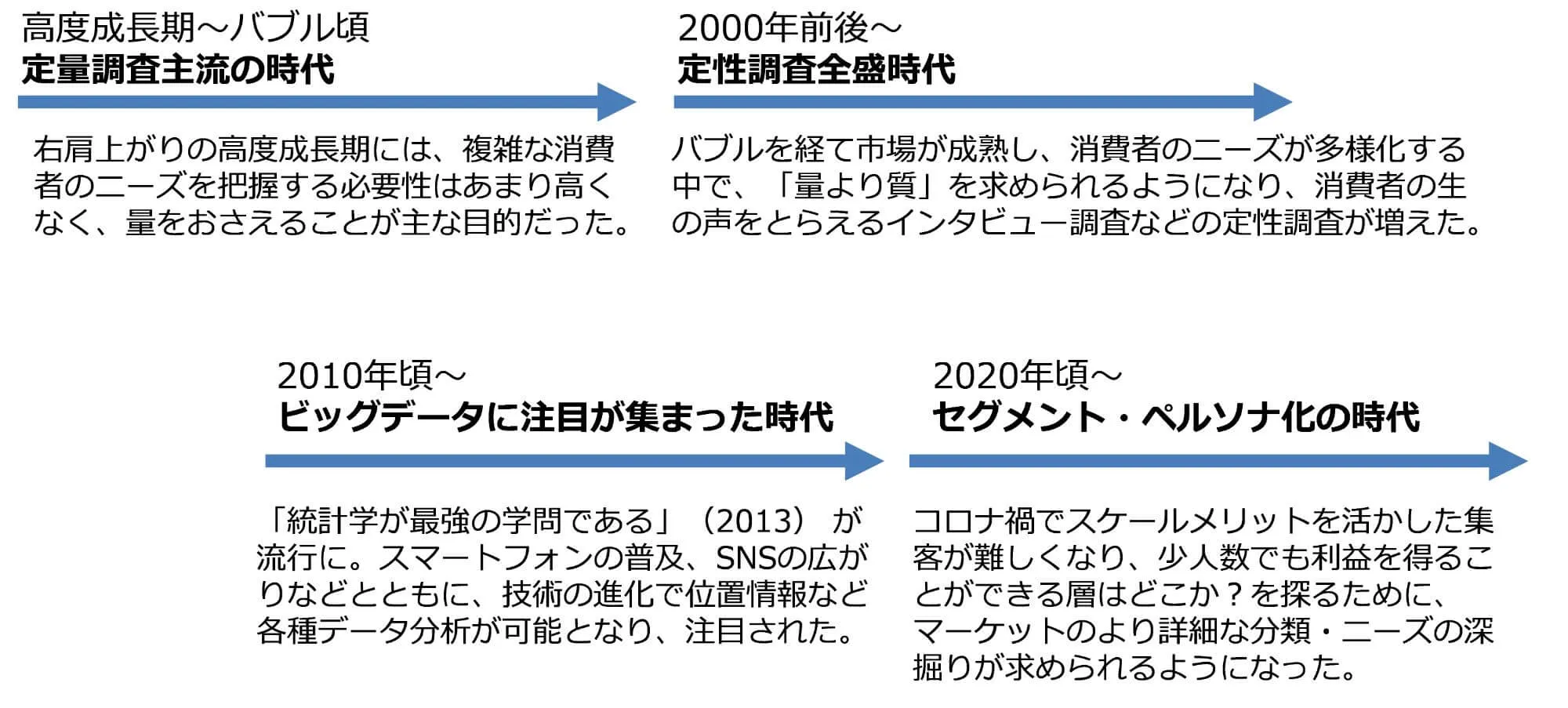
Looking at how marketing research (marketing data) has been utilized over time, during the period of rapid economic growth—when products sold simply by being offered—there was little need to grasp complex consumer needs. Instead, so-called survey questionnaires, designed to gauge “how much will sell,” were the mainstream approach.
However, after the bursting of the bubble economy, as the Japanese market matured, consumer needs diversified, shifting the focus from quantity to quality. Additionally, the economic downturn led to a period where goods were not selling well, creating a need to delve deeper into consumer needs, which led to the widespread adoption of interview surveys.
Since then, over the past decade or so, driven by the widespread adoption of smartphones and advancements in ICT, the use of various types of big data—such as location data—has progressed, enabling the capture of consumer behaviors they may not even be aware of.
Furthermore, a trend I’ve noticed gaining momentum since around last year is the creation of “personas.” A persona, literally, refers to the process of highlighting the profile of individual consumers in a more concrete and detailed manner. But why is the “persona” concept receiving renewed attention right now? Personally, I believe it is because the COVID-19 pandemic has made it difficult to attract large crowds and leverage economies of scale. Consequently, there is a growing need to understand the market in greater detail to identify “which segments can generate profits even with a small customer base” and “who recognizes the highest value in our products and services.”
3. The Difference Between “Segments” and “Personas”
There is another concept that serves a similar role to personas: “segments.” So, how do segments and personas differ? Both segments and personas are tools frequently used to visualize consumers more concretely, to set targets for product strategies, and to align understanding among team members involved in the entire process of service and product development—from upstream to downstream. However, the main difference lies in their level of granularity.
Segments are, by definition, “groups.” They divide the market into several groups and identify the characteristics of each group.
(As a preliminary step to creating personas, segments can also be used to identify potential groups that might contain personas. For example, our company has created “Travel Life Segment 5 (TLS5),” which divides travelers into five groups based on values related to travel and lifestyle.)
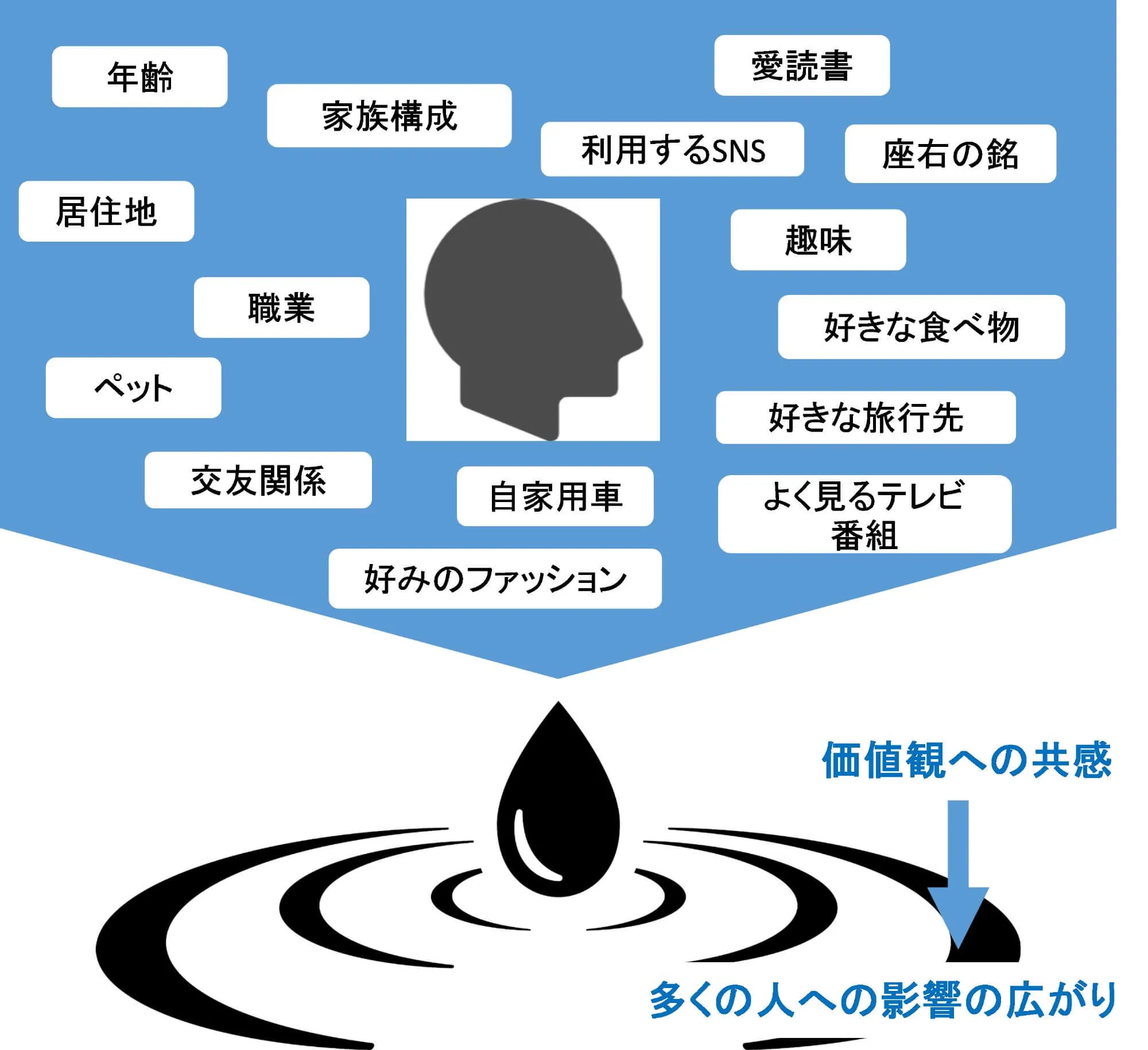
On the other hand, a persona is not a group but a hypothetical individual consumer. It involves imagining (or creating) a detailed lifestyle—including family structure, place of residence, financial situation, hobbies, and social relationships—to serve as a target image for services or products.
There are various benefits to digging deeper than just segments to create a user profile based on a persona, such as reducing discrepancies in how the target audience is perceived among team members and enabling a more concrete visualization of the necessary services and products. However, personally, I believe the greatest benefit is that it makes it easier to decide “which services or features are unnecessary for the target audience. ”When the user profile remains vague, it’s difficult to make the decision to cut something out because you might think, “This might be necessary, and that might be necessary too.” However, the clearer the user profile becomes, the easier it is to think, “Ah, this person definitely wouldn’t need this service or feature,” and by eliminating excessive services and features, you can lead to greater productivity.
4. Can Personas Be Used in Service Marketing for Tourism?
Unlike manufacturing marketing, service marketing—such as in tourism—involves a broad scope of service recipients, which may make it feel difficult to narrow down the target audience. In such cases, why not consider a persona as a single “influencer”? An influencer is an individual, but information spreads from them through social media and other channels, ultimately attracting the interest of many people.
Recent trends in influencer marketing in Europe and the U.S. are said to be shifting from celebrities and YouTubers with large followings (megainfluencers) to individuals who share values with their followers and wield significant influence, even with smaller followings (micro-influencers and nano-influencers). This indicates a growing demand for more targeted marketing activities.
For example, the “Watanabe Couple,” who gained popularity by traveling around Japan in a van and sharing the charms of local areas on YouTube, have many followers interested in visiting rural areas and rural living. The promotional campaign featuring the “Watanabe Couple” and a farm stay experience in Taiki Town, Mie Prefecture, can be considered one example of this targeted approach.
That said, whether it comes to utilizing influencers or defining the target audience and icon for one’s own services or products, selecting the appropriate persona is a challenging task. So-called “yuru-chara” (cute mascots) can be considered one type of icon, but it seems that these characters do not always fully embody the company’s unique appeal. When considering what elements are necessary for an appropriate embodiment, “personas” can be a useful tool. By clearly defining a persona who understands your products or services and recognizes their value, and then targeting them precisely, you can more easily gain their empathy. This approach can also help mitigate risks such as damage to your brand image that might result from selecting influencers or icons that don’t align with your brand.
Wouldn’t it be interesting to consider what kind of persona embodies your values and resonates with your target audience?
著者