Panel Discussion with Tourism Experts: “Tourism × The Value of the Real World” — Exploring the “Value of the Real World” and the Future of Travel in a Society Rapidly Shifting Toward Online and Digital Technologies

What Is the "Value of Real-Life Experiences" in Travel?
Partly due to the impact of the COVID-19 pandemic, the shift to online activities has accelerated rapidly in recent years, and online meetings and internet shopping have become commonplace. At the same time, however, there seems to be a growing desire to maintain relationships with the people and experiences that matter most to us through real-life, in-person interactions. How will this rapid shift toward online and digital platforms affect the nature of travel? Through dialogue with experts possessing diverse insights into tourism, we will take this opportunity to reconsider the “value of the real” in travel.
Discussion Participants
Hirokazu Kobayashi: Professor, Faculty of Tourism and Community Development, Kokugakuin University; Ph.D. (Tourism Studies).
Specializes in tourism marketing, tourism DX, DMOs, DMCs, and sustainability. Serves as an expert advisor for the Japan Tourism Agency’s Tourism DX Project, among other roles. Recent publications include “Theory of Regional Travel Business” (sole author), as well as columns in Weekly Travel Journal and serialized articles for the inbound tourism web media “Yamato-gokoro.jp.”
Kunihiko Moriya: Associate Professor, Faculty of Tourism and Community Studies, Atomi University.
After working as a researcher at private-sector and public-interest foundation research institutes, he assumed his current position in 2023. Specializes in tourism policy, destination management, and business tourism (MICE, workation, etc.).
Kunio Mano: Editor-in-Chief, Rurubu Information Edition, JTB Publishing Co., Ltd.
With experience as Editor-in-Chief of the information media outlet Rurubu Kids and a secondment to JR East, he possesses extensive knowledge regarding online information dissemination and travelers’ mobility needs.
Yutaka Nakane: Lead Consultant, JTB Tourism Research & Consulting Co., Ltd.
He is engaged in planning and formulating commercialization strategies that address both regional revitalization and market dynamics from a tourism perspective. He serves as a project coordinator with a comprehensive perspective spanning from identifying issues to planning, commercialization, and business continuity.
Moderator
Saya Miyazaki: Researcher, JTB Tourism Research & Consulting, Inc.
She researches and analyzes changes in consumer attitudes and behavior, and conducts surveys and research on themes such as the changes brought about by travel
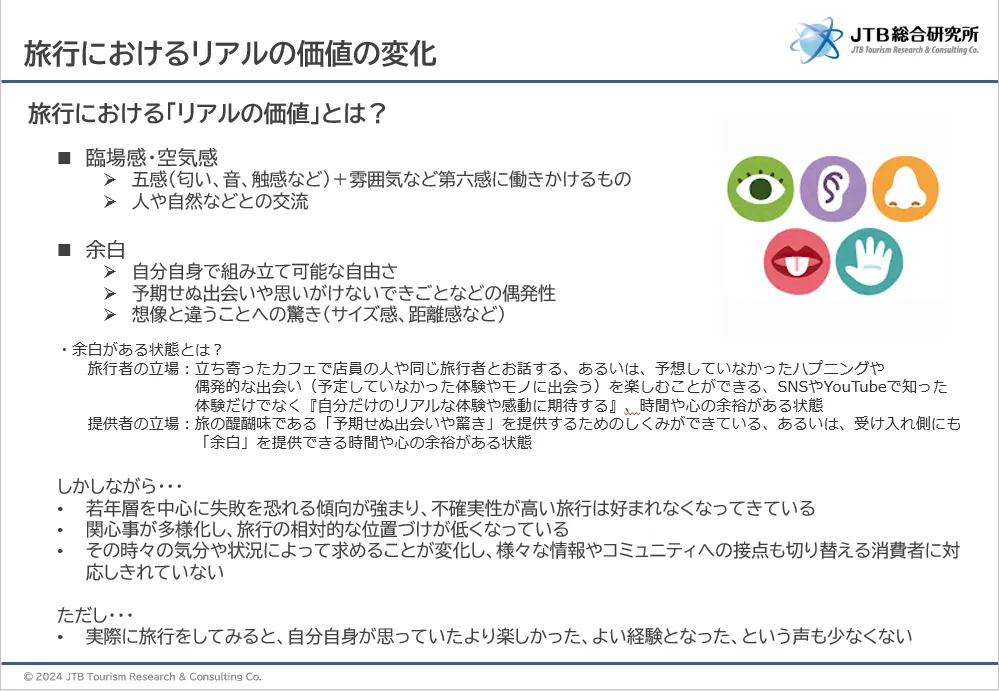
The “value of the real” in travel refers to the gap between one’s own “expectations” and the actual experience, as well as the “margin” and “unplanned events and encounters.”

Miyazaki: With the COVID-19 pandemic over the past few years, we’ve faced situations where we couldn’t meet people we wanted to see or go out even when we wanted to. I feel that the value of actually going to a place to talk with people and have experiences has increased. What do you think the “value of the real” in travel is?
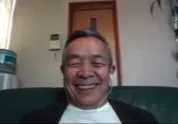
Nakane: I think it’s what you might call a “sense of presence”—the value of actually encountering something, whether it’s a person, a town, or a mountain, and experiencing it through all five senses. The true thrill of travel lies in being moved by the gap between the “expectations” we hold based on our prior knowledge and what we actually experience.
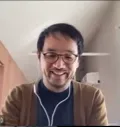
Mano: When it comes to travel, it’s hard to truly grasp a sense of distance, scale, or atmosphere without a real-life experience. It’s common to see a giant Buddha in a guidebook and imagine something grand, only to visit in person and think, “Wait, it’s this small?”
Kobayashi: Even with international conferences, while online meetings were popular for a time during the pandemic, we’re definitely returning to in-person gatherings. We’ve come to realize anew that it’s not just the meeting time that matters, but also the casual conversations during downtime. In other words, “breathing room” and “chance events and encounters” are what’s important.
Nakane: Going on a trip and having an elderly local couple offer you tea and show you the way—that’s exactly what I mean. Popular TV shows like “Bus Travel” and “Walking Travel” are all about experiencing those moments of connection with ordinary people.
Mano: In the book *Weak Ties*, travel is discussed as follows
“There is no such thing as an ‘irreplaceable individual.’ Our ways of thinking and our desires are defined by our current environment, and even our search terms online are predicted by Google. Still, if we want to make our one and only life irreplaceable, we have no choice but to search for new keywords. What makes this possible is physical movement, travel, and weak ties” (Hiroki Azuma, Gentosha, 2016).
Physical movement, for better or worse, is inseparable from “chance encounters.” Through travel driven by positive motivations, “improvise” and “physically” overcoming the filter bubble leads to the discovery of a new world (and a new self). Isn’t that precisely the “value of reality” in travel?
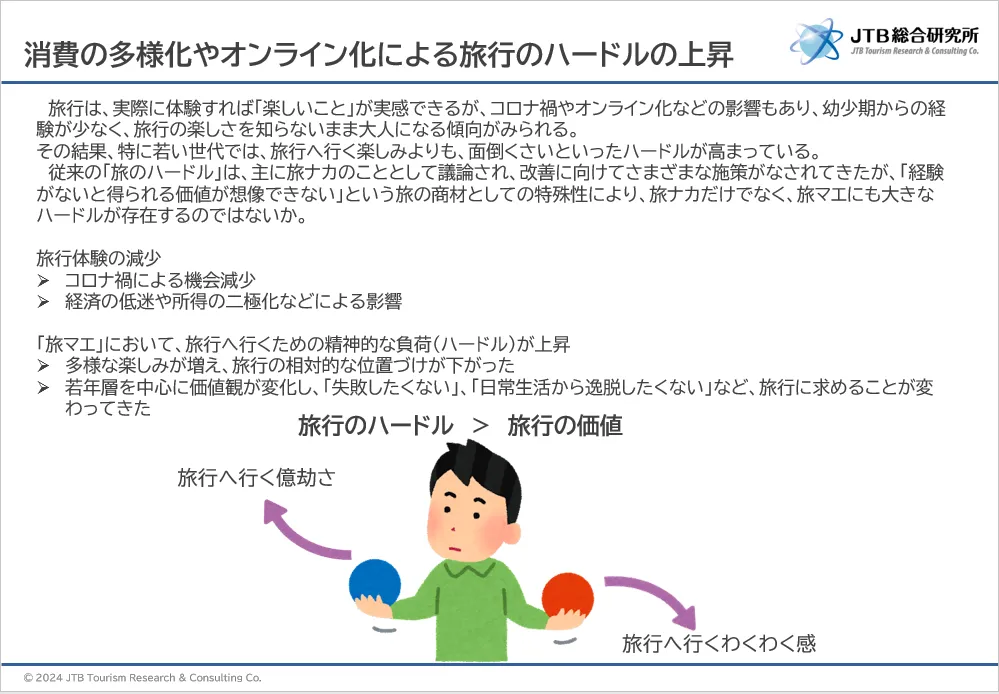
The loss of real-life childhood experiences during the COVID-19 pandemic and the relative decline in the value of travel
Miyazaki: Are you saying that opportunities for actual experiences have decreased due to the shift to online activities and the COVID-19 pandemic?
Moriya: I think people with some travel experience truly appreciate the value of traveling in person. On the other hand, when I talk with current college students, I get the sense that—partly due to the pandemic—many young people aren’t even being given the chance to experience that value in the first place.
Mano: It is said that “intellectual curiosity” is the driving force behind a child’s brain development and is essential for expanding future possibilities. From a neuroscientific perspective, moving back and forth between the real and virtual worlds is said to be useful for fostering intellectual curiosity. For example, it’s important to build on experiences like a child becoming interested in animals after looking at an encyclopedia at home, then going to the zoo, and finally reviewing what they saw in the encyclopedia back at home. Nowadays, however, things may often be concluded solely through virtual experiences.
Kobayashi: The ways people spend their leisure time have also diversified. In the past, travel might have been just one of ten ways to have fun, but now it’s merely one among many. When I
take students on field trips to rural areas, many aren’t very enthusiastic before we go, but once we’re there, they often say it was worth it. Travel differs from other forms of consumption in that you can’t truly appreciate its value until you experience it firsthand.
Moriya: It’s not that in-person travel is unnecessary because it can be replaced online; rather, people fail to recognize its value simply because they haven’t had the experience in the first place. We need to raise the baseline to some extent, starting from childhood. The first opportunity is a family trip, followed by a graduation trip, then business trips after starting a job, and a honeymoon after marriage—but all of these opportunities have diminished due to the COVID-19 pandemic and the shift to online activities.
Nakane: In countries like France, travel has long been encouraged through legislation such as the “Vacation Act.” In Japan, too, with the rise of flexible work arrangements like telework, it’s important to create an environment that makes travel easier—for example, by allowing students to participate in classes online.
Adapting to the Changing Meaning of “Real” and Enhancing the Value of Travel
Miyazaki: What can we do to encourage people who haven’t yet realized the value of travel to actually go on trips?
Mano: From a marketing perspective, interests and preferences have become highly segmented; it’s no longer “a hundred people, a hundred tastes,” but rather “one person, a hundred tastes.” Even for the same person, preferences change depending on the situation, and the target audience shifts accordingly. If you try to
identify “real life” for a certain group on a large scale, it ceases to be anyone’s “real life.” We live in an era where it’s difficult to find the greatest common denominator. On the other hand, if we try to cater to individual needs, we face the problem that traditional methodologies can’t monetize them. Rather than gathering people with a special interest in a particular subject, it might be effective to convey that even ordinary subjects can be enjoyed in various ways depending on the context and one’s own perspective.
Moriya: Many people involved in tourism in local communities understand that travel has value, but there are also many who lack the experiences necessary to truly feel that value. I believe it is necessary to bridge this gap. Isn’t it also important to promote educational initiatives that encourage experiences starting from childhood?
Kobayashi: In an uncertain social environment marked by new infectious diseases, disasters caused by extreme weather, and deteriorating international relations, the mindset of “not wanting to fail” is growing stronger. When it comes to travel, perhaps what people are seeking isn’t a complete escape from daily life—the “extraordinary”—but rather a sense of excitement that doesn’t stray too far from the ordinary (and doesn’t cause anxiety).
Nakane: To make travel more accessible to younger generations with limited travel experience, it is also important to provide a sense of purpose and meaning—such as the idea that traveling can benefit or contribute to the destination (through volunteer activities like cleaning up the area or providing labor).
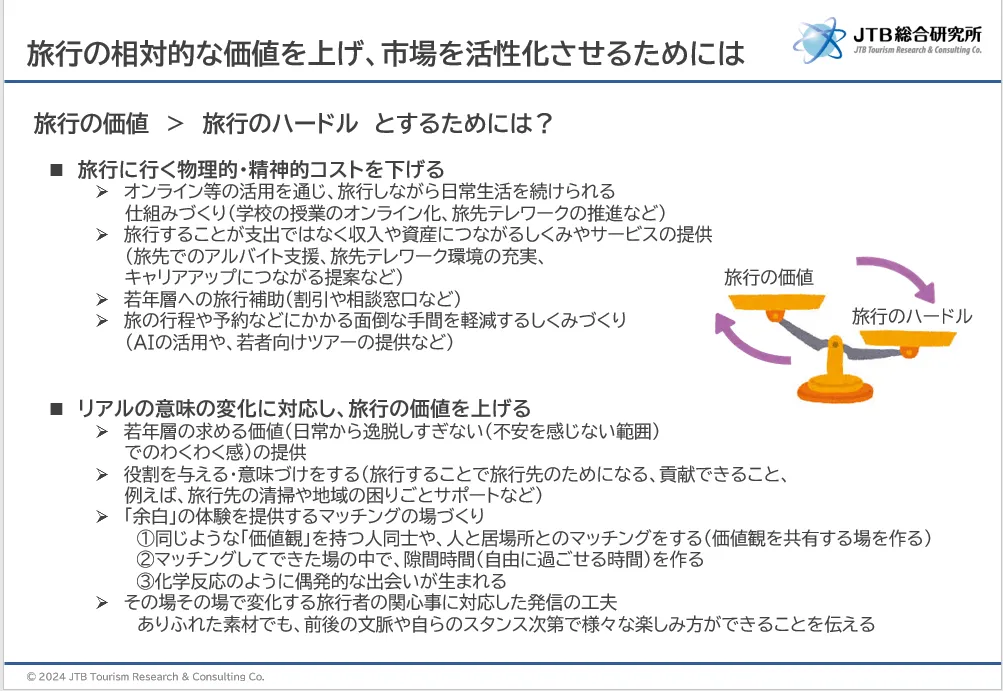
Our Thoughts Following the Discussion
While individual hobbies and preferences vary widely, the time allotted to each person remains the same: 24 hours a day, 365 days a year. Given this, it is no exaggeration to say that travel is at a disadvantage, as it takes time—including the preparation period for making reservations—and costs a certain amount of money. So why do people still go on trips?
Before our discussion, I believed that the “value of the real experience” in travel was simply the ability to perceive the atmosphere of a place through one’s five senses. However, I came to realize that the “space” to perceive that atmosphere—and the “chance encounters” that can only be experienced by being there—are also crucial. I believe that this is the true “value of the real experience” and the fundamental reason why people go on trips.
I want to continue exploring what we can do to make travel feel more accessible to people and help them recognize its value.
著者