Japan’s Tourism Competitiveness and Global Trends as Seen in the 2019 Travel & Tourism Competitiveness Report
On September 4, the World Economic Forum (WEF)—known for the Davos Conference—released its 2019 Travel & Tourism Competitiveness Report. This report, published every two years, examines the global travel and tourism industry. In this column, we will examine Japan’s competitiveness in tourism compared to 2017, as well as changes among countries around the world.
1. Global Tourism Competitiveness Ranking of 140 Countries
Japan ranks 4th. Singapore saw a significant drop in the rankings
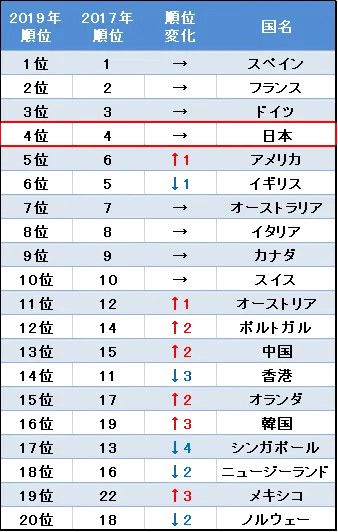
In the 2019 edition, Japan ranked 4th in tourism competitiveness. Spain took the top spot, followed by France and Germany; the top 10 remained unchanged from 2017. Although Singapore is a highly competitive country in the travel and tourism sector, it dropped from 13th to 17th place this year. According to the country-specific report, while Singapore received high marks in categories such as the global business environment, abundant human resources and labor force, and tourism policies, its overall ranking was affected by lower scores compared to the previous edition regarding international openness—due to visa requirements—and the protection of natural and cultural resources (Table 1).
(Table 1)
2. Changes in Japan’s Evaluation and Global Positioning Across the 14 Indicators Used to Calculate the Ranking
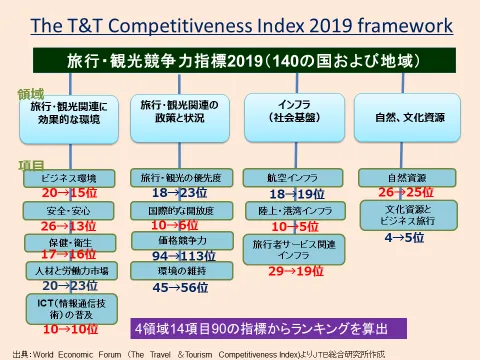
This competitiveness assessment is based on the “four pillars,” “14 pillars,” and “90 indicators” established by the World Economic Forum. Below, we examine which of the 14 pillars saw Japan’s scores improve and which saw them decline.
(1) Changes in Japan’s Evaluation Across the 14 Categories
Japan improved its ranking from 2017 in 7 of the 14 categories (Figure 1).
- Categories where Japan’s ranking improved (or remained unchanged)
- Effective environment for travel and tourism: “Business Environment,” “Safety and Security,” “Health and Hygiene,” “ICT Adoption”
- Travel and tourism policies and conditions: “International Openness”
- Infrastructure (Social Infrastructure): “Land and Port Infrastructure,” “Infrastructure Related to Traveler Services”
- Natural and cultural resources: “Natural resources”
- Items with lower ratings
- Environment conducive to travel and tourism: "Human Resources and Labor Market"
- Travel and Tourism Policies and Conditions: "Priority Given to Travel and Tourism," "Price Competitiveness," "Environmental Sustainability"
- Infrastructure (Social Infrastructure): "Aviation Infrastructure"
- Natural and Cultural Resources: "Cultural Resources and Business Travel"
(Figure 1)
(2) Regarding the two items where ratings declined: "Priority of Travel and Tourism" and "Environmental Sustainability"
Among the items listed above, we examined the “indicators” that make up the two items where Japan’s evaluation dropped significantly: “Priority of Travel and Tourism” and “Environmental Conservation.”
"Priority of Travel and Tourism"
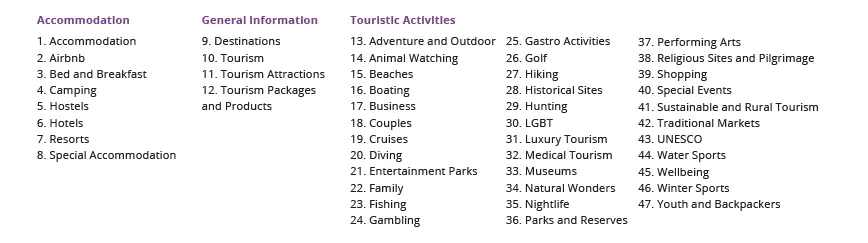
This category comprises seven indicators. Among them, Japan’s score for “National Brand Strategy” was 68.4 points, dropping from 42nd place in the previous ranking to 108th.“National Brand Strategy” is a score derived from analyzing the results of 25.74 million keywords searched by travelers worldwide across 47 items in three categories: “Accommodation,” “Travel Products and Information,” and “Markets and Activities” (Table 2) (Source: Bloom Consulting, Digital Demand).Among countries with high overall rankings, the scores for this indicator were 79.3 for Spain, 74.5 for France, and 82.5 for Germany. Many countries clustered around the 70-point mark.
In 2017, the categories were “Culture,” “Travel Products and Information,” and “Activities,” with 45 items in total. In 2019, “Culture”—a strength for Japan—was omitted from the categories, and it is thought that this made it difficult to showcase Japan’s strengths, which may have affected the score. Additionally, the number of search terms was 12.88 million in 2017, and it doubled in 2019. As the number of global travelers increases, the things they seek from travel are becoming increasingly diverse, and matching these expectations with a country’s unique appeal will become increasingly important in the future (Table 2).

"Environmental Sustainability"
In this category, Japan ranked 132nd in “Number of Endangered Species,” one of the 10 indicators. Combined with “Area of Protected Areas” (76th) and “Attractive Natural Heritage” (59th) under “Natural Resources,” these were the indicators in the country report where Japan was specifically noted as having “room for improvement. ”In Japan today, initiatives are underway to promote the country’s appeal while preserving its natural and cultural environment through national parks, such as the “National Park Enjoyment Project” promoted by the Ministry of the Environment and the “National Park Official Partnership,” which collaborates with private companies and organizations to showcase the appeal of national parks to the world.
At the same time, we must not forget that companies around the world are also taking even more proactive steps to protect nature and the environment. For example, since 2016, TripAdvisor has stopped selling tickets for facilities that offer activities involving direct contact with captive wild animals. In 2017, Expedia also announced that it would stop accepting reservations for activities involving contact with specific wild animals on its booking site.
3. A Leap in Travel and Tourism Competitiveness Across Many Countries
An era where efforts to address global issues significantly influence rankings
Christoph Wolf, Head of the Transport and Tourism Division at the World Economic Forum, commented on the report as a whole: “In 2019, travel and tourism competitiveness surged in many countries as barriers to travel decreased and travel costs fell. While this presents an opportunity to generate benefits for both the economy and development, striking a balance between infrastructure development and environmental protection is essential to securing long-term gains.”
Two years have passed since the previous report, and competition in travel and tourism among countries and regions worldwide has intensified. As nations vie for supremacy, we have entered an era where a country’s ability to promote its unique appeal to a diverse range of travelers while simultaneously addressing global challenges—such as environmental protection and sustainability—significantly influences its overall evaluation.