Reflections on Workation and Lifestyle: Insights from Living in Multiple Locations
More and more regions are embracing workation. As diverse work styles become more widespread, multi-location living is also gaining attention. A veteran researcher who has maintained a second base on the coast—separate from his primary residence—and has been living a life that blends remote work with leisure for the past 10 years examines the challenges and possibilities for workation to take root in Japan based on his personal experience.
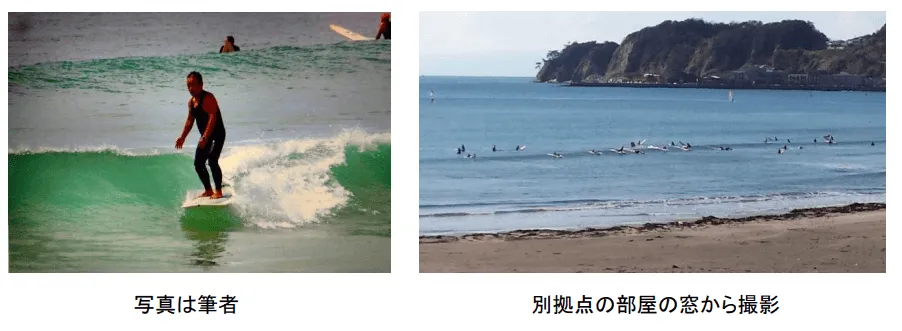
Like so many other trends, the term “workation” and the lifestyle it represents originated in the United States and made its way to Japan. While it is gaining traction here, it has not yet become widespread among the general public. As Japanese people embrace foreign loanwords and catchy slogans, local communities and tourism professionals—eager to revitalize their towns through tourism—are beginning to adopt workation as a solution.I certainly do not intend to dismiss workation. In fact, I have maintained a separate base on the coast away from my primary residence for about 10 years—though it might not strictly qualify as “workation”—and have lived a life that blends remote work with leisure (surfing). While I apologize for speaking solely from my own personal experience, I would like to consider the challenges and possibilities for workation to take root in Japan based on my actual experiences.
1. “Workation”: A Term Driven by Supply and Government Initiatives
There was a time when local governments across Japan, driven primarily by the Resort Act (Comprehensive Resort Area Development Act), were eager to attract resort development. However, while timing was partly an issue, the decisive factor was the gap between the supply side’s vision and consumers’ and citizens’ awareness of and behavior toward resort life. For workation to take root steadily—even if it takes time—it must be viewed as a new lifestyle for people. It is not merely a narrow concept of travel. The challenge now is to use the experience of the COVID-19 pandemic as a catalyst, so that both companies and individuals come to appreciate the appeal of “borderless work and travel” as a new lifestyle and begin to act on it.
2. Viewing Workation as a New Lifestyle for Consumers
(1) Travel-Oriented vs. Work (Lifestyle)-Oriented: The Motivation Behind Workations
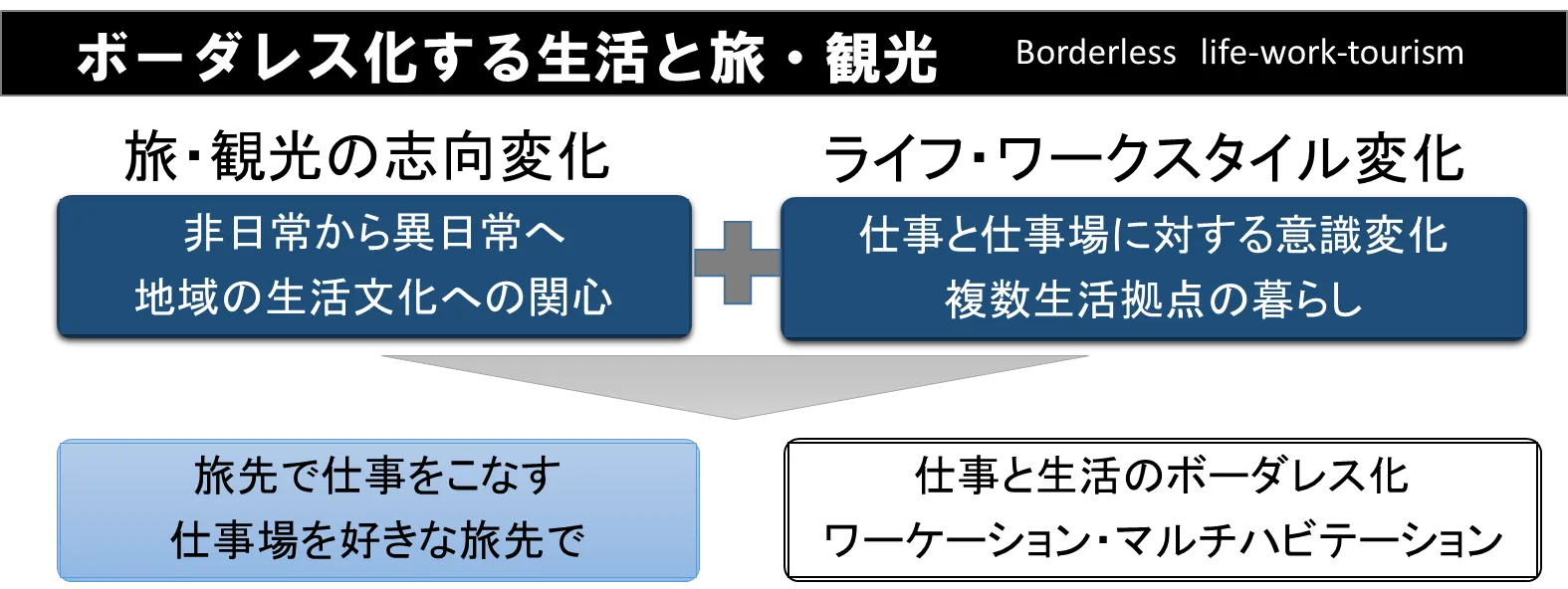
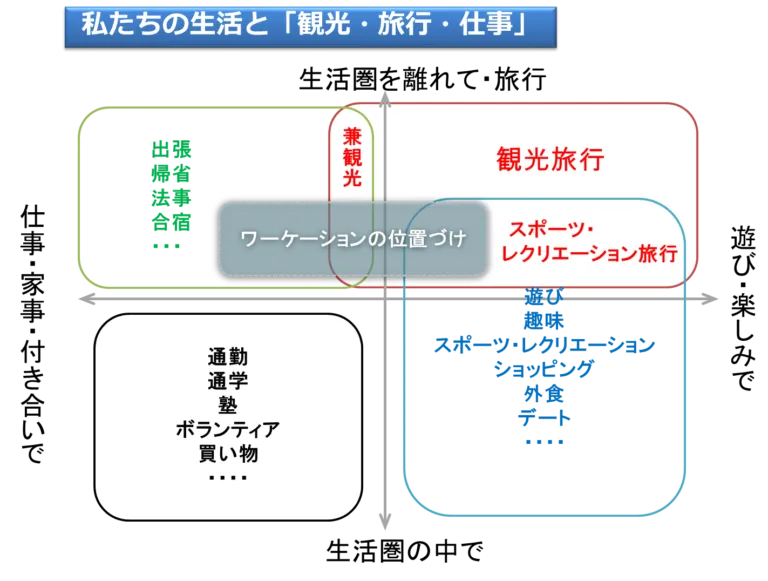
While workation involves the blurring of boundaries between time and place for “leisure and enjoyment” (such as tourism and travel) and “work,” there are two major differences in the motivations for engaging in workation in each individual’s specific situation.
One is the case where, driven by a travel- or leisure-focused mindset—such as “I really want to travel to [destination] right now! But I have work I can’t miss!”—the individual still wants to get their work done. You’ve made plans to travel with family or friends for the first time in a while and really want to go, but an urgent task comes up or an important meeting is scheduled. In the past, this would have meant canceling or postponing the trip, but now, as long as you have a laptop and Wi-Fi, you can handle work temporarily while on the road. The other is the motivation to change one’s workplace or lifestyle to a different environment, thinking, “I’ve been forced to work from home, but since I can fully perform my duties without going to the office, I might as well do it from a pleasant travel destination rather than just at home. ”It’s a lifestyle that eliminates wasted commuting time and allows you to spend your time in a place where you can go sightseeing or play sports as soon as work is done. Given the experience with telework and remote work forced upon us by the COVID-19 pandemic, I suspect there are quite a few people who have realized that if working from home poses no problems, why not do it from a location with a better environment? While some surveys indicate that there is still little movement on the corporate side to recognize workation and consider it as a formal policy or system, workation in the narrow sense refers to a company officially permitting work even during holidays or vacation time. Judged by that standard, companies likely have no choice but to limit remote work to situations where the employee’s home is designated for work management and workers’ compensation purposes.
Currently, workation is being highlighted as a strategy to revitalize tourist destinations and lodging facilities nationwide, with efforts underway to improve facilities and create accommodation packages. However, many of these initiatives are designed with the former type of traveler—those motivated by leisure—in mind. While this is not to be dismissed, the priority must be whether such destinations can be expected to generate stable demand and, more importantly, whether they will be selected as travel destinations in the first place. Simply installing Wi-Fi, a measure already widespread in many tourist areas, is unlikely to serve as a differentiating factor. It goes without saying that the key distinction lies in whether a destination can become a place people “want to visit even if it means bringing work along.”
(2) Suitability Varies by Job Type and Work Content
Not only workation but also remote work and telework have their own suitability depending on the job type. The service industry is a prime example. The least problematic are IT and creative fields, where a computer and internet connection allow for a certain level of daily work to be done anywhere; consultants, researchers, and writers like myself have long stayed in rural areas to complete our work. Even in general corporate settings, the COVID-19 pandemic has forced many to work from home, and both employees and companies have likely realized that, depending on the department, work can be managed effectively remotely. Furthermore
, suitability isn’t determined solely by industry; even for the same person, the nature and intensity of the task at hand can make workation unsuitable. Working “while enjoying a pleasant environment or scenery” different from one’s home surroundings can actually be distracting and hinder concentration when dealing with urgent, high-pressure tasks. In my seaside room, the coast and the ocean are right in front of my desk, but when I have such work to do, I have to close the curtains and shut myself off from the outside world to get anything done. Conversely, if I want to brainstorm ideas or sort through a backlog of tasks in my head to refresh myself, moving to a pleasant environment can be effective. We often see images of people sitting on the beach with their laptops open, facing the blue sea, but I doubt they can keep working for more than an hour.
(3) Consider people other than travelers who bring work with them
This is a personal anecdote, but even when I’m at the beach and the weather is nice, if I tell my wife, “I have work to do, so you can go to the beach by yourself,” she rarely goes. In many workation settings, the person bringing work isn’t alone. There are also families visiting on summer vacation with spouses and children. In fact
, it’s necessary for the host to consider not only the environment for the person working but also how their companions will spend their time, and to devise enjoyable programs and services for them as well.
(4) Does Workation Create a Clear Balance Between Work and Leisure?
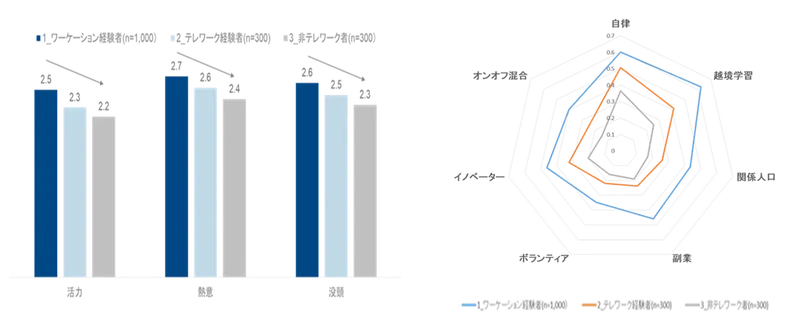
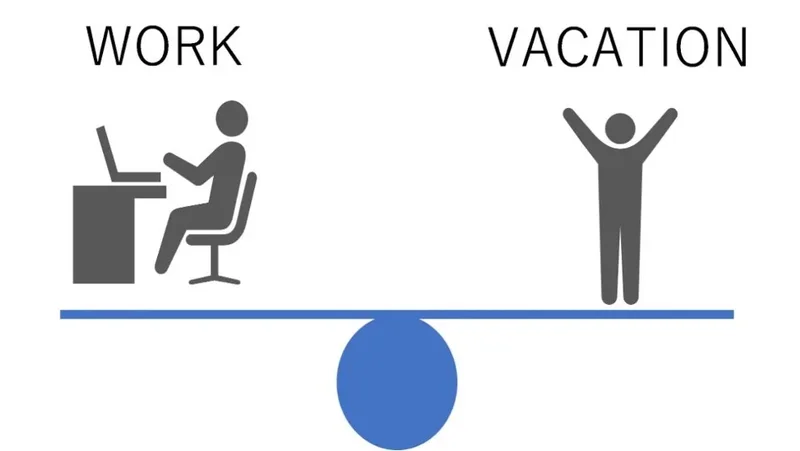
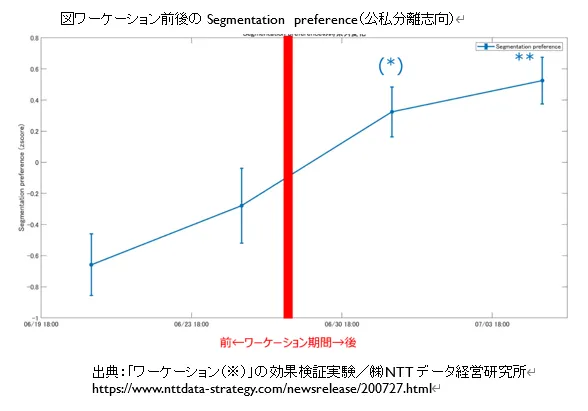
When it comes to the blurring of the lines between work and tourism or leisure, people used to think, “There’s no clear distinction between work and play” or “You shouldn’t bring work home.” However, there are some interesting experimental results here. These come from a workation pilot study conducted by NTT Data Management Research Institute, Inc., using a panel of participants. The study focused on the psychological trends and changes in participants before, during, and after the workation, and the results indicate that “experiencing a workation promotes a clearer separation between work and personal life.” Furthermore, this effect extends not only to the duration of the workation but also influences participants’ daily lives and work after the program ends. As the author, I can personally relate to and agree with this point. This is because when faced with urgent tasks, one seeks a place to concentrate even while traveling, and once the work is done, one wants to quickly switch to one’s hobbies or leisure activities.
3. Workation Is Not an “Extraordinary Experience” but an “Unusual Experience”
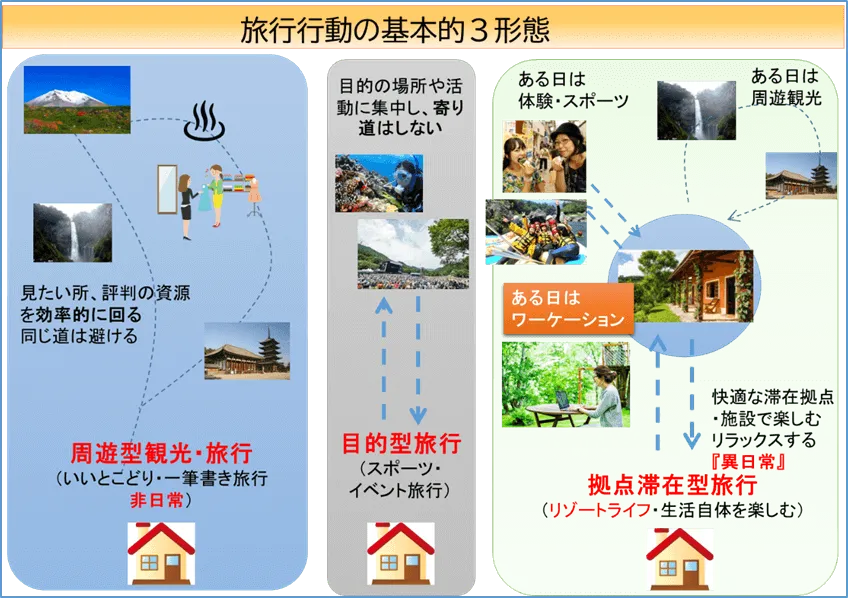
It has long been said that the appeal of tourism lies in “experiences outside the ordinary.” This is because these experiences—whether in terms of scenery, resources, cuisine, or other aspects—take place in settings and offer things that cannot be obtained in daily life; it is this gap that defines them as “outside the ordinary.” In contrast, an “experience of a different ordinary” refers to enjoying a lifestyle where “work and play are one” in a pleasant environment distinct from the daily routine of commuting between home and the workplace. "Circuit-style tourism and travel," which has driven the popularization of travel in postwar Japan, involves selecting and linking together resources, facilities, and experiences that are out of the ordinary. The standard approach is to efficiently visit as many resources and tourist spots as possible, and it was common for travelers to have little time to spare, often resulting in rushed trips. On the other hand, travel seeking an "alternative daily life" experience is essentially "resort life. "This type of travel involves staying in one location with a beautiful natural environment, enjoying the overall rhythm and balance of life—taking short trips or engaging in sports during the stay, and even taking a nap in one’s room when tired. Precisely because it involves living in a different setting, it is perfectly acceptable to include some work during the trip. Of course, as mentioned earlier, it is not only important for the person bringing work along but also for their companions to enjoy their stay. It is crucial to be mindful of how time is spent and to focus on work more intensely than usual while also being able to switch off effectively.
Accommodations that have traditionally catered to the “two meals a day” model of traditional sightseeing trips must recognize that, if they wish to make workation a key selling point, simply providing desks, facilities, and Wi-Fi is merely a prerequisite. They will need to aim to become regions, facilities, services, and products that users actually want to stay in.
Finally, “lifestyle-focused workation” should not be viewed merely as tourism or travel. It is fundamentally a matter of an unprecedented lifestyle—one that encompasses multi-habitation, semi-permanent residence, and even relocation. The regions poised to lead the way in realizing this as a concrete business opportunity are those blessed with natural beauty within a 100-kilometer radius of major cities like Tokyo and Osaka. The key will be whether a lifestyle can take root in which people can return immediately to their homes and workplaces in Tokyo if necessary, visit frequently over weekends, and become familiar with the region while making local friends. Furthermore, from the perspective of the host regions, this should not be viewed solely within the framework of traditional travel business models, such as overnight stays with two meals or experiential tours. In addition to discounted long-term stay plans, the potential for real estate businesses—such as membership-based schemes, rentals, and shared housing—should be considered. Above all, it is essential to explore what kind of lifestyle consumers desire and what they actually need.