[Part 1] Business Succession in Family-Run Regional Ryokan: Conditions for Successful Family and Third-Party (M&A) Succession

At small, family-run inns in rural areas, business succession has become a critical management issue due to factors such as aging facilities, debt, and labor shortages.In this article, drawing on my experience as both a ryokan owner and a consultant in this field, I will examine both intra-family succession and third-party succession (M&A), considering what should be preserved, what should be changed, and how to establish an effective management structure following the succession. This article will be published in two parts: Part 1 and Part 2. Part 1 examines the current situation and challenges surrounding business succession, while Part 2 explores post-succession management structures and post-merger integration (PMI).
1. Introduction
While inbound demand is recovering and spreading to regional areas, a significant number of lodging operators are exiting the market due to factors such as aging facilities, debt, and labor shortages.As the market becomes increasingly polarized between facilities benefiting from growing demand and those struggling to remain in business, the succession of ryokan operations is no longer merely a matter of finding buyers for shares or properties. It has become a comprehensive management challenge that extends to determining who will take over management after the succession and how to transform the business while maintaining relationships with the local community.
For small, family-run ryokan in rural areas, the business value cannot be fully captured by considering only the market value of the land and buildings or current profitability. It is necessary to evaluate the business by taking into account the area’s reputation as a tourist destination, local resources such as hot springs, the trust built up within the community, and future tourism demand.
In intra-family succession, rather than simply following the previous generation’s management methods, a proactive approach is required to create new business opportunities while leveraging the inherited management resources. This aligns with the concept of “Effectuation.”On the other hand, in third-party succession (M&A), success hinges on the ability to design and execute Post-Merger Integration (PMI)—which consists of adjusting transfer terms, integrating management, building trust with stakeholders, and consolidating operations—well before the succession takes place.
2. Small Regional Ryokans as M&A Targets
For family-run inns, succession to relatives—such as children or their spouses—has long been considered a leading option.Furthermore, regional inns—where the market value of land and buildings is lower than in urban areas and the number of guest rooms and revenue scale are small—have traditionally been considered less suitable targets for M&A. However, in recent years, these assumptions have been changing. One factor behind this shift is the expansion of inbound tourism demand and its spread to regional areas.
The total number of overnight stays by foreign visitors in 2025 reached 179.92 million, a 55.6% increase compared to 2019.In regional areas outside the eight prefectures comprising the three major metropolitan areas, the total number of overnight stays by foreign visitors is projected to increase from 33.58 million in 2023 to 60.56 million in 2025.The share of regional areas in the national total also rose by 5.2 percentage points during the same period, from 28.5% to 33.7% [1].
The growth rate in regional areas in 2025 was 19.1 percent year-over-year, exceeding the 5.1 percent growth rate in the three major metropolitan areas.International tourism demand is also expanding to snow resorts, hot spring resorts, and regions with unique natural and cultural resources. This shift provides an opportunity to reevaluate the future profitability and business value of regional ryokan, which have traditionally been assessed primarily based on real estate value and current earnings capacity.
Figure 1: Percentage of Total Overnight Stays by Foreign Visitors in Regional Areas
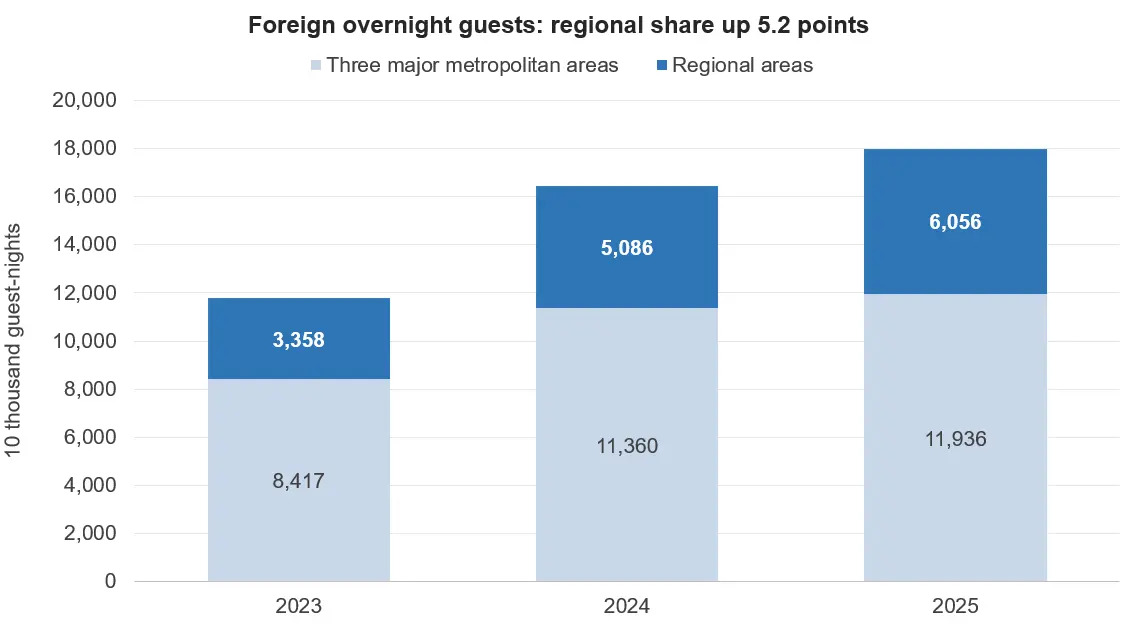
by the author based on the Japan Tourism Agency’s “Survey on Accommodation Travel Statistics (2025, Annual Figures [Final Figures])” Note: The three major metropolitan areas consist of the eight prefectures of Tokyo, Kanagawa, Chiba, Saitama, Aichi, Osaka, Kyoto, and Hyogo. Regional areas refer to all other areas. Unit: 10,000 guest-nights
However, just because accommodation demand is growing in regional areas does not mean that all hot spring resorts and ryokans are uniformly benefiting from this trend. Whether a ryokan can capture this demand depends largely not only on transportation access and seasonal fluctuations but also on the competitiveness of guest rooms and in-house facilities, the ability to secure staff, and the richness of dining, transportation, and experiential offerings in the surrounding area.Therefore, simply being located in a tourist destination does not in itself increase a ryokan’s value in the context of business succession. Only when a ryokan has an operational structure capable of transforming regional resources—such as hot springs, cuisine, nature, and culture—into attractive products and services, and converting them into stable revenue, will its future prospects be evaluated as business value.
The fact that the ability to turn local resources into revenue determines a ryokan’s business value is also crucial when considering what to inherit and what to change in the context of succession within the family.
3. “Business Resources” to Be Inherited
The strength of succession within the family lies in the ability to gradually pass on relationships of trust with customers, employees, business partners, and the local community over time. On the other hand, as the business environment undergoes significant changes, it is difficult to achieve sustainable business growth by simply following the previous generation’s management methods to the letter.Successors are expected to implement initiatives such as establishing regular closing days to ensure employees have days off, revising prices in response to demand and the value provided, and strengthening direct sales through the company’s website. Furthermore, they must proactively address new management challenges, including the recruitment of external talent and the utilization of digital transformation (DX) and artificial intelligence (AI).What should be inherited in a business succession is not the previous generation’s management methods themselves, but rather the business resources built up over many years—such as the business name, reputation, hot springs, customers, employees, and networks within the local community. Successors must leverage these resources while restructuring management practices to align with the needs of the times.
A useful reference for considering how to utilize inherited management resources and create new value in the business succession of ryokan is Kojima’s (2023) study, which examined seven family-run ryokan [2].This study analyzes the results of on-site surveys from the perspectives of family business theory, socio-emotional wealth (SEW) (*1), and effectuation (*2).The paper concludes that the surveyed business owners employ not only causation—working backward from predetermined goals to identify necessary means—but also the concept of effectuation, which uses currently available resources as a starting point to generate new outcomes amid uncertainty.Specific initiatives identified include collaboration with local businesses, disseminating information via social media, crowdfunding, and product development that leverages existing resources.
(*1) Socioemotional Wealth (SEW)
: Non-financial values—such as family values, attachment to the company, trust, and relationships—that are prioritized in family-owned businesses.
(*2) Effectuation: A decision-making approach in which, in situations where the
future is difficult to predict, one acts based on currently available resources and relationships to create new opportunities while expanding the network of collaborators.
The five principles of Effectuation used by Kojima (2023) in his analytical framework can be organized as follows in the context of business succession at traditional Japanese inns:
- A bird in the hand (start with existing resources): Begin with resources already in hand, such as the inn’s name, hot springs, cuisine, regular customers, employees, and relationships with the local community.
- Tolerable Loss (Experiment within reasonable limits): Rather than focusing on expected returns, define the range of acceptable losses and conduct small-scale trials.
- Crazy Quilt (Create Together with Collaborators): Collaborate with stakeholders who share your goals, such as other ryokan in the industry, DMOs, financial institutions, and external talent.
- Lemonade (Turning Unexpected Events into Opportunities): Turn unexpected events—such as disasters, fluctuations in demand, or a lack of successors—into opportunities for new product development or organizational restructuring.
- Airline Pilot (Shaping the Future Through Action): Rather than relying solely on future predictions, shape the future by consistently taking actions that you can control.
Thus, it is crucial to adopt an approach that builds upon inherited resources through a series of small, practical steps and collaborative efforts.
However, Kojima (2023) is not a study that directly examined the success factors of third-party succession. What the paper demonstrates is that, among the family-run inns surveyed, entrepreneurial decision-making—which transforms the business while utilizing existing resources—was observed.Based on these findings, this paper argues that the key to intra-family succession lies not in preserving traditional management methods as they are, but in reworking the inherited business resources to adapt them to the new environment.
However, not all inns are able to opt for intra-family succession. As the lack of successors becomes more widespread, the methods of succession themselves are diversifying.
Although these figures are not limited to the lodging industry, according to a 2025 survey by Teikoku Databank, the rate of small businesses without a successor was 57.3%.Furthermore, the breakdown of how new representatives assume their positions is as follows: internal promotion (36.1%), succession within the family (32.3%), M&A and other methods (20.6%), and external recruitment (7.6%) [3].Methods other than family succession have already become major means of succession. Even for traditional Japanese inns (ryokan), rather than deciding early on whether to opt for succession within the family or by a third party, it is important to prepare a framework that allows for the comparison of multiple options.
Figure 2: Background of Leadership Transitions (Preliminary 2025 Figures, All Industries)
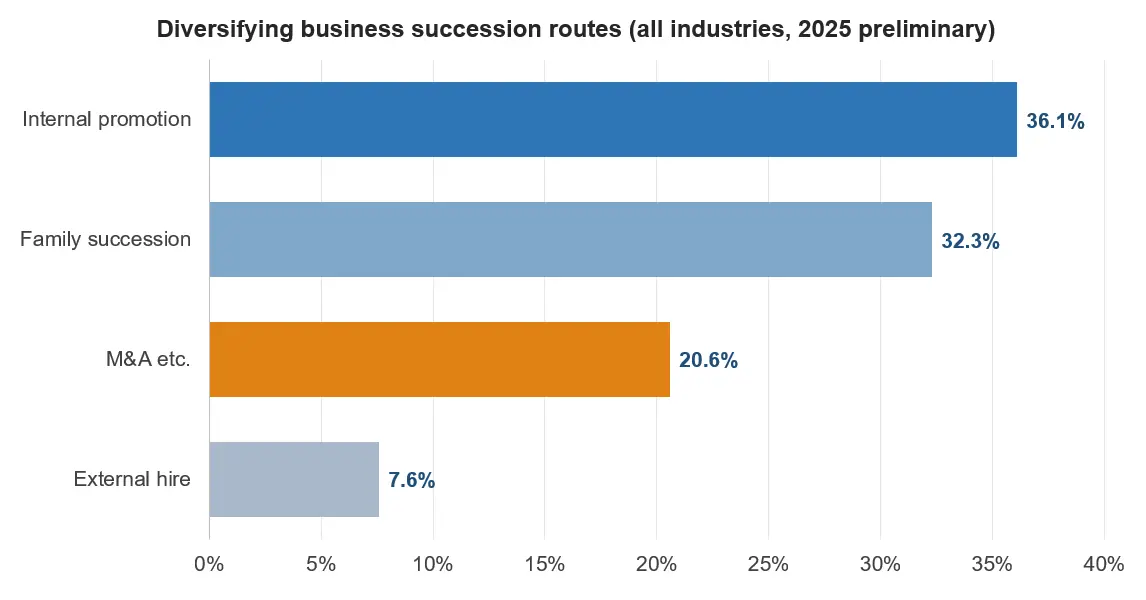
by the author based on Teikoku Databank’s “Nationwide Survey on Trends in the ‘Lack of Successors’ Rate (2025)” Note: These statistics are not limited to the lodging industry. Only the four main categories are shown
4. Market Exits Proceed Amid a Recovery in Demand
While inbound demand continues to expand, accommodation providers are also continuing to exit the market. According to Teikoku Databank, there were 89 bankruptcies in the accommodation industry in 2025 (liabilities of 10 million yen or more, involving legal restructuring), a 14.1% increase from the previous year’s 78 cases.There were 178 cases of business suspensions, closures, and dissolutions; combined with bankruptcies, this means 267 operators exited the market [4].
Of these bankruptcies, suspensions of business, and dissolutions, 75.3% occurred in regional areas outside the three major metropolitan areas [4].A combination of aging facilities, labor shortages, rising food and utility costs, and the burden of repaying debts accumulated during the COVID-19 pandemic has led to a growing polarization between facilities capable of investing in renovations and value-added services to capitalize on the recovery in demand, and those that have lost the financial capacity to do so.
Figure 3: Accommodation Operators That Will Exit the Market in 2025
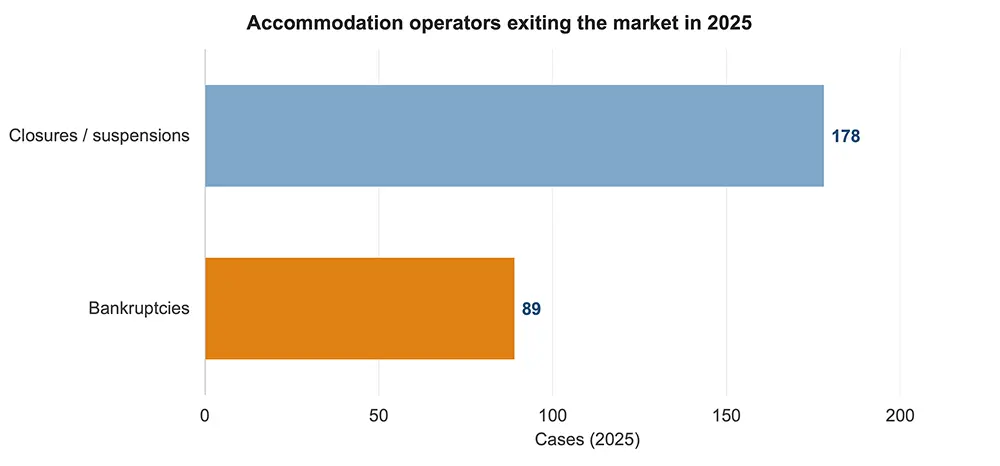
Note: Bankruptcies refer to legal reorganizations involving liabilities of 10 million yen or more
Regarding M&A activity in the ryokan sector, there are insufficiently developed official statistics on completed transactions that allow for long-term comparisons using a consistent definition. Therefore, it is not possible to directly establish a causal relationship between the increase in bankruptcies and the increase in ryokan M&A activity.On the other hand, the total number of M&A transactions among Japanese companies reached 5,115 in 2025, setting a new record high [5]. Furthermore, in the aforementioned changes in company leadership, “M&A and others” accounted for 20.6 percent.
In several ryokan cases that the author has supported or consulted on in recent years, considering third-party succession (M&A) has become a major issue alongside succession within the family. It should be noted that the following descriptions are not generalizations based on statistical surveys, but rather practical observations that summarize common trends without identifying specific cases.
5. The Intentions of the Three Parties Involved in Succession
The transfer price is not the only factor causing succession negotiations to drag on. A major contributing factor is the lack of shared understanding among the current parent-generation owner, potential successors within the family, and candidate third-party acquirers regarding “what to preserve,” “what to change,” and “which burdens each party will assume.”Based on cases in which the author has provided support or consultation, the following intentions and concerns have been identified among the various parties involved.
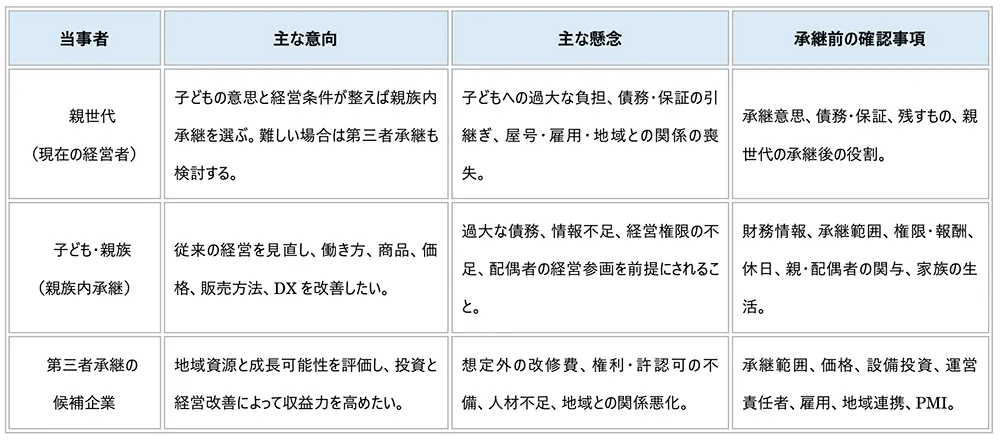
In the cases I have been involved in, there is an increasing trend where current owners of the parent generation do not consider succession to their children to be the only option.If the child is willing to take over and the conditions for stable management after the succession—such as the burden of debt and profitability—are in place, they opt for succession within the family. On the other hand, if the child does not wish to take over, or if continuing operations is difficult due to excessive debt, the approach is not to force the succession but to consider succession to a third party.When proceeding with succession within the family, we also see clients seeking advice on strengthening their financial foundation prior to the succession through measures such as coordinating with financial institutions, reducing debt, and securing external capital. Furthermore, even when transferring the business to a third party, the choice of buyer is not based solely on the transfer price.There is a tendency to prioritize whether the values upheld over many years—such as the business name, employee employment, business relationships, and ties to the local community—will be maintained after the succession. It is necessary to view these values as socio-emotional assets and reach an agreement in advance among the parties involved regarding what to preserve and what to change following the succession.
Even if the next generation—the potential successors—have been aware of the possibility of taking over the inn since childhood, they often leave their hometown to pursue higher education or employment, establishing their lives—including careers and families—elsewhere. Consequently, even if asked by their parents to take over the business, it is not easy for them to return home immediately.In some cases, the younger generation only begins to seriously consider succession for the first time when triggered by their parents’ advancing age or illness. Often, the younger generation is not rejecting the idea of taking over the inn itself, but rather feels reluctant to inherit it without being able to change the management style of the parent generation.They hope to implement measures such as designating days when the inn is closed to ensure employees have stable time off, as well as developing new customer bases, reviewing prices and services, sharing information and engaging in joint procurement with local peers, outsourcing operations, and utilizing experts and digital transformation (DX) and artificial intelligence (AI).On the other hand, major factors causing hesitation include inheriting substantial debt and personal guarantees, insufficient disclosure of financial information, and the expectation that a spouse will automatically participate in management.
Potential third-party successors do not simply take over the current business as is; rather, they make investment decisions based on the premise that they will enhance the property’s profitability after the succession through facility renovations and revisions to sales strategies. Consequently, the purchase price is determined not only by current sales revenue and the value of the building but also based on future cash flows, net of necessary capital expenditures and working capital.In the next chapter, we will examine what specific factors prospective acquirers evaluate and what capabilities they utilize to realize the potential value of a ryokan.
References and Sources
[1] Japan Tourism Agency (2026), “Survey on Accommodation and Travel Statistics (2025 Annual Figures [Final Figures])”
[2] Koji Kojima (2023)“A Study on Family Entrepreneurship in Family-Owned Ryokans,” *Tourism Management Review*, Vol. 3, pp. 2–15
[3] Teikoku Databank (2025), “Nationwide Survey on Trends in the ‘Lack of Successors’ Rate (2025)”
[4] Teikoku Databank (2026)“Trends in Bankruptcies, Suspensions, Closures, and Dissolutions in the ‘Lodging Industry’ (2025)”
[5] Recof (2026) “Cross-Border M&A Market Information”
著者