“Tourism × Social Trends” — The Shift Toward the Neo-Sharing Economy —
In recent years, the tourism industry has been called upon to do more than simply increase visitor numbers; it must also focus on building long-term relationships between visitors and local communities, promoting community development, adapting to market changes driven by the entry of other industries, and promoting tourism with sustainability in mind. To achieve this, a vision that takes into account long-term trends in society, technology, and consumer behavior is essential. Drawing on over 20 years of experience in developing scenarios for social trends, I will explore the key points of future changes in tourism, society, and consumer behavior.
1. A long-term perspective is becoming increasingly important for understanding the "present"
I have the impression that, compared to other industries, the tourism industry—particularly travel agencies—has historically placed less emphasis on analyzing long-term social and technological changes (social trends). This is not to say that this is necessarily a bad thing. The reason for this likely lies in the differences in product lifecycles. For example, in the automotive manufacturing sector, the development period for a new car is typically 3 to 5 years, and the time from its launch as a new model to the next model change is about 5 to 8 years.Recently, there has been a trend toward even longer intervals between model changes, meaning that the products currently under development must remain “in their prime” as active offerings for a total of more than 10 years into the future. Therefore, the question of “What will society look like 10 or 20 years from now?” becomes a crucial perspective. When it comes to travel, since product lifecycles are not that long, it may be that the ability to flexibly respond to the immediate needs of travelers was considered more important than developing products and services with a long-term view.
However, the nature of travel has been gradually changing. In the tourism of the future, I believe a vision that takes into account long-term societal, technological, and consumer trends is indispensable. This includes not only the number of visitors but also building a “relationship population” that considers the long-term relationship between visitors and the local community; engagement with urban development itself; responding to unprecedented market changes driven by the entry of other industries; and promoting tourism with sustainability in mind.
Here, drawing on over 20 years of experience in developing scenarios for social trends, I would like to explore the key points regarding future tourism and the changes in society and consumer behavior.
2. Identifying the Core (Latent Desires)
When discussing societal and consumer trends, I am often told, “That’s something that’s been said for ages—it’s not new at all. Is that really a trend?”
It’s true that things that have been talked about for a long time may seem obvious and not particularly interesting. However, from a psychological perspective, consumers will not react to a given stimulus (a product or service) unless there is a specific reason to do so.For example, the advent of smartphones has transformed various aspects of people’s lifestyles, such as how they access information and communicate. However, underlying this were latent desires—such as the desire to access information without being constrained by time or place, or to communicate more casually without worrying about the other person’s circumstances. When technology and services responded to these needs, they brought about significant changes in people’s awareness and daily lives.
It can be argued that there is a large trunk (latent desire) underlying such social trends, and when changes in the social environment or new technologies intersect with it, new branches (trends) sprout.
3. Consumer feedback only reveals trends that are an extension of the present
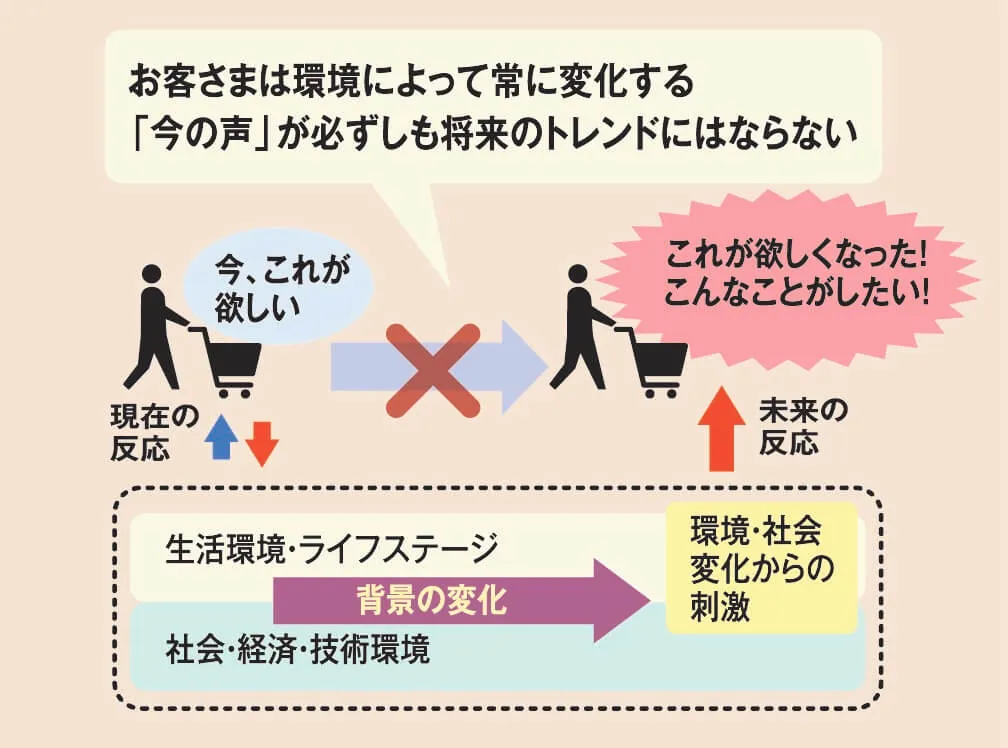
Another common approach is to listen to consumer feedback and use consumer needs as the basis for planning future products and services. However, consumers can only make judgments within the scope of currently available products and services; they cannot imagine products or services that do not yet exist and say they want them.While it is certainly important to listen to consumer feedback and apply it to product and service development, becoming overly fixated on consumer feedback can hinder the creation of innovative products and services that leverage new technologies.It may feel like a detour, but rather than directly extrapolating future changes from current consumer needs, I believe the key to scenario planning lies in first identifying latent desires and then interpreting how consumers will react when those desires intersect with future changes in the social environment and new technologies.
4. Growing Desire to “Avoid Risk and Break Free from Stagnation”
I would like to take a fresh look at the social environment and consumer attitudes over the past few decades. Economically, the era of steady growth ended with the bursting of the bubble, giving way to a prolonged period of stagnation. Pressured by the momentum of emerging economies, particularly in Asia, Japan’s international competitiveness has also declined. Furthermore, concerns about pensions due to the declining birthrate and aging population, as well as the widening income gap, are major social issues.According to the results of the “18-Year-Olds’ Attitudes Survey” conducted by The Nippon Foundation from January to February 2022, which compared six countries worldwide, only 13.9% of Japanese respondents believed that Japan’s future would “improve”—the lowest percentage among young people in the six countries surveyed (China: 95.7%, India: 83.1%, UK: 39.1%, US: 36.1%, South Korea: 33.8%).A survey we conducted several years ago targeting Generation Z and Millennials yielded similar results, suggesting that a sense of resignation regarding the future may be spreading, particularly among younger generations.
Beyond economic factors, the frequent occurrence of major earthquakes and natural disasters, as well as the spread of new infectious diseases such as COVID-19, are major factors contributing to people’s anxiety.
Given this environment, it is easy to imagine that Japanese consumers are living with a profound sense of risk and stagnation, harboring a desire to somehow break free from this situation or at least find a slightly more comfortable place to be.
5. Advances in technology and changes in social systems have dramatically expanded the range of choices available in daily life
So, how have “technology” and “social systems”—which intersect with these desires—evolved? In recent years, the emergence of smartphones has arguably brought about the most significant change. People have been liberated from the constraints of time and place when it comes to accessing information and communicating. They can now belong to various “communities” in the digital realm, such as social media, and have multiple places to call home.The “metaverse,” a term we’ve been hearing more and more about lately, is another example. It can be said that the emergence of an unprecedented amount of information and “places to belong” has significantly transformed our lifestyles.
In terms of changes to social systems, the promotion of diversity and the diversification of work and learning styles are considered to have had a significant impact. It is no longer uncommon for people to choose flexible life paths—such as juggling multiple jobs or leaving a company to retrain—rather than following a single, linear life course like “college → employment → marriage → retirement.” While people may still feel a sense of stagnation, haven’t they gained access to a wider range of choices in their daily lives?
6. The Sharing Economy Advances to a New Stage
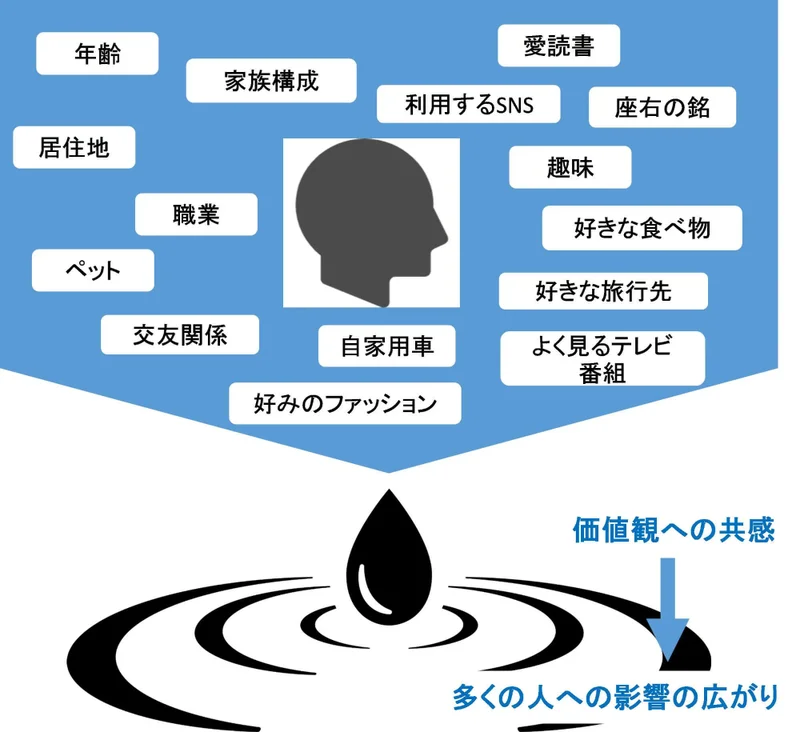
Next, I would like to consider what kind of chemical reaction occurs when consumers—who harbor a desire to “avoid risk and escape a sense of stagnation”—gain access to “diverse options.” One thing that comes to mind is that people will likely seek out more comfortable environments to escape the risks and stagnation in their immediate surroundings, and their desire to adapt to different situations across multiple settings will grow stronger.We often hear people say they “switch up their persona” depending on the social media platform they’re on, and this trend is likely to intensify. Furthermore, the ability to share the “values” that are important to oneself is likely to become a key criterion for choosing a community, as people seek to feel comfortable within it.
Furthermore, people will likely seek not only personal change but also flexibility in the spaces they inhabit.
Opinions may vary on what this will ultimately bring about, but I personally believe the sharing economy is poised to enter a new phase. Until now, the primary goal of the sharing economy has been to share “underutilized assets”—such as objects, spaces, and skills—to improve efficiency. The premise was always to provide unused items to those who wanted to use them.
However, the shift toward online activities, which accelerated rapidly during the COVID-19 pandemic, has significantly altered our concepts of time and space. The living room at home, for example, serves as a place for the family to relax at one moment and as a meeting room the next, blurring the lines between public and private spaces. There is now a growing demand for a single space to be used flexibly according to the situation and purpose.
Given these circumstances, I believe the scope of the sharing economy will expand significantly. It will no longer be limited to “idle assets” but will also include sharing assets that are currently in use, or using assets for different purposes as they themselves undergo transformation.
7. Impact on Travel
In the realm of travel and tourism, we anticipate a growing demand for spaces, accommodations, and communities that can flexibly accommodate multiple purposes and situations.For example, in the accommodation sector, subscription services offering flat-rate access have become widespread due to the COVID-19 pandemic. However, “tsugi tsugi,” launched by Tokyu in 2021, has gained popularity with its concept of “a lifestyle akin to travel, moving from one ‘home’ to another,” based on a new “multi-location mobility” approach that blurs the line between travel and daily life.
Additionally, “Engawa,” a community space in Sanjo City, Niigata Prefecture, features a wall-less, open-access area with restaurants and rest areas, serving as a hub where people of all ages actively interact.
From the perspective of regional revitalization, “relationship population”—people who have an emotional connection to a region and build ongoing relationships with it, occupying a middle ground between the “visitor population” (travelers) and the “resident population”—is gaining attention. To attract such people, creating “places to belong” that can adapt flexibly like an amoeba depending on the situation and purpose will likely be crucial for the future of tourism.
著者